
 Worksheets
Quiz #16 - Magnetics and Waves
Total questions: 123
Worksheet time: 1hrs 18mins
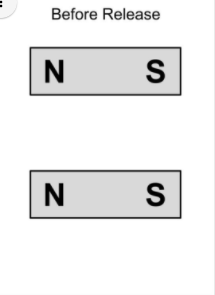
Draw the correct motion of the magnetic field between these 2 magnets.

True or False: A magnet is attracting when it pushes objects away from each other.
True
False
How can magnets cause objects to have kinetic energy?
A magnetic force can convert kinetic energy stored in a magnetic field to potential energy.
Kinetic energy can convert potential energy stored in a gravitational field.
A magnetic energy can convert potential energy stored in a gravitational field to kinetic energy.
A magnetic force can convert potential energy stored in a magnetic field to kinetic energy.
The ability to make things move or change
Transfer
Energy
Repel
Convert
The energy something has because it's moving.
kinetic energy
potential energy
magnetic energy
force


A child moves a blue magnet towards the red magnet that cannot move. What happens to the potential energy in the system of magnets?
Potential energy decreases because the blue magnet train moves in the same direction as the magnetic force.
Potential energy decreases because the blue magnet train moves against the magnetic force.
Potential energy increases because the blue magnet train moves against a magnetic force.
Potential energy does not change because the magnets in the system do not change.

Look at the picture carefully.
Which screws will be attracted?
iron and steel screws
iron and aluminum screws
steel and aluminum screws
all screws

What would happen when two north poles of magnets are placed together?
The force will pull them together (attract).
The force will push them away from each other (repel).
The strength of the magnet is doubled.

What would happen when the opposite poles of magnets are placed together?
The force will pull them together (attract).
The force will push them away from each other (repel).
The strength of the magnet is doubled.
True or False: All metals are attracted to magnet.
True
False
Where is the force of attraction the strongest on a magnet?
above the magnet
below the magnet
at the poles
in the middle

What do the lines around this magnet represent?
North Pole
South Pole
Magnetic Declination
Magnetic Field
If you cut a magnet in half, what happens to the poles?
One half gets the North Pole, the other half gets the South Pole.
Both halves get only a South Pole.
Both halves get only a North Pole.
Both halves get a North pole and a South Pole.
What is responsible for the Magnetic Field around Earth?
The Sun
The Earth's core
The Earth's crust
The Earth's mantle

Look at the picture carefully.
The paper clips are . . .
magnet
magnetic objects
Which of these materials would be attracted to a magnet?
copper
aluminum
cobalt
iron
Magnetism is a _________ force
non-contact
contact
chemical
biological
The two poles are called the _______ poles
east and west
north and east
south and west
north and south
Unlike (opposite) poles _____, like (same) poles _____
repel, attract
connect, repel
attract, repel
repel, connect
Which object would a magnet attract?
a glass bottle
a piece of paper
a steel paper clip
a rubber eraser

A ________ is a device that has a magnet on a needle that spins freely. It is used for navigation because its needle usually points north.
calculator
ruler
compass
map


Radio waves and _______ are used in communication
Microwaves
Gamma rays
Visible light
Ultraviolet


Wavelength Not Frequency

Wavelength Not Frequency


Electromagnetic waves vary in
the speed they travel in a vacuum.
wavelength and frequency.
the way they reflect.
the orientation of their electric and magnetic fields.
The full range of frequencies of electromagnetic radiation is called
visible light.
radio waves.
the electromagnetic spectrum.
invisible radiation.

The visible light spectrum ranges between
radar waves and X-rays.
television waves and infrared rays.
infrared rays and ultraviolet rays.
ultraviolet rays and gamma rays.

Cellular telephones utilize
radar waves.
very high frequency waves.
very low frequency waves.
microwaves.
Select the correct order of waves on the EMS from low to high energy
Radio, Micro, Infra, Visible, Ultra, X-ray, Gamma
Gamma, X-ray, Ultra, Vis, Infra, Micro, Radio
Vis, Micro, Infra, Ultra, X-ray, Gamma, Radio
Micro, Radio, Vis, Infra, Ultra, X-ray, Gamma
How are Electromagnetic waves different from Mechanical waves?
EM waves have very short wavelengths
EM waves transmit energy instead of matter
EM waves can travel through the vacuum of space (without particles)
EM waves can change direction by reflection

High frequency in EM waves equals
high energy and short wavelength
high energy and long wavelength
low energy and short wavelength
low energy and long wavelength

The _______________ determines the color of visible light.
wavelength (and frequency)
speed
amplitude
particles of the medium
A student builds a circuit that lights a light bulb. A second bulb is added to the same loop between the first bulb and the battery. Which statement describes the brightness of each bulb? (hint: series circuit)
Each bulb will be as bright as the first bulb was
The first bulb will be the same brightness, and the second bulb will be dimmer
Each bulb will be dimmer than the first bulb was
The first bulb will be dimmer than it was, and the second bulb will not light

The images show two steps in a procedure a student used to examine an electric circuit. Which question might the student be investigating?
How does changing the voltage affect the brightness of a light bulb?
How does an open circuit compare with a closed circuit?
Is a light bulb an electric insulator or an electric conductor?
Is more energy transformed in an electric circuit in a light bulb or in a wire?
Which statement best describes an electric current?
Energy transfers inside of an electric device
Charged particles move through a conductor
Type of conductor or insulator
The measurement of the electric potential energy in a circuit
Adding which object to a circuit will create a potential energy difference in a circuit?
switch
wire
light bulb
battery
What are the 3 main components to a simple circuit?
An energy source, conducting wire and load
An energy source, insulation and load
An energy source, induction pathway and load
An energy source, conducting wire and a switch
An electric (a) is the movement of electrically charged particles.
As the electric current through a wire increases, the magnetic field around the wire becomes stronger.
True
False
Which of the following conditions is necessary for a magnet inside a wire loop to produce an electric current? (Mechanical Energy --> Electric Energy)
The magnet must be stationary
The wire loop must be part of an open circuit
The wire loop must already have a current running through it
The magnet must be in motion
By changing the current in the wire, you can change the ____ of an electromagnet.
strength and charge
direction and coils
charge and strength
strength and direction

In the figure shown, what happens when the amount of current flowing in the wire coil is increased?
the magnetic field becomes stronger
the magnetic field disappears
the position of the north and south poles is reversed
the strength of the magnetic field decreases
What are the ways to increase the strength of the electromagnet? (select all that apply)
Increasing the current
Increasing the voltage
Decreasing the distance
Increasing the number of coils
Increasing the distance
A(n) (a) is a temporary magnet made with a current-carrying wire coil wrapped around a magnetic core.
(a) is the interaction between charges and magnets.
Would you rather build: Sumo-wrestling junkbots OR racing junkbots?

Sumo-wrestling

Racing
Betty made a simple electromagnet using just a battery and a wire. What could Betty do to increase the strength of her electromagnet?
Coil the wire around a paper towel roll.
Coil the wire around a nail.
Coil the wire around a test tube.
Coil the wire around a toothbrush.

Which of the following would decrease the strength of this electromagnet?
removing its iron core
increasing the number of wire loops in the coil
adding batteries to the circuit
increasing the current through the coil

Which of the following is a way to increase the strength of an electromagnet?
Increase the amount of electricity running through the coil.
Increase the temperature of the air around it.
Replace the iron core with a plastic core.
Increase the temperature of the iron core.

The electromagnet picked up the entire pile of paper clips as soon as it's turned on. Which of the following might allow the electromagnet to pick up one paper clip at a time?
increasing the number of batteries supplying voltage to the electromagnet
increasing the distance between the electromagnet and the paper clips
increasing the number of loops in the electromagnet's coil
removing the iron nail from the core of the electromagnet
An electromagnet could be found in which of the following objects?


Frank wants to make a simple electromagnet. Which of these does Frank need to have to create the electromagnet?
magnet
battery
iron filings
light bulb
True or False:
The strength of an electromagnet can be altered by increasing the number of coils around the core.
True
False
Electromagnetic technology is used in many different ways today. Which of these are uses of this technology?
high-speed trains
electric generators
metal detectors
all of these
Electromagnetic technology becomes more advanced to fill ever more complex roles. Which of these is an application of electromagnets?
refrigerator coils
car brake systems
speaker and microphone technology
all of these

As the electrons flow through the wire, _______ is generated around the wire.
a magnetic field
gravitational potential energy
a convection current
elastic potential energy
What are the two categories of mechanical waves based on the motion of particles?
Longitudinal and transverse waves
Crest and trough waves
Amplitude and frequency waves
Wavelength and energy waves
In transverse waves, the direction of the wave is perpendicular to the direction of what?
The wave's amplitude
The wave's frequency
The energy transfer or vibrations
The wave's wavelength
Which components are included in all transverse waves?
Wavelength, crest, trough, amplitude, and frequency
Amplitude, energy, wavelength, and direction
Frequency, energy, amplitude, and speed
Direction, speed, wavelength, and energy
How is wavelength defined in a transverse wave?
The distance from one crest to the next trough
The height from the crest to the resting position
The distance from one crest to the next crest
The time it takes to move from one crest to the next trough
What does a greater amplitude in a wave indicate?
The wave carries less energy
The wave is moving faster
The wave carries more energy
The wave has a longer wavelength
What is the definition of frequency in the context of waves?
The speed at which a wave travels through a medium
The number of waves that pass a fixed point in one second
The height of a wave from crest to trough
The distance between two consecutive crests or troughs of a wave
What is meant by the term 'hertz' in the study of waves?
The amplitude of a wave
The speed of a wave
The unit of frequency of a wave
The wavelength of a wave
What happens to the frequency of a wave if its wavelength increases?
The frequency increases
The frequency remains the same
The frequency decreases
The frequency is not related to wavelength
Which term describes the bending of a wave when it enters a different medium?
Reflection
Refraction
Diffraction
Transmission
What is the term used to describe the phenomenon when waves bend around corners or spread out after passing through a small opening?
Reflection
Refraction
Diffraction
Transmission
What is the result called when two or more waves overlap and combine?
Reflection
Refraction
Diffraction
Interference
Which of the following is NOT an application of wave-based technology?
Ultrasonic technology
WiFi waves
Vehicle parking sensors
Solar panel energy conversion
Label the Transverse Wave.
Wavelength
Crest
Amplitude
Rest / Origin
Trough


Which parts of your eye are transparent?
Retina
Optic Nerve
Cornea
Iris
Lens


What 2 parts of your eye does light refract?
Retina
Cornea
Optic Nerve
Lens
What is the correct sequence (order) of how we are able to see?
Optic Nerve - Retina - Lens - Cornea
Cornea - Retina - Lens - Optic Nerve
Lens - Cornea - Retina - Optic Nerve
Cornea - Lens - Retina - Optic Nerve
Red Light + Green Light = ______ Light
Magenta (Shade of Pink)
Yellow
Blue
Brown
Cyan (Shade of Light Blue)
Red Light + Blue Light = ______ Light
Magenta (Shade of Pink)
Yellow
Blue
Brown
Cyan (Shade of Light Blue)
Green Light + Blue Light = ______ Light
Magenta (Shade of Pink)
Yellow
Blue
Brown
Cyan (Shade of Light Blue)
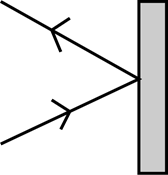
In the illustration, the light ray striking the object is-


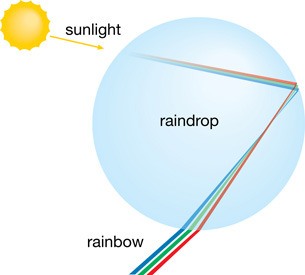

Why do we see grass as green?
Green light is absorbed
Green light is reflected

What would you call this?
Bounce back
Reflection
Diffraction
Refraction

A carbon nanotube capturing light is an example of:
Reflection
Refraction
Absorption

Light waves bouncing off of this lake is an example of:
Reflection
Refraction
Absorption
The substance that a wave is passing through
medium
frequency
wavelength
gravy

Sonar and echolocation use ----- to detect objects under water.
Refraction
Reflection
witch picture is diffraction


Definition: The spreading out of waves as they pass through an opening or around objects.
Reflection
Refraction
Diffraction
Resonance

