
 Worksheets
Physical Science Final Fall 2024
Total questions: 98
Worksheet time: 8hrs 10mins
What is the formula for Ohm's Law?
V=IR
P=IV
E=mc2
F=ma
Which element has the atomic number 6 on the Periodic Table?
Oxygen
Nitrogen
Carbon
Helium
Calculate the speed of a car that travels 150 kilometers in 3 hours.
30 km/h
50 km/h
60 km/h
70 km/h
If a chemical reaction follows the Law of Conservation of Mass, what can be said about the mass of the reactants and products?
Mass of reactants is greater
Mass of products is greater
Mass is equal
Mass is not conserved
Which of the following is an example of a simple machine?
Lever
Engine
Battery
Circuit
Determine the oxidation number of sulfur in SO2 .
+2
+4
+6
0
Explain how valence electrons determine the chemical reactivity of an element.
Valence electrons are not involved in chemical reactions.
Elements with a full valence shell are highly reactive.
Elements with one or two valence electrons are less reactive.
Elements with incomplete valence shells tend to be more reactive.
A car accelerates from rest to a velocity of 20 m/s in 5 seconds. What is its acceleration?
2 m/s²
4 m/s²
5 m/s²
10 m/s²
Describe the difference between ionic and covalent bonds.
Ionic bonds involve sharing electrons; covalent bonds involve transferring electrons.
Ionic bonds involve transferring electrons; covalent bonds involve sharing electrons.
Both involve sharing electrons.
Both involve transferring electrons.
Using Newton's Second Law, calculate the force required to accelerate a 10 kg object at 3 m/s².
10 N
20 N
30 N
40 N
What was special about Rube Goldbergs drawings?
They were always very detailed
They show a complicated way of doing a simple task.
They were always in black and white
He never used paint
Energy in motion is referred to as:
Kinetic energy
Potential energy
Thermal energy
Total energy
This energy happens to all objects that fall.
Elastic
Gravitational
Mechanical
Potential
Stored energy is referred to as:
kinetic
potential
Jovian
Newton discovered (a) laws of motion

Fill in the blanks, Newton's third law states for every ________, there is an ________ and _______________ reaction
(a)

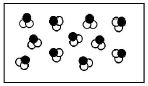
A pure substance which is an Element
A pure substance which is an Compound
Which of the following chemical formula represents an element?
C
H2O
NaCl
NH3
Which of the following is a molecule of a compound?
H2
Cl2
NH3
F2

A pure substance which is an Element
A pure substance which is a Compound

According to the periodic table what element is in group 9 period 4?
Hydrogen
Magnesium
Cobalt
Sulfur
According to the periodic table what element is in group 7 period 4?
Hydrogen
Manganese
Plutonium
Nitrogen

How many valence electrons does Aluminum have?
1
3
5
7
How many valence electrons does Lithium have?
1
3
5
7
How many valence electrons do group 14 elements have?
2
4
6
8

What two elements are in the same Period?
K - Potassium and Na - Sodium
Li - Lithium and Mg - Magnesium
B - Boron and C - Carbon
Zn - Zinc and N - Nitrogen

There are_______ periods and _________ groups in the periodic table.
8, 7
18, 7
15, 10
7, 18
Elements more reactive the further __________ on the periodic table.
Right
Left

How many energy shells does Fe - Iron have?
26
2
4
55
How do covalent bonds form?
Donating & receiving valence electrons between atoms
Oppositely charged ions attract each other & form bonds
Scientists are still not sure how they form
Sharing valence electrons between atoms
The formation of a covalent bond relies on the interaction or bonding of...
2 Nonmetals
1 Nonmetal & 1 Metal
2 Metals
2 Noble Gases
Calcium Oxide, CaO
Covalent Bond
Ionic Bond
When forming an ionic bond, a metal atom
Gains electrons to form a cation
Loses electrons to form a cation
Gains electrons to form an anion
Loses electrons to form an anion

When mixing milk and vinegar, a white, chunky, solid substance is formed. What has occurred?
Physical change: state of matter
Chemical change: precipitate
Physical change: freezing
Chemical change: new gas
Determined whether the following equation is balanced or unbalanced. Ag + O2 ---> 2Ag2O
Balanced
Unbalanced
Determine whether the following equation is balanced or unbalanced. 4P +5O2 ---> 2P2O5
Balanced
Unbalanced
Students observed a piece of iron change from shiny to rusty. What caused this change?
a chemical reaction
a heat reaction
a cold reaction
a physical reaction
Which is the best example of a new substance forming?
lighting a match
cutting a piece of paper
popping a balloon
hitting a nail with a hammer
Bending metal
Physical Change
Chemical Change
Boiling Water
Physical Change
Chemical Change
A Candle Burning
Physical Change
Chemical Change


What does the number 3 represent in 4NH3?
Subscript
Superscript
Coefficient
What does the number 4 represent in 4NH3?
Subscript
Superscript
Coefficient
Speed = _______________
Distance + time
Distance – time
Distance x time
Distance / time
This occurs when an object speeds up, slows down, or changes direction.
Speed
Velocity
Acceleration
Another way to explain the speed and direction of a object would be to describe it’s ________
Speed
Velocity
Acceleration
Velocity = _______________
Speed – direction
Speed + direction
Speed x direction
Speed / direction


What is the motion of the car in the graph?
The car is speeding up
The car is slowing down
The car is at a constant speed towards reference point
The car is at a constant speed away from reference point

What is the motion of the car in the graph?
The car is slowing down
The car is speeding up
The car is traveling at a constant speed
The car is not moving

What is the motion of the car in the graph?
The car is moving quickly
The car is not moving
The car is moving towards the reference point
The car is changing direction

Which line shows a faster speed?
The dotted line
The solid line

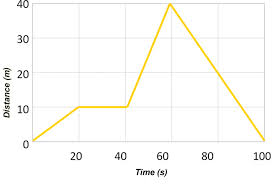
What is happening to the motion of the walker in the graph?
The walker changed direction, away from the reference point
The walker changed direction, towards the reference point
The walker started to slow down
The walker started to speed up

Friction _____________ motion
Works in the same direction as
Opposes
Has not effect on
Pulls against
Which type of friction keeps objects from sliding around all over the place
Static Friction
Rolling Friction
Fluid Friction
Sliding Friction
Which of these materials do you predict would have the MOST amount of friction
Metal
Tile
Sand Paper
Denim



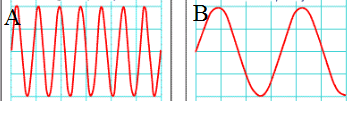

Which image represents a transverse wave?
A
B
Sound waves are which type of waves?
transverse
seismic
longitudinal
frequency

