
 Worksheets
1st Semester Review - Earth Science
Total questions: 135
Worksheet time: 3hrs 22mins

What does helio mean?
earth
jupiter
sun
pluto
What does geo mean?
earth
sun
pluto
jupiter
What scientist discovered the Geocentric Model?
Ptolemy
Copernicus
Galileo
Plato
What scientist discovered the Heliocentric Model?
Copernicus
Galileo
Ptolemy
Plato
Which model states that earth is positioned at the center of the universe?
Heliocentric
Geocentric
Which model states that the Sun is positioned at the center of the universe?
Heliocentric
Geocentric
Who supported Copernicus's Heliocentric Model
Galileo
Plato
Ptolemy
No one
Edwin Hubble discovered that the universe was still expanding by using what technological tool?
Eyes
Space probes
telescope
Space spy
How old is the universe?
13.8 Billion years old
1.3 Billion years old
2,020 years old
13.7 Million years old
Olivia, Abigail, and Nora are on a space adventure! They're trying to map out the solar system. Can you help them figure out the correct order of the planets furthest from the sun?
Saturn, Uranus, Jupiter, Neptune
Uranus, Neptune, Jupiter, Saturn
Neptune, Jupiter, Uranus, Saturn
Jupiter, Saturn, Uranus, Neptune
Hey Zoe, Oliver and Abigail! Let's take a trip to outer space. Can you tell me which planet, being the fifth one from the sun, is also the largest in our solar system?
Jupiter
Saturn
Mars
Earth
James, Abigail, and Luna are on a space adventure! They come across a planet and Luna thinks it's a gas giant. Can you guess which planet they are looking at?
Venus
Earth
Mars
Neptune

Ethan, Charlotte, and Sophia are on a space adventure! They come across the asteroid belt. Can you help them figure out where it is located?
between Earth and Mars
between Jupiter and Saturn
between Mars and Mercury
between Mars and Jupiter
Imagine you are on a space adventure with Abigail and Ethan. You come across a planet that supports life, is composed of rock, and is the 3rd planet from the sun. Can you guess which planet it is?
Venus
Earth
Mercury
Mars
Abigail, Avery, and Ethan are on a space adventure! They've reached the 8th planet from the Sun, an outer planet. Can you guess which planet they've landed on?
Mars
Neptune
Earth

Anika, Grace, and Henry are on a space adventure! They are exploring the inner planets. What common characteristic would they find in these planets?
Large
Gaseous
Rings
Rocky Surface
Hey Benjamin, Hannah, and Luna! Can you guess which planet is the only one to do a funky dance and spin on its side? Also, it's the seventh one in line from the sun!
Earth
Jupiter
Neptune
Uranus
Imagine Harper, Noah, and Abigail are on a space adventure! They come across Uranus, Saturn, Jupiter, and Neptune. Which planet do you think they would find has the coldest surface temperature?
Uranus
Saturn
Jupiter
Neptune
Noah, Michael, and Aria are on a space adventure! They've just passed the first planet from the sun and are now approaching the second one. This planet is a dry, rocky world shrouded in toxic clouds. Can you guess which planet they're visiting?
Mercury
Venus
Earth
Mars

Daniel, Emma, and Sophia are on a space adventure! They come across a planet known as the "red planet". Can you help them identify which planet it is?
Venus
Mercury
Earth
Mars
Imagine this, Olivia, James, and Jackson! You're on a spaceship, zooming through the solar system. You come across the sixth planet from the sun. It's so light, it could float in water! Can you guess which planet it is?
Jupiter
Saturn
Uranus
Neptune
Ethan, Noah, and Arjun are on a space adventure! Can you help them remember the correct order of the planets starting from the sun?
mars, venus, mercury, earth
venus, mercury, earth, mars
mercury, venus, earth, mars
mercury, earth, venus, mars
Imagine Charlotte, William, and Benjamin are astronauts exploring the universe. They come across a planet that is most similar to earth and is often referred to as her "sister" planet. Can you guess which planet they discovered?
Mars
Venus
Earth
Mercury
Imagine Benjamin, Harper, and Mia are astronauts exploring the universe. They come across the inner planets and notice some characteristics. Can you help them identify 3 common traits of these inner planets?
Rocky
Smaller
Gaseous
Terrestrial
Imagine Scarlett, Mia, and Aria are astronauts exploring the universe. They come across Venus, often called Earth's twin. But there's a major reason why they can't set up a picnic there. Can you guess why?
Because Venus has no atmosphere.
Because Venus' surface temperature is about 480oC.
Because the water on Venus' surface is too hot to support life.
Because Venus' dense clouds keep the planet's temperature very low.

Arjun, Ethan, and Aiden are on a space adventure and they come across a bar graph that compares the orbital speeds of the planets. They are trying to draw conclusions from the graph. Can you help them figure out which of these conclusions can definitely be drawn from the graph?
The planet's rotation speed increases with increasing distance from the Sun.
The mass of the planets increases with increasing distance from the Sun.
The gravitational pull of the Sun decreases with increasing distance from the Sun.
The orbital periods of the planets increase with increasing distance from the Sun.
Imagine Mia, Grace, and Lily are astronauts exploring the vast universe. They come across two sets of planets. One set is closer together, while the other is more spread out. Which set of planets are they likely to find closer together?
Inner Planets
Outer Planets
Imagine Aria, Henry, and Olivia are on a spaceship exploring the solar system. They start wondering, why do planets like Earth orbit the sun and not the other way around? What could be the reason?
The sun has a greater mass than the planets
The sun is the center of the universe
The planets have a smaller diameter than the sun
The sun is the center of the solar system

Elijah, Lily, and Ava are on a virtual space mission to Saturn! They have some data about the planet. Which piece of information will help them figure out how long a year lasts on Saturn?
The mass of Saturn
The radius of Saturn
The time it takes for Saturn to rotate on its axis
The time it takes for Saturn to orbit around the Sun

Emma, Liam, and Arjun are on a space adventure! They are trying to figure out which is the 4th planet from the Sun. Can you help them?
Earth
Jupiter
Mars
Mercury
Priya, Charlotte, and James are having a debate. They are trying to remember which planet has just 1 moon. Can you help them out?
Venus
Jupiter
Earth
Mercury
Isla, Oliver, and Avery are on a space adventure! They're curious and start wondering, what would happen if they could magically double the distance of a planet from the Sun? Can you help them figure it out?
The planet’s year length would be longer.
The planet’s mass would be doubled.
The planet’s orbital period would become shorter.
The planet’s day length would be shorter.
Where is the Asteroid Belt located?
Between Earth and Mars
In the Kuiper belt
Between Mars and Jupiter
Beyond the Oort cloud
Which of the following best describes a comet?
It is made of ice, rock, and dust.
It is located between Mars and Jupiter
It has a short elliptical orbit
Comets are leftover fragments from the time when planets formed in the solar system.
Which of the following is FALSE about meteoroids, meteors, and meteorites?
A meteor burns in the mesosphere and is called a "shooting star".
They are made of ice.
They are made of rock and debris from space.
They vary in size and can be as small tiny pebbles or very large.
True or False: A comet's tail points AWAY from the Sun?
(a)
What keeps the planets in orbit around the sun?
gravity
friction
density
distance
A brick and a pencil are dropped at the same time from the same height. Which one would hit the ground first?
brick
pencil
both would hit at the same time
Which statement about gravity is true?
gravity causes objects to pull towards one another
gravity causes objects to push away from each other
gravity only takes place between planets
the moon doesn't have any gravity

Which model has greater gravitational attraction.
Model A
Model B
Model A and B have the same amount of gravitational attraction.


What phase of the moon is this?
Waxing Gibbous
Waning Gibbous
Waxing crescent
Waning crescent
What makes it possible for you to see the surface of the moon from Earth?
The moon gives off its own light.
Light from Earth is reflected by the moon’s surface.
Light from the sun is reflected by the moon’s surface.
The moon absorbs sunlight during the day and glows at night.

Name the phase
First Quarter
Waxing Crescent
New
Waxing Gibbous

Name this phase
Full
Waning Gibbous
Third Quarter
Waning Crescent

Name the phase
First Quarter
Waxing Crescent
New
Waxing Gibbous
How many miles is the moon from Earth?
240 miles
240, 000 miles
24 miles
240, 000
Why does the moon not support life?
because it has many craters
because it is a large rock
because it has a very thin
because it is lit by the Sun
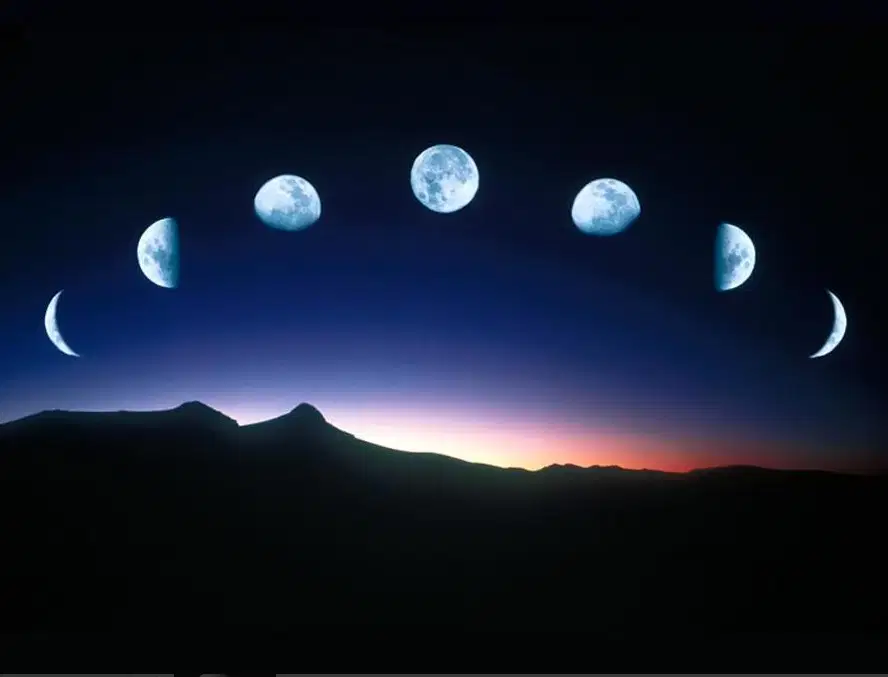
When the moon waxes it goes from ___________.
1st quarter to 3rd quarter
new moon to full moon.
full moon to new moon.
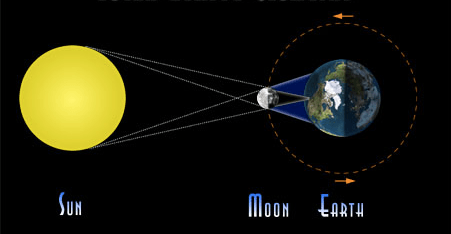
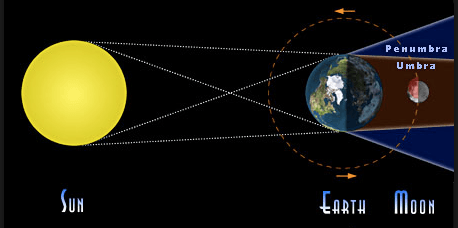


Which contains the greatest amount of Earth's freshwater?
groundwater
oceans and seas
lakes and rivers
glaciers and polar ice caps
Water on Earth is found naturally as a solid, a liquid, and a gas. Where is MOST of the solid water on Earth?
deep in Earth's mantle (inside the Earth)
in Earth's polar regions (North & South Poles)
in the outer atmosphere (space)
at the bottom of the ocean
Only 3% of the water on Earth is freshwater. About 60% of that water is not available for man's use. Why is this?
it is frozen
it is polluted
it is too salty
it is in aquifers
Approximately 99.7% of all water on Earth is found in oceans, seas, ice, and in the atmosphere. Based on this information, which statement is most accurate?
The Earth's freshwater supply is infinite. (we cannot run out)
Less than 0.3% of Earth's water is drinkable.
Humans are dependent on ocean water.
The water cycle returns all usable water to the sea.
Place the following in order from largest amount of water found on Earth to the smallest: glaciers and ice caps, groundwater, saltwater.
rivers and lakes, glaciers and ice caps, groundwater, saltwater
groundwater, saltwater, rivers and lakes, glaciers and ice caps
saltwater, glaciers and ice caps, groundwater, rivers and lakes
What is the greatest harm to freshwater?
animals
humans
nothing
water cycle
How are features found on land similar to features found on the ocean floor?
They both have mountains, valleys, canyons, etc.
They both have only canyons.
They both have only mountains.
They aren't similar at all.
The Mariana Trench is widely studied to -----
understand how land features are constantly changing
understand what living organisms are found there
understand how the ocean floor is constantly changing
compare it to features on the land
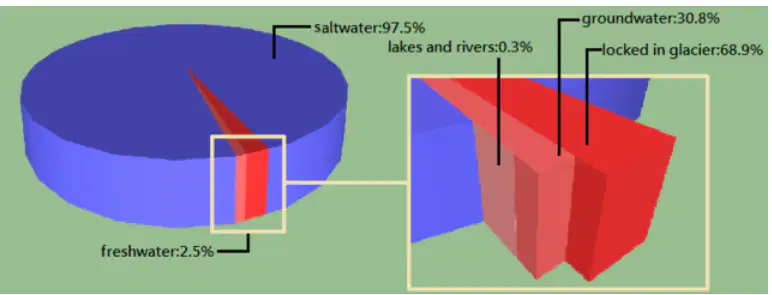
What would be the best title for the graph based on the data shown?
Water Conservation
Types of Freshwater
Earth's Water Distribution
Lakes, Glaciers, and Oceans
What factor is most helpful in telling the difference between ocean water and freshwater?
Ocean water contains salt.
Ocean water can't freeze.
Ocean water has no oxygen.
Ocean water is always warmer.

Humans can only consume (drink)
Freshwater
Saltwater
Saltwater makes up how much of the Earth's water supply?
97%
75%
25%
3%
Freshwater makes up how much of the Earth's water supply?
97%
75%
25%
3%
Which option helps us conserve (save) water?
Taking shorter showers
Letting the water run while we brush our teeth
Taking long showers
At which location in the ocean would you find the most dense water?
near the top
spring and neap
surface and density
lukewarm and cold
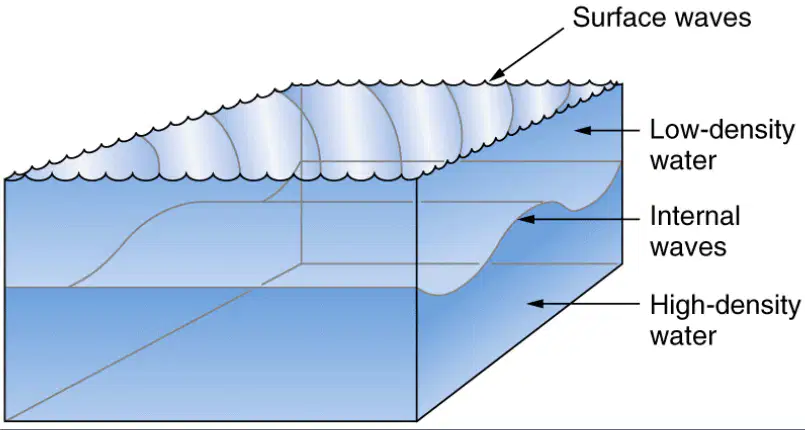
Which type of currents are found in high-density water?
Deep Ocean Currents
The curving of surface winds due to Earth's rotation, powered by winds.....
Tide
Which factor does NOT influence wave height?
speed
distance
length
temperature
Density currents circulate ocean water __________.
fast
slowly
at a constant pace
at an irregular pace


Movement of energy through a body of water is a
Tide
current
wave
longshore drift
Energy power source for starting the continuous process of the water cycle. Without this, there would be NO water cycle.
the sun
gravity
underground hotspots
electricity
How does the sun's energy contribute to the water cycle process?
It heats the water, causing it to evaporate into the atmosphere
It causes the accumulated rain drops in the clouds to fall to the ground
It causes rain drops to condensate in the clouds
When water is heated by the sun, the atmospheric conditions change the state of water from a liquid to a gas. Which step is this in the water cycle?
precipitation
runoff
condensation
evaporation
Identify the step in which water returns to Earth's surface from the atmosphere in the form of rain, sleet, hail, or snow.
condensation
evaporation
precipitation
runoff
When water cools and condenses, clouds form as water droplets clump around tiny dust particles. What step is this in the water cycle?
evaporation
condensation
precipitation
runoff
The precipitation that runs off the land and eventually flows into oceans, rivers, or lakes is called ______.
runoff
evaporation
precipitation
condensation
When it rains, some water runs across Earth's surface, flows down rivers, and empties into oceans. The Atlantic Ocean is an example of an area of __________.
evaporation
condensation
accumulation
groundwater
This is a type of evaporation where plants release water vapor into the air, almost like they are "sweating". This is called __________.
transportation
transpiration
translation
precipitation
When precipitation falls to the ground and soaks into the soil through spaces and cracks in the rocks, this process is called ___________.
condensation
runoff
groundwater
infiltration
Where on Earth's surface does the most evaporation occur and the most precipitation fall?
plants and soil
the oceans
the mountains
The rise and fall of Earth's waters on its coastlines are called
currents
tides
waves
gravity
A large stream of water that moves through the ocean is called a
longshore drift
current
tide
wave
Which best describes the Gulf Stream?
A cold ocean current that cools the weather off near Australia.
A cold ocean current that helps decrease global warming.
A warm ocean current that influences weather along the east coast of the U.S. and up toward Europe.
A warm ocean current that influences weather in Cuba and moves toward Antarctica.
How do deep ocean currents form?
The form as warm, dense water sinks and flows beneath cold ocean water.
They form as cold, dense water sinks and flows beneath warm ocean water.
They form as warm, dense water sinks and flows with other warm ocean water.
The wind blows causing the deep ocean currents.
Which two features together control the density of seawater?
temperature and sea depth
salinity and pressure
temperature and salinity
salinity and depth
As ocean water flows, the ___ stored in the ocean from the sun is distributed around Earth.
algae
heat energy
marine life
salt
Which of the following types of water would SINK the fastest?
warm and salty
cold and salty
warm and fresh
cold and fresh
What causes surface currents and winds to follow a curved path?
a tsunami
the Coriolis Effect
the waves
the tides
What is the main cause of the Coriolis Effect?
earth’s rotation
trade winds
temperature
the sun and ocean
Surface currents tend to carry water that is _______________________
warm and less salty
cold and more salty
lukewarm with no salt
icy
What happens to the ocean as depth increases?
temperature increases
salinity decreases, temperature decreases
pressure decreases
temperature decreases, salinity increases
The height of a wave is MOST affected by the
speed of the wind
salinity of the ocean
speed of the ocean
amount of solar energy
A stream of ocean water moving in a continuous flow is known as ______.
an ocean current
global winds
an air mass
a front

Surface currents are mainly formed by and driven by ______.
the Coriolis Effect
Cold and Warm Water
Convection
the Wind
The gravitational pull that the moon has on Earth is _____.
greater on solids than liquids
the main cause of high and low tides
responsible for longshore currents
responsible for tsunamis

