Wayground logo

Free Printable Worksheets

Font size

S
M
L
XL
Worksheets

Electricity Final Review

Total questions: 61

Worksheet time: 1hrs 11mins

Name
Class
Date
1.
The picture shows an electrical circuit. This circuit is a series circuit because: 
a)
It has 3 light bulbs.
b)
The same current flows through all three light bulbs.
c)
It uses a single battery.
d)
The electrical current is divided between the three light bulbs.
2.
What is the total resistance (RT) across this circuit?
a)
3 kΩ
b)
10 kΩ
c)
13 kΩ
d)

18 kΩ

3.
As resistors are added in series to a circuit, the total resistance will...
a)
increase
b)
decrease
c)
stay the same
4.
What is a switch's function in a circuit?
a)
to make the current hotter or colder
b)
turn on and off the flow of current
c)
the pathway that current flows
d)
to add more power to the circuit
5.
wood is a _____?
a)
conductor
b)
insulator
6.
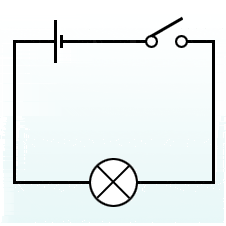
this circuit is .....?
a)
open
b)
parallel
c)
closed
d)
The cutest little circuit evah!
7.
When all parts of the circuit are connected it is a ______ circuit. 
a)
open
b)
closed
8.
When you flip a light switch on and off you are closing and opening a circuit.
a)
true
b)
false
9.
An object through which electrons can easily flow is called a(n) ___________.
a)
Conductor
b)
Insulator
10.
What is a common energy source for a circuit?
a)
Light bulb
b)
Battery
c)
Wire
d)
Switch
11.
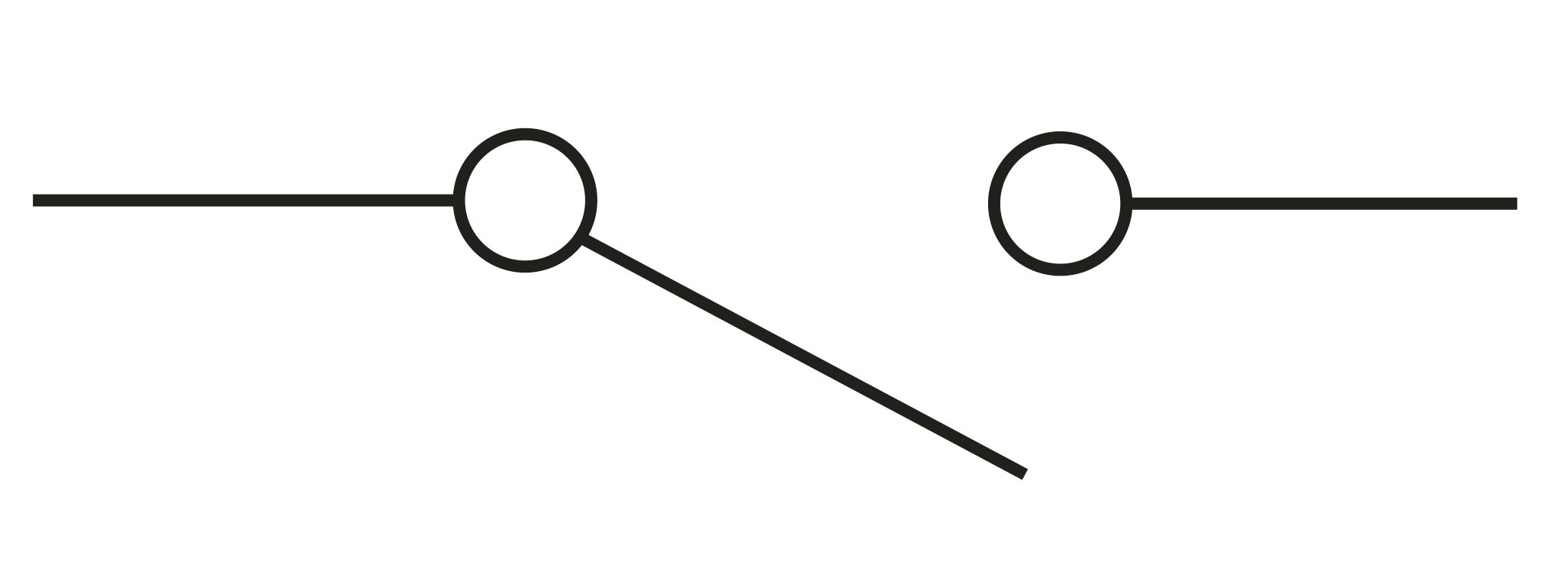
this is the symbol for a _____?
a)
switch
b)
light 
c)
battery
d)
wires
12.

Why is electrical wiring usually made from copper?

a)

Because copper is shiny

b)

Because copper conducts electricity

c)

Because copper is not magnetic

d)

Because copper insulate electricity

13.

Why is electrical wiring usually are covered with a layer of plastic?

a)

To make it look pretty

b)

To help electricity flow along the wire

c)

To make it safe

d)

To add more energy

14.
This circuit has a battery, buzzer, and switch.
When the switch is closed the buzzer will sound because -
a)
the switch gives energy to the battery
b)
the buzzer is made of special plastic
c)
the wires are cooled by the surrounding air
d)
electricity can flow in a complete path
15.
Which bulbs will light?
a)
1 and 2
b)
2 and 3
c)
3 and 4
d)
4 and 2
16.
Will the light bulb in this circuit light and why/why not?
a)
yes, because it has two batteries
b)
no, because the switch is open
c)
yes, because it is in a circuit
d)
no, because the bulb is burned out
17.
What size resistor would produce a 3 Amp current flow with a 12 Volt battery
a)
1 Ohm
b)
3 Ohms
c)
4 Ohms
d)
12 Ohms
18.
What is current measured in?
a)
Ω (Ohms)
b)
V (Volts)
c)
A (Amps)
d)
W (Watts)
19.
What is resistance measured in?
a)
Ω (Ohms)
b)
V (Volts)
c)
A (Amps)
d)
W (Watts)
20.
What is Resistance?
a)
The flow of electrons
b)
Electric potential difference
c)
A battery
d)
The ability to reduce the flow of electrons
21.
Electricity that flows in a closed path is called a
a)
path
b)
current
c)
circuit
d)
light
22.
What types of charges attract?
a)
Positive and Positive
b)
Positive and Neutral
c)
Negative and Neutral
d)
Positive and Negative
23.
What is the Voltage of a circuit that has a resistance of 5 Ω and a current of 2 A?
a)
25 V
b)
10 V
c)
2.5 V
d)
0.4 V
24.
The mathematical relationship among Voltage, Current, and Resistance
a)
Faraday's Law
b)
Tesla's Law
c)
Edison's Law
d)
Ohm's Law
25.
Current times Resistance equals
 (I X R)
a)
Power
b)
Voltage
c)
Amperage
d)
Ohm
26.

Voltage divided by Resistance

(V / R)

a)

Current

b)

Power

c)

Ohms

d)

Watts

27.

Voltage divided by Current

(V / I)

a)

Current

b)

Power

c)

Resistance

d)

Watts

28.
If the Voltage is increased and the resistance stays the same, Current will
a)
Increase
b)
Decrease
c)
Stay the same
d)
X
29.
If the Voltage stays the same and Resistance is increased, Current will 
a)
Increase
b)
Decrease
c)
Stay the same
d)
X
30.

If the battery produced 12.6 Volts what would be the current flow for a 6 Ohm resistor?

a)

2.1 Amps

b)

2.4 Amps

c)

1.71 Amps

d)

15 Amps

31.
How many Volts would we need to produce a current flow of 8 Amps through a 6 Ohm resistor
a)
12 volts
b)
24 volts
c)
1.3333
d)
48 volts
32.
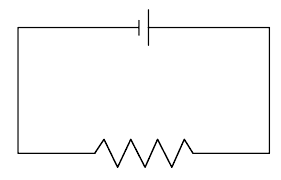
This circuit has a 24 volt battery and the resistor is 8 ohms. How many amps are running through the circuit?
a)
3 Amps
b)
192 Amps
c)
2 Amps
d)
4 Amps
33.
What word means how hard it is for electrons to flow through.
a)
Current
b)
Voltage
c)
Resistance
d)
Power
34.
What word means how fast the electrons flow.
a)
Current
b)
Voltage
c)
Resistance
d)
Power
35.
The flow of electricity requires a
a)
complete path
b)
incomplete path
c)
insulated current
d)
complex circuit
36.
To complete a circuit the switch must be
a)
unattached
b)
open
c)
closed
d)
It depends
37.

How does an object become negatively charged?

a)

by adding electrons

b)

by removing protons

c)

either adding electrons or removing protons

38.

How does an object become positively charged?

a)

by adding protons

b)

by removing electrons

c)

either by adding protons or removing electrons

39.

Select all of the statements that are true.

a)

Oppositely charged objects repel

b)

Oppositely charged objects attract

c)

Similarly charged objects repel

d)

Similarly charged objects attract

40.

Electrically connecting an object to the earth by means of a metal wire or other conductor is called

a)

grounding

b)

a circuit

c)

neutral

d)

negative charge

41.

Identify letter C

a)

filament

b)

contact point

c)

contact wire

d)

glass bulb

42.

Identify the circuit element

a)

resistor

b)

battery

c)

switch

d)

diode

43.

Charge is measured in

a)

coulombs

b)

amperes

c)

ohms

d)

volts

44.

Current is measured in units of

a)

coulombs

b)

amperes

c)

ohms

d)

volts

45.

Resistance is measured in units of

a)

coulombs

b)

amperes

c)

ohms

d)

volts

46.

What is the property of a resistor called?

a)

Capacitance

b)

Voltage

c)

Resistance

d)

Current

47.

What does the long stem of a battery symbol indicate?

a)

Negative terminal

b)

Positive terminal

c)

Ground

d)

Neutral

48.

What is the function of a switch in a circuit?

a)

To store charge

b)

To emit light

c)

To open or close a circuit

d)

To increase resistance

49.

What is a closed circuit?

a)

A circuit with a gap in the path of electrons

b)

A circuit that is not connected in a loop

c)

A circuit connected in a loop so the battery can power the device

d)

A circuit with no battery

50.

What is produced when charges move?

a)

A magnetic field

b)

A current

c)

A static charge

d)

A chemical reaction

51.

What does a large current imply?

a)

Few electrons flow toward the positive

b)

A lot of electrons flow toward the positive

c)

Electrons flow toward the negative

d)

Protons flow toward the positive

52.

What defines whether a material is a conductor or an insulator?

a)

The color of the material

b)

The density of the material

c)

How easily electrons can flow in the material

d)

The weight of the material

53.

What is a key feature of all mechanical switches?

a)

They have only one contact point.

b)

They are always made of plastic.

c)

They have at least two contact points.

d)

They do not conduct electricity.

54.

What happens when a "normally off" momentary switch is pressed?

a)

The circuit remains open.

b)

The circuit closes temporarily.

c)

The circuit reverses direction.

d)

The circuit increases voltage.

55.

What are the two materials commonly used as electrodes in modern dry cells?

a)

Copper and gold

b)

Zinc and carbon

c)

Lead and aluminum

d)

Sodium and magnesium

56.

What type of current do batteries provide?

a)

Alternating current (AC)

b)

Direct current (DC)

c)

Static current

d)

Variable current

57.

What dictates the rate at which charge flows in a battery?

a)

The size of the battery

b)

The demand of the circuit

c)

The color of the battery

d)

The brand of the battery

58.

What is the same for each element in a series circuit?

a)

Voltage

b)

Current

c)

Resistance

d)

Power

59.

What happens when a large current flows through a fuse?

a)

It lights up

b)

It cools down

c)

It "blows"

d)

It changes color

60.

What is the main difference between a fuse and a circuit breaker?

a)

A fuse can be reset

b)

A circuit breaker can be reset

c)

A fuse increases current

d)

A circuit breaker decreases voltage

61.

What is electrical resistance?

a)

A measure of how much a material resists the flow of current

b)

A measure of how fast electrons move through a conductor

c)

A measure of the voltage applied to a circuit

d)

A measure of the power consumed by a device