
Font size
 Worksheets
BTA Chem Term 2 Review Practice
Total questions: 120
Worksheet time: 3hrs 37mins
Which two elements would NOT form an ionic bond?
calcium and lithium
calcium and oxygen
lithium and oxygen
calcium and carbon
Fill in the blank: A charged particle that forms when an atom gains or loses electrons is called a(n)
(a)
What is the correct molecular formula of Calcium Chloride?
CaCl
Ca2Cl
CaCl2
Ca3Cl2
An example of a covalent compound is
sodium floride
calcium chloride
carbon dioxide
all of the above
In all covalent bonds, valence electrons are
lost
gained
shared equally
shared
What is the chemical formula for the compound containing one nitrogen atom and two oxygen atoms?
O2N
N2O
NO
NO2
The force of attraction that holds together atoms that share electrons is a(n) (a) bond.
The force of attraction that holds together oppositely charged ions is a(n) (a) bond.

The following properties are all characteristics of ionic compounds EXCEPT
high melting and boiling points
soft
crystal lattice structure
conduct electricity when dissolved in water
Is the following compound ionic or covalent?
A material that forms a crystal lattice
Ionic
Covalent
Is the following compound ionic or covalent?
PBr5
Ionic
Covalent
Is the following compound ionic or covalent?
A material with a high melting point
Ionic
Covalent
Name the following covalent compound: N2O5
Nitrogen oxide
Dinitrogen pentoxide
Nitrous oxide
Nitrogen pentoxide
Name the following ionic compound: Al2S3
Dialuminum Trisulfide
Aluminum sulfide
Aluminum sulfur
Aluminum monosulfide
Name the following ionic compound: NaF
Sodium fluoride
Monosodium fluoride
Sodium monofluorine
Sodium monofluoride
Name the following covalent compound: CF4
Carbon fluoride
Monocarbon tetrafluoride
Carbon tetrafluoride
Carbon fluorate
Name the following ionic compound: Na2S
Disodium sulfide
Sodium sulfer
Sodium sulfide
Sodium monosulfide
The name of Zn(NO3)2 is
zinc nitride
zinc nitrate
zinc dinitrate
zinc II nitrite
What covalent formula corresponds to dichlorine monoxide?
Co₃O
ClO₂
Cl₂O
(Cl₂)₂O
How can you identify a covalent compound?
2 or more nonmetals
1 metal and 1 nonmetal
all metals
all transition metals
Which particle is responsible for bonding?
protons
valence electrons
neutrons
electrons
What is the chemical formula for Ammonium?
NH4+
NH3
NH4-
NH3+
What is the name for CN-?
Cyanite
Cyanide
Cyanate
Cyan
What is the name for NO3-?
Nitride
Nitrite
Nitrate
Nitrogen Oxygen
What is the name for CO32-?
Bicarbonate
Carbonite
Chromate
Carbonate
What is the element name for Br?
Bromine
Boron
Beryllium
Bohrium
What is the element name for Pb?
Plutonium
Lead
Palladium
Tin
What is the symbol for ARSENIC?
As
Ar
Ae
Ac
chlorate
(ClO3)-1
(ClO2)-1
(ClO)-2
(ClO3)-2
Hydroxide
HO-1
OH-1
OH-2
OH
Phosphate
PO4-3
PO2-3
PO4-2
PO3-3
Which is the formula for sodium sulfate?
Na2SO3
Na2SO4
Na(SO4)2
NaSO3
Which name–formula pairs are correct?
ammonium sulfate, (NH4)2SO4
magnesium carbonate, MgCO3
calcium sulfate, Ca2(SO4)2
calcium phosphate, Ca3(PO4)2
sodium chlorite, NaClO
Which is the silver ion?
Au2+
Ag2+
Ag+
Si+
Which is the zinc ion?
Zn2+
Zr2+
Zn+
Zr+
Assume that 5.6 L H2 at STP reacts with excess CuO according to the following equation:
CuO (s) + H2 (g) ---> Cu (aq) + H2O (l)
How many moles of Cu are produced?
0.250 mol
2.50 mol
25.0 mol
25.00000 mol
How many liters of NH3 are needed to react completely with 30.0L of NO?
4NH3(g) + 6NO (l)--> 5N2 (g) + 6H2O (l)
5.0 L
20.0 L
7.5 L
120.0 L
Actual yield = 62g
Calculate the percent yield.
Solid aluminum react with HCl according to the following balanced equation at STP:
2Al (s) + 6HCl (aq) --> 2AlCl3 (aq) + 3H2 (g)
If 13.5 g of Al (s) reacts with excess HCl, how many liters of H2 gas are generated?
15.2 L
16.8 L
12.5 L
14.8 L
2Al + 3H2SO4 → Al2(SO4)3 + 3H2
How many grams of aluminum sulfate would be formed if 250g H2SO4 completely reacted with aluminum?
0.85 g
290 g
450 g
870 g
Mg(s) + 2 HCl(aq) → MgCl₂(aq) + H₂(g)
How many moles of HCl are consumed in the production of 7.5 moles of MgCl₂?
3.8 moles
15 moles
7.5 moles
23 moles

What is the temperature of the metal cube when thermal equilibrium is achieved between the cube and the liquid?
Heat flows from _______ to _________.
warm to cool
cool to warm
The specific heat of a substance varies with the mass of a sample. True or False?
True
False
1 food calorie = _______ chemistry calories
1000
1
500
4.184
What is the SI unit of heat and energy?
calorie
celsius
joule
Sweating is an __________________ process because heat is released.
endothermic
exothermic
Ice cream melting is an example of an __________ process.
endothermic
exothermic
If two objects have different temperatures when they come in contact, heat will flow from the warmer object to the cooler one UNTIL ____________
one reaches a temperature of zero
they both have an equal temperature
one runs out of energy

What is the q of this problem?
3°C
525 J
4.18 J/g°C
unknown (aka ?)
How many calories are absorbed when 100 g of water increases in temperature from 20 o C to 40 o C?
12540 cal
-3000 cal
3000 cal
A reaction takes place in a calorimeter. The water temperature decreased. Which way did energy flow?
Into the system
Into the surroundings
Out of the system
A bowl of hot soup sits on a table. Which is the system?
The air
The soup
both
A glass of water is placed in a freezer. Which way does energy flow?
Into the freezer
Into the glass of water
Energy does not flow
If enthalpy(ΔH) is on the reactants side of a chemical reaction, then the reaction is _________.
Endothermic
Exothermic
If an enthalpy (ΔH) value is given outside of a chemical equation and it is a positive value, then the reaction is _______________.
Endothermic
Exothermic


What kind of reaction is shown in graph A on the left?
Endothermic
Exothermic
Cannot be determined


NaCl was heated starting at an initial temperature of 0°C. The heating curve is shown in the picture. What is the melting point of this substance?
0°C
801°C
1000°C
1465°C

In which region(s) of the heating curve would water be a liquid and a gas at the same time?
A
B
C
D
E
If a process has a positive q (+q)
the process absorbs energy
the process releases energy
isothermic
If a process releases heat...
q will be negative
q will be postive
For an exothermic reaction, ΔH is...
negative
positive
In the following reaction, A + 2B --> 3C, ΔH = 640 kJ . How much energy is needed to react 4 moles of A?
2560 kJ
1280 kJ
1920 kJ
3840 kJ

The graph is showing an _________ reaction
endothermic
exothermic
What is collision theory?
Molecules must collide in the correct orientation with enough energy to bond.
Molecules need enough energy to collide and react.
Atoms constantly collide and react.
The minimum energy needed for atoms to react
What is the purpose of a catalyst?
Helps to slow down a reaction
Replaces the products
Helps to speed up a reaction
Replaces the reactants
Decreasing the concentration of a substance will usually........
Slow down the reaction
Speed up the reaction
Have no affect on the reaction
Which has more surface area?
Large chunks of chalk
Cube of sugar
Powdered sugar
Small chunks of sugar
What criteria must be met for reactant collisions to result in a successful product?
The reactants must collide with each other
The reactants must collide with enough energy and be in the right positions
The reactants must have enough energy to form the activated complex
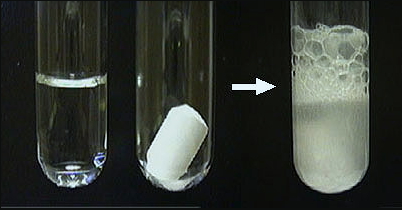
How could we make this reaction happen more quickly?
Decrease the concentration of the acid
crush the chalk to increase the surface area
Put the test tube in an ice bath

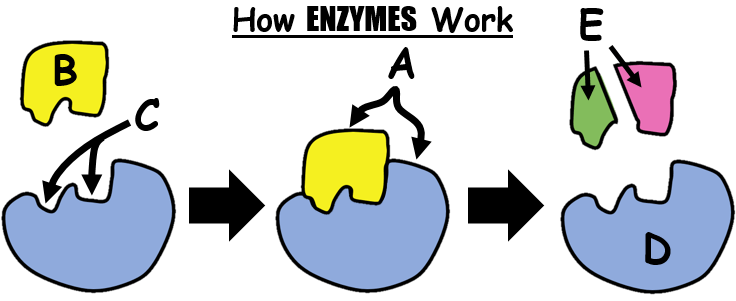
From this screenshot, the how would you describe the surface area of the orange and green compound
a solid with minimum surface area
a solid with MAX surface area
a gas with minimum surface area
a gas with MAX surface area
According to the trends of collision theory, which concentration of catalyst would have the highest reaction rate
0.15 mol / L
0.5 mol / L
1.0 mol / L
0.1 mol / L
Which solution is more concentrated?
Solution 1:
500 mL of water
100 g of salt
Solution 2:
500 mL of water
90 g of salt
Solution 1
Solution 2
They have the same concentration
I have no idea
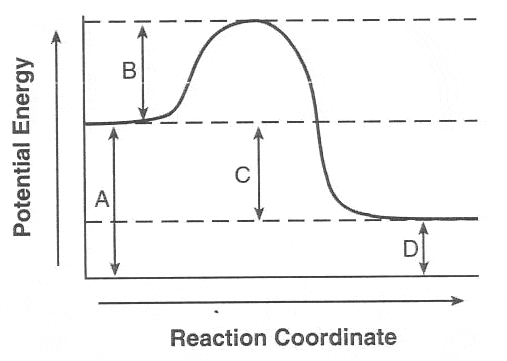
If a catalyst for this reaction was present, which arrows would be affected?
Arrow A
Arrow B
Arrow C
Arrow D
Arrows B and C
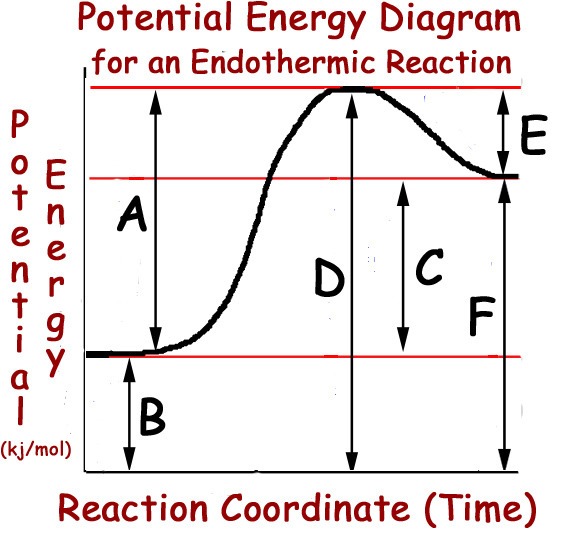
What letter represents the activation energy for the forward reaction?
A
B
C
D
E
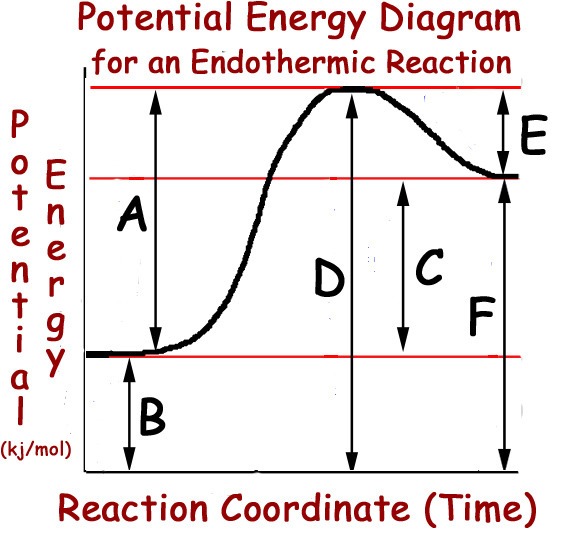
Is the forward reaction endothermic or exothermic?
endothermic
exothermic
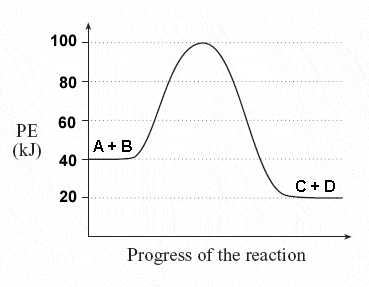
What is the value of ΔHrxn for the forward reaction?
-40 kJ
-20 kJ
100 kJ
60 kJ
20 kJ

Which letter represents the activation energy for the reverse reaction?
A
B
C
D
E
Catalysts permit reactions to proceed along a ___________energy path.
lower
higher
magnetic
psycho's


Observe the diagram. Which statement is true about the kinetic energy of the molecules in the containers?
The molecules are moving faster in Diagram A
The molecules are moving slower in Diagram A
The molecules are moving at the same rate in both diagrams
2SO2(g)+O2(g) ⇌ 2SO3(g) + Heat
Increasing the temperature will...
shift equilibrium right
shift equilibrium left
increase pressure
have no change
2SO2(g)+1O2(g) ⇌ 2SO3(g) + Heat
Increasing the pressure on the system will...
shift equilibrium right
shift equilibrium left
slow rate of reaction
have no change
N2 + O2 <=> 2NO
If O2 is removed, the concentration of N2 will _______.

Which of the two graphs reaches equilibrium?
Neither
The left
Both
The right
If the pH of a solution is 4.0, what is the pOH?
4.0
10.0
1.0 x 10 -4
cannot be determined from the information
Ammonia has a pOH of 2. Ammonia is a(n) __________.
acid
base
neutral
metal
What is the [H+] if the pH is 4.0?
1.0 x 10⁻¹⁰ M
1.0 x 10⁻¹⁴ M
1.0 x 10⁻⁴ M
1.0 x 10⁻⁷ M

Of the metals gold, iron, and sodium, which will not give up its electrons to silver (Ag) in a redox reaction?
Au
Fe
Na
Cd
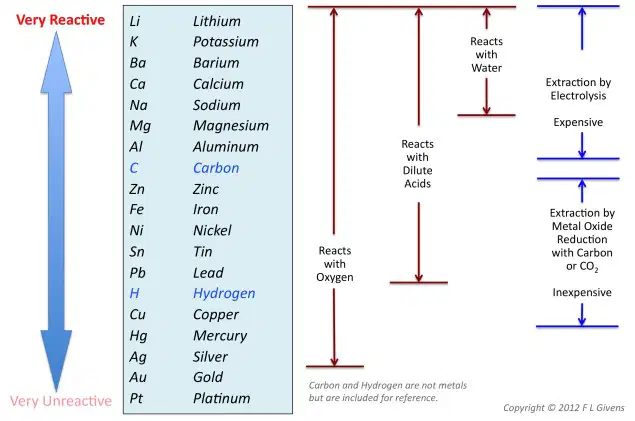
Of the metals Fe, H, K, and Mg, which spontaneously donate electrons to sodium (Na)?
Fe
H
K
Mg
Which metal is more reactive than calcium?
magnesium
potassium
silver
aluminum
The electrons in a nonpolar covalent molecule are shared...
Evenly
Unevenly
Electrons are not shared
None of the Above
A diatomic molecule like O2 is always _____ because electrons are shared _____
nonpolar; unequally
polar; equally
nonpolar; equally
polar; unequally
What must the difference in electronegativity between two atoms be in order for the bond between them to be nonpolar covalent?
less than 0.4
greater than 1.7
between 0.4 and 1.7
exactly 0
Order the types of bonds based on the charge of their molecules. (lowest amount of charge to greatest)
Polar Covalent --> Ionic --> Nonpolar Covalent
Ionic --> Nonpolar Covalent --> Polar Covalent
Ionic --> Polar Covalent --> Nonpolar Covalent
Nonpolar Covalent --> Polar Covalent --> Ionic

Which of the following formulas represents a polar molecules?
CO2
CCl4
H2
H2O

Is this molecule polar or non-polar?
Polar
Non-polar

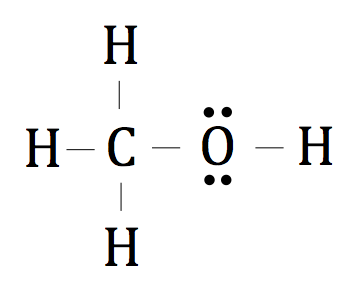
Is the following molecule polar or non-polar?
polar
non-polar
CH4 is
polar
non-polar

