
 Worksheets
genetics and segregation
Total questions: 50
Worksheet time: 1hrs 20mins

Each parent passes ___ allele to their offspring.
The different forms of a gene are called
factors
alleles
masks
traits
How many alleles do we inherit for each gene?
1
2
3
4
Why did Gregor Mendel use pea plants for his experiments on heredity?
Peas taste good and are easy to cook.
Pea plants look very lovely in the garden and produce beautiful flowers.
Pea plants have easily observable traits, produce several generations in a year, and self pollinate.
Peas are a good source of vitamin A, vitamin C, folate, thiamine, iron and phosphorus. They are rich in protein, carbohydrates, and fiber and low in fat.
What is heredity?
The passing of traits from parent to offspring.
A family tree that shows the relationships between an organism and its ancestors.
A diagram that is used to predict the genotypes of offspring produced by two parents.
A notable feature or characteristic of an organism.
What did Mendel use to represent the "factors" pass on by parent to offspring?
Capital and lower case letters
Letters and numbers
Large and small numbers
A color scale
What does Homozygous dominant mean?
That both alleles for a gene are recessive, so the recessive form of the trait will be expressed.
That one allele is dominant and one is recessive, which mean the dominant trait will be expressed in the offspring.
That both alleles for a gene are dominant, so the dominant form of the trait will be expressed.
That no alleles are present.
Why did Mendel choose to work with the garden pea plant?
Because the pea plant is easy to work with.
Because pea plants are fast growing
Because the pea plant has a number of characteristics, each with only two forms
all of the above
In a cross between a homozygous dominant parent and a homozygous recessive parent, what is the chance of the offspring having a heterozygous genotype?
25%
50%
75%
100%
What is an allele?
a chemical found in DNA
a certain form of a gene that can be recessive or dominant
a physical trait
a pair of chromosomes
A dominant allele.....
is expressed half of the time
is never expressed
is expressed in homozygous dominant and heterozygous individuals
is only expressed in homozygous individuals
Which of the these is homozygous?
gg
Yy
Nn
Ee
What organism did Mendel study?
pea plants
onions
mice
cats
The parental genotypes (Gg and gg) can be described as being--
Both homozygous recessive
Heterozygous; homozygous recessive
Both heterozygous
Both homozygous dominant
Which of the following genotypes is homozygous recessive?
AA
Aa
aa
None of the above
Which of the following genotypes is heterozygous?
HH
hh
Hh
None of the above
tt
Which of the following statements best describes Mendel's Law of Segregation?
Each parent only passes one allele for each trait to their offspring.
All offspring inherit the same traits from each parent.
Alleles for each trait blend to create a new trait in offspring.
Traits are passed down unchanged to offspring.
Why are traits sometimes different between parents and offspring?
Offspring always inherit dominant traits from both parents
Traits are randomly chosen from either parent's alleles, which can result in different combinations
Offspring create new alleles not present in their parents
Parents pass down identical traits to all offspring
What are the offspring of the P generation called?
F3 generation
F2 generation
F4 generation
F1 generation
What did Mendel conclude about the inheritance of traits?
Traits are only inherited from the mother
Traits are controlled by factors that exist in pairs
Traits are not inherited
Traits are random
What is the probability that a tossed coin will land heads up?
1 in 5
1 in 4
1 in 3
1 in 2
What is the term used to describe an organism with two different alleles for a trait?
Hybrid
Homozygous
Recessive
Dominant
What did Mendel observe in the F₁ generation when crossed purebred tall plants with purebred short plants?
All the plants in the F₁ generation were short.
3/4 of the plants in the F₁ generation were short and 1/4 were tall.
3/4 of the plants in the F₁ generation were tall and 1/4 were short.
All of the plants in the F₁ generation were tall.
The factors that control a trait are known as _______
F₁
parents
genes
alleles
In flies, red eyes (R) are dominant to brown eyes (r). A heterozygote fly is crossed with a homozygous recessive fly. What percentage of offspring will have brown eyes?
25%
50%
75%
100%
In flies, red eyes (R) are dominant to brown eyes (r). A heterozygote fly is crossed with a homozygous recessive fly. What fraction of offpsring will be heterozygotes?
1/4
1/2
2/4
3/4
In a plant species, long stems (L) are dominant to short stems (l). A heterozygous plant is crossed with a homozygous dominant plant. What percentage of offspring will have short stems?
25%
50%
75%
0%
In a plant species, long stems (L) are dominant to short stems (l). A heterozygous plant is crossed with a homozygous dominant plant. What will be the ratio of genotypes in the offspring?
1:1
2:2
1:3
0:4
In a species of mammals, gray fur (G) is dominant to white fur (g). Two heterozygous mammals are mated together and produce offspring. What fraction of offspring will have gray fur?
1/4
1/2
3/4
2/4
In a species of mammals, gray fur (G) is dominant to white fur (g). Two heterozygous mammals are mated together and produce offspring. What percentage of the offspring will have white fur?
25%
50%
75%
100%
R- round
r-wrinkled
What is the genotype for wrinkled?
RR
rr
Rr
What is a Punnett square used for in genetics?
Identifying the parents of offspring
Calculating the age of offspring
Determining the gender of offspring
Predicting the traits of offspring


What are the possible genotypes for this cross?
TT = 25% Tt= 50% tt=25%
tt = 100%
TT= 75% tt = 25%
Tt = 100%
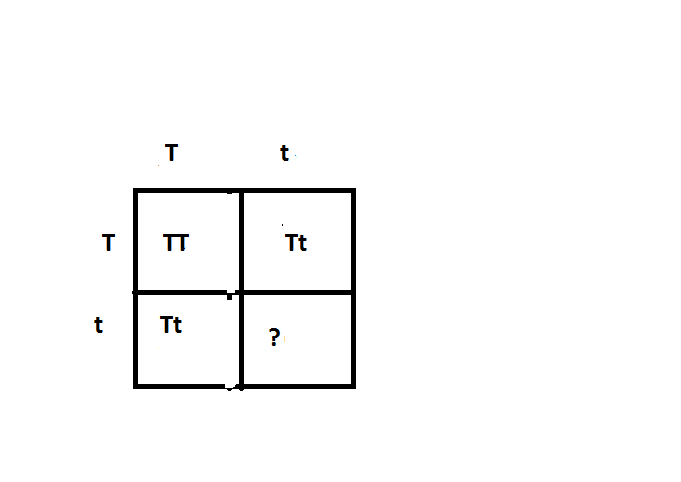
Look at the Punnett Square, what belongs in the missing square?
tt
Tt
Dominant
TT

What percentage of the offspring will have green pods?
25%
50%
75%
100%


