
 Worksheets
Ohio Science Test Prep
Total questions: 63
Worksheet time: 43mins
Name
Class
Date
1.
Sound is caused by?
a)
force
b)
vibrations
c)
instruments
2.
Sound travels FASTEST through which of these materials?
a)
Air
b)
Empty space
c)
Metal
d)
Water
3.

What is frequency?
a)
the number of vibrations per second
b)
how high or low a sound is
c)
the loudness or softness of a sound
d)
the back and forth movement of matter
4.
What is volume?
a)
how high or low a sound is
b)
the loudness or softness of a sound
c)
the number of vibrations per second
d)
vibrations
5.
What medium does sound travel through slowest?
a)
gas
b)
solid
c)
liquid
d)
trees
6.
High pitches are produced by objects vibrating _______________.
a)
quickly
b)
slowly
7.
Sound travels in which direction?
a)
down
b)
forward
c)
up
d)
all directions
8.
If a sound bounces back it is called ______________.
a)
frequency
b)
sound
c)
pitch
d)
an echo
9.
Light bounces when it is
a)
reflected
b)
absorbed
c)
refracted
10.
Light bends when it is
a)
refracted
b)
reflected
c)
absorbed
11.

Which images are opaque?
a)
A & C
b)
A,C,E, & F
c)
D, E, & F
d)
A & E
12.

Which explains why the fork looks different under water?
a)
light can't pass through the glass
b)
the wavelength of light lengthens
c)
the amount of light increases when going through water
d)
light is refracted at an angle
13.
Which term means to bounce off the surface of something?
a)
Refract
b)
Absorb
c)
Reflect
d)
prism
14.
Light bounces when it is
a)
reflected
b)
absorbed
c)
refracted
15.
Light bends when it is
a)
refracted
b)
reflected
c)
absorbed
16.
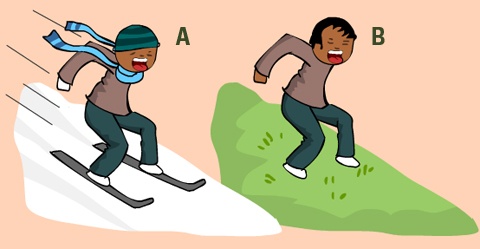
Why is it harder for the boy in Image B to get down the hill?
a)
Motion
b)
Friction
c)
Work
d)
Displacement
17.
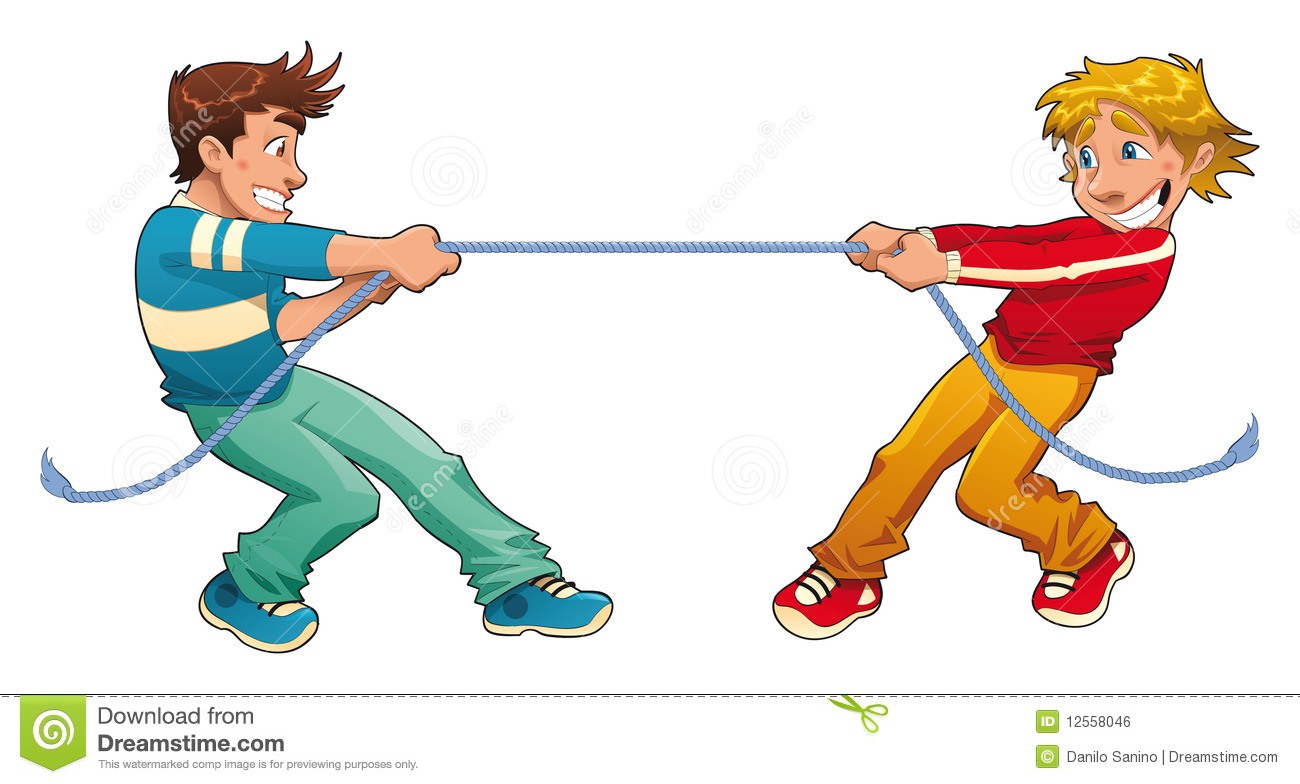
If these boys are pulling with the same amount of force. What will happen?
a)
The boy in blue will win.
b)
They will not move at all.
c)
The boy in red will win.
d)
Both will fall down.
18.
Any time the forces are unbalanced, an object will remain at rest. True or false?
a)
true
b)
false
19.
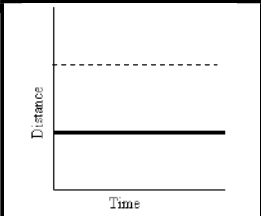
What does this graph represent?
a)
Constant speed
b)
Acceleration
c)
Not moving
20.
A baseball is thrown a distance of 50 meters. What is the speed if it takes 2 seconds to cover that distance?
a)
100 m/s2
b)
25 m/s2
c)
52 m/s2
d)
100 seconds
21.
Speed is equal to
a)
Distance/Time
b)
Time/Distance
c)
Time x Distance
d)
Acceleration
22.

What is this graph showing?
a)
Constant Speed
b)
Acceleration (speeding up)
c)
Deceleration (slowing down)
d)
No motion
23.
An object at rest will remain at rest or in the same uniform motion unless acted upon by an unbalanced force: law of inertia.
a)
Newton's First Law of Motion
b)
Newton's Second Law of Motion
c)
Newton's Third Law of Motion
24.
as mass increases, the acceleration has to decrease: the law of acceleration
a)
Newton's First Law of Motion
b)
Newton's Second Law of Motion
c)
Newton's Third Law of Motion
25.
If one object exerts a force on a second object, the second object exerts a force equal in magnitude and opposite in direction on the object body; law of interaction
a)
Newton's First Law of Motion
b)
Newton's Second Law of Motion
c)
Newton's Third Law of Motion
26.
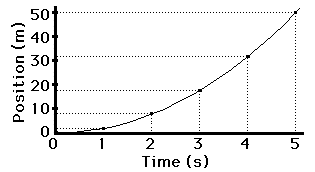
The picture of the position vs. time graph shows an object that is...
a)
accelerating/speeding up
b)
moving at a constant speed
c)
not moving
d)
accelerating/slowing down.
27.
How is gravity affected by mass?
a)
the larger the mass of the object, the greater the gravity
b)
small objects have no gravity
c)
gravity is not affected by mass of objects, whether large or small
28.
What is the Average Speed?
Distance: 10m
Time: 5s
Distance: 10m
Time: 5s
a)
2
b)
1/2
c)
50
d)
100
29.
A ball is moving in a certain direction. What would happen to the ball if a greater force was applied on the ball along its direction of motion?
a)
The speed of the ball would decrease.
b)
The speed of the ball would increase.
c)
The ball will stop instantly.
d)
The ball will change direction.
30.

A train that travels 100 kilometers in 4 hours is traveling at what average speed? Remember: Speed= distance/time
a)
50 km/h
b)
100 km/h
c)
400 km/h
d)
25 km/h
31.
If two boxes are pushed with the same amount of total force, and one weighs 1kg and the other weighs 100kg, which one will accelerate faster?
a)
1kg box
b)
100 kg box
c)
they will accelerate at the same rate
32.
Why are decomposers necessary in the food chain?
a)
They provide nutrients for plants.
b)
They photosynthesize.
c)
They are food for carnivores.
d)
They prey on herbivores.
33.
Which of the following directly use the Sun's energy to produce their own food?
a)
decomposers
b)
carnivores
c)
consumers
d)
producers
34.
If a population of grizzly bears gradually increases over time, which of the following will most likely occur?
a)
The number of prey species will decrease.
b)
The size of the bear population will continue to increase.
c)
The bear population in that area will eventually die out.
d)
The number of prey species will increase.
35.

According to the energy pyramid, which of the following will most likely happen to the other organisms if all the harvest mice died?
a)
The number of hawks would decrease, and the number of insects would increase.
b)
The number of hawks would increase, and the number of insects would increase.
c)
The number of hawks would increase, and the number of insects would decrease.
d)
There would be no change in the rest of the chain.
36.
Which of the following food chains shows the correct energy flow from left to right?
a)
rabbit > owl > grass
b)
grass > rabbit > owl
c)
owl > rabbit > grass
d)
grass > owl > rabbit
37.

How can the wolf in this picture benefit from plants even if it never eats plants?
a)
The rabbit eats the plants, and the wolf eats the rabbit.
b)
The plants help the rabbit to hide from the wolf.
c)
The plants make the wolf run slower.
d)
The rabbit eats the wolf, and the grass decomposes the rabbit.
38.
Which of the following is not an adaptation that would help a plant survive in the desert?
a)
very long root systems
b)
the ability to store water in stems
c)
tiny or no leaves
d)
large leaves to absorb sunlight
39.
Which of these adaptations would help an animal survive a cold winter season?
a)
losing extra fat on the body
b)
shedding fur
c)
hibernating in a cave
d)
sweating to release heat
40.
People don't eat grasses, but grasses are still important to people. Relating to the food chain, why are grasses important to people?
a)
People eat organisms that eat the grasses.
b)
Grass surfaces are safer than concrete.
c)
People use grass surfaces for recreation.
d)
Grass fields can't hide dangerous animals.
41.

According to the food web, if the snail population of this ecosystem increases, which of the following is most likely to occur?
a)
The grass population will increase.
b)
The grass population will decrease.
c)
The snails will eventually become extinct.
d)
The grasshopper population will increase at nearly the same rate.
42.
What is the relationship between the Sun, plants, and animals in a food web?
a)
The Sun provides energy for both plants and animals to make their own food.
b)
The Sun provides energy for plants to make their own food, and animals eat plants or other animals.
c)
The Sun provides light so animals can see which plants to eat.
d)
The Sun provides heat energy for animals to survive, but not plants.
43.

Look at the following table and picture.
These teeth most likely belong to a:
These teeth most likely belong to a:
a)
deer.
b)
tiger.
c)
chimpanzee.
d)
panda bear.
44.
Which of the following best explains why many trees in cold environments have short, pointy leaves?
a)
Shorter leaves can better tolerate strong winds and are less likely to blow off trees than large, broad leaves.
b)
Animals in colder environments are not adapted to eat any other kind of leaf.
c)
The cold prevents the leaves from growing longer and broader.
d)
Short, pointy leaves do not become weighed down by snow, so the trees' limbs are less likely to break.
45.
The spinning of the Earth on its axis that causes night and day.
a)
Rotate
b)
Revolve
46.
The imaginary line running through the center of Earth.
a)
axis
b)
moon
c)
constellation
d)
orbit
47.
What causes Earth's seasons?
a)
the tilt of Earth's axis
b)
Earth's rotation
c)
the revolution of the Moon
d)
Earth's distance from the Sun
48.
The rotation of Earth on its axis causes the pattern of _____.
a)
night and day
b)
constellations
c)
Earth's seasons
d)
the phases of the moon
49.
Fixed patterns of stars are called _____.
a)
Constellations
b)
Nebulas
c)
orbits
d)
systems
50.
How are stars DIFFERENT from planets?
a)
Stars are solid and rocky.
b)
Stars are made of frozen gases.
c)
Stars do not move.
d)
Stars revolve around the Sun.
51.
It takes Earth _________ to make one complete rotation on its axis.
a)
24 hours
b)
365 days
c)
28 days
d)
24 days
52.
It takes Earth _____________ to make one revolution or orbit around the Sun.
a)
365 days
b)
365 hours
c)
28 days
d)
24 hours
53.
It takes about _____________ for the moon to go through all of its phases.
a)
28 days
b)
365 days
c)
24 hours
d)
24 days
54.
A rocky body that orbits around a planet.
a)
moon
b)
star
c)
axis
d)
Sun
55.
Which of the following is true?
a)
Earth is the center of the solar system
b)
The sun orbits the earth
c)
Gravity exists only on Earth
d)
The sun is the center of the solar system
56.
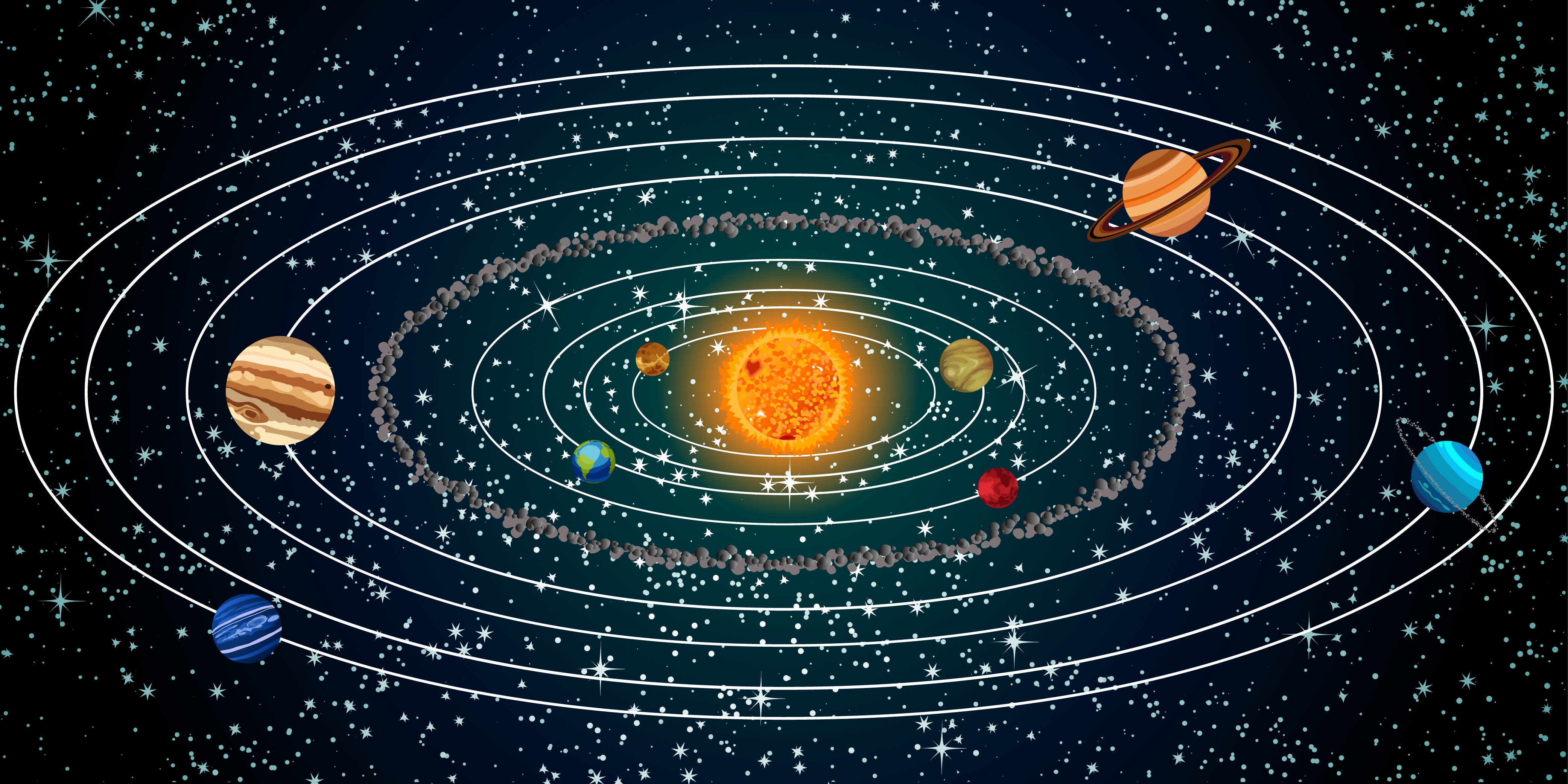
Why do planets orbit the sun (and not float around in space)?
a)
the moons are keeping them in place
b)
They were hit by an asteroid
c)
they were hit by a comet
d)
the sun's gravity keeps them in place
57.
What is one difference between comets and the Moon?
a)
The Moon has a core of ice, while comet cores are solid rock.
b)
Comets have large orbits around the Sun, while the Moon orbits Earth.
c)
The Moon reflects light from the Sun, while comets generate their own light.
d)
The Moon has a large orbit around the Sun, while comets orbit Earth.
58.

When the Northern Hemisphere of Earth is Leaning away from the Sun, What season is the Southern Hemisphere experiencing?
a)
Summer
b)
Winter
c)
Spring
d)
Fall
59.

What season is letter A?
a)
Winter
b)
Summer
c)
Spring
d)
Fall
60.

In the summer many people enjoy going to the beach. There is a beautiful beach in Argentina, which is located in the Southern Hemisphere. Which diagram shows the position of Earth when it is summer in Argentina?
a)
A
b)
B
c)
C
d)
D
61.

That this animal has fur is an...
a)
inference
b)
conclusion
c)
observation
d)
opinion
62.

What can you infer about the temperature for E.coli bacterial growth?
a)
E. coli does not grow well at low and high temperatures.
b)
E coli will continue to grow at very high temperatures.
c)
E.coli grows best at very low temperatures
d)
E.coli grows best at very high temperatures.
63.
A biology class of 24 students decides to measure the height of each student and then calculate the average height for the class. Which of these is a possible source of error in this activity?
a)
The number of males and females in the class
b)
The difference in the ages of the students in the class
c)
The total number of students in the class
d)
The accuracy of making and recording measurements
100 %

