wayground logo

Free Printable Worksheets

Font size

S
M
L
XL
Worksheets

Open Science Education Genetics

Total questions: 115

Worksheet time: 2hrs 42mins

Name
Class
Date
1.

DNA stands for

a)

Dioxyribo Nucleic Acid

b)

Dunder Nucleic Acid

c)

Dopamine Nucleic Acid

d)

Deciduous Nucleic Acid

2.

Which is in order from largest to smallest structure?

a)

chromosome, DNA strand, gene, nucleotide

b)

chromosome, gene, DNA strand, nucleotide

c)

gene, DNA strand, chromosome, nucleotide

d)

DNA strand, chromosome, gene, nucleotide

3.

What are the parts of a nucleotide?

a)

phosphate, sugar, base

b)

A, T, G, C

c)

Nucleic Acids

d)

two base pairs connected

4.

Which of the following is correctly matches: ATT GTA CGA

a)

TAA CAT GCT

b)

ATT GTA CGA

c)

TAA GTA TCG

d)

GCC ACG TAC

5.

What do genes do?

a)

make proteins

b)

store energy

c)

create covalent bonds

d)

create hydrogen bonds

6.

The 'backbone' or 'ribbon' of the DNA strand is made of:

a)

phosphate and sugar

b)

phosphate only

c)

phosphate and base

d)

sugar and base

7.

What is this a picture of?

a)

nucleotide

b)

DNA strand

c)

chromosome

d)

gene

8.

Label the picture in order:

a)

phosphate ; sugar ; base

b)

phosphate ; base ; sugar

c)

base ; sugar ; phosphate

d)

base ; phosphate ; sugar

9.

Which of the following correctly matches: GCT AGA TCG

a)

CGA TCT AGC

b)

TAG CTC GAT

c)

ATC GAG CTA

d)

ATG CTC CGT

10.

DNA is shaped in a:

a)

double helix

b)

tightly packed swirl

c)

twisted ladder

d)

nucleotide

11.

antiparallel stands of nucleotides run in:

a)

opposite directions

b)

the same direction

c)

base pairs

d)

chromosomes

12.

In which phase does the DNA copy itself?

a)

interphase

b)

metaphase

c)

anaphase

d)

telophase

13.
Adenine bonds with ______________.
a)
Guanine
b)
Thymine
c)
Cytosine
d)
Adenine
14.
Guanine bonds with ______________.
a)
Adenine
b)
Guanine
c)
Cytosine
d)
Thymine
15.
Why is DNA important?
a)
it is very small and very complicated
b)
it's in everything
c)
it serves as the blueprint for traits of all living things
d)
because we eat it every day for energy
16.
What are the 4 nitrogen bases?
a)
adenine, thymine, cytoplasm, and guanine
b)
adenine, thymine cytosine, and guanine
c)
adenine, thymine, cytosine, and gylcerol
d)
adenine, thymine, cytosine, and glucose
17.
Which sequence of DNA bases would pair with this partial strand
ATG TGA CAG
a)
ATG TGA CAG
b)
TAC ACT GTC
c)
GTA AGT GAC
d)
CAT TCA CTG
18.

Where does the DNA molecule unzip at during DNA replication?

a)

Between the sugar and phosphate

b)

Between the sugar and nitrogen bases

c)

Between the nitrogen bases

19.

Which part of a DNA molecule is responsible for the direct coding of specific traits in an organism?

a)

The number of hydrogen bonds that hold the strands of DNA together

b)

The number of carbons in the DNA molecule.

c)

The sequence of nucleotide bases in the DNA molecule

d)

The sequences of phosphates along each DNA strand

20.
DNA replication results in two DNA molecules,
a)
each one with two original strands
b)
each one with two new strands
c)
each one with one new strand and one original strand
d)
one with two new strands and the other with two original strands
21.
order of replication
a)
3, 2, 1, 4
b)
2, 1, 4, 3
c)
2, 3, 1, 4
d)
3, 4, 1, 2
22.

Who created models of DNA

a)

Chargaff

b)

Franklin

c)

Watson and Crick

d)

Hershey and Chase

23.

Who used x-rays to take pictures of DNA

a)

Chargaff

b)

Franklin

c)

Watson and Crick

d)

Hershey and Chase

24.

Who worked with pea plants

a)

Mendel

b)

Griffith

c)

Avery

d)

Hershey and Chase

25.

Who (Secretly) took a look at Franklin's image of DNA

a)

Chargaff

b)

Franklin

c)

Watson and Crick

d)

Hershey and Chase

26.

Who is known as the "Father of Genetics"

a)

Mendel

b)

Griffith

c)

Avery

d)

Hershey and Chase

27.
Which of these is controlled by your DNA?
a)
Color of your eyes
b)
What you ate yesterday
c)
Tattoos
d)
How many bonds carbon wants
28.
Which of the following would be determined by the order of the Nitrogen Bases in your DNA?
a)
Your Gender.
b)
The Number of Chromosomes you have.
c)
Your hair color.
d)
The number of siblings you will have.
29.
Assume that you have straight hair and your sibling has curly hair. What accounts for this difference?
a)
You have DNA and your sibling does not.
b)
The your sequence of nitrogen bases is different than your sibling.
c)
Your sibling has a weave. 
d)
Your sibling has a genetic mutation. 
30.
G = green, g = yellow
The genotype for a yellow plant is...
a)
GG
b)
Gg
c)
gg
d)
all of the choices result in yellow
31.
Which of the following is homozygous dominant?
a)
Yy
b)
Y
c)
yy
d)
YY
32.

Which of the following alleles is homozygous (purebred) recessive?

a)

TT

b)

Tt

c)

tt

d)

ts

33.
Genotype refers to the ...
a)
physical expression of the genes
b)
the possible combination of alleles in a gene
c)
whether an allele is dominant or recessive
d)
how an organism will appear
34.
The exact genetic makeup of an organism, such as RR, Tt, PP is its?
a)
phenotype
b)
dominance
c)
genotype
d)
trait
35.
Tt is-
a)
homozygous dominant
b)
homozygous recessive
c)
heterozygous
d)
none of these
36.
The hidden form of an inherited trait
a)
dominant trait
b)
recessive trait
c)
purebred
d)
hybrid
37.
If "T" is the allele for tall and "t" is the allele for short, then Tt would produce?
a)
tall
b)
short
c)
medium
d)
not enough info
38.
T - tall and t = short
In the punnett square below, what belongs in the missing square
a)
tt
b)
Tt
c)
Bb
d)
TT
39.
What is the yellow seed genotype?
a)
aa
b)
Aa
c)
AA
d)
AA or Aa
40.
In a heterozygous genotype, the ___________ allele takes over in the phenotype.
a)
recessive
b)
dominant
c)
lower case letter
d)
both 
41.
Two brown eyed parents (Bb) have a baby. What is the chance the baby is blue eyed?
a)
0 %
b)
25%
c)
50%
d)
75%
42.

What is the probability that the offspring will express the dominant trait?

a)

25%

b)

50%

c)

75%

d)

100%

43.
What type of "square" helps us solve genetic problems?
a)
carpenter square
b)
Mendel square
c)
Punnett square
d)
genetic square
44.
TT,tt,PP,pp,SS,ss are examples of alleles that are?
a)
homozygous
b)
heterozygous
c)
different
d)
homologous 
45.
The exact genetic makeup of an organism, such as RR, Tt, PP is its?
a)
phenotype
b)
dominance
c)
genotype
d)
trait
46.
Y for yellow body is dominant over y for blue body.  What alleles would produce yellow bodies?
a)
YY,yy
b)
Yy,yy
c)
YY only
d)
YY,Yy
47.
"The Great White Shark was 20 feet in length.  Phenotype or Genotype?
a)
phenotype
b)
genotype
48.
A physical characteristic that can be passed from parent to offspring.
a)
behavior
b)
trait
c)
strong muscles
d)
ability to fly a plane.
49.

When two Dominant alleles come together they can result in a blended phenotype.

a)

CoDominance

b)

Incomplete Dominance

c)

Mixer

d)

Genetical Identity

50.

When two Dominant alleles come together they can result in BOTH being present in the phenotype.

a)

CoDominance

b)

Incomplete Dominance

c)

Mixer

d)

Genetical Identity

51.

Cats that have wite fur with orange stripes and patches are an example of what?

a)

CoDominance

b)

Incomplete Dominance

c)

Incoherent Dominance

d)

DomDominance

52.

Wavy hair is a mix of curly and straight hair. Which of the following expalains this blending of traits?

a)

CoDominance

b)

Incomplete Dominance

c)

Incoherent Dominance

d)

DomDominance

53.

The passing on of traits and behaviors from parents to their offspring is

a)

offspring

b)

heredity

c)

DNA

d)

genes

54.
Which best explains why children resemble their parents?
a)
they eat same foods
b)
they have similar DNA
c)
they speak the same language
d)
they have the same interests
55.
Which deals with the transmission of inherited traits from one generation to another?
a)
anatomy
b)
ecology
c)
genetics
d)
forensics
56.

Which term describes the different forms of a gene

a)

Chromosome

b)

Allele

c)

DNA

d)

Punnett Squares

57.

If something is heterozygous, it is also _____

a)

purebred

b)

hybrid

c)

dominant

d)

recessive

58.

If something is homozygous, it can also be called____

a)

phenotype

b)

genotype

c)

hybrid

d)

purebred

59.

Where is the majority of DNA stored within a cell?

a)

Chloroplast

b)

Cell wall

c)

Cell membrane

d)

Nucleus

60.

Which statement is true?

a)

Your DNA is identical to your siblings.

b)

Your DNA is identical to your father's.

c)

Your DNA is identical to your mother's.

d)

Your DNA is unique to you.

61.

Green peas are dominant (G) to yellow peas (g). What is the genotype for a hetereozygous dominant offspring?

a)

Gg

b)

gg

c)

GG

d)

none of these

62.
What percentage of the offspring will be purebred dominant?
a)
0%
b)
25%
c)
50%
d)
75%
63.
Dominant alleles are represented by a(n)
a)
phenotype
b)
lower case letter
c)
upper case letter
d)
punnett square 
64.
D = dimples        d = no dimples 
What is the genotype for a homozygous recessive offspring?
a)
DD
b)
Dd
c)
dd
65.
If two purebred species (BB) are crossed, what percentage of their offspring would be BB?
a)
25%
b)
50%
c)
75%
d)
100%
66.
Short hair (S) is dominant to long hair (s).
What is the genotype for an offspring with long hair?
a)
SS
b)
Ss
c)
ss
67.
What percentage of the offspring will be heterozygous dominant?
a)
100%
b)
75%
c)
50%
d)
25%
68.
If green is dominant over purple, then what is the genotype for this individual?
a)
Purple
b)
Green
c)
GG
d)
gg
69.
A __________ is a segment of DNA that codes for a particular protein, which leads to a particular trait.
a)
Gene
b)
Allele
c)
Codon
d)
Nucleotide
70.
The letters on the TOP AND SIDE of a punnett square represent ______________.
a)
The combination of alleles in offspring.
b)
The possible alleles given by the parents following meiosis.
c)
The genotype and phenotype of offspring.
d)
The results of genetic mutations in offspring.
71.
What do we call the table used to calculate the probability of an offspring's genotype?
a)
Punnett square
b)
Venn diagram
c)
Golden ratio
d)
Fibonacci sequence
72.
Which is the correct phenotype for this organism?
a)
BB
b)
blue
c)
green
d)
bb
73.
What would the ratio for genotypes be for this Punnett Square?
a)
2Bb:2bb
b)
2BB:2Bb
c)
1BB:2Bb:1bb
d)
4Bb
74.
G = dominant green and y = recessive yellow
A fish has a Gy genotype, what will its phenotype be?
a)
yellow
b)
green
c)
greenish-yellow
d)
red
75.
What is a gene?
a)
An entire chromosome that  codes for a trait
b)
a piece of clothing
c)
a piece of a DNA on chromosome that codes for a trait
d)
Chemical messengers in your brain that code for a trait
76.
A homozygous dominant dog with brown fur is crossed with a heterozygous dog with brown fur. What are the percentages of the possible genotypes?
a)
100% BB
b)
75% BB and 25%Bb
c)
50 % BB and 50% Bb
d)
50% Bb and 50% bb
77.
Magda is a tall, 11 year old drummer. She has a scar on her right cheek. She is good at swimming. Which of her traits did Magda most likely inherit?
a)
height
b)
the scar
c)
ability to swim
d)
ability to play drums
78.
The drawing shows the structure of what molecule?
a)
A DNA molecule
b)
A lipid molecule
c)
A carbohydrate molecule
d)
A protein molecule
79.
What is the percentage of homozygous recessive offspring?
a)
0%
b)
25%
c)
50%
d)
75%
80.
this image is an example of
a)
codominance
b)
dominance
c)
incomplete dominance
81.
A breed of chicken shows codominance for feather color. One allele codes for black feathers, another codes for white feathers. The feathers of heterozygous chickens of this breed will be:
a)
all black
b)
all white
c)
all gray
d)
speckled black and white
82.

In some carnations, flower color exhibits codominance. Identify the correct genotypes for red, white, and speckled carnations.

a)

Red = RR, white = rr, speckled = SS

b)

Red = RR, white = WW, speckled = SS

c)

Red = RR, white = RW, Speckled = WW

d)

Red = RR, white = WW, speckled = RW

83.
If this image were real, it would represent what type of inheritance?
a)
incomplete dominance
b)
codominance
c)
polygenic inheritance
d)
compete dominance
84.
A red flowered plant (RR) breeds with a White flowered plant (WW). The gene for petal color in these plants expresses incomplete dominance.  What percentage of the offspring will have pink (RW) flowers?
a)
0%
b)
25%
c)
50%
d)
100%
85.

A roan cow shows codominance in fur color (brown and white). What is the phenotype ratio expected in offspring a female roan and a male roan mate together?

a)

All four would be brown and White

b)

Half would be orange, half would be white

c)

2 Brown: 2 Brown and White: 0 White

d)

1 Brown: 2 Brown and White: 1 White

86.

What is a chromosome?

a)

a gene pair where each allele in the pair is the same version

b)

long strand of DNA condensed (or supercoiled) into a stick-like structure

c)

a gene pair where each allele in the pair is a different version

87.

What are base pairs?

a)

molecules that will bond together, such as adenine with thymine and cytosine with guanine

b)

a gene pair where each allele in the pair is a different version

c)

a distinct portion of your cell's DNA that carries genetic instructions for a particular protein

88.

What are homologous chromosomes?

a)

gene pair where each allele in the pair is the same version

b)

the physical expression of a set of genes for a particular trait

c)

chromosome pairs (one from each parent) that are similar size and carry genes for the same trait

89.
What phase is  shown in the picture?
a)
anaphase 1
b)
anaphase 2
c)
metaphase 1
d)
telophase 1
90.
The process of crossing over occurs in what phase of meiosis?
a)
anaphase 1
b)
prophase 1
c)
prophase 2
d)
telophase 1
91.
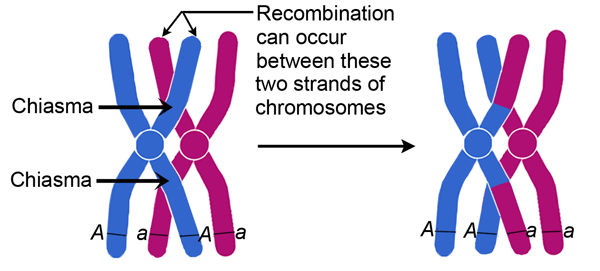
This image shows chromosomes during Prophase 1. Which of the following correctly describes the process shown?
a)
segregation of sister chromatids
b)
condensation and segregation of alleles
c)
mutationin which the DNA content of the gene is altered
d)
crossing - over in which alleles are exchanged
92.
What phase is  shown in the picture?
a)
anaphase 1
b)
anaphase 2
c)
metaphase 1
d)
telophase 1
93.
The correct order of the phases of mitosis and meiosis could be abbreviated as:
a)
MAPT
b)
PAMT
c)
TPAM
d)
PMAT
94.
The nuclear membrane dissolves during
a)
Prophase
b)
Metaphase
c)
Anaphase
d)
Telophase
95.
What phase is shown here?
a)
Prophase II
b)
Metaphase I
c)
Metaphase II
d)
Anaphase I
96.
What phase is shown here?
a)
Metaphase II
b)
Telophase I
c)
Telophase II
d)
Metaphase I
97.
What phases is shown here?
a)
Prophase II
b)
Prophase I
c)
Anaphase II
d)
Interphase I
98.
What phase is shown here?
a)
Anaphase I
b)
Prophase I
c)
Metaphase II
d)
 Metaphase I
99.
What phase is shown here?
a)
Telophase II
b)
Anaphase II
c)
Metaphase I
d)
Interphase I
100.
What phase is shown here?
a)
Telophase I
b)
Metaphase II
c)
Telophase II
d)
Anaphase I
101.
What phase is this?
a)
Interphase II
b)
Prophase I
c)
Metaphase I
d)
Anaphase II
102.
Meiosis results in the production of
a)
2 diploid cells
b)
2 haploid cells
c)
4 haploid cells
d)
4 diploid cells
103.
The end of meiosis results in  ____ to each other.
a)
2 cells that are identical
b)
4 cells that are identical
c)
2 cells that are not identical
d)
4 cells that are not identical
104.
Why would it be important to replicate DNA before a cell divides in mitosis or meiosis?
a)
In order for genetic information to be transferred into daughter cells.
b)
In order for the cell to be able to increase in size.
c)
In order for the DNA to be contained in the nucleus.
d)
In order for the cell to re-order the DNA sequencing in the new cells.
105.
The structure labeled A is a(n)
a)
chromatid
b)
centriole
c)
centromere
d)
chromophere
106.

Each chromosomes pairs with its corresponding homologus chromosome to form a tetrad

a)

Metaphase I

b)

Telophase I & Cytokinesis

c)

Prophase I

d)

Anaphase II

107.
What are chromosomes?
a)
different versions of genes
b)
condensed DNA 
c)
uncoiled DNA
108.

daughter cells in Meiosis

have _________ the normal chromosome number.

a)

half

b)

equal

c)

more than

d)

double

109.

Alleles of different genes tend to be inherited together when those genes are located on _________

a)

The same gene

b)

different genes

c)

the same chromosome

d)

different chromosomes

110.

The end product of mitosis is ____________ daughter cells

a)

2

b)

3

c)

4

d)

5

111.

Meiosis produces_____________

a)

Body cells

b)

Gametes

112.

Which of the following is true of both meiosis and mitosis?

a)

Both are preceded by chromosome/DNA replication

b)

The chromosome number from the original cell changes

c)

Homologous chromosomes may stay together.

d)

Both result in the formation of human cells

113.

Meiosis produces_________

a)

four genetically identical diploid cells.

b)

four genetically identical haploid cells.

c)

four genetically different diploid cells.

d)

four genetically different haploid cells.

114.
What process is represented in this diagram and what are the resulting daughter cells produced?
a)
mitosis, gametes
b)
mitosis, body cells
c)
meiosis, gametes
d)
meiosis, body cells
115.
When does DNA replicate?
a)
interphase
b)
prophase I
c)
telophase I
d)
cytokinesis