
 Worksheets
Basic Astronomy & Earth Dimensions
Total questions: 100
Worksheet time: 2hrs 35mins
From which set of polar and equatorial diameters can the actual shape of the Earth be inferred (determined)?
polar diameter = 12,756 km / equatorial diameter = 12,714 km
polar diameter = 12,714 km / equatorial diameter = 12,756 km
polar diameter = 12,714 km / equatorial diameter = 12,714 km
polar diameter = 12,756 km / equatorial diameter = 12,756 km

The diagram above represents the Earth's polar and equatorial diameters. The Earth's polar circumference must be...
less than the equatorial circumference
greater than the equatorial circumference
the same as the equatorial circumference
The best evidence that the Earth has a spherical shape would be provided by
the prevailing wind direction at many locations on the Earth's surface
the change in the time of sunrise and sunset at a single location during 1 year
the time the Earth takes to rotate on its axis at different times of the year
photographs of the Earth talken from space
Measurements taken from space show the Earth to be
greatest in diameter at the Equator
pear shaped
greatest in diameter at the Poles
the perfect sphere

If an observer on Earth views Polaris on the horizon, the observer is located at the ...
North Pole (900 north)
Tropic of Cancer (23.50 north)
Equator (00)
Tropic of Capricorn (23.50 south)
What causes the moon to appear to change shape?
moon craters
moon marias
moon phases
moon eclipses
What does a solar system contain?
a group of stars
a star and the planets close to it
the planets and moons around a star
a star and the planets and other objects that revolve around it
What causes day and night on earth?
earth rotating on its axis
earth revolving around the sun
earth's tilt
the moon orbiting earth
An orbit is...
a planet spinning on an axis
the distance between a planet and the sun
the speed a planet moves around the sun
the path an object takes around another object in space
Which of the following is a good demonstration of earth's rotation on its axis?
a spinning top
a bouncing ball
a falling rock
a train on a track
A planet can have 1 or more moons. What is another word to describe what a moon is to a planet?
an asteroid
a comet
a star
a satellite

Which is true about the diagram above?
In the Northern Hemisphere it is fall, and in the Southern Hemisphere it is spring.
In the Northern Hemisphere it is winter, and in the Southern Hemisphere it is spring.
In the Northern Hemisphere it is spring, and in the Southern Hemisphere it is summer.
In the Northern Hemisphere it is summer, and in the Southern Hemisphere it is winter.

Which moon phase would you see from earth?
full moon
crescent moon
third quarter moon
first quarter moon
How long does it take the moon to revolve around the earth?
about as long a one of earth's seasons
about as long as one rotation of Earth
about as long as one rotation of the moon
about as long as one revolution of Earth around the sun

About how long will it take for Earth to move from point Y to point Z?
6 months
1 year
12 hours
24 hours

Which position would allow us on Earth to see a new moon?
1
2
3
4
Which statement is true about every planet in our solar system?
They have satellites
They rotate on their axes
They are made of rock
They have nitrogen in their atmosphere

Which moon phase would someone on earth see?
full moon
first quarter
new moon
last quarter
How do scientists classify different types of galaxies?
by shape
by color
by number of stars
by temperature
Carla sees a small object streak across the night sky. It trails a bright stream of light behind it. Which of the solar system’s objects does Carla see?
a moon
a comet
an asteroid
a dwarf planet

According to the diagram, which of the following correctly states the season for the given location?
It is spring at location G
It is winter at location H
It is fall at location J
It is summer at location K
Imagine that the moon started rotating faster. How would it look different if you were looking at it from Earth?
The moon would appear dimmer
The moon appear brighter
You could see different sides of the moon
The moon would move across the sky more quickly
If the mass of the Sun increased what would happen to the amount of gravity it exerts?
nothing would happen
it will decrease
it will stay the same
it would also increase
What is mass?
the amount of pounds you are
the amount of matter within an object
the measure of the pull of gravity on an object
no one knows

In what shape do planets orbit around the Sun?
elliptical
irregular
no one knows
spiral

What is the proof the universe started as a single point that exploded?
galaxies are still shrinking around us
galaxies are still moving away from us
galaxies are still moving closer to us
there is no proof

Which planet is the closest to the Sun?
Mercury
Venus
Earth
Pluto
Why do time zones exist on Earth?
Because the Earth is a square
Because the Earth is flat
Because the Earth is round
Because the Earth is a triangle
What happens to ships on the ocean as they move away from view?
They float upwards
They disappear top first
They stay visible
They disappear bottom first
What evidence do we have that the Earth is round?
Stories from sailors
Myths and legends
Drawings from ancient times
Photographic evidence
What is the biggest difference between the Geocentric Model and the Heliocentric Model?
the shape of the planets' orbits
the movement of the moon
the center of the solar system


What is the name of this model?
Heliocentric Model
Geocentric Model
Circle Model
Aristotle Model

Which scientific instrument did Galileo use to change the world?
telescope
spyglass
mirror
magnifying glass
Most scientists believe the Big Bang Theory explains which of the following questions?
How our planets and moons formed
How our universe began
How the sun turns hydrogen into helium
How fast light travels through space
Where is the center of the universe located?
There is no center of the universe.
At the center of the Milky Way galaxy.
14.5 billion light years away from Earth.
In a large singularity near the Andromeda Galaxy.
Polaris cannot be seen. Where must the observer be?
At the equator
In the northern hemisphere
In the southern hemisphere
At the North Pole
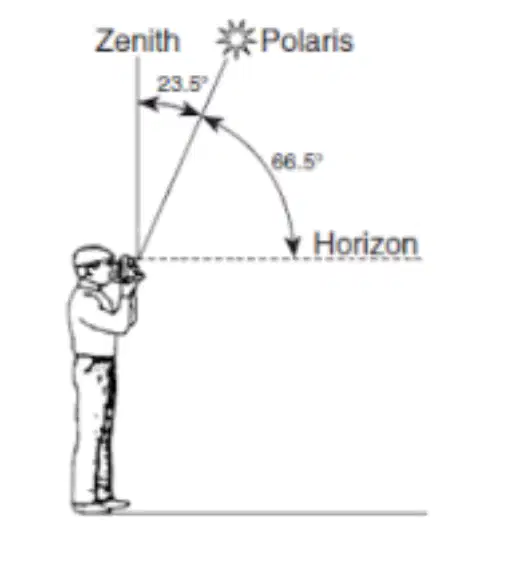
Based on the image, what is the altitude of Polaris?
23.5 degrees
66.5 degrees
90 degrees
It cannot be determined from the image
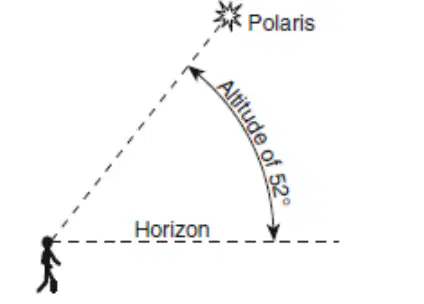
Based on the image, what is the latitude of the observer?
52 degrees S
66.5 degrees N
52 degrees N
It cannot be determined from the image
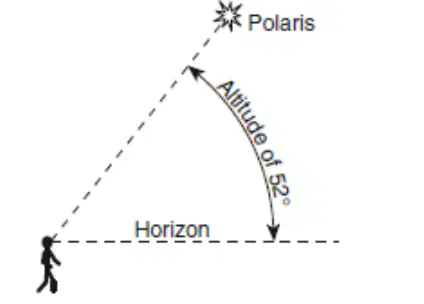
What hemisphere is the observer in?
Northern hemisphere
Southern hemisphere
Eastern hemisphere
Western hemisphere
Can you see Polaris from the southern hemisphere?
Yes, always
No, never
Only during the day
Only during the night
What is a solar eclipse?
When the Moon passes between the Sun and Earth, blocking the Sun's light
When the Earth passes between the Sun and Moon, casting a shadow on the Moon
When the Sun moves behind the Earth, causing darkness
When the Moon moves into the Earth's shadow
What causes a hemisphere to be in the summer season?
It's closer to the sun.
It's receiving the direct rays of the sun.
It's tilted away from the sun.
The axis is pointed towards the north star.
What is the main cause of the seasons?
earth's tilted axis
earth's distance from the sun
earth's elliptical orbit
earth's rotation on its axis
Imaginary line that runs around the earth at 0 degrees
axis
equator
longitude
degrees

Which statement about polaris is best illustrated by the diagrams shown below?
polaris is located in a winter constellation
polaris is located at the zenith at each location.
polaris' apparent movement through the sky follows a south-to-north orientation.
polaris' altitude is equal to a locations latitude.
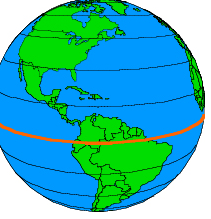
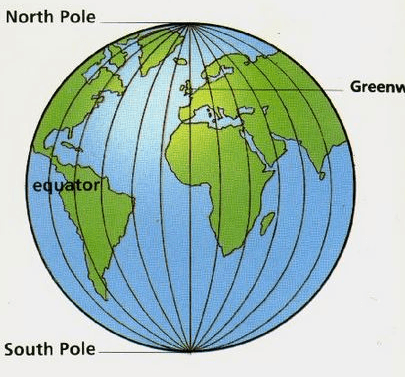
The Sun is made of...
Water and Ice
Hydrogen
Magnesium
Hydrogen and Helium
The Sun is a star
True
False
The Sun is a ball of hot burning gas
True
False

Which letter receives the most direct sunlight?
A
B
C
Which letter receives the least amount of direct sunlight?
A
B
C

Which letter has indirect sunlight and therefore will be cooler?
A
B

Which letter has direct sunlight and therefore will be warmer?
A
B


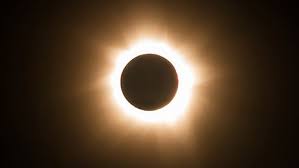
When the moon looks like this, is it a solar eclipse or a lunar eclipse?
Solar Eclipse
Lunar Eclipse

What is the largest planet in our Solar System?
Mars
Earth
Jupiter
Neptune
Which planet in the Solar System has the most visible rings?
Earth
Saturn
Mars
Pluto
What does the Moon control on Earth?
Cars
Phones
Satellites
Tides

What does the Sun revolve around?
Earth
The center of our galaxy
The center of the universe
The Sun doesn't revolve
____________are areas of gas on the sun that are cooler than the gas around them.
Solar Wind
Solar Flares
Sunspots
Core
The _______ Keeps the temperature of earth stable throughout the day and night.
Sun
Atmosphere
Moon
Ozone Layer
Which of the following is not a gaseous planet?
Mars
Neptune
Saturn
Jupiter
Why do we have seasons on earth?
The earths tilt allows more or less sunlight on earth depending on the time of year.
The distance between the sun and earth change throughout the year
The suns temperature increases throughout the year
The Earths rotation changes speed depending on the month of the year.

This is planet ...
Saturn
Mercury
Jupiter

That is ...
a comet
a meteor
a star

Astronomy is the science of ...
solar system
planets
space

The Earth is perfectly spherical in shape.
True
False

The constellations of the northern sky are able to be viewed by people living in the southern hemisphere... and vice versa.
Truth!!
Lies!!


Stars like the sun appear to rise in the ___________ and set in the _____________.
West, East
North, South
South, North
East, West
The Big Dipper



