
Font size
 Worksheets
Emergency Medicine and Code Blue Management
Total questions: 49
Worksheet time: 45mins
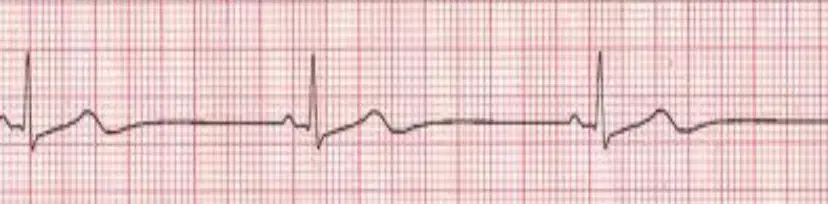
The ECG pattern shown is called?
A) Sinus Tachycardia
B) Sinus Bradycardia
C) Ventricular Tachycardia
D) Normal Sinus
Which type of tachycardia is characterized by a rapid heart rate with a wide QRS complex and is often seen in patients with structural heart disease?
Ventricular Tachycardia
Supraventricular Tachycardia
Torsades de pointes
Atrial Fibrillation
(a) is a type of tachycardia that can be identified by its twisting QRS complexes around the isoelectric line and is often associated with a prolonged QT interval.
Ventricular Tachycardia
Supraventricular Tachycardia
Atrial Flutter

Which of the following ECG patterns is characterized by rapid, irregular electrical activity?
Ventricular fibrillation
Asystole
Normal sinus rhythm
Atrial flutter

Identify the ECG pattern that shows a flat line, indicating no electrical activity.
Ventricular fibrillation
Asystole
Tachycardia
Bradycardia
Match the following EKG strips

Normal Sinus Rhythm

Sinus Bradycardia

Ventricular Tachycardia
Match the following EKG strips

Sinus Tachycardia

Ventricular Tachycardia

Torsades de Pointes

Superventricular Tachycardia
Match the following EKG strips

Ventricular Tachycardia

Ventricular Fibrillation

Asystole
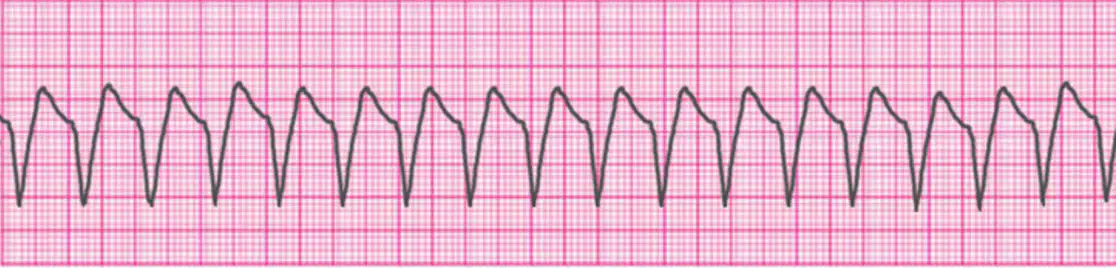
A patient presents with this EKG rhythm which of the following steps would treat the patient. Select all that apply.
Defribrillation
CPR
Epinepherine
Adenosine
A patient in V-tach who underwent an elective cardioversion becomes unresponsive, and their pulse is 69bmp what do you do?
CPR
prepare to Intubate
defibrillate
adminiter atropine
administer epinepherine
A patient in Vtach who fell unresponsive and has no pulse how do you treat them?
CPR
Intubate
defibrillate
Match the following medication dose to the correct medication
1mg IV q3-5 minutes
Epinepherine
0.5mg q3-5 minutes
Atropine
300mg IV push --> 150mg
Amiodarone
6mg IV push --> 12mg
Adenosine
0.25mg/kg IV over 2 minutes
Diltiazem
Match the following Medications guide to the correct dysrhythmia
Ventricular Fibrillation
Ventricular Tachycardia
PEA
Asystole
Unresponsive Bradycardia
Symptomatic Bradycardia
Superventricular Tachycardia
Match the following Medications guide to the correct dysrhythmia
Torsades de Pointes
Bradycardia
Atrial Fibrillation
Atrial Flutter
patients must go to the ER to be watched when given (a) because it can cause Superventricular Tachycardia
(a) can cause asystole
Reorder the following steps when treating stable Ventricular Tachycardia
300mg Amiodarone
150 mg amiodarone
Drip
Reorder the following treatment for unstable ventricular pulse
Cardioversion
CPR
intubation prep
Reorder the following steps when treating pulse Ventricular Tachycardia and Ventricular Fibrillation
CPR
Defibrillation
Epinephrine 1mg
Amiodarone 300mg
Amiodarone 150mg
How do you treat Superventricular Tachycardia (SVT)
Adenosine 12mg first
Adenosine 6mg first
Atropine 0.5 mg first
CPR first
How to treat symptomatic bradycardia. Select all that apply
1mg Epi
0.5 Atropine
1mg Atropine
defibrillator
How do you treat PEA. Select all that apply.
CPR
1mg EPI
1mg Atropine
300mg Amiodarone
How do you treat sinus bradycardia
monitor
atropine
cardioversion
cpr
adenosine
How to treat torsades de pointes
adenosine 6mg
cardioversion
atropine
cpr
magnesium
How do you treat atrial fibrillation
cardioversion
monitor
adenosine
atropine
(a) is a rhythm that resembles (b) but (c) a pulse and you treat with (d)
A 30 year old female patient has deep partial thickness burns on the back of the right arm, posterior trunk, front of the left leg, anterior head and neck, and perineum. The patient weighs 150 lbs. Use the Parkland Burn Formula to calculate the total amount of Lactated Ringers that will be given over the next 24 hours?
14,690mL
12,512mL
10,064mL
16,896mL
A patient aditted to the ICU with electrical burns are at risk for? Select all that apply.
Heart Failure
Kidney Failure
Cervical Spine injury
Hypothermia
Hyperthermia
A patient presents with burns to the face, ear, and eyelid. How would you assess their airway?
Ask them to swallow
Ask them to cough
Use a light to visualize the airway
Count their respirations
Which patient would you see first in the ICU
The patient with burns to the face and chest. BP: 120/70, HR: 90, RR:24
The patient with respiratory Bronchitis who is coughing green sputum. BP: 128/86, HR, 80, RR 26
The patient with a fractured tibia. BP: 100/60, HR: 88, RR: 17
The patient with DM1. BP: 100/60, HR:102, RR28
I patient in the ICU and codes and the monitor shows rhythm but the new nurse is unsure if they can feel the pulse when they check the carotid artery. What should the nurse do?
Feel the radial pulse
Start CPR
Defibrillate
Administer Adenosine
A patient is prescribed cyclosporine after a kidney transplant. How would the patient know that they patient understands their education?
When the patient states they can stop the medication after 1 year
When the patient states that they can stop the medication after 10 years
When the patient states they can stop the medication in 5 years
When the patient states they must continue the medication for life
A patient burned 60% of their total body surface area. 18 months later the patient is pregnant with their first child. What complications could she suffer from? Select all that apply.
Depression
PTSD
Contractures
Body image issue
A 30 year old female patient has deep partial thickness burns on the back of the right arm, posterior trunk, front of the left leg, anterior head and neck, and perineum. What is the patients TBSA?
37%
45%
63%
58.5
A patient has deep partial thickness burns on the front and back of the right and left leg, front of right arm, and anterior trunk.
18%
58.5
37%
43%
Categorize the following assessments into primary and secondary survery
Look for obstructions
Assess respiratory rate, effort, and oxygenation
Assess heart rate, blood pressure, capillary refill, and skin color.
Check for and control external bleeding
Allergies
Conduct a rapid neurological assessment using AVPU (Alert, Verbal, Pain, Unresponsive)
Fully expose the patient to assess for hidden injuries
Prevent hypothermia by covering the patient after assessment
Check pupil size and reaction
Establish IV access
Medications
Past medical history
Last meal (important for potential surgery)
Events leading up to the injury or illness
Head-to-Toe Examination
Bloodwork
Imaging
Pain Assessment and Management
What tag is given if a client can obey commands in emergency triage?
Red
Black
Yellow
Green
What tag does a client receive if they can spontaneously breathe after airway positioning?
Red
Black
Green
Yellow
If the respiratory rate is less than 15 or greater than 45, then the client receives a _________.
red tag
green tag
black tag
yellpw tag
How can a nurse decrease the risk of infection and prevent cross-contamination and decrease the risk of infection in the burn-injured patient? Select all that apply.
Proper hand hygeine
Changing gloves
adminitering antibiotics
isolating the patient
Elective cardioversion is a treatment for VT that involves:
Performing surgery to correct heart defects
Inserting a pacemaker to regulate heartbeats
Administering medication to stabilize heart rhythm
Using electrical shocks to restore normal heart rhythm
What is Atropine used for and what is the dose?
Atropine is an antibiotic used for infections.
Atropine is a vasopressor used in bradycardia. 0.5mg if symptomatic, 1mg if unresponsive.
Atropine is used for treating hypertension.
Atropine is a pain reliever.
What do you do for a patient who has a ventricular tachycardia, unresponsive, hypoxic but has a palpable pulse? Select all that apply.
start CPR immediately
Provide synchronized cardioversion
administer atropine
administer adenosine
prepare to intubate
A 55-year-old male presents with a heart rate of 48 beats per minute, is alert and oriented with a blood pressure of 110/70 mmHg, a respiratory rate of 16 breaths per minute, and an oxygen saturation of 98% on room air. His temperature is 98.6°F. The patient is experiencing?
Sinus bradycardia
Superventricular Tachycardia
Ventricular Tachycardia
Bradycardia
A 78-year-old male presents with a heart rate of 35 beats per minute, blood pressure of 85/45 mmHg, a respiratory rate of 20 breaths per minute, and an oxygen saturation of 90%. His temperature is 98.4°F. He appears lethargic and reports dizziness and fatigue. He is pale and diaphoretic, with cool extremities. The patient is experiencing?
Sinus bradycardia
Bradycardia
Ventricular Tachycardia
Asystole
A 70-year-old female was found unresponsive with no palpable pulse. The monitor shows organized electrical activity, but there is no mechanical contraction. There are no measurable vital signs—heart rate is effectively zero, with no respirations or oxygen saturation. She is unresponsive. What is the patient experiencing?
Superventricular Tachycardia
Torsades de pointes
Pulseless Electrical Activity
Asystole
A 65-year-old male is brought in with a heart rate of 160 beats per minute and a blood pressure of 85/50 mmHg. His respiratory rate is elevated at 28 breaths per minute, and his oxygen saturation is 92%. His temperature is 98.7°F. He appears lethargic with intermittent confusion. He reports chest pain and dizziness. His pulses are weak, and he is hemodynamically unstable. What is the patient experiencing?
Torsades de Pointes
Superventricular Tachycardia
Pulseless electrical activity
Ventricular Tachycardia
A 60-year-old female with a history of alcohol use disorder presents after an episode of syncope. Upon arrival, her heart rate is fluctuating between 150-250 beats per minute with a polymorphic ventricular tachycardia pattern seen on the ECG. Her blood pressure is 78/40 mmHg, respiratory rate is 30 breaths per minute, and oxygen saturation is 89%. Her temperature is 98.2°F. She is confused and diaphoretic, with weak peripheral pulses. Lab results reveal hypomagnesemia. The patient is in?
Ventricular Tachycardia
Torsades de Pointes
Bradycardia
Superventricular Tachycardia
A 32-year-old female arrives at the emergency department with a rapid heart rate of 210 beats per minute, blood pressure of 100/60 mmHg, respiratory rate of 28 breaths per minute, and an oxygen saturation of 95%. Her temperature is 99.1°F. She appears anxious and is complaining of palpitations and mild chest discomfort. She denies syncope but feels short of breath. Her mental status is intact, but she is visibly distressed by the rapid heart rate. What is the patient experiencing
Superventricular Tachycardia
Torsades de Pointes
Ventricular Tachycardia
Pulseless Electrical Activity
Normal Sinus Rhythm

