
 Worksheets
Chapter 2 The Chemical Basis of Life I: Atoms, Molecules, and
Total questions: 100
Worksheet time: 50mins
What is matter?
Anything that has mass and occupies space
Anything that is weightless and invisible
Only solid objects
Only living organisms
What are all life forms composed of?
Energy
Matter
Light
Sound
In which states can matter exist?
Solid, liquid, or gas
Solid, plasma, or vapor
Liquid, vapor, or plasma
Gas, plasma, or light
What are the smallest functional units of matter that form all chemical substances?
Molecules
Compounds
Atoms
Elements
What cannot be further broken down into other substances by ordinary means?
Molecules
Atoms
Compounds
Mixtures
What do chemists study that are two or more atoms bonded together?
Elements
Compounds
Molecules
Mixtures
What is each specific type of atom called?
Molecule
Compound
Element
Mixture
What charge do protons have?
Positive (+)
Negative (−)
Neutral
Variable
Where are neutrons found in an atom?
In the atomic nucleus
In the orbitals
Outside the atom
In the electron cloud
What is the charge of electrons?
Negative (−)
Positive (+)
Neutral
No charge
What happens when protons and electrons are present in equal numbers in an atom?
The atom has no net charge
The atom becomes positively charged
The atom becomes negatively charged
The atom becomes unstable
Diagram showing the structure of hydrogen and helium atoms with protons, neutrons, and electrons labeled.
Hydrogen has 1 proton and 1 electron, while helium has 2 protons, 2 neutrons, and 2 electrons.
Hydrogen has 2 protons and 2 electrons, while helium has 2 protons, 2 neutrons, and 2 electrons.
Hydrogen has 1 proton and 1 neutron, while helium has 2 protons, 2 neutrons, and 2 electrons.
Hydrogen has 1 proton and 1 electron, while helium has 1 proton, 1 neutron, and 1 electron.
What distinguishes one element from another?
Number of electrons
Number of neutrons
Number of protons
Atomic mass
What does the atomic number of an element equal?
Number of neutrons
Number of electrons
Number of protons
Atomic mass
Why is the net charge of an atom zero?
Because the number of protons equals the number of neutrons
Because the number of electrons equals the number of neutrons
Because the number of protons equals the number of electrons
Because the atomic mass is balanced
How is the periodic table organized?
By atomic mass
By atomic number
By electron affinity
By density
What do the rows in the periodic table correspond to?
Number of protons
Number of electron shells
Number of neutrons
Number of isotopes
What do the columns in the periodic table indicate?
Atomic mass
Number of protons
Numbers of electrons in the outer shell
Number of isotopes
Why do elements in the same column of the periodic table have similar properties?
They have the same atomic mass
They have the same number of protons
They have the same number of electrons in their outer shells
They have the same density
What is the atomic number of Carbon (C)?
6
12
14
8
Which element has the symbol 'Ne'?
Neon
Nitrogen
Nickel
Neptunium
What is the atomic mass of Oxygen (O)?
15.999
18.998
20.180
14.007
Which element is in Group 1 and Period 1?
Hydrogen
Helium
Lithium
Beryllium
What is the relationship between the mass of protons and neutrons compared to electrons?
Protons and neutrons are 1,800 times heavier than electrons.
Protons and neutrons are 1,800 times lighter than electrons.
Protons and neutrons have the same mass as electrons.
Protons and neutrons are 1,800 times lighter than each other.
What is the atomic mass assigned to the most common form of carbon?
6
12
24
1
How does the atomic mass of a hydrogen atom compare to that of a carbon atom?
It is equal to the mass of a carbon atom.
It is twice the mass of a carbon atom.
It is 1/12 the mass of a carbon atom.
It is 12 times the mass of a carbon atom.
What is the atomic mass of a magnesium atom relative to a carbon atom?
Half the mass of a carbon atom.
Twice the mass of a carbon atom.
Equal to the mass of a carbon atom.
1/12 the mass of a carbon atom.
Where is a proton located in an atom?
Around the nucleus
In the electron cloud
In the nucleus
Outside the atom
What is the charge of a neutron?
+1
0
-1
+2
Which subatomic particle has a mass relative to the electron of 1?
Proton
Neutron
Electron
Positron
What is the charge of an electron?
+1
0
-1
+2
What is weight derived from?
Gravitational pull on a given mass
The size of an object
The color of an object
The temperature of an object
How much does a man weigh on the moon if he weighs 154 pounds on Earth?
About 25 pounds
About 50 pounds
About 100 pounds
About 200 pounds
What would a man's weight be on a neutron star's surface if he weighs 154 pounds on Earth?
21 trillion pounds
154 pounds
25 pounds
1,000 pounds
What remains the same for a man in all locations?
Mass
Weight
Height
Temperature
What is another name for the Dalton unit?
Atomic mass unit (amu)
Mole
Avogadro's number
Carbon unit
How many Daltons is the atomic mass of carbon?
12 Daltons
6 Daltons
24 Daltons
1 Dalton
What does one Dalton (Da) equal in terms of the mass of a carbon atom?
1/12 the mass of a carbon atom
1/6 the mass of a carbon atom
1/24 the mass of a carbon atom
The same as a carbon atom
What is Avogadro's number?
6.022x10²³
3.014 x 10^23
9.109 x 10^23
1.602 x 10^23
What is the main difference between isotopes of an element?
Number of protons
Number of electrons
Number of neutrons
Atomic number
How many neutrons does ¹²C have?
4
6
8
10
What is the average of the weights of different isotopes of an element called?
Atomic number
Atomic mass
Atomic weight
Atomic density
What are radioisotopes used for in medicine?
Blood transfusion
Cancer treatment and imaging
Bone marrow transplant
Organ donation
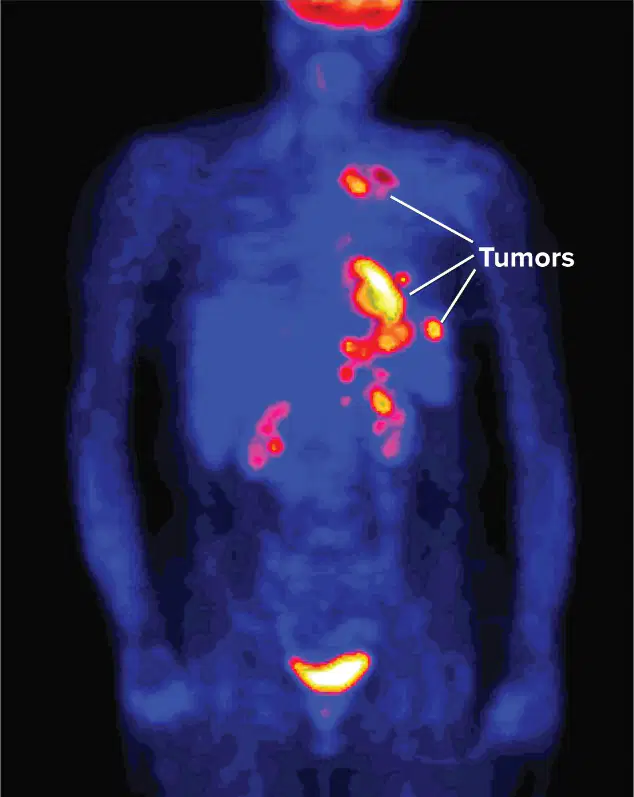
What does Figure 2.6 primarily depict?
A healthy human body
Tumors in a human body
A weather map
A plant cell structure
Which elements make up about 95% of the atoms in living organisms?
Hydrogen, oxygen, carbon, and nitrogen
Calcium, potassium, sodium, and magnesium
Iron, zinc, copper, and manganese
Phosphorus, sulfur, chlorine, and iodine
Where do hydrogen and oxygen primarily occur in living organisms?
In proteins
In water
In carbohydrates
In lipids
What is the primary role of carbon in living organisms?
It is found in proteins
It is a trace element
It is the building block of all living matter
It occurs primarily in water
What percentage of atoms in living organisms are made up of mineral elements?
Less than 0.01%
Less than 1%
About 95%
About 50%
Why are trace elements essential in living organisms?
They make up about 95% of atoms
They are the building blocks of proteins
They are essential for normal growth and function
They occur primarily in water
Which element has the highest percentage of human body mass?
Carbon
Oxygen
Hydrogen
Nitrogen
What is the symbol for Potassium?
P
K
Na
Ca
Which element is considered a trace element with less than 0.01% of total mass?
Calcium
Magnesium
Boron
Phosphorus
What percentage of all atoms in the human body is Hydrogen?
25.5%
9.5%
63.0%
1.4%
What is a molecule?
A single atom
Two or more atoms bonded together
A mixture of elements
A type of chemical reaction
What does a molecular formula represent?
The weight of a molecule
The color of a compound
Chemical symbols of the elements in the molecule
The temperature at which a compound melts
In the molecular formula H₂O, what does the subscript indicate?
The charge of the molecule
The number of molecules
How many of each atom are present
The boiling point of the compound
What is a compound?
A single element
A molecule composed of two or more elements
A type of gas
A liquid solution
How can the properties of a compound compare to the properties of the individual elements?
They are always the same
They can be drastically different
They are always weaker
They are always stronger
What is a characteristic of a covalent bond?
Electrons are shared to fill valence shells.
Electrons are transferred to form ions.
Hydrogen atoms are involved.
Electrons are lost to form a stable structure.
Which type of bond can be polar or nonpolar?
Covalent bond
Ionic bond
Hydrogen bond
Metallic bond
What occurs in a hydrogen bond?
A hydrogen atom from one polar molecule is attracted to an electronegative atom from another molecule.
Electrons are shared between atoms.
Electrons are transferred to form ions.
Atoms share a pair of electrons.
What happens in an ionic bond?
Electrons are transferred, forming ions that are attracted to each other.
Electrons are shared to fill valence shells.
Hydrogen atoms are involved.
Atoms share a pair of electrons.
What do atoms share in a covalent bond?
Protons
Neutrons
A pair of electrons
A pair of protons
What type of bond is formed when atoms share one pair of electrons?
Double bond
Triple bond
Single bond
Ionic bond
Which of the following is an example of a double bond?
H–F
O=O
N≡N
C–C
How many pairs of electrons are shared in a triple bond?
1 pair
2 pairs
3 pairs
4 pairs
What compound is formed when fluorine (F) and hydrogen (H) combine?
Water (H2O)
Hydrogen fluoride (HF)
Carbon dioxide (CO2)
Sodium chloride (NaCl)
What is the octet rule?
Atoms are stable when their outer shell is full with 8 electrons
Atoms are stable when they have 6 electrons in the outer shell
Atoms are stable when they have 10 electrons in the outer shell
Atoms are stable when they have 4 electrons in the outer shell
Which element is an exception to the octet rule by having only 2 electrons in its outer shell?
Hydrogen
Oxygen
Carbon
Nitrogen
How many electrons are needed for hydrogen to complete its outer shell?
1
2
3
4
Which atom requires 4 electrons to complete its outer shell?
Hydrogen
Oxygen
Nitrogen
Carbon
What is the typical number of covalent bonds formed by oxygen?
1
2
3
4
Which atom has 7 electrons in its nucleus as shown in the diagram?
Hydrogen
Oxygen
Nitrogen
Carbon
What type of bond is formed when electrons are shared between atoms?
Ionic bond
Covalent bond
Metallic bond
Hydrogen bond
In the diagram, how many unpaired electrons are shared between the two atoms?
1
2
3
4
What type of bond forms between atoms of different electronegativity?
Ionic bond
Nonpolar covalent bond
Polar covalent bond
Metallic bond
In a polar covalent bond, shared electrons are more likely to be close to which atom?
Less electronegative atom
More electronegative atom
Atom with larger atomic radius
Atom with lower ionization energy
What does the unequal distribution of electrons in a polar covalent bond create?
Ionic charge
Polarity
Metallic bond
Nonpolar molecule
Which of the following is an example of a polar covalent bond?
C-C
O-H
Na-Cl
H-H
What is a characteristic of nonpolar covalent bonds?
Unequal sharing of electrons
Equal sharing of electrons
Large charge difference across the molecule
Formed between atoms with different electronegativities
Nonpolar covalent bonds occur between atoms with what kind of electronegativities?
Very different electronegativities
Similar electronegativities
No electronegativity
Opposite electronegativities
Which of the following is an example of a nonpolar covalent bond?
H-O
C-C
Na-Cl
N-H
What is NOT a feature of nonpolar covalent bonds?
No charge difference across the molecule
Equal sharing of electrons
Formed between atoms with similar electronegativities
Large charge difference across the molecule
What type of bond is characterized by electrons being shared equally between atoms?
Nonpolar covalent
Polar covalent
Ionic
Metallic
Which type of bond has a difference in electronegativity between atoms greater than 1.8?
Nonpolar covalent
Polar covalent
Ionic
Hydrogen
In which type of bond are electrons shared unequally between atoms?
Nonpolar covalent
Polar covalent
Ionic
Metallic
What is a hydrogen bond?
A bond where a hydrogen atom is attracted to an electronegative atom of another molecule
A bond where two hydrogen atoms share electrons
A bond that forms between two metal atoms
A bond that involves the transfer of electrons between atoms
How are hydrogen bonds represented?
As solid lines
As dashed or dotted lines
As wavy lines
As zigzag lines
What role do hydrogen bonds play in DNA?
They hold the DNA strands together
They break down DNA strands
They form the backbone of DNA
They are not involved in DNA structure
What are enzymes?
Molecules that store genetic information
Molecules that catalyze biologically important chemical reactions
Molecules that provide structural support
Molecules that transport oxygen
What is a hydrogen bond?
A strong attraction between two hydrogen atoms.
A weak attraction between a partially positive hydrogen and a partially negative atom.
A covalent bond between hydrogen and oxygen.
A bond that forms only in DNA molecules.
What role do hydrogen bonds play in a DNA molecule?
They form the backbone of the DNA strand.
They hold the two twisted strands together along the entire length.
They are responsible for the replication of DNA.
They provide energy for cellular processes.
What are van der Waals dispersion forces?
A type of strong molecular attraction
A type of weak molecular attraction
A type of chemical bond
A type of ionic bond
Why do van der Waals dispersion forces arise?
Because electrons are fixed in place
Because electrons are located within orbitals in a random way
Because molecules are always positively charged
Because of strong covalent bonds
What can arise due to van der Waals dispersion forces?
A permanent electrical attraction
A fleeting electrical attraction to other nearby molecules
A strong magnetic attraction
A chemical reaction
How strong can the collective strength of van der Waals dispersion forces be?
Very weak
Non-existent
Quite strong
Always strong
What is an ion?
An atom or molecule that has gained or lost one or more electrons
An atom or molecule that has gained or lost protons
An atom or molecule that has gained or lost neutrons
An atom or molecule that has gained or lost photons
What charge does a cation have?
Net positive charge
Net negative charge
Neutral charge
No charge
What charge does an anion have?
Net negative charge
Net positive charge
Neutral charge
No charge
How does an ionic bond occur?
When a cation binds to an anion by electrostatic attraction
When two cations bind together
When two anions bind together
When a cation binds to a neutron

