
 Worksheets
Space Unit Review
Total questions: 65
Worksheet time: 33mins
What theory explains the origin of the universe?
Nebular Theory
Big Bang Theory
Oscillating Universe Theory
Multiverse Theory
Which of the following is NOT a type of galaxy?
Elliptical
Spiral
Irregular
Cylindrical
What keeps planets in orbit around the Sun?
Centripetal force
Electromagnetic force
The Sun’s gravity acting on the planets
The Moon’s pull on the oceans
Which of the following is TRUE about black holes?
They give off visible light
They have low density
They can only form from the most massive stars
They rotate at the speed of light
What causes the seasons on Earth?
Variations in Earth's distance from the Sun
Changes in the Sun's energy output
Earth's tilted axis and revolution around the Sun
The Moon's gravitational pull on Earth
Which of the following unit represents the largest distance?
Astronomical Unit (AU)
Light Year (ly)
Kilometer (km)
Centimeter (cm)
Which of the following is NOT a phase in the life cycle of an Average Star, such as the Sun?
Neutron Star
Red giant
White dwarf
Planetary Nebula
Which of the following is NOT a possible phase in the life cycle of a Massive Star?
Neutron Star
Planetary Nebula
Red Supergiant
Supernova
Which of the following best describes the shape of Earth's orbit around the Sun?
Perfect circle
Slightly elliptical
A highly eccentric (very flattened) ellipse
Parabola
What causes solar eclipses?
The Moon passing between the Earth and Sun
Earth's shadow falling on the Moon
The Sun passing between the Earth and Moon
Sunspots covering the Sun's surface
What causes lunar eclipses?
The Moon passing between the Earth and Sun
Earth's shadow falling on the Moon
The Sun passing between the Earth and Moon
Sunspots covering the Sun's surface
Which of the following correctly orders the inner planets of our solar system, starting from the one closest to the Sun?
Venus, Mercury, Earth, Mars
Mercury, Venus, Earth, Mars
Mercury, Earth, Venus, Mars
Mars, Earth, Venus, Mercury
Which of the following correctly orders the outer planets of our solar system, starting closest to the Sun?
Jupiter, Saturn, Uranus, Neptune
Saturn, Uranus, Neptune, Jupiter
Neptune, Uranus, Saturn, Jupiter
Uranus, Saturn, Jupiter, Neptune
The death outcome of a star is based on:
Its mass
Its colour
Its temperature
How old it is
Which of the following is NOT a possible death outcome for a star:
Supernova
White Dwarf
Black Hole
Neutron Star
Which celestial object has the greatest impact on the Ocean’s Tides on Earth?
Sun
Supermassive Black Hole
Venus
Moon
Which of the following is NOT true about the Milky Way?
It is a barred spiral galaxy
It is in the Local Group along with Andromeda and Triangulum
It got its name from the collection of dust and stars we can see in the night sky
It revolves around the Sun
What do scientists understand to be at the center of all galaxies?
A Stellar Nebula
A Supermassive Black Hole
The Milky Way
The Sun
Which of the following objects make and emit their own energy (light and heat):
Sun
Moon
Earth
Asteroid
At maximum, we are seeing how much of the Moon from Earth?
Quarter
Half
All of the Moon
Crescent
What phase(s) of the Moon will result in the highest tides on Earth?
Full or New
First or Third Quarter
Cresent
Gibbous
What phase(s) of the Moon will result in the lowest tides on Earth?
Full or New
First or Third Quarter
Cresent
Gibbous
What type of galaxy is made of the oldest stars and are typically the largest?
Dwarf
Elliptical
Spiral
Irregular
What type of galaxy is typically made of the youngest stars?
Dwarf
Elliptical
Spiral
Irregular
Which of the following is NOT a piece of evidence that supports the Heliocentric Model of our Solar System?
Elliptical Orbits
The Red-Shift of Distant Galaxies
Apparent Retrograde Motion
The relationship between a planet’s orbital radius and its orbital speed
Which would be best measured in Astronomical Units (AU)?
The distance between Mars and Venus
The distance between the Milky Way and Andromeda galaxies
The distance between Miller High School and Riffel High School
The distance between the Sun and Betelgeuse (a distant star)
What are the two major pieces of evidence supporting the Big Bang Theory?
Blue-shift of distant stars/galaxies and Cosmic Microwave Background Radiation
Cosmic Microwave Background Radiation and Apparent Retrograde Motion
Red-shift of distant stars/galaxies and Cosmic Microwave Background Radiation
Red-shift of distant stars/galaxies and Apparent Retrograde Motion
Why is it that we only see one side of the Moon from Earth?
The Moon rotates on its axis at the SAME RATE that is revolves around the Earth
The Moon rotates on its axis at the SAME RATE that the Earth rotates on its axis
They both orbit the Sun at the SAME RATE
The Earth revolves around the Moon at the SAME RATE that the Moon rotates on its axis
What object(s) are responsible for the tides on Earth?
The Sun only
The Moon only
The Sun and Moon
The Moon and Venus
Why did scientists create different units to discuss distances in space?
To make calculations easier
To confuse people
To sell more textbooks
To make space travel possible
What piece of evidence supporting the Big Bang Theory does the doppler effect help us explain?
Cosmic Microwave Background Radiation
Redshift of Galaxies
Abundance of Light Elements
Large Scale Structure
Which of the following accurately describes a lunar eclipse?
A lunar eclipse occurs when the Earth is between the Sun and the Moon, and the Earth's shadow falls on the Moon.
A lunar eclipse occurs when the Moon is between the Sun and the Earth, and the Moon's shadow falls on the Earth.
A lunar eclipse occurs when the Sun is between the Earth and the Moon, and the Sun's shadow falls on the Earth.
A lunar eclipse occurs when the Earth is between the Moon and the Sun, and the Moon's shadow falls on the Sun.
What is the primary reason for the phases of the Moon as observed from Earth?
The Moon's rotation on its axis
The Earth's shadow falling on the Moon
The Moon's distance from the Earth
The relative positions of the Earth, Moon, and Sun
What is the main factor that determines the color of a star?
Its age
Its size
Its temperature
Its distance from Earth
Which of the following stars are most likely to be blue in colour?
A star with a temperature of 25000K
A star with a temperature of 4800K
A star with a temperature of 1200K
A star with a temperature of 93000K
Which of the following stars are most likely to be red in colour?
A star with a temperature of 25000K
A star with a temperature of 4800K
A star with a temperature of 1200K
A star with a temperature of 93000K
Which of the following best explains why we experience day and night?
The Sun's rotation on its axis
The Earth's rotation on its axis
The Earth's orbit around the Sun
The Moon's orbit around the Earth
What is the primary force that holds a galaxy together?
Magnetism
Nuclear Force
Gravity
Electromagnetism
Which of the following does NOT belong to the local group?
Andromeda
Milky Way
Triangulum
Sombrero
What is the term for the bulging center of a spiral galaxy?
Hub
Nucleus
Core
Command Center
How do scientists classify galaxies?
According to how many stars there are
According to how close they are to Earth
According to the shape of the galaxy
According to the type of shift we see from Earth (blue or red shift)
Which type of galaxy each has its own shape, age, and structure?
Irregular
Spiral
Dwarf
Elliptical
What type of galaxy is the Milky Way?
Irregular
Spiral
Barred Spiral
Elliptical
The inner/rocky planets are made up of ____________ materials because the solar winds could not push them as far away when the solar system was forming
heavier
lighter
gases
water
The outer/gas giant planets are made up of ____________ materials because the solar winds could push them far away when the solar system was forming
heavier
metal
lighter
water
The rocky/inner planets are ___________ to each other and _________ to the Sun
Closer; closer
Further; further
Closer; further
Further; closer
The outer/gaseous planets are ___________ to each other and _________ to the Sun
Closer; closer
Further; further
Closer; further
Further; closer
In what shape do the planets orbit the Sun?
Perfect circle
Ellipse
Triangle
Impossible to know
Which of the following space objects have the most eccentric orbit?
Comet
Planet
Moon
Asteroid

What type of galaxy is shown
Barred Spiral
Elliptical
Irregular
Cylindrical
What type of star is the Sun?
Average Star
Massive Star
Black Hole
Red Giant
What does GPS stand for?
Global Positioning System
Good Planets System
Global Preparation Satellites
Globular Protein Satellite
Which of the following is NOT a satellite?
The Earth
The Moon
A meteoroid
Satellites used for GPS

What type of galaxy is this?
Spiral
Elliptical
Barred Spiral
Irregular
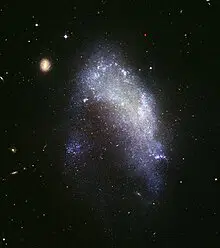
What type of galaxy is this?
Irregular
Elliptical
Cylindrical
Barred Spiral
Which of the following objects radiate its own energy?
The Sun
Comets
The Moon
The Earth
What is the death outcome of the Sun?
Red Giant
Supernova
Neutron Star
White Dwarf
Which of the following distances would be best measured in light years
The distance between the Milky Way and Andromeda Galaxy
The distance between Regina and Saskatoon
The distance between Mars and the Sun
The distance between the Sun and Neptune
When are tides the highest?
Neap Tide
Spring Tide
In the afternoon
When there is a Quarter Moon
How much of the moon is ALWAYS lit up (even if we can't see it)?
All of it
Half
It always changes with the phases
A Quarter
When are tides the lowest?
When the Moon is Full
Neap Tide
Spring Tide
During a New Moon
What phase is the Moon in during a Neap Tide?
First or Third Quarter
New Moon only
Full or New Moon
Third Quarter only
What is the main reason Pluto is no longer classified as a major planet?
It is too far from the Sun
It does not clear its orbit of other debris
It is made mostly of gas
It has no moons
Which phenomenon provides evidence that the universe is expanding?
Redshift of distant galaxies
Seasons on Earth
Solar eclipses
Phases of the Moon
What type of star is the Sun right now?
Average Star
Massive Star
Red Giant
White Dwarf

