
 Worksheets
Review Quizizz for 3rd 9-Weeks
Total questions: 140
Worksheet time: 7hrs 0mins
What is a wave?
A solid object that remains stationary
A disturbance that transfers energy from place to place
A type of sound
A form of light
Which of the following is a type of mechanical wave?
Electromagnetic wave
Transverse wave
Sound wave
Both B and C
The medium in wave terminology is the (a) through which a wave travels.
How does a transverse wave move through a medium?
Parallel to the direction of the wave
At right angles to the direction of the wave
In a circular motion
In a zigzag pattern
Calculate the speed of a wave with a wavelength of 2 meters and a frequency of 5 Hz.
10 m/s
7 m/s
15 m/s
5 m/s
What happens to a wave when it is absorbed by a medium?
It speeds up
It is reflected
Its energy is transferred to the medium
It passes through unchanged
Explain why sound waves travel faster in liquids and solids than in air.
Because liquids and solids are denser than air
Because air is a better conductor of sound
Because sound waves are electromagnetic
Because air has more particles
The effect of high amplitude on sound is (a)
The highest point of a transverse wave is called the (a) .
Describe the process of refraction.
When a wave is absorbed by a medium
When a wave enters a new medium at an angle and bends
When a wave bounces off a surface
When a wave travels in a straight line
What is the relationship between wavelength and frequency in determining the speed of a wave?
Speed = frequency / wavelength
Speed = wavelength + frequency
Speed = wavelength * frequency
Speed = wavelength - frequency
How does diffraction affect a wave?
It causes the wave to speed up
It causes the wave to bend around barriers
It causes the wave to stop
It causes the wave to reflect
(a) do not require a medium to transfer energy.
What is the law of reflection?
The angle of incidence is greater than the angle of reflection
The angle of incidence equals the angle of reflection
The angle of incidence is less than the angle of reflection
The angle of incidence is unrelated to the angle of reflection

crest
A
amplitude
C
wavelength
B
Trough
D
Label the following points
Amplitude
Wavelength
Crest
Trough
Match the following
wave needs a medium
Mechanical Wave
wave does not need a medium
Electromagnetic Wave
particles in wave move perpendicular (right angles) to wave
Transverse Wave
particles in wave move parallel to wave
Longitudinal Wave


What type of wave behavior is shown in this image?
Reflection
Refraction
Diffraction
Constructive Interference

This image depicts which of the following wave behaviors?
Reflection
Refraction
Diffraction
Resonance

The picture to the left shows which wave behavior?
absorption
reflection
diffraction
refraction
What do we call the part of a longitudinal wave that is spread apart?
compression
rarefaction
wavelength
amplitude


What is a longitudinal wave?
A wave that moves perpendicular to the direction of wave travel.
A wave that moves through the medium parallel to the direction of wave travel.
A wave that does not require a medium to travel.
A wave that moves in a circular motion.
Which part of a longitudinal wave is characterized by low density?
Compression
Rarefaction
Crest
Trough
Identify the high-density region of a longitudinal wave.
Rarefaction
Compression
Amplitude
Wavelength
Which of the following is an example of a longitudinal wave?
Light wave
Sound wave
Water wave
Radio wave
Explain how particles move in a longitudinal wave.
Particles move in a circular motion.
Particles move parallel to the direction of wave travel.
Particles move perpendicular to the direction of wave travel.
Particles do not move at all.
If a sound wave has a frequency of 500 Hz and travels at a speed of 340 m/s, what is its wavelength?
0.68 m
1.36 m
0.34 m
2.72 m
A tuning fork produces a sound wave with a frequency of 256 Hz. If the speed of sound in air is 343 m/s, calculate the wavelength of the sound wave.
1.34 m
1.25 m
1.50 m
1.75 m
What is the effect of increasing the amplitude of a sound wave?
The pitch of the sound increases.
The loudness of the sound increases.
The speed of the sound increases.
The frequency of the sound increases.

(a) cause the medium to move perpendicular to the direction of the wave. (b) cause the medium to move parallel to the direction of the wave.
Label the wave.
Compression
Rarefaction
What is the top part of a transverse wave called?
Trough
Crest
Amplitude
Wavelength
Which term describes the bottom part of a transverse wave?
Crest
Amplitude
Trough
Frequency
What is the term for the maximum distance that the particles of a medium move away from their rest position in a transverse wave?
Wavelength
Frequency
Amplitude
Crest
How is the distance between two corresponding parts of a wave defined?
Frequency
Amplitude
Wavelength
Crest
What is the unit of frequency in transverse waves?
Meters
Seconds
Hertz
Amplitude
If a wave has a frequency of 5 Hz, how many waves pass a given point in one second?
1
5
10
15
A transverse wave has a wavelength of 2 meters. If the distance from one crest to the next is measured, what is the value?
1 meter
2 meters
3 meters
4 meters
If the amplitude of a transverse wave is increased, what happens to the energy carried by the wave?
It decreases
It remains the same
It increases
It becomes zero
A wave travels through a medium at a right angle to the direction of the wave. What type of wave is this?
Longitudinal wave
Transverse wave
Surface wave
Mechanical wave
Explain why the frequency of a wave is important in determining the wave's properties.
It determines the wave's speed
It affects the wave's amplitude
It indicates how often the wave oscillates
It changes the wave's direction
A transverse wave has a frequency of 10 Hz and a wavelength of 3 meters. Calculate the speed of the wave.
10 m/s
20 m/s
30 m/s
40 m/s
If two waves have the same frequency but different amplitudes, what can be inferred about their energy?
They have the same energy
The wave with higher amplitude has more energy
The wave with lower amplitude has more energy
Energy cannot be determined from amplitude
Match the following
wave needs a medium
Mechanical Wave
wave does not need a medium
Electromagnetic Wave
particles in wave move perpendicular (right angles) to wave
Transverse Wave
particles in wave move parallel to wave
Longitudinal Wave
Label the following points
Amplitude
Wavelength
Crest
Trough
crest
A
amplitude
C
wavelength
B
Trough
D
What is the relationship between wavelength and frequency in determining the speed of a wave?
Speed = frequency / wavelength
Speed = wavelength + frequency
Speed = wavelength * frequency
Speed = wavelength - frequency
What is the amplitude of the green wave?
0
1
2

The speed of light in a vacuum is approximately 300,000,000 m/s. If a wave has a frequency of 500 Hz, what is its wavelength in meters?
600,000 meters
600,000,000 meters
600 meters
600,000,000,000 meters
A sound wave travels through air at a speed of 343 m/s and has a wavelength of 0.7 meters. What is the frequency of this sound wave in Hz?
490 Hz
245 Hz
343 Hz
4900 Hz
If a radio wave has a frequency of 100,000,000 Hz, and it travels at the speed of light (300,000,000 m/s), what is its wavelength in meters?
3 meters
30 meters
0.3 meters
300 meters
A wave with a wavelength of 4 meters travels at a speed of 240 m/s. Calculate its frequency in Hz.
60 Hz
600 Hz
6 Hz
24 Hz
A seismic wave has a frequency of 10 Hz and a wavelength of 50 meters. What is the speed of this seismic wave in meters per second (m/s)?
500 m/s
50 m/s
5 m/s
100 m/s
A microwave oven emits radiation with a frequency of 2,450,000 Hz. What is the wavelength of this microwave radiation in meters?
122.45 meters
0.12245 meters
12.245 meters
1.2245 meters
A wave has a wavelength of 500 meters, and travels at 250 m/s. Calculate the frequency in Hz.
0.5 Hz
2 Hz
5 Hz
50 Hz
If a wave has a speed of 340 m/s and a frequency of 1000 Hz, what is its wavelength in meters?
0.34 meters
3.4 meters
34 meters
340 meters
An ocean wave has a wavelength of 25 meters and a speed of 10 m/s. Determine its frequency in Hz.
0.4 Hz
4 Hz
40 Hz
0.04 Hz
Given a wave with a wavelength of 0.5 meters and a speed of 200 m/s, what is its frequency in Hz?
400 Hz
40 Hz
4 Hz
0.4 Hz
Suppose there is a wave with a frequency of 60 Hz and a wavelength of 8 meters. What is its speed in meters per second (m/s)?
480 m/s
48 m/s
4.8 m/s
800 m/s
You're listening to a musical note with a wavelength of 0.68 meters. If the speed of sound in air is approximately 343 meters per second, what is the frequency of this musical note?
504.41 Hz
50.44 Hz
5.04 Hz
5044.1 Hz
You are conducting an experiment with a slinky spring. You send a wave down the slinky, and it travels a distance of 6 meters in 3 seconds. What is the speed of the wave in meters per second (m/s)?
2 m/s
3 m/s
6 m/s
18 m/s
Imagine a sound wave with a frequency of 440 Hz and a speed of 330 m/s. What is the wavelength of this sound wave in meters?
0.75 meters
7.5 meters
75 meters
0.075 meters
A wave travels at a speed of 500 m/s and has a frequency of 250 Hz. What is its wavelength in meters?
2 meters
20 meters
0.2 meters
200 meters
A guitar string vibrates with a frequency of 320 hz. If the wavelength of the vibration is 0.23 meters what is the speed of the wave?
320.23 m/s
1391.3 hz
73.6 m/hz
73.6 m/s
A wave travels through water at a speed of 1500 m/s and has a frequency of 300 Hz. What is its wavelength in meters?
500 meters
5 meters
50 meters
0.5 meters
A sound wave in a steel rod travels at a speed of 5960 m/s and has a frequency of 500 Hz. What is the wavelength of this sound wave in meters?
1.192 meters
11.92 meters
119.2 meters
0.1192 meters
A wave travels at a speed of 400 m/s and has a wavelength of 2 meters. What is its frequency in Hz?
2 Hz
0.2 Hz
20 Hz
200 Hz
If a wave has a frequency of 150 Hz and a speed of 450 m/s, what is its wavelength in meters?
3 meters
30 meters
300 meters
0.3 meters

(a) have the highest frequencies and the shortest wavelengths.

A wave with a large wavelength will have a ______ frequency and _____ energy
high, low
low, high
high, high
low, low

The section of the spectrum that is the ONLY one we can see is (a) .

As the frequency of an electromagnetic wave increases, the amount of energy in that wave (a)

High frequency waves have (a) wavelengths.

EM waves with the longest wavelength are (a) .
(a) have a SHORTER wavelength than visible light.
EM waves with the lowest frequency are (a) .
The color waves with the lowest frequency are (a) .
The color waves with the shortest wavelength are (a) .

The diagram shows a person observing a thunderstorm located several kilometers away. The person hears the thunder several seconds after seeing the lightning. Which statement accurately explains the difference in observations of sound and light by the observer?
Human eyes see light faster than their ears can hear sound.
The medium the waves are traveling through is different for each type of wave.
Light waves travel faster than sound waves.
Sound waves travel faster than light waves.

The diagram below shows a pencil in a glass of water. When viewed from the side, the pencil appears to be broken. What process causes this to happen?
absorption
evaporation
reflection
refraction

The diagram below shows a light ray. In this diagram, the light ray is being (a)
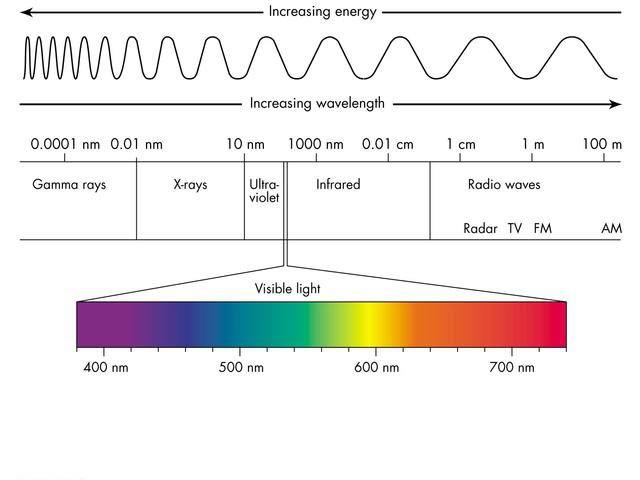
What is the correct order of the visible light spectrum starting with the longer wavelength?
Red, yellow, orange, blue, violet, indigo
Violet, indigo, blue, green, yellow, orange, red
Green, yellow, blue, indigo, red, orange
Red, orange, yellow, green, blue, indigo, violet
An example of a wave with a long wavelength and low frequency is (a) .
What happens to the wavelength of a wave as its frequency increases?
It decreases.
It remains the same.
It increases.
It fluctuates.
What is the relationship between energy and frequency in electromagnetic waves?
Energy fluctuates with frequency.
Energy increases as frequency increases.
Energy decreases as frequency increases.
Energy remains constant regardless of frequency.


The wave with the second highest frequency on the spectrum is (a) .
Which of these waves has a higher frequency (higher energy) than visible light?
radio waves
microwaves
infrared waves
ultraviolet waves
Which type of electromagnetic wave is primarily used in medical imaging to view the inside of the human body?
Microwaves
X-rays
Radio waves
Gamma rays
The color in the visible spectrum with the highest energy is (a)
Which electromagnetic wave is commonly used in remote controls?
Infrared
Gamma rays
Ultraviolet
Radio waves
Which type of electromagnetic wave is used in night vision goggles?
Microwaves
Infrared
X-rays
Ultraviolet

Match the following electromagnetic waves with their APPLICATION.
Infrared
Remote Controls
Microwaves
Wifi Signal
Ultraviolet
Disinfecting
X-Rays
Medical Imaging
Radio Waves
Television Broadcasting
What is electricity?
A) A form of energy resulting from the movement of charged particles
B) A type of magnetism
C) A chemical reaction
D) A form of sound
The force of attraction or repulsion between two charged particles is known as (a) .
Electric Force
Magnetic Force
Gravitational Force
Nuclear Force
Opposite charges (positive and negative) attract, while like charges (a) .
The buildup of electric charges on the surface of an object is known as (a) .
Static Electricity
Electric Current
Electromagnetism
Nuclear Reaction
Adding more batteries increases current and strengthens the (a) field of an electromagnet.
An electric circuit is a (a) pathway through which electric current flows.
Open
Closed
Broken
Which of the following is a component of electric circuits?
Battery
Magnet
Plastic
Wood
What happens to the current in a parallel circuit if one branch/section of the circuit fails?
The whole circuit stops working
The rest still work
The voltage increases
The current doubles
Adding batteries in parallel keeps the voltage the same but increases (a) .
Voltage
Current
Resistance
Power
Electricity is a form of energy resulting from the movement or presence of (a) .
Static electricity is the buildup of electric charges on the (a) of an object.
Surface
Core
Center
Edge
A circuit is a (a) through which electric current flows.
In a parallel circuit, components are connected across (a) , forming multiple paths for current.
Electric charges that are different (a) each other.
A small device that stores energy in a chemical form
Complete circuit
Switch
Resistor
Battery
Only one pathway for the electricity to flow that has the same current flowing through each device.
More than one path for the electricity to flow that has the same voltage flowing through each device.
Resistance is measured in a unit called _____.
amperes
ohms
volts
watts

Which device measures the amount of current in an electrical circuit?
Voltmeter
Ammeter
Ohmmeter
Thermometer
What is resistance?
the amount of push the electrical source supplies to the circuit
how much a given device restricts the flow of electric current
flow of electric charge
none of the above
Identify the component in an electric circuit that stores energy and provides a voltage source.
Resistor
Battery
Voltmeter
Ammeter
Which component in a circuit is used to measure the current flowing through it?
Voltmeter
Resistor
Ammeter
Switch
Explain why a switch is important in an electric circuit and describe its function.
It provides resistance to the circuit.
It opens or closes the circuit to control the flow of electricity.
It measures the voltage across the circuit.
It stores electrical energy.
A circuit contains a battery, a light bulb, and a switch. If the light bulb does not light up, what could be a possible reason?
The battery is not connected.
The switch is open.
The light bulb is faulty.
All of the above
What is the role of a voltmeter in an electric circuit?
To measure the current
To measure the voltage
To provide resistance
To store energy
A circuit consists of a battery, a resistor, and a light bulb. If the light bulb is not glowing, what steps would you take to troubleshoot the issue?
Check if the battery is charged.
Ensure all connections are secure.
Test the light bulb with a multimeter.
All of the above
Which component in a circuit is used to control the flow of electricity by opening or closing the circuit?
Resistor
Switch
Battery
Voltmeter
How does a resistor affect the current in an electric circuit?
It increases the current.
It decreases the current by restricting the flow of electricity.
It has no effect on the current.
It stores the current.
What happens to the total resistance in a circuit if more resistors are added in series?
The total resistance decreases.
The total resistance increases.
The total resistance remains the same.
The total resistance becomes zero.

What component does the picture above represent?
Battery
Light bulb
Ammeter
Resistor


A small device that stores energy in a chemical form
Complete circuit
Switch
Resistor
Battery
Only one pathway for the electricity to flow that has the same current flowing through each device.
More than one path for the electricity to flow that has the same voltage flowing through each device.

Is the symbol for _____.
Light bulb
Resistor
Battery
Switch


This symbols is representative of a _____.
voltage
Voltmeter
Volume

This symbols is representative of a _____.
Ammeter
Ampere
And

What components are in this schematic diagram?
battery, switch, bulb, wires
switch, switch, bulb
battery, switch, bulb, motor

