
 Worksheets
Unit 6 Review
Total questions: 80
Worksheet time: 5hrs 50mins



Wind can carry seeds to new places, so more plants can grow.
Atmosphere and Biosphere
Hydrosphere and Biosphere
Atmosphere and Geosphere
Geosphere and Biosphere
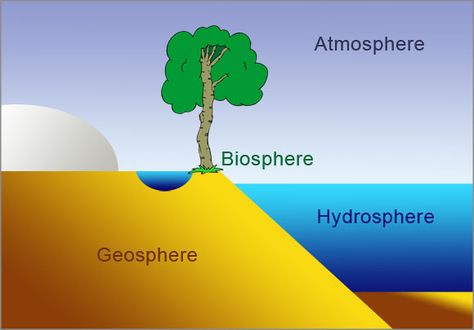
Earth is divided into four different spheres. Which statement is true about the interaction between two of these spheres?
Weather is an interaction between the hydrosphere and the geosphere.
A plant receiving water from precipitation is an interaction between the biosphere and the hydrosphere.
An ice cap providing shelter for an arctic animal is an interaction between the biosphere and the hydrosphere.
The formation of the Grand Canyon is an example of an interaction between the geosphere and the atmosphere.


What is the thinnest layer of the Earth?
Crust
Mantle
Outer Core
Inner Core

What is the thickest layer of the Earth?
Crust
Mantle
Outer Core
Inner Core

Which layer of the Earth is a dense solid ball of Iron and Nickle?
Crust
Mantle
Outer Core
Inner Core

What layer of the Earth is represented by the letter D?
Crust
Mantle
Outer Core
Inner Core

What layer of the Earth is represented by the letter C?
Crust
Mantle
Outer Core
Inner Core

What layer of the Earth is represented by the letter B?
Crust
Mantle
Outer Core
Inner Core

What layer of the Earth is represented by the letter A?
Crust
Mantle
Outer Core
Inner Core

Temperature _____________________ as you go deeper into the earth.
increases
decreases
goes up and down depending on the layer
stays the same
Pressure ______________________ as you go deeper into the Earth.
increases
decreases
goes up or down depending on the layer
stays the same
Density ______________________ as you go deeper into the Earth.
increases
decreases
goes up or down depending on the layer
stays the same
In which type of rock might you see a fossil?
Marble
Igneous rock
Metamorphic rock
Sedimentary rock
How are metamorphic rocks created?
Cooling and crystallizing as it moves away from the core
Formed from pieces of other rock
None of these options are correct.
Heat and pressure as they move toward the core
When rocks are deeply buried, placing them under pressure because of the weight of overlying layers, this is called:
lithification
cementation
deposition
compaction

According to the diagram, Igneous rock becomes Metamorphic by melting and cooling.
true
false
Molten rock that erupts on Earth's surface
deposit
lava
magma
mineral
Series of processes that change one type of rock into another type of rock
extrusive rock
rock
rock cycle
sediment
Rock material that is broken down into smaller pieces or dissolved in water as rocks erode
extrusive rock
rock
rock cycle
sediment
One of the major rock types that is created from previously existing rock by the action of intense heat and pressure
igneous rock
metamorphic rock
plastic deformation
sedimentary rock
Magma --> _____________ --> Igneous Rock
Melting
Cooling
Metamorphism
Compaction
Metamorphic Rock --> Weathering & Erosion --> __________
Magma
Igneous
Sediment
Metamorphic
Sedimentary --> ____________--> magma
Weathering and Erosion
Heat and Pressure
Melting
Cooling
Rock formed from liquid molten rock (lava or magma) that cools slowly and hardens. Found near volcanoes and fissures; can have crystals.
Metamorphic Rock
Igneous Rock
Sedimentary Rock
Regolith Rock
Rock formed from sediments, such as sand, pebbles, shells and remains of dead plants / animals; often deposited in layers
Regolith
Sedimentary Rock
Igneous Rock
Metamorphic Rock

The process when rocks break into smaller pieces due to exposure to natural elements is called
erosion
weathering
sediments


This rock was another type of rock that was heated and compressed over time. What type of rock is this?
Sedimentary
Igneous
Metamorphic

This rock started as molten magma but transformed after a volcano erupted. What type of rock is this?
Sedimentary
Igneous
Metamorphic

This rock was formed by smaller pieces of rock that settled at the bottom of a lake millions of years ago. What type of rock is this?
Sedimentary
Igneous
Metamorphic
How are rocks classified?
How they are formed, their composition, and their texture
Their composition, their size, and their weight.
Their mass and their composition
How they are formed, their weight, and their color
Which type of igneous rocks are formed by cooling UNDER the surface?
Intrusive
Extrusive
Using public transportation, like trains and buses, rather than cars helps conserve nonrenewable resources because public transportation -
needs more water to maintain than the same number of cars
uses less fossil fuels to move people from place to place
involves using much more paper for printed materials
To save and use a resource carefully
Renewable
Nonrenewable
Conservation
Which of the following is a way to reduce energy?
Turn ON all the lights
Turn OFF all the lights
Turn ON the heater to high heat
True or false. When you conserve you use less resources to save energy.
True
False
True of false. When you reduce, reuse, and recycle you are conserving natural resources?
True
False
To CONVERT WASTE INTO REUSABLE new MATERIAL.
WASTE
CONSERVATION
RECYCLE
Fossil fuels include coal, oil and natural gas. Fossil fuels are classified as nonrenewable because they -
take millions of years to be replaced
require expensive equipment
can be found all over Earth’s surface
What are some water conservation methods?
Taking shorter showers
Fixing leaky faucets
Using water-efficient appliances
All of the above
The release of harmful waste into the environment is known as...?
Fossil Fuels
Smog
Pollution
Acid Rain
Which of these is a disadvantage (bad thing) of fossil fuels?
They are free, we just dig them up
They are a limited supply and can run out
They do not take a long time to replenish
They are good for the environment
What is a condition where people in communities cannot meet a minimum standard of living due to a lack of resources?
Malnutrition
Poverty
Famine
Hunger
When people are living in poverty
and cannot meet a minimum standard of living
they lack _________?
a family
food and water
resources
hunger
Coal, Natural Gas, and Oil are known as ....?
Renewable Resources
Waste
Fossil Fuels
Recycled Fuels
why do people suffer from malnutrition ?
not eating enough undernutrition or not eating enough of the right food to give your body the nutrients it needs
when they eat to much food and get sick a lot
when they don't exercise enough and eat to much
Resources that exist in the environment without human intervention
Renewable Resources
Nonrenewable Resources
Natural Resources
Conservation
variety of life on Earth.
Biodiversity
Thermal Energy
Solar Energy
Natural Resources
the act of using a natural resource so that it is not depleted or permanently
damaged
Sustainability
Conservation
Fossil Fuels
Natural Resources
gases that trap heat in the atmosphere and contribute to the
greenhouse effect
Fossil Fuels
Greenhouse Gases
Petroleum
Natural Gas
the heating of the Earth’s surface due to human activities such as the
burning of fossil fuels.
Global Warming
Natural Gas
Fossil Fuels
Greenhouse Gases

