
Font size
 Worksheets
EARTH SCI UNIT TEST
Total questions: 82
Worksheet time: 5hrs 41mins
How does salt water from the ocean end up as fresh water in precipitation?
Runoff leaves salt in the soil
Precipitation leaves salt in the clouds
Evaporation leaves salt in the ocean
Condensation leaves salt in the water vapor
What is the primary energy source that drives the Earth’s water cycle between the atmosphere, oceans, and land?
Wind
Sunlight
Ocean currents
Rotation of Earth
Water gains energy during evaporation. During what process in the water cycle is this energy released?
Infiltration/percolation through the soil
Transpiration from plants
Runoff into the lake and ocean
Condensation that forms clouds
__________ occurs when water flows over the surface of land.
Runoff
Condensation
Precipitation
Transpiration
The __________ is the where gases form a blanket around the Earth.
Biosphere
Atmosphere
Hydrosphere
Lithosphere-----
Transpiration is the
process by which grass grows in the summer months
process by which plants absorb water through their roots and then release it through the pores on their leaves
process by which water evaporates into the air through animals
process by which salt water is purified
Evaporation is...
the process in which water turns into a solid
the process by which the sun turns water into air
the process by which water changes from a liquid state into a gas
the process by which clouds form
Condensation is...
the process in which water vapor cools and becomes a liquid
the process by which water turns into a gas
the process by which the sun heats water and it turns into gas
the process by which clouds convert water into precipitation
precipitation is...
rain, snow, clouds, condensation
sand, dirt, mud, rain
rain, snow, ice, hail
hail, snow, sun, runoff
During this stage of the water cycle energy is added
condensation
precipitation
evaporation
transpiration
During this stage of the water cycle, energy is lost...
condensation
precipitation
evaporation
transpiration
As water turns into water vapor and rises, it cools and becomes... pick the answer that shows the two forms of the water cycle
evaporation -- transpiration
transpiration -- evaporation
precipitation -- condensation
evaporation -- condensation
The five types of surface water are...
groundwater, runoff, glaciers, springs, & volcanic steam
lakes, rivers, oceans, springs, & runoff
runoff, volcanic steam, aquifers, & treatment plants
groundwater, glaciers, lakes, rivers, & oceans
Lithosphere is the...
Hard outer layer of the earth
The warm inner layer of earth's crust
The air above the land
The clouds in the sky
Hydrosphere is the...
The gas around earth
The air above earth
The land on earth
Water on earth
Biosphere is the
the earth's water
the global ecosystem composed of living and non-living organisms
the hard layer of earth on the surface
the air surrounding earth
In which layer of the geosphere does the asthenosphere lie
core
mantle
oceanic crust
continental crust
Which statement best describes the distribution of water on Earth
Most water is freshwater and most of that freshwater is in ice and glaciers
Most water is saltwater and most of that saltwater is groundwater
A small percentage of water is freshwater. Most of that freshwater is atmospheric water
A small percentage of water is freshwater. Most of that freshwater is in ice and glaciers
About half of water on Earth is freshwater and half is saltwater.
Part of the Earth where life is found
Biome
Ecology
Biosphere
Ecosystem
What is the most abundant renewable energy source on Earth?
Wind
Solar
Hydro
Fossil Fuels
The Earth is creating new crust at the mid-ocean ridge so it stands to reason that the Earth is getting bigger.
True
False
The Earth has an inner, outer, and bi-outer core.
True
False
A volcanologist examines lava expelled during the latest eruption. She is studying what
Earth sphere?
Geosphere
MAgnetosphere
Cryosphere
Hydrosphere
In order to piece together Earth's magnetic history, geologists use data from ________.
rock units on land
Ocean crust
Both A and B
Neither A nor B
The cryosphere encompasses ________.
polar regions
mountain tops
ice shelves
All of the above
The most abundant gas in the atmosphere is ________.
a. oxygen
b. nitrogen
c. carbon dioxide
d. Argon
The geothermal gradient describes
the increase in pressure within Earth
the decrease in temperature within Earth
the decrease in pressure within Earth
the increase in temperature within Earth
The majority of water on the planet is ________.
Fresh
Brackish
Saline
Brine
What produces Earth's magnetic field?
the movement of Earth's tectonic plates
the pressure of Earth's crust upon Earth's mantle
the rotation of Earth's core
the bombardment of Earth's atmosphere by solar particles
Which statement about Earth's atmosphere is true?
Carbon dioxide is now the most abundant gas because of human activities that burn fossil fuels.
Oxygen is the most abundant gas because it is produced by plants during photosynthesis.
Nitrogen is the most abundant gas because it does not react with minerals and rocks at Earth's surface.
None of these statements are true.
Which of the following are considered major constituents of ocean water?
chloride and sodium
calcium and fluoride
potassium and bicarbonate
magnesium and strontium
Earth is composed of which of the following spheres?
geosphere and biosphere
cryosphere and hydrosphere
atmosphere and magnetosphere
All of the above
Which of the following processes is most necessary to form sedimentary rocks?
Cooling
subduction
deposition
metamorphism
Definition Of Glacier
the layer of solid rock between Earth’s crust and core
the combination of Earth's inner and outer core, mantle, and crust
a continuous stream of charged particles emitted by the Sun which flows outward into
them
a large mass of ice resting on, or overlapping, a land surface
the portion of Earth's crust that makes up the ocean floor and is generally denser
the combination of Earth's inner and outer core, mantle, and crust
Lithosphere
Geosphere
Biosphere
Atmosphere
the layer of solid rock between Earth’s crust and core
inner core
Mantle
Outer Core
Oceanic crust
the part of the earth in which living organisms are known to exist
Geosphere
Atmosphere
Biosphere
Asthenosphere
the layers of gasses that surround a planet
Atmosphere
Biosphere
Geosphere
Asthenosphere
water with a low salt concentration--usually 1% or less
Salt water
Brackish water
Fresh water
Ground water
Materials that have large and connected pores which allows water to pass through easily
Permeable
Impermeable
Is a land area covered with water (marshes, swamps and bogs)
watershed
tributary
The upper layer of soil and rock that contain air as well as water
saturated zone
unsaturated zone
Any of the water liquid or soil water on Earth's surface
The land area that supplies water to a river system
A lake that stores water for human use, such as drinking, watering crops, boating and fishing
dams
reservoir
The land area that supplies water to a river system
groundwater
river
The underground area where water fills the cracks and pores in soil and rocks
unsaturated zone
saturated zone
Any layer that can hold water
Water that flows over the ground instead of sinking into the ground
runoff
Is the underground boundary where the soil permanently saturated with water
Is a stream or river that flows into a larger river
Materials that have small and unconnected pores which water cannot pass through easily
Permeable
Impermeable
Is a hole sunk into the ground to reach a supply of water

The movement of deep, cold, nutrient filled water to the surface of the ocean after the winds move the warmer water away is called _______.
Ocean Current
Upwelling
Deep Currents
Surface Currents

Surface currents are mainly formed by and driven by the ______.
Winds

Regular movements of ocean water formed by density and are far below the surface, are called
_________.
Ocean water is more dense than fresh water at the same temperature due to differences in _________.
Deep Ocean currents are primarily caused by ________.
temperature and salinity
wind
gravity
precipitation

The warm, strong current off the coast of Florida is the ____________.
Gulf Stream
Current

When surface currents meet continents they ___?
Stop moving
Are deflected (change paths)
Continue in the direction they were going

Salt water is ____________ fresh water.
more dense than
less dense than
the same density as
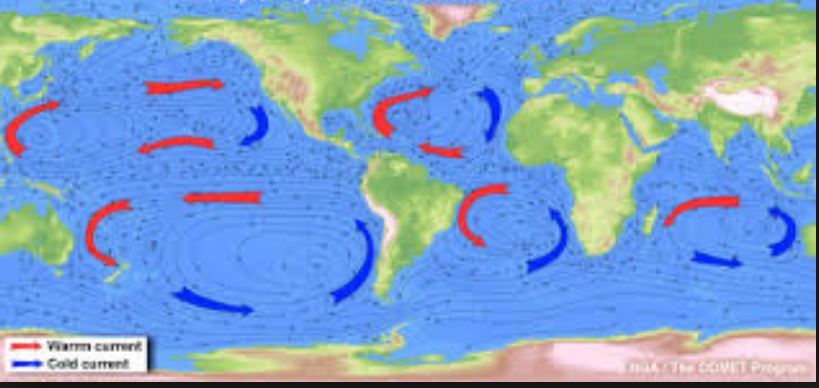

Why is it warmer in Charleston than it is in San Diego even though they are the same distance from the Equator?
Why is it colder in San Diego than it is in Charleston even though they are the same distance from the Equator?

Organisms such as ____, ____, and ____ rely on ocean currents for transportation.
Sea turtles, coconut trees, and plankton
Oxygen, nitrogen and carbon
thermal and kinetic energy
fish, kelp, sea otters
Ocean currents transport matter and energy. Besides water, ocean currents also carry important matter such as ____, ____and _____ necesary for the survival of marine organisms.
fresh water, ice and warm water
coconuts, plankton and sand dollars
nitrogen, carbon dioxide, and oxygen

Contains the Ozone Layer.
Troposphere
Stratosphere
Mesosphere
Thermosphere
All of the above.
Where ALL weather takes place.
Troposphere
Stratosphere
Mesosphere
Thermosphere
All of the above.
Located CLOSEST to Earth's surface.
Troposphere
Stratosphere
Mesosphere
Thermosphere
All of the above.
Coldest layer.
Troposphere
Stratosphere
Mesosphere
Thermosphere
All of the above.
Hottest layer, thinnest air.
Troposphere
Stratosphere
Mesosphere
Thermosphere
All of the above.
Greatest air pressure because it has the most molecules.
Troposphere
Stratosphere
Mesosphere
Thermosphere
All of the above.
78% of the Earth's atmosphere is ___________ and 21% of the Earth's atmosphere is _____________.
Oxygen, Nitrogen
Nitrogen, Oxygen
Nitrogen, Carbon Dioxide
Oxygen, Carbon Dioxide
In the troposphere, the temperature _____ as altitude increases.
Increases
Decreases
Stays the same
Goes up and down
As altitude increases, air pressure....
Increases
Decreases
Stays the same
Goes up and down
The ozone layer is a sublayer of the ________ layer.
Troposphere
Stratosphere
Exosphere
Mesosphere
Why is the ozone layer vital to life on Earth?
Planes fly in the ozone layer
It is made up of oxygen (O2)
It shields the Earth from ultraviolet (UV) rays from the sun
It causes clouds to be created

