wayground logo

Free Printable Worksheets

Font size

S
M
L
XL
Worksheets

Chapter 14 Gene Expression and Regulation

Total questions: 78

Worksheet time: 50mins

Name
Class
Date
1.
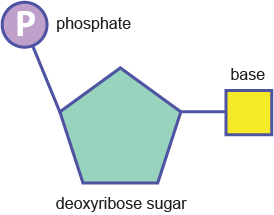
What are the three components of a nucleotide?
a)
sugar, hydrogen, nitrogen base
b)
sugar, oxygen, nitrogen base
c)
sugar, phosphate, nitrogen base
d)
sugar, phosphate, protein
2.

What is the correct order to make a protein?

a)

Protein, DNA, RNA

b)

RNA, DNA, Protein

c)

DNA, RNA, Protein

d)

Protein, RNA, DNA

3.

Where is RNA made?

a)

nucleus

b)

cytoplasm

c)

mitochondria

d)

ER

4.

Where are proteins made?

a)

muscles

b)

nucleus

c)

outside the nucleus in the cytoplasm

5.

RNA contains which sugar?

a)

deoxyribose

b)

Ribose

c)

glucose

d)

fructose

6.

RNA has what base that is instead of thymine?

a)

guanine

b)

adenine

c)

thymine

d)

uracil

7.
How would the DNA sequence GCTATA be transcribed to mRNA?
a)
GCUAUA
b)
CGATAT
c)
CGAUAU
d)
GCUTUT
8.

Transcribe the following DNA sequence into RNA: (Hint! Remember that RNA has U instead of T!)


AAT TAG GGC TCG

a)

AAT TAG GGC TCG

b)

TTA ATC CCG AGC

c)

UUA AUC CCG AGC

d)

TTU UTC CCG UGC

9.

What is Transcription?

a)

The making DNA segment.from mRNA.

b)

The making of an RNA strand into a protein.

c)

The making of an mRNA strand from the DNA template.
10.
Amino acids are the building blocks of... 
a)
DNA
b)
RNA
c)
Atoms
d)
Proteins
11.
What does protein synthesis DO?
a)
makes genes
b)
makes proteins
c)
makes new cells
d)
deletes cells
12.
Cytosine always pairs with
a)
Adenine
b)
Thymine
c)
Uracil
d)
Guanine
13.
Which organelle is DNA usually found in?
a)
cell membrane
b)
vacuole
c)
ribosome
d)
nucleus
14.
Nucleotides are made up of a sugar, phosphate, and..?
a)
nitrogenous base
b)
nucleic acid
c)
cholesterol
d)
fatty acid
15.
Guanine bonds with ______________.
a)
Adenine
b)
Guanine
c)
Cytosine
d)
Thymine
16.

Three sequential mRNA bases for a triplet code for a particular amino acid, each triplet is called a ​ (a)  

Choose from the below words
codon
anticodon
17.
How can a person's muscle cells have the same exact DNA sequences as their nerve cells even though the look and perform completely different?
a)
The two different cells become mutated
b)
The proteins expressed in each cell are different
c)
They actually have different DNA in the two types of cells.
d)
The genome of the different cells changes
18.
Which of the following best explains the term gene expression?
a)
the production of proteins based on the genetic information in DNA
b)
the suppression of RNA polymerase
c)
the suppression of protein production
d)
the production of lipids based on the genetic information in DNA
19.
The lac operon genes only become expressed if:
a)
lactose binds to the repressor
b)
glucose binds to the repressor
c)
lactose binds to the operator
d)
the repressor binds to the operator
20.
In the lac operon model the genes within the operon will be expressed if:
a)
lactose is absent in the cell
b)
glucose is present in the cell
c)
lactose is present in the cell
21.
If an mRNA molecule has introns and exons in it, where is it?
a)
At a ribosome
b)
In the nucleus
c)
In a prokaryotic cell
d)
could be in the nucleus or the ribosome
22.
what is an operon?
a)
a part of a ribsome
b)
a part of a Rna
c)
a unit made up of linked genes that code for proteins needed to do a specific task
d)
needed for dna replication
23.
what does a promoter do?
a)
it allows a gene to be transcribed
b)
it creates a DNA segment
c)
it is another word for ribosomes
d)
it is another word for RNA
24.

DNA controls the cell by instructing it when and how to make different

a)

nucleotides

b)

proteins

c)

fatty acids

d)

carbohydrates

25.

Amino acids are joined together in order to form...

a)

DNA

b)

ribosomes

c)

proteins

d)

RNA

26.

Unlike DNA, RNA...

a)

is double-stranded.

b)

contains the base Thymine.

c)

contains the base Uracil.

d)

is longer than DNA.

27.

Which of the following is NOT directly required for translation?

a)

amino acids

b)

tRNA

c)

DNA

d)

ribosomes

28.

Which is the organelle that makes proteins?

a)

Nucleus

b)

Ribosome

c)

Rough ER

d)

Golgi Apparatus

29.

Where does transcription take place?

a)

nucleus

b)

cytoplasm

c)

ribosome

d)

Grandma's kitchen

30.
_______ is made during transcription and ________ is made during translation.
a)
mRNA / a protein
b)
a protein / mRNA
c)
Ribosome / Nucleus
d)
mRNA / tRNA
31.

Codons contain ______ bases of which kind of RNA?

a)

2, messenger

b)

3, messenger

c)

3, transfer

d)

1, ribosomal

e)

3, ribosomal

32.

Choose the nucleotide sequence of the RNA strand that would be complementary to the following DNA strand:

ATTGCA

a)

AUUGCA

b)

ATTGCA

c)

UAACGU

d)

TAACGT

33.

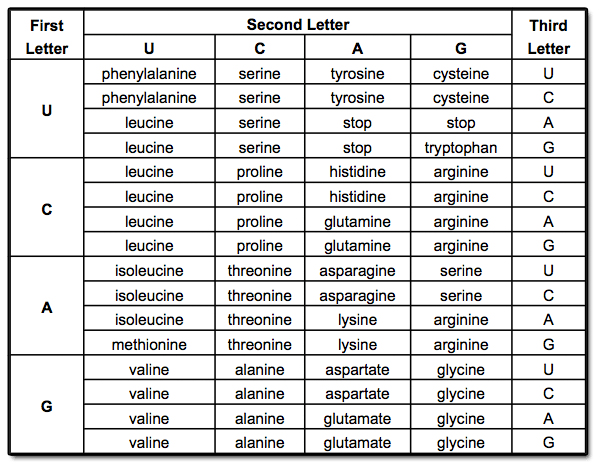
What amino acid is represented by the codon AUG?

a)

Phenylalanine

b)

Methionine

c)

Leucine

d)

Stop codon

34.
What process is going on in this photo? 
a)
Transcription 
b)
Translation 
c)
Replication 
d)
All the above 
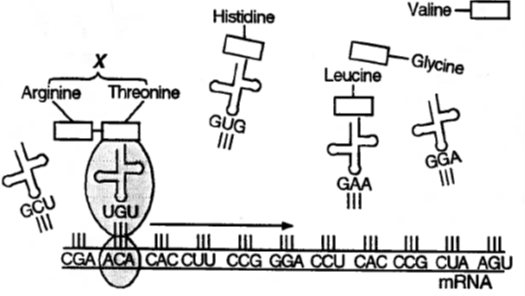
35.

What process is happening in the diagram?

a)

transcription

b)

translation

c)

DNA replication

d)

mitosis

36.

What does tRNA bring to the ribosome?

a)

amino acids

b)

nucleotides

c)

proteins

d)

mRNA

e)

fresh jams

37.
What is a Gene?
a)
A segment of RNA that encodes for a protein
b)
A chromosome
c)
A segment of DNA that encodes for a protein
d)
Your genome
38.
What is the first step in protein synthesis? 
DNA -> mRNA
a)
transcription
b)
translation
c)
replication
d)
mutation
39.
What is the function of a repressor?
a)
to delete RNA
b)
to make RNA
c)

to block RNA polymerase

40.
Why do cells need repressors?
a)
so we only make proteins we need
b)
so we can make as my proteins as possible
41.

An operon is

a)

a genetic on/off switch in prokaryotes

b)

a genetic on/off switch in eukaryotes

c)

a group of related genes and the associated gene switches in prokaryotes

d)

a group of related genes and the associated gene switches in eukaryotes

42.

Where does the RNA Polymerase bind to for the initiation of

a)

Regulator

b)

Structural genes

c)

Operator

d)

Promotor

43.

True or False: All of your body cells contain the same genes.

a)

True

b)

False

44.

The structure X is a ________.

a)

ribosome

b)

nucleus

c)

tRNA

d)

DNA

45.
What is the relationship between a protein, the cell, and DNA?
a)
DNA is produced by protein which is produced in the cell
b)
Protein is composed of DNA which is produced in the cell
c)
DNA controls the production of protein in the cell
d)
A cell is composed of DNA and protein
46.
Which sections of mRNA are cut out and discarded before the mRNA leaves the nucleus?
a)
Exons
b)
Introns
c)
Genes
d)
Amino acids
47.

During transcription in eukaryotic cells, mRNA starts copying from the __________.

a)

introns

b)

poly-A tail

c)

stop codon

d)

TATA box

48.
What amino acid is represented by the codon UUA?
a)
Phenylalanine
b)
Tyrosine
c)
Leucine
d)
Stop codon
49.

A polypeptide is a sequence of ____________________ held together by a ______________ bond.

a)

amino acids; peptide

b)

fatty acids; ionic

c)

proteins; hydrogen

d)

fatty acids; covalent

50.

Your body needs (a)   to create muscles, regulate chemical reactions, transport oxygen, and perform other important tasks in your body.

51.
Change in the genetic material of a cell.
a)
mutation
b)
RNA
c)
promoter
d)
anticodon
e)
homeotic gene
52.

What type of mutation is this?


Original DNA;

TATGAACTGGAA


Mutated DNA;

TATGAATTGGAA

a)

Substitution

b)

Insertion

c)

Deletion

d)

Frameshift

53.

A mutation is a _______________ in the nucleotide base sequence of a gene.

a)

wrinkle

b)

change

c)

bump

d)

tumor

54.

What are three types of point mutations

a)

Silent

b)

Missense

c)

Inversion

d)

Nonsense

55.

In which of the following ways does genetic information typically flow in an organism?

a)

trait --> proteins --> RNA --> DNA

b)

RNA --> trait -->protein --> DNA

c)

DNA --> RNA --> protein --> trait

d)

DNA --> protein --> trait--> RNA

56.
What is does this image represent? 
a)
Mutation
b)
Translation 
c)
tRNA
d)
Transcription 
57.
What mutation has occurred here? 
T-G-A-C-C-A
T-G-A-G-C-A
a)
Substitution
b)
Deletion
c)
Insertion
d)
Frameshift 
58.
Are all mutations bad?
a)
Yes
b)
No
59.
Why are insertion and deletion (frameshift) mutations so harmful?
a)
They change all of the codons from the mutation on down the line, which changes the amino acid sequence
b)
They insert things that an organism doesn't need.
c)
They often delete things that organisms need.
d)
Insertion and deletions are not any more harmful than substitution mutations.
60.
Why is the order of amino acids so important?
a)
The order of amino acids dictates what shape the protein will fold into.
b)
It is not important. The protein folding chamber will force the protein to fold into the correct shape.
61.
DNA molecule segment is : TTACGCAAG
The mutated DNA segment is TTACGCAAC. This is an example of ___ mutation.
a)
Base Substitution
b)
Base Insertion
c)
Base Inversion
d)
Translocation
62.
DNA molecule segment is : TTACGCAAG
The mutated DNA segment is TTCGCAAG. This is an example of ___ mutation.
a)
Substitution
b)
Deletion
c)
Insertion
d)
Inversion
63.
DNA molecule segment is : TTACGCAAG
The mutated DNA segment is TTACGCAAC. This is an example of ___ mutation.
a)
Substitution
b)
Insertion
c)
Inversion
d)
Translocation
64.
Which RNA bases would pair with TACGAA in transcription
a)
AUGCUU
b)
ATGCTT
c)
GCATCC
d)
GCAUCC
65.
a change in one DNA triplet that may result in a new triplet that codes for a stop codon instead of an amino acid is known as
a)
missense
b)
nonsense
c)
frameshift
d)
silent
66.
A type of substitution in which no  amino acids change is called 
a)
Missense
b)
Nonsense
c)
Silent
d)
Deletion
67.
Mutations are__________
a)
Harmful
b)
Harmful or beneficial
c)
Neutral
d)
Harmful, neutral, or beneficial
68.
Which of the following can increase the rate of mutation?
a)
UV Radiation
b)
Viruses
c)
toxic chemicals 
d)
All of the above
69.
A frameshift mutation would result from...
a)
a base deletion only
b)
a base substitution only
c)
either an insertion or deletion of a base
d)
a base insertion only
70.
Original: ATC CAT
Mutation: ATC GCAT
What mutation occurred?
a)
deletion
b)
insertion
c)
silent
d)
transverse
71.

This is a(n)

a)

translocation

b)

insertion

c)

duplication

d)

inverson

72.

This is a(n)

a)

translocation

b)

insertion

c)

duplication

d)

inverson

73.

This is a(n)

a)

translocation

b)

insertion

c)

duplication

d)

inverson

74.
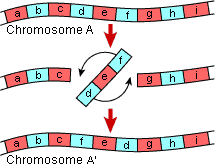
What type of chromosomal mutation is this?
a)
Translocation
b)
Inversion
c)
Deletion
d)
Duplication
75.

Part of a chromosome is repeated

a)

Gene Mutation

b)

Point Mutation

c)

Deletion Mutation

d)

Duplication Mutation

76.

Which molecule carries the genetic code from the nucleus to the ribosome?

a)

mRNA

b)

tRNA

c)

DNA

d)

rRNA

77.

What is the role of tRNA during translation?

a)

It transcribes DNA into RNA.

b)

It replicates DNA.

c)

It brings amino acids to the ribosome.

d)

It synthesizes mRNA.

78.

Which of the following best describes a frameshift mutation?

a)

A mutation that changes one base to another

b)

A mutation that adds or removes a base, altering the reading frame

c)

A mutation that duplicates a segment of DNA

d)

A mutation that does not change the amino acid sequence