
Font size
 Worksheets
a little 8 and mostly 9
Total questions: 120
Worksheet time: 10hrs 0mins
At standard pressure and temperature, what will be the physical state of bromine?
liquid
gas
solid
plasma
How would you classify NaCl?
element
compound
heterogeneous mixture
homogeneous mixture
Which statement accurately describes particles of an ideal gas, according to the kinetic molecular theory?
The distance between the gas particles is much greater than the size of the particles
As the gas particles collide, the total energy of the system increases
The gas particles have strong intermolecular forces
The gas particles move in a circular motion
Which temperature is equal to 170 C?
103 K
443 K
-103 K
498 K

What does ΔT stand for?
Heat-Joules
Mass-Grams
Specific Heat-J/g*C
Temperature Change-*C
What does q stand for?
Heat-Joules
Mass-Grams
Specific Heat-J/g*C
Temperature Change-*C

What type of reaction is this?
Endothermic
Exothermic
Allergic

What type of reaction is this?
Endothermic
Exothermic
Allergic
What heat energy is required to raise the temperature of a 1g sample of mercury (cHg=.16 j/g*C) by 100*C?
16j
.0016j
16000j
625 j
4180 j of heat energy are added to change the temperature of water by 10*C. How many grams of water are being heated? cwater=4.18 j/g*C
4.18 j/g*C
10000g
174724g
100g
Calculate A 50g sample is heated with 500 joules of energy and has a 10*C temperature change. Calculate it’s specific heat.
1 j/g*C
250000 j/g*C
500 j/g*C
10 j/g*C
What does c stand for?
Heat-Joules
Mass-Grams
Specific Heat-J/g*C
Temperature Change-*C

The potential energy diagram of a reaction is shown. Which statement below is correct relating to this reaction?
#1 represents the enthalpy change for this exothermic reaction.
#2 represents the enthalpy change for this endothermic reaction.
#3 represents the enthalpy change for this endothermic reaction.
#4 represents the enthalpy change for this exothermic reaction.
During an exothermic reaction, heat content in the surroundings increases because
heat energy is destroyed during reactions
the reaction absorbs heat energy
the energy contained in the reactants is lower then the products
the energy contained in the products is lower than the reactants
The amount of heat energy required to change the temperature of 12 g of gold from 45°C to 15°C is -47 J. What is the specific heat capacity of gold?
0.13 J/(g°C)
17,000 J/(g°C)
1600 J/(g°C)
0.065 J/(g°C)

The graph represents the uniform heating of a substance, starting with the substance as a solid below its melting point. Which line segment listed below represents an increase in potential energy and no change in average kinetic energy?
Line segment AB
Line segment BC
Line segment CD
Line segment EF

Ice cream melting is an example of an __________ process. (heat enters the system from the surroundings)
endothermic
exothermic
Sweating is an __________________ process because heat is released.
endothermic
exothermic
Mass must always be in ________ for energy calculations.
kilograms
grams
joules
calories
When heat flows from system to the surroundings that is an example of an ________________ process.
exothermic
endothermic
What device is used to measure the amount of heat involved in a chemical reaction or physical process?
barometer
calorimeter
thermometer
Heat flows from _______ to _________.
warm to cool
cool to warm
The unit for q (heat energy) can be in joules or calories. True or false?
true
false
The law of conservation of energy states that
in any chemical or physical change, energy cannot be created or destroyed, only changed in form.
heat changes occur during chemical and physical changes.
energy is the capacity to do work or to supply heat
there are two types of energy, kinetic and potential
1000 calories = ____ kcal
10
100
1
1000
Which of these processes is endothermic?
freezing
condensation
deposition
sublimation
A chemical reaction in a beaker causes the beaker to feel cold to the touch. What type of reaction occurred?
endothermic
exothermic
Which of these is the unit for specific heat?
J
J/g
J/goC
oC
Which of these phase changes requires energy to be released?
boiling
sublimation
condensation
melting
Which type of energy is the energy stored in chemical bonds?
kinetic energy
potential energy
chemical potential energy
mechanical energy
What is the specific heat of water?
2.02 J/goC
2.05 J/goC
4.184 J/goC
41.84 J/goC
A piece of aluminum with a mass of 20.0 grams is heated from 30 oC to 95 oC. If the specific heat of aluminum is 0.904 J/goC, how much heat is gained by the aluminum?
1717.60 J
1175.20 J
963.68 J
542.4 J
A 300 gram sample of a metal is cooled from 120 oC to 60 oC, and releases 4230 J of energy. What is the specific heat of the metal?
7.61 x 10⁷ J/goC
4.26 J/goC
0.47 J/goC
0.235 J/goC
4Fe(s) + 3O2(g) → 2Fe2O3(s) + 1625 kJ
Is this reaction endothermic or exothermic?
endothermic
exothermic

Is the reaction represented in this graph endothermic or exothermic?
endothermic
exothermic
A sample of H2O with a mass of 60 grams boils until it has completely changed to steam. How much heat was absorbed?
Hfus = 334 J/g
Hvap = 2260 J/g
7525 J
135,600 J
1112.1 J
20,040 J
What are chemical reactions that absorb energy?
endothermic
fast
slow
exothermic
What are the two main types of energy?
endothermic and exothermic
spontaneous and nonspontaneous
potential and kinetic
entropy and enthalpy
Consider the reaction: 2 H2O + energy --> 2H2 + O2
exothermic because releasing energy
exothermic because absorbing energy
endothermic because absorbing energy
endothermic because releasing energy
What does temperature measure?
heat
average kinetic energy
space
time

How much heat does an aluminum block absorb if 10.00 grams is heated from 25.0oC to 50.0oC? *Specific heat of aluminum is 0.900 J/goC
450 J
-450 J
225 J
-225 J

The specific heat of platinum is 0.133 J/g°C. How much heat is released when a 10 g piece of platinum cools from 100°C to 50°C?
66.5 J
665 J
0.0266 J
0.665 J

Releasing heat into the surroundings occurs during an ___________________ reaction.
Exothermic
Endothermic
Kinetic Energy
Thermal Energy
If 238 J of heat is absorbed by a sample of metal with a mass of 40.7 g, and it raises the temperature from 20.0°C to 32.4°C, what is the specific heat capacity of the metal?
2.34 J/g°C
0.472 J/g°C
6.13 J/g°C
0.163 J/g°C


endothermic
What happens when kinetic energy increases?
Temperature increases.
Temperature decreases.
Temperature is not affected by kinetic energy.
A sample of a compound has a mass of 30 g and a specific heat of 0.258 J/g*K. If its temperature drops 40 K, how much heat was released? ( q=mcΔT )
309.6 J
-309.6 J
465 J
-465 J
When water evaporates, the process is...
endothermic
exothermic
When wood is burned in a campfire, the process is...
endothermic
exothermic
For an exothermic reaction, ΔH is...
negative
positive
In the following reaction, A + 2B --> 3C, ΔH = 640 kJ . How much energy is needed to react 4 moles of A?
2560 kJ
1280 kJ
1920 kJ
3840 kJ
In the following reaction, 2A + 2B --> C, ΔH=−60 kJ . What is the ΔH when 6 moles of A are reacted?
-180 kJ
-360 kJ
180 kJ
360 kJ
If you touch an exothermic reaction, it will feel...
hot
cold
If you touch an endothermic reaction, it will feel...
hot
cold

The graph is showing an _________ reaction
endothermic
exothermic


Which of the following is an example of an endothermic process or reaction?
condensing
freezing
combustion
melting
Which of the following is an example of an exothermic process or reaction?
melting
boiling
photosynthesis
freezing
If the temperature of a sample is decreased, the particles
slow down
have a lower kinetic energy
speed up
slow down and have a lower kinetic energy
What is the percent error when students find that a cheese puff has 2.8 Cal / gram and the manufacturer's value is 5.8 Cal / gram
52 %
48 %
55 %
45%
Kinetic energy
energy is neither created nor destroyed
stored energy or energy of position
energy of motion
randomness in position or energy level
the entropy of the universe is constantly increasing
Potential energy
energy is neither created nor destroyed
stored energy or energy of position
energy of motion
randomness in position or energy level
the entropy of the universe is constantly increasing
What is the SI unit of heat and energy?
calorie
celsius
joule
What is collision theory?
Molecules must collide in the correct orientation with enough energy to bond.
Molecules need enough energy to collide and react.
Atoms constantly collide and react.
The minimum energy needed for atoms to react
____ reactions usually feel cold.
endothermic
exothermic
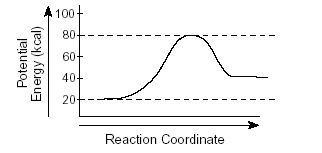
What is the ΔH of this reaction?
40 kJ
20 kJ
80 kJ
-60 kJ
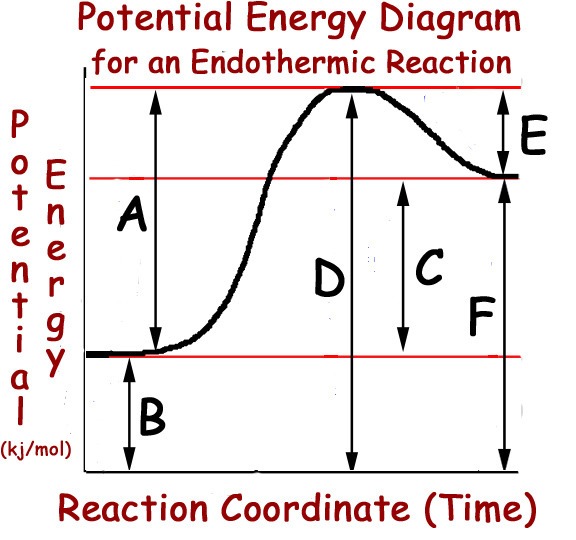
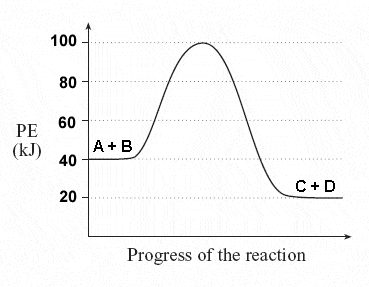

What is the change of the heat of the reaction (ΔH)?
100 kJ
-175 kJ
-50 kJ
75 kJ
How does a catalyst work in speeding up a reaction?
By lowering the activation energy or reaction
by giving them more energy
by making them more available
What is the name given to a catalyst in the human body?
Biology
Catalyst
Chemical
Enzyme
When a catalyst is added to a reaction the rate of reaction,,,
Increases
Decreases
Does not change
How does a catalyst work in speeding up a reaction?
By lowering the activation energy or reaction
by making them more available
by giving them more energy
Which temperature is equal to 170 C?
103 K
443 K
-103 K
498 K
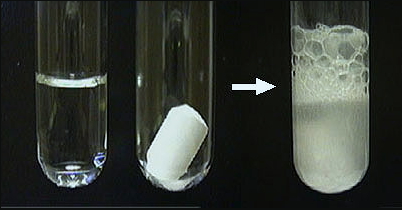
How could we make this reaction happen more quickly?
Decrease the concentration of the acid
crush the chalk to increase the surface area
Put the test tube in an ice bath
When surface area is decreased the rate of reaction...
Decreases, because there are LESS possible sites for correct collisions
Increases, because there are LESS possible sites for correct collisions
Decreases, because there are MORE possible sites for correct collisions
Increases, because there are MORE possible sites for correct collisions
Which has more surface area?
Large chunks of chalk
Cube of sugar
Powdered sugar
Small chunks of sugar
A temperature increase causes the particles ......
to slow down
move faster
collide higher
in the right order
How does a catalyst work in speeding up a reaction?
By lowering the activation energy of reaction
by giving them more energy
by making them more available
Which of the following increase the reaction rate?
less surface area
lower temperature
increased concentration
What factors effect rate of reaction?
Temperature, Concentration, Pressure and Energy
Surface Area, Concentration, Energy and Pressure
Temperature, Pressure, Concentration and Surface area
Pressure, Surface area, Density and Energy
Why does a higher concentration increase the rate of reaction?
it increases the amount of reactants
it lowers the activation energy
it increases the energy of particle collisions
it increases the frequency of particle collisions
What happens if molecules collide but not in the correct orientation
Molecules always collide correctly
All collisions result in products
Explosion
No reaction
Endothermic reactions absorb energy. How does it feel to the touch, and what happens to the temperature of the beaker/surroundings?
your hand feels cool
the temperature goes up
your hand feels cool the temperature goes down
your hand feels warm
the temperature goes up
your hand feels warm the temperature goes down
Exothermic reactions release energy. What does your hand feel and what happens to temperature of the beaker/surroundings?
your hand feels cool and the temperature goes down
your hand feels cool and the temperature goes up
your hand feels warm and the temperature goes down
your hand feels warm and the temperature goes up

