
 Worksheets
Rocks, Minerals, Weathering & Erosion
Total questions: 100
Worksheet time: 2hrs 36mins

According to the Moh's hardness scale, which of the following minerals is the hardest?
diamond
talc
gypsum
The property of a mineral splitting evenly along a flat surface is
Luster
Streak
Cleavage
The property of a mineral splitting unevenly is
Luster
Streak
Fracture
How a mineral reflects light from its surface is known as
Element
Fracture
Luster
What mineral property is determined by scratching a mineral across an unglazed, white tile?
Hardness
Color
Streak
A physical property that is easy to observe is
Luster
Color
Hardness
A measure of how easily a mineral can be scratched.
Texture
Luster
Hardness
The size and shape of pieces of materials in a rock.
Structure
Texture
Luster
What type of rock does magma form as it cools?
igneous
sedimentary
metamorphic
In which location would you most likely find an igneous rock?
near a volcano
on a sandy beach
near the mouth of a river
Which of the following best explains the forces that cause a rock to change into a metamorphic rock?
heat in the layers below the rock
pressure in the layers above the rock
pressure from above the rock layers above and heat from the magma
Intrusive rocks are made in...
A Microwave
A Factory
The Earth
Extrusive rocks are made on...
A Grill
The Earth's Surface
The Sun
Extrusive Rocks Are Formed By...
Frying Pans
Lava
Grilling

Is this Intrusive or Extrusive?
Intrusive
Extrusive
sediment
organic rock
deposition
weathering
sediment
erosion

The squeezing sediments together in layers
compaction
weathering
cementation
________ is the process by which a rock changes form or mineral content as a result of environmental changes such as heat and pressure.
Rifting
Metamorphism
Precipitation

According to the diagram, how does a sedimentary rock become a metamorphic rock?
Weathering and Erosion
Heat and Pressure
Compaction and Cementation

According to the diagram, how does magma become an igneous rock?
Melting
Cooling
Compaction and Cementation
Scratching a mineral against a glass plate is a method used for determining the mineral's
color
hardness
luster
cleavage
Which mineral property is illustrated by the peeling of muscovite mica into thin, flat sheets?
streak
cleavage
luster
hardness

A—cleavage; B—hardness; C—streak
A—cleavage; B—streak; C—hardness
A—streak; B—cleavage; C—hardness
A—streak; B—hardness; C—cleavage
Which mineral shows no cleavage, has a hardness of 7, and a composition of SiO2?
Graphite
Halite
Garnet
Quartz
Which mineral is the major component of drywall?
selenite gypsum
talc
calcite
muscovite mica
Which mineral is white or colorless, has a hardness of 2.5, and splits with cubic cleavage?
pyrite
halite
calcite
mica

Which two processes formed this rock?
compaction and cementation
melting and solidification
heating and application of pressure
folding and faulting
The best evidence for determining the cooling rate of an igneous rock during its solidification is provided by
faults in the rock
composition
density
the crystal size of its minerals
The obsidian's glassy texture indicates that it formed from a magma that cooled
slowly, deep below Earth's surface
quickly, deep below Earth's surface
quickly, on Earth's surface
slowly, on Earth's surface
Which rock is of felsic composition, low in density, light in color, and coarse grained?
gabbro
granite
rhyolite
basalt
A mafic igneous rock is most likely to be relatively
low in density and dark in color
high in density and light in color
low in density and light in color
high in density and dark in color
Which land-derived sedimentary rock could have formed by the compaction and cementation of particles smaller than 0.0004 centimeter in diameter?
siltstone
sandstone
limestone
shale
Limestone, gypsum, and salt are rocks formed by the processes of
weathering and metamorphism
evaporation and precipitation
melting and solidification
erosion and deposition
Which type of sedimentary rock contains the greatest range of particle sizes?
sandstone
siltstone
conglomerate
shale
A fossil is not likely to be found in
limestone
sandstone
basalt
shale
Metamorphic rocks result from the
cooling and solidification of molten magma
Heat and pressure causing recrystallization of rocks
erosion of rocks
compression and cementation of soil particles
Which sedimentary rock is most likely to be changed to slate during regional metamorphism?
dolostone
conglomerate
breccia
shale
In which set are the rock drawings labeled with their correct rock types?


The sedimentary rock limestone will change into the metamorphic rock...
slate
quartzite
marble
metaconglomerate
The sedimentary rock sandstone will change into the metamorphic rock...
slate
quartzite
marble
metaconglomerate
What is mechanical weathering?
The natural breakdown of rock into sediments by physical changes
The process of rocks absorbing water and reacting with their molecules
The scouring or scraping of rock caused by glaciers or wind-blown sand
The peeling off of thin layers of rock from exposed surfaces
What are the common causes of mechanical weathering?
Ice wedging, root growth, and impacts
Abrasion, exfoliation, and oxidation
Hydration, carbonation, and hydrolysis
Evaporation, adhesion, and cohesion
What is exfoliation?
The process of rocks absorbing water and reacting with their molecules
The peeling off of thin layers of rock from exposed surfaces
The scouring or scraping of rock caused by glaciers or wind-blown sand
The natural breakdown of rock into sediments by physical changes
What are some agents of mechanical weathering?
Ice wedging, root growth, and impacts
Abrasion, exfoliation, and oxidation
Hydration, carbonation, and hydrolysis
Evaporation, adhesion, and cohesion
What is chemical weathering?
The natural breakdown of rock into sediments by physical changes
The process of rocks absorbing water and reacting with their molecules
The scouring or scraping of rock caused by glaciers or wind-blown sand
The peeling off of thin layers of rock from exposed surfaces
What are some chemical reactions that cause chemical weathering?
Ice wedging, root growth, and impacts
Abrasion, exfoliation, and oxidation
Hydration, carbonation, and hydrolysis
Evaporation, adhesion, and cohesion
How does water contribute to chemical weathering?
By freezing and expanding in cracks of rocks
By dissolving certain rocks and minerals
By breaking down small rocks as it carries them downstream
By reacting with the molecules of rocks
What factors determine the rate of weathering?
The composition of the rock, the rock's surface area, and climate conditions
The actions of living organisms and the shape of the landscape
The elevation and the temperature
The humidity and the actions of living organisms
What is differential weathering?
The process of rocks absorbing water and reacting with their molecules
The peeling off of thin layers of rock from exposed surfaces
The scouring or scraping of rock caused by glaciers or wind-blown sand
The uneven weathering of different rocks in the same landform
Why do rocks with a greater surface-area-to-volume ratio change faster?
Because they are more exposed to air and water
Because they have a higher elevation
Because they are more resistant to weathering
Because they have a higher temperature
Which of the following is NOT true about erosion and deposition?
Erosion is the removal of rock from one place to another.
Deposition is the laying down of sediment carried by wind, water, or ice.
Water, wind, gravity and human activities are agents of erosion.
Human influence and activities decreased the rate of erosion.
Which of the following human activities does not accelerate soil erosion?
farming
logging
building construction
fishing
Which of the following is not an agent of erosion?
Gravity (mass movements)
wind
fire
glaciers
running water/waves
Which of the following is NOT correct about mass movements?
Gravity triggers rockfall.
Gravity pulls boulders on steep slopes that have less vegetation.
Gravity causes glaciers to flow down valleys.
Gravity causes winds by pulling heavier cold air down beneath lighter warm air.
None of the above.
Which of the following does not affect the rate of deposition?
color of sediment
size of sediment
density of sediment
shape of sediment
Which is NOT true about sorted and unsorted sediments?
Sorted sediments has particles of the same size.
Unsorted sediments are mixed in size, shape and density.
Sorting of sediments happen during deposition.
Sorting of sediments happen during weathering.
Which is NOT TRUE about gravity, wind, water and glacial deposition?
Wind deposits are sorted and layered.
Streams deposit sediment when the velocity of the stream decreases.
Glaciers deposit sediment along the ice front as the glacier freezes.
Beaches are deposited sand along shorelines.
All of these are true about wind deposition EXCEPT
Wind deposit sediments as sand dunes or loess.
Wind deposits are unsorted.
Wind deposits occur in arid/dry climates.
Wind deposits occur along coastlines
Which of the following is NOT one of the ways to control soil erosion?
crop circle
windbreaks
terrace farming
contour plowing
All of these are examples of mass movements EXCEPT
landslide
rockslide
rockfall
waterfall

the process that BREAKS DOWN rocks into smaller pieces caused by wind, rain, ice, chemicals, freezing, or thawing
Erosion
Weathering
Deposition
The Hulk

Rocks that have been changed from other rocks by heat and pressure
Metamorphic
Sedimentary
Igneous

Hot molten rock located deep below the earth’s surface
Crust
Magma
Lava
Core

Particles are DROPPED in a new location
Weathering
Erosion
Deposition

The deeper we dig, the farther back in time we see.
True
False

The oldest layers are found on the
Top
Bottom

What is the Principle of Superposition?
that layers of sediment initially extend laterally in all directions; in other words, they are laterally continuous.
the principle that in a series of stratified sedimentary rocks the lowest stratum is the oldest
social organization that holds that social and political issues should be dealt with at the most immediate (or local) level that is consistent with their resolution.
waves will be faster at higher magnitude
Discuss the limitations of the law of superposition in determining the absolute age of rock layers.
Geological processes such as folding, faulting, and erosion can disrupt the original order of rock layers.
The law of superposition cannot account for the presence of unconformities in rock layers.
The law of superposition does not consider the possibility of overthrusts, where older rocks are pushed over younger rocks.
The law of superposition only applies to sedimentary rock layers, not igneous or metamorphic rocks.
How does the law of superposition relate to the concept of stratigraphy?
The law of superposition states that in a sequence of undisturbed sedimentary rocks, the oldest rocks are at the bottom and the youngest are at the top. This is the fundamental principle of stratigraphy.
Stratigraphy is based on the principle that rocks are randomly arranged
The law of superposition states that the oldest rocks are at the top and the youngest are at the bottom
The law of superposition has no relation to stratigraphy
How does the law of superposition help in determining the relative age of rock layers?
It helps in determining the relative age of rock layers by establishing the order in which they were formed.
It helps in determining the relative age of rock layers by measuring their density.
It helps in determining the relative age of rock layers by analyzing their chemical composition.
It helps in determining the relative age of rock layers by looking at the color of the rocks.
Explain the principle of original horizontality.
Layers of sediment are originally deposited vertically due to tectonic forces.
The principle of original horizontality does not apply to sedimentary rocks.
The principle of original horizontality states that layers of sediment are originally deposited at a 45-degree angle.
Layers of sediment are originally deposited horizontally under the action of gravity.
Principle that Earth's processes occurring today are similar to those that occurred in the past
unconformities
uniformitariansim
superposition
catastrophism

Which statement best describes the layers of rock in this picture?
The layers would have been deposited as they are pictured, so nothing has happened to them.
The layers have been disturbed since they would have been deposited horizontally .
The layers are all the same age since they are all in the same location.

The principle of relative age determination that states that the fault in this picture is younger than the rocks it cuts.
The Law of Cross-Cutting Relationships
The Law of Original Horizontalily
The Law of Superposition
The Law of Sediment

Which principle of relative age determination states that most sedimentary rocks are deposited underwater?
The Law of Superposition
The Law of Gravity
The Law of Original Horizontality
The Earth is Flat


Which layer is OLDER? Layer M or layer P?
layer M
layer P
cannot be determined
both layers are of the same age

Which layer is OLDER? Layer E or layer A?
layer E
layer A
cannot be determined
both layers are of the same age

What is the sequence of rock formation from oldest to youngest?
A,B,C,D,E,F
D,F,E,C,B,A
F,E,D,A,B,C
F,E,D,C,B,A
A dating method of measuring the age of an event or object in years.
time
cross-cutting
absolute
relative

Which of the following geologic events would have happened most recently?
rock formation of 3
rock formation of 6
rock formation of 2
rock formation of 1

Which of the four numbered features on this figure is the oldest?
1
2
3
4

Which principle can be used to determine the relative age of an igneous intrusion (a.k.a dike)?
Superposition
Original horizontality
Cross cutting Relationship
Inclusion
These are the preserved remains or evidence of ancient living things.
fossils
corals
teachers
rocks
boomers


What is the best reason that fossil #4 is NOT a good index fossil?
It is not widespread
it is not short-lived (in numerous layers)
It is in half of the outcrops


Which particles will be transported by a stream moving at a velocity (speed) of 5 cm/s?
pebbles, sand, silt, and clay, only
sand, silt, and clay, only
silt and clay, only
clay, only
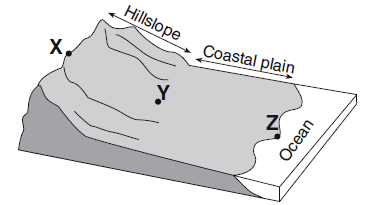
Compared to the stream speed between point X and point Y, the stream speed between point Y and point Z is most likely
greater, since the slope of the land decreases
greater, since the slope of the land increases
less, since the slope of the land decreases
less, since the slope of the land increases

Erosion is most likely greatest at locations
A and B
B and C
C and D
D and A
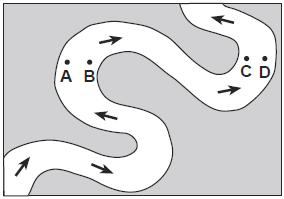
Which two locations have the fastest water flow?
A and B
B and C
C and D
D and A

What is the name of the largest sediment that can be transported by a stream moving at a velocity of 100 centimeters per second (cm/s)?
silt
sand
pebbles
cobbles

