
 Worksheets
Phase Change, Exothermic & Endothermic Reactions
Total questions: 100
Worksheet time: 1hrs 18mins
Phase change going from Liquid to Solid...
Melting
Freezing
Condensation
Sublimation
Phase change going from a Gas to a Liquid...
Sublimation
Deposition
Ionization
Condensation
Phase change going from a Liquid to a Gas...
Vaporization
Deposition
Condensation
Melting
Phase change going from a Gas to a Plasma...
Melting
Vaporization
Ionization
Freezing
Phase change going from a Solid to a Gas...
Deposition
Sublimation
Condensation
Recombination
Phase change going from a Solid to a Liquid...
Freezing
Condensation
Melting
Sublimation
Phase change going from a Plasma to a Gas...
Ionization
Recombination
Condensation
Sublimation
Phase change going from a Gas to a Solid...
Deposition
Sublimation
Condensation
Vaporization
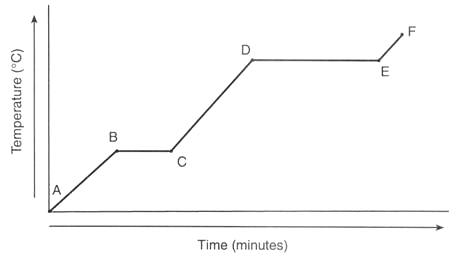
Is the substance gaining or losing energy?
Gaining
Losing
Are the particles moving faster or slower as time goes on?
Faster
Slower
What state/phase is the object likely from points A to B?
Solid
Liquid
Gas
Plasma
What is happening to the particles in the substance between points A and B?
Melting
Freezing
Speeding Up
Slowing Down
What is happening to the particles in the substance between points D and E?
Melting
Freezing
Vaporizing
Sublimating

Is the substance gaining or losing energy?
Gaining
Losing

Where on the graph are phase changes taking place?
1
2
3
4
5

If this is a boiling point graph of a mixture of two liquids, what is the boiling point of the first liquid?
30ºC
70ºC
140ºC
185ºC
If this is a boiling point graph of a mixture of two liquids, what is the boiling point of the second liquid?
30ºC
70ºC
140ºC
185ºC
If this is a boiling point graph of a mixture of two liquids, at what point is both liquids completely liquid?
A
B
C
D
E
If this is a boiling point graph of a mixture of two liquids, between which two points is liquid 1 part liquid and part gas?
A & B
B & C
C & D
D & E
If this is a boiling point graph of a mixture of two liquids, between which two points is liquid 1 all gas and liquid 2 is all liquid?
A & B
B & C
C & D
D & E
If this is a boiling point graph of a mixture of two liquids, between which two points is liquid 1 all gas and liquid 2 is part liquid and part gas?
A & B
B & C
C & D
D & E
If this is a boiling point graph of a mixture of two liquids, at what point is liquid 1 starting to boil?
A
B
C
D
E
If this is a boiling point graph of a mixture of two liquids, at what point is liquid 2 finished boiling?
A
B
C
D
E
If this is a boiling point graph of a mixture of two liquids, between which two points would you stop heating and/or change the collection flask in order to separate these liquids?
A & B
B & C
C & D
D & E
What would you need to do to a mixture of two liquids in order to create this boiling point graph?
heat it up
cool it down
place it on a balance
pour it into a graduated cylinder
If this is a phase change graph of a pure substance, what is the melting point of this substance?
30ºC
70ºC
140ºC
185ºC
If this is a phase change graph of a pure substance, what is the freezing point of this substance?
30ºC
70ºC
140ºC
185ºC
If this is a phase change graph of a pure substance, what is the boiling point of this substance?
30ºC
70ºC
140ºC
185ºC
If this is a phase change graph of a pure substance, what is the phase of the substance at point A?
B.E.C.
solid
liquid
gas
plasma
If this is a phase change graph of a pure substance, between which two points is it both a solid and a liquid?
A & B
B & C
C & D
D & E
If this is a phase change graph of a pure substance, between which two points is it both a liquid and a gas?
A & B
B & C
C & D
D & E
If this is a phase change graph of a pure substance, between which two points is it just a liquid?
A & B
B & C
C & D
D & E
If this is a phase change graph of a pure substance, at which point is all the liquid turned into gas?
A
B
C
D
E
If this is a phase change graph of a pure substance, at which point is it finished melting?
A
B
C
D
E
If this is a phase change graph of a pure substance, at which point does it start to melt?
A
B
C
D
E
If you want to heat 50 ml of a liquid to determine its boiling point, what tool would you use to measure its volume?
graduated cylinder
balance
metric ruler
beaker
flask
If you want to heat 50 ml of a liquid to determine its boiling point, what tool would be best to heat it in?
graduated cylinder
balance
metric ruler
flask
If you want to heat 50 ml of a liquid to determine its boiling point, what would you add to the flask with the liquid?
a magnet
some hydrochloric acid
some boiling chips
some additional water
If you want to heat 50 ml of a liquid to determine its boiling point, what tool would you use to measure the temperature?
balance
thermometer
graduated cylinder
beaker
If you want to heat 50 ml of a liquid to determine its boiling point, what metric units would you use to measure the temperature?
Celsius
Fahrenheit
grams
meters
Phase change going from a Gas to a Liquid...
Sublimation
Deposition
Ionization
Condensation
Phase change going from a Liquid to a Gas...
Vaporization
Deposition
Condensation
Melting
Phase change going from a Solid to a Gas...
Deposition
Sublimation
Condensation
Recombination
Phase change going from a Solid to a Liquid...
Freezing
Condensation
Melting
Sublimation
Phase change going from a Gas to a Solid...
Deposition
Sublimation
Condensation
Vaporization
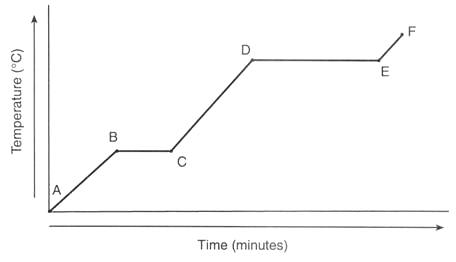
What state/phase is the object likely from points A to B?
Solid
Liquid
Gas
Plasma
What is happening to the particles in the substance between points D and E?
Melting
Freezing
Vaporizing
Sublimating
Where on the graph are phase changes taking place?
1
2
3
4
5
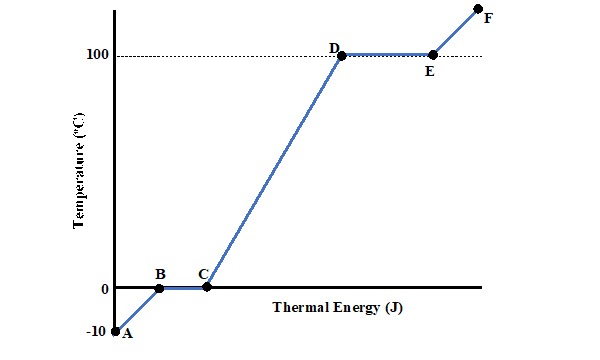
Between which two points is the gas heating up?
A ----> B
B <---- C
C ----> D
D ----> E
E ----> F


What energy is stored and waiting to be used?
Kinetic Energy
Potential Energy
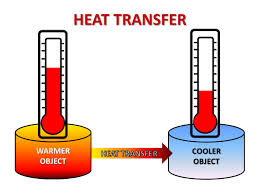
The law of conservation of energy states that
energy can be created or destroyed
energy cannot be created or destroyed
energy can be potential or kinetic only
heat energy is kinetic energy
What would likely happen if you were to touch the flask in which an exothermic reaction was occurring?
The flask would feel cooler
The flask would feel warmer
The flask would feel the same before and after a reaction
None of the above
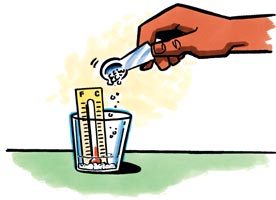

During an exothermic reaction, heat is _________ and chemical bonds __________.
released, formed
absorbed, broken
released, broken
absorbed, formed
During an endothermic reaction, heat is ________ and chemical bonds _______.
released, formed
absorbed, broken
released, broken
absorbed, formed
What instrument would you use to detect an endothermic or exothermic reaction?
triple beam balance
ruler
thermometer

How many Joules of energy are required to make 50.0 grams of ice at 0 οC completely melt?
334 J
0 J
33,400 J
16,700 J
What is the formula to calculate heat energy required to raise the temperature of any substance?
Q=mc∆t
Q=mH
Q= ½mv
m=QC
The heat absorbed while a solid is melting is known as....
heat of fusion
heat of solid
heat of liquid
heat of vaporization
Calculate the energy needed to completely boil away 30 g of water at 100 ⁰C .
67,800 J
2260 J
226,000 J
100 J
Heat always flows from a __________________ to a cooler object.
warmer
cooler
liquid
gas
Higher temperatures indicate
slower motion of molecules
molecules at rest
faster motion of molecules
Temperature when a substance changes from a solid to a liquid
freezing point
heat of fusion
thermal expansion
melting point
The Temperature when a liquid turns to a solid
freezing point
heat of fusion
thermal expansion
melting point
The amount of heat needed to change 1 gram of a substance from the liquid phase to the gas phase is ___
Heat of Vaporization
Boiling point
Heat Energy
Phase change
Temperature when a substance changes from a liquid to a gas
Heat of Vaporization
Boiling point
Heat Energy
Phase change
How many Joules of energy are required to make 100 grams of ice at 0 οC completely melt?
200 J
400 J
33,400 J
2,000,000 J

How does a catalyst work in speeding up a reaction?
By lowering the activation energy or reaction
by giving them more energy
by making them more available
What term is given to a reaction which transfers heat energy to the surroundings?
Endothermic
Reversible
Exothermic
Exotermic
When barium hydroxide and ammonium chloride react, the temperature of the mixture decreases. What kind of reaction is this?
Endothermic
Decomposition
Exothermic
Indothermic
When calcium reacts with water, the temperature changes from 18°C to 39°C. Which statement is correct?
The solution at the end is acidic
The reaction is reversible
The reaction is exothermic
The reaction is endothermic
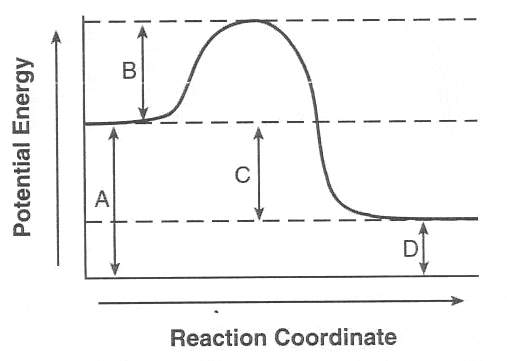
Rank the state os matter from FASTEST to SLOWEST particle speed.
solid, liquid, gas
liquid, solid, gas
gas, liquid, solid
gas, solid, liquid
The higher the temperature a substance has the
more energy it has
less energy it has
What is necessary for a chemical reaction to occur?
Correct orientation of particles when they collide
particle collisions
an increase or decrease in temperature
particle collisions with sufficient energy
a catalyst
What happens to reaction rate if surface area is decreased?
it increases
it decreases
it stays the same
What happens to reaction rate when temperature is decreased?
it increases
it decreases
it stays the same.

