
 Worksheets
EKim Science7 Unit4.6 Biodiversity & Classification SG
Total questions: 94
Worksheet time: 2hrs 12mins
To make it easier to communicate about organisms, scientists
use the same system for naming organisms
use only the common names for organisms
use only Latin names for organisms
use only physical traits for naming organisms
Which of the following statements is true?
The fewer traits two organisms share, the more closely related they are.
DNA evidence cannot reveal how closely related two organisms are.
Two closely related organisms always look similar.
Even though two organisms have the same common name, they may not be closely related.
Which of the following did Linnaeus use to name organisms?
DNA evidence
appearance
vestigial organs
embryo development
Scientists compare the components of one organism’s DNA with those of another organism’s DNA to find (a) of a common ancestor.
genetic evidence
physical evidence
the traits
the taxon
The classification level that includes the least number of organisms is
Genus
Species
Family
Order
The purpose of a dichotomous key is
to give organisms scientific names
to classify organisms into groups
to make identifying organisms as easy as possible
to help scientists remember scientific names
Instead of eating, yeasts take in nutrients from their surroundings. They are classified as
fungi
archaea
bacteria
plants
All ____ are multicellular eukaryotes that make their own food.
animals
protists
plants
Archaea
Microscopes and other advances in technology have allowed scientists to observe that there are three fundamentally different types of cells. Scientists have used this information to group the six kingdoms into.
species
domains
families
orders
Scientists classify jaguars, ocelots, and lynx in the same family based on the animals’
similar physical traits
scientific names
similar habitats
different genes
____ helps people communicate about organisms.
A trait
A gene
Classification
Taxonomy
Any type of feature that can be used to tell two species apart is called a
taxon
trait
characteristic
key
A group of species that share similar traits is
a family
a genus
an order
a class
Which of the following is the correct way to write the scientific name of the briar rose?
Rosa canina
Rosa Canina
rosa canina
rosa Canina
Which of the following statements about a dichotomous key is true?
It asks a series of questions that can be answered in many ways.
It gradually narrows down the list of possible choices to identify an organism.
It relies on paintings or photographs to identify organisms.
It is a tool for grouping organisms.
If evidence showed that an organism fit into a different genus than scientists had thought, the organisms’ ____ would change.
traits
name
appearance
genes
____ are multicellular eukaryotes that get their food by eating other organisms.
Archaea
Animalia
Fungi
Protists
How many kingdoms do modern scientists use in their classification system?
five
six
three
four
The domain that includes unicellular organisms that can survive in extreme environments is called
Eukarya
Archaea
Protista
Bacteria
If two organisms share the same trait, then taxonomists
conclude that they must share a common ancestor
try to determine whether they share a common ancestor
classify the two organisms in the same genus
conclude that they must have similar habitats
Even if a scientist is unfamiliar with a caracal, its classification in the genus Felis would help him or her know many of its
species
traits
domains
phyla
The more closely related two organisms are,
the more similar their habitats
the more similar their appearance
the more recently they came from a common ancestor
the more recently they came from different ancestors
Which of the following is the correct order of levels in the classification system?
kingdom, phylum, family, order, class, genus, species
kingdom, phylum, order, class, family, genus, species
kingdom, phylum, class, order, family, genus, species
kingdom, class, phylum, order, family, genus, species
Which of the following organisms is most closely related to Chameleo gracillis?
Aubrieta gracillis
Phaseolus vulgaris
Chameleo dilepis
Phaseolus lunatus
According to some scientists, which of the following kingdoms should be split into several kingdoms, because the organisms in it are so varied?
Fungi
Protista
Plantae
Archaea
Every question in a dichotomous key has
only two answer choices
only one answer choice
at least three answer choices
at least four answer choices
Which of the following statements is true?
Eukaryotic cells are less complex than prokaryotic cells.
Eukaryotic cells have a nucleus.
Eukaryotic cells are always smaller than prokaryotic cells.
Eukaryotic cells can survive in more extreme conditions than organisms in the Archaea domain.
Unicellular organisms that do not have a nucleus and can cause human diseases are
Bacteria
Fungi
Archaea
Protista
After comparing the DNA of the red panda and the giant panda, scientists discovered that the red panda was more closely related to the raccoon and that the giant panda was more closely related to the bear. This discovery led scientists to change the animals’
evidence
classification
traits
genes
Select the term that best completes the statement. The process in which scientists arrange organisms into groups based on similarities is called _________________.
classification
evolution
genetic
taxonomy
Select the term that best completes the statement. When scientists have arranged organisms into groups, they give the organisms names. This science is called _________________.
taxonomy
classification
evolution
genetic
To determine biological relationships, a taxonomist compares the ________________ of two different species.
traits.
habitats.
colors.
sizes.
Select the term that best completes the statement. ________________ are groups of organisms that share certain characteristics. Options: classification, evolution, genetic, physical, system, taxonomy, taxons, traits.
classification
evolution
genetic
taxons
Select the term that best completes the statement. ________________ evidence may include characteristics such as color, size, and weight.
physical
classification
genetic
taxonomy
Select the term that best completes the statement. Scientists sometimes compare the DNA sequences of two organisms for similarities. This ________________ evidence proves that the organisms are closely related.
genetic
classification
evolution
physical
Explain how scientists may use physical and genetic evidence to determine how closely related two species of birds are.
Scientists use physical traits and genetic markers to assess the relationship between bird species.
Scientists rely solely on physical traits to determine bird species relationships.
Genetic evidence is the only method used to determine bird species relationships.
Physical evidence is more important than genetic evidence in determining bird species relationships.
Select the term that best completes the statement. A(n) ______ is a group of species with similar traits.
genus
binomial nomenclature
Linnaeus
organism
Select the term that best completes the statement. The system for naming species is called ______. Options: binomial nomenclature, family, genus, Linnaeus, order, organism, phylum, species.
binomial nomenclature
family
genus
Linnaeus
Select the term that best completes the statement. A dichotomous key is a set of questions that helps scientists find the scientific name of a(n) ______. Options: binomial nomenclature, family, genus, Linnaeus, order, organism, phylum, species.
organism
binomial nomenclature
genus
species
Select the term that best completes the statement. A(n) ______ is more specific than a kingdom, but less specific than a class. Options: binomial nomenclature, family, genus, Linnaeus, order, organism, phylum, species.
phylum
family
genus
order
Select the term that best completes the statement. ______ invented the system that scientists use to name species.
Linnaeus
Darwin
Newton
Einstein
Select the term that best completes the statement. ______ is the most specific level in the classification system.
species
genus
family
order
What levels of classification do each of the names in binomial nomenclature represent? Which two plants from the list below are most closely related? Explain your answer. Hippuris vulgaris, Phaseolus vulgaris, Phaseolus lunatus.
Hippuris vulgaris and Phaseolus vulgaris are most closely related because they share the same genus.
Phaseolus vulgaris and Phaseolus lunatus are most closely related because they share the same genus.
Hippuris vulgaris and Phaseolus lunatus are most closely related because they share the same species.
All three plants are equally related because they share the same family.
I'm the kingdom that contains organisms similar to bacteria.
Archaea
Protista
Fungi
Plantae
I'm a group of species that have similar characteristics.
Genus
Family
Order
Class
I'm the arrangement of kingdoms into larger groups.
Domain
Phylum
Class
Order
I'm the kingdom that includes organisms—either unicellular or with a simple multicellular structure—that don't fit easily into animals, plants, or fungi.
Protista
Animalia
Plantae
Fungi
I'm the system for naming species developed by Linnaeus.
Binomial nomenclature
Taxonomic classification
Genus-species naming
Linnaean taxonomy
I'm the kingdom that contains unicellular organisms with no nucleus.
Bacteria
Protista
Fungi
Plantae
I'm the kingdom that includes plants such as trees, grass, and moss.
Plantae
Animalia
Fungi
Protista
I'm the science of naming and classifying organisms.
Taxonomy
Biology
Ecology
Genetics
I ask a series of questions that can be answered in only two ways.
Dichotomous key
Multiple choice test
Open-ended survey
Likert scale
I'm the kingdom that includes mushrooms, molds, and yeasts.
Fungi
Plantae
Animalia
Protista
I'm the process of arranging organisms into groups based on similarities.
Classification
Photosynthesis
Metabolism
Respiration
I'm the kingdom that includes animals, from lions and tigers to bugs.
Animalia
Plantae
Fungi
Protista
whales, sharks, humans, bears, dogs, fish.
Vertebrates
Invertebrates
Mammals
Reptiles
Eukarya—contains the kingdoms Protista, Fungi, Plantae, and Animalia.
Domain
Species
Genus
Family
can cause human disease and spoil food, but some are helpful.
Bacteria
Viruses
Fungi
Parasites
fur, feathers, scales, sharp fangs, bone structure, size.
Characteristics
Habitat
Diet
Behavior
bread mold, parasol mushroom, many are decomposers.
(a)
Your answer to each question leads you to another question with only two choices. Helps you identify species.
Dichotomous Key
Periodic Table
Flowchart
Mind Map
giant kelp, seaweed, many live in pond water or sea water.
Algae
Coral
Plankton
Moss
oak tree, corn, sequoia tree, prairie grass.
Plants
Animals
Minerals
Fungi
resemble bacteria, live in the ocean and also in some extreme environments.
(a)
two names, such as Aubrieta gracilis, Chameleo gracilis, Rosa canina. Scientific name consisting of genus and species.
Binomial Nomenclature
Taxonomy
Classification
Nomenclature
The process through which species develop new traits is called
evolution
adaptation
artificial selection
overproduction
The first organisms to live on land were
dinosaurs
plants
amphibians
insects
Evidence of past species, and how they changed over time, can be found in
differences in the structures of species
differences in the development of species
the fossil record
the environment
A(n) (a) is a group of organisms whose offspring can breed.
adaptation
trait
variation
species
Scientists believe that bats, lizards, and manatees share a common ancestor because they
have the same shape
live in the same environment
have a similar bone structure
have forelimbs with similar functions
Birds that we see today come in a variety of shapes and sizes because of
natural selection
similar structures
acquired traits
overproduction
Out of the thousands of eggs a female salmon lays, only several dozen will reach adulthood. This is an example of
adaptation
overproduction
variation
natural selection
The fossil record shows that organisms have evolved over the last
4 billion years
4 million years
400,000 years
40,000 years
Darwin found many new species of finches on the Galápagos Islands because
the populations of finches on different islands were separated from each other as well as from the mainland
the finches were able to fly back and forth between the islands and the mainland
the habitat on all the islands was similar
there were no other animals on the islands
According to Darwin’s theory of natural selection,
organisms pass on acquired traits to their offspring
organisms best suited to their environment survive and reproduce at a higher rate
organisms produce only a small number of offspring
a slight change in organisms is unlikely to improve their chances for survival
Select the term that best completes the statement. Scientists have arranged kingdoms into larger groups called _________________. Options: Animalia, Archaea, Bacteria, domains, Fungi, Plantae, Protista, species.
domains
Animalia
Archaea
Bacteria
Select the term that best completes the statement. More than 90 percent of the organisms in the kingdom ________________ are insects.
Animalia
Archaea
Bacteria
Fungi
Select the term that best completes the statement. Unicellular organisms that can survive in extreme environments belong to the kingdom _________________.
Archaea
Animalia
Bacteria
Fungi
Select the term that best completes the statement. Organisms, either unicellular or multicellular, that absorb their nutrients from their surroundings belong to the kingdom _________________.
Fungi
Animalia
Plantae
Protista
Select the term that best completes the statement. Multicellular organisms that can make their own food belong to the kingdom _________________.
Plantae
Animalia
Fungi
Protista
If scientists discovered a unicellular organism that has a nucleus, they would classify this organism in the kingdom _________________.
Protista
Animalia
Bacteria
Archaea
The three domains are:
Bacteria, Archaea, Eukarya
Animalia, Plantae, Fungi
Protista, Monera, Fungi
Chordata, Arthropoda, Mollusca
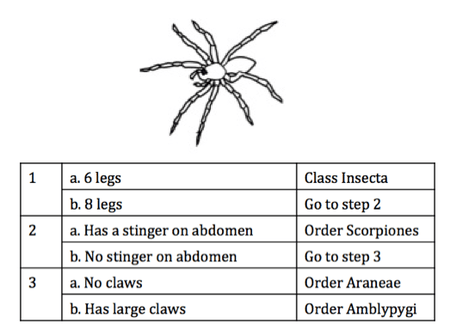

arachnids and insects?

Which of the following is an accurate description of the fiddler crab?
3 Paris of walking legs on both sides
Two propodus
3 Chelipeds
A pair of eyes
A student discovers an arachnid with a segmented abdomen, long legs, and a tail with no stinger.
The student uses the dichotomous key below to identify it.
1. a) Abdomen segmented.............go to 2
b) Abdomen not segmented ......go to 4
2. a) Abdomen with tail....................go to 3
b) Abdomen without tail...............go to 5
3. a) Tail with stinger..........................Scorpion
b) Tail without stinger.....................Whip scorpion
4. a) Legs longer than body.............Daddy Long Legs
b) Legs not longer than body……….Wind scorpion
5. a) Covered with spines .......................Mite
b) Few spines.....................................Tick
Whip Scorpion
Daddy Long Legs
Mite
Tick

Which letter in the picture has two pairs of wings?
M
K
F
L

Which of the paired statements could be used to tell the difference between the two insects using a dichotomous key?
Has 6 legs
Has 8 legs
Large hind legs
Small hind legs
2 pairs of spots on wing cover
3 pairs of spots on wing cover
Antennae absent
Antennae present

Which shark is the picture of?
Cow Shark
Great White Shark
Hammerhead Shark
Saw Shark
92-102.
Answer the questions below after watching the video
What does the term 'biodiversity' encompass?
The variety of all life forms and ecosystems
Only plant species and their ecosystems
Just the genetic variations within species
Only the variety of animal species
Why is biodiversity not evenly spread across the planet?
Land availability
All of the above
Climate conditions
Human preferences
Which area is known for high biodiversity?
Coral reefs
Urban areas
Arctic regions
Deserts
How many species are estimated to exist according to biologist Robert May?
Nearly 15 million
Around 5 million
Approximately 10 million
About 1.2 million
What does genetic diversity refer to?
Number of habitats available
Different genes in all living species
Differences within species
Variety of ecosystems
What is ecosystem diversity?
Variety of genes
Single ecosystem type
Different species only
Variety of habitats and ecological processes
Which of the following is an example of species diversity?
Many breeds of dogs at a dog show
A community of living things in a small yard
A huge maple tree that is 100 years old
A garden filled with tomato plant varieties
What can lead to the extinction of a species?
Climate stability
Natural evolution only
Human activities only
Both natural evolution and human activities
How can humans help recover biodiversity?
Focusing only on urban development
By increasing industrial activities
Through conservation and sustainable practices
Ignoring the environmental issues
What is a direct benefit of biodiversity to humans?
Clean water and stable climate
Entertainment
Technological advancements
Economic growth
Biodiversity helps to maintain (a) in ecosystems.

This is an example of
High species diversity
Low species diversity
High genetic diversity
High ecosystem diversity
Why is genetic diversity important within a species?
It decreases the species' ability to adapt to environmental changes
It ensures that all individuals are genetically identical
It increases the species' potential to adapt to environmental changes
It makes the species more susceptible to diseases

