
 Worksheets
untitled
Total questions: 129
Worksheet time: 2hrs 49mins
. What are the building blocks of proteins called?
nucleotides
proteins
amino acids
carbohydrates

Using the codon identify the amino acid sequence:
AUG-CCA-GUA-GGG-UAA
MET-HIS-ALA-GLY-STOP
MET-PRO-GLY-VAL-STOP
MET-PRO-VAL-GLY-STOP
MET-THR-SER-ASP-STOP


Glucose
What is the correct sequence of protein synthesis?
A. tRNA brings amino acids to the ribosome
B. DNA molecules serve as the templates for mRNA.
C. mRNA molecules move to ribosomes.
D. Polypeptides are formed on ribosomes.
A-B-C-D
B-C-A-D
C-B-A-D
D-B-A-C
Overall, protein synthesis consists of these steps
DNA synthesis, RNA synthesis and transcription
transcription and translation
DNA synthesis, transcription and translation
When RNA polymerase Unzips DNA and starts to copy a gene, what type of RNA does it create?
What are the monomers of DNA?
What is unique about each gene in our DNA?
The Central dogma is the explanation of how _____ is converted into _____.
DNA, proteins
Which of the following steps in protein synthesis happens first?
Which of the following in protein synthesis happens last
rRNA reads the codon of mRNA
mRNA leaves the nucleus
amino acids are bonded together using tRNA to make a protein
mRNA is created from RNA polymerase
What is the job of rRNA?
Use the DNA sequence below to determine the proper RNA sequence. TTT-CGC-ATA
AAA-GCG-UAU
During transcription which of the following does NOT happen?
Where does transcription occur in the cell?
Where does Translation occur in the cell?
What is another name for rRNA
Codons are always found on the ______ of the ribosome.
Bottom
Top
Anti codons are always found on the ______ of the codon and are attached to the ______.
Top ; tRNA
Bottom ; tRNA
Top ; mRNA
Bottom ; rRNA
tRNA creates a polypeptide chain during which phase of the central dogma?
mRNA is in the nucleus during which phase of the central dogma?
What is attached to the top of a tRNA?
What is the job of mRNA?
This sequence describes:
how many amino acids are coded for?
what is the complementary tRNA anticodons?
Glucose
A. tRNA brings amino acids to the ribosome
B. DNA molecules serve as the templates for mRNA.
C. mRNA molecules move to ribosomes.
D. Polypeptides are formed on ribosomes.
A. tRNA brings amino acids to the ribosome
B. DNA molecules serve as the templates for mRNA.
C. mRNA molecules move to ribosomes.
D. Polypeptides are formed on ribosomes.

Where does translation occur in the cell?
cytoplasm
DNA
RNA
nucleus

This is a process that happens in living cells. Name the process and the location that it occurs within the cell.
transcription, cytoplasm
translation, cytoplasm
translation, nucleus
transcription, nucleus
In what process is mRNA synthesized?
Transcription
Translation
DNA Replication
Mitosis
How many codons equals 1 amino acid?
1
2
3
4
How many codons equals 1 amino acid?
1
2
3
4
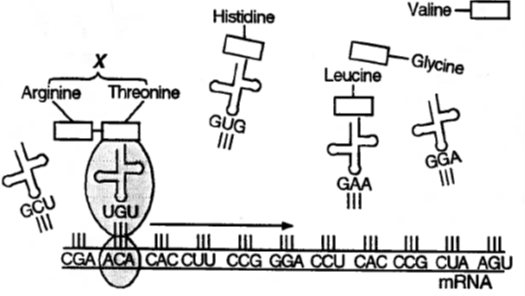
Identify all the structural differences between RNA and DNA.
DNA uses deoxyribose sugar, RNA uses sugar ribose
DNA pairs Adenine with Uracil, RNA pairs Adenine with Thymine
DNA is a double helix, RNA is a single helix
DNA pairs Adenine with Thymine, RNA pairs Adenine with Uracil
Which organelle is the location where protein is made?
Ribosome
Nucleus
Cytoplasm
Nucleotide
When these bond together, they form a protein
Amino Acids
Peptide Bonds
Ribose
Nucleotides
During translation, this type of ribonucleic acid is responsible for delivering amino acids to help make a protein.
mRNA
rRNA
tRNA
dRNA
There are a total of ____ different amino acids
20
1
4
unlimited
mRNA occurs during this process
Translation
Transcription
Replication
Delivery
Which of the following is the complementary mRNA sequence to this DNA strand: AACTGAA
UUGACUU
TTGACTT
AACTGAA
AACUGAA
ATG GGA ACT CCA
This molecule carries genetic code from the nucleus to the ribosomes in the cytoplasm.
rRNA
tRNA
mRNA
DNA

What process is happening in the diagram?
transcription
translation
dna replication
mitosis
What is the sequence for protein synthesis?
mRNA made from DNA, it leaves the nucleus and enters the cytoplasm, tRNA brings an amino acid to the ribosome where the mRNA is located where the protein is made
DNA leaves the nucleus & enters the cytoplasm, tRNA brings an amino acid to the ribosome where the mRNA is located where the protein is made
tRNA brings an amino acid to the ribosome where the mRNA is located where mRNA is made to construct more DNA
mRNA made from another mRNA, it leaves the nucleus and enters the cytoplasm, tRNA brings an amino acid to the ribosome where the mRNA is located where the protein is made
Transcription= ______________
makes tRNA for amino acid attachment
making more DNA
translates proteins
creates the code for proteins
Translation=________________
makes tRNA
creates amino acids
creates proteins
makes a code

What is the round structure attached at the top?
codon
amino acid
tRNA
ribosome
Several amino acids create a ________________.
protein
tRNA
code
ribosome
The following DNA strand is TTACCGATACAT, what would the transcription mRNA strand be?
AAUGGUAUGUA
TTACCGATACAT
UUAGGCUAUCUA
AATGGCTATGTA
Using this mRNA strand: CUC-AAG-UGC-UUC, what would the correct original DNA strand?
CUC-AAG-UUG-UUC
GAG-UUC-ACG-AAG
GAG-TTC-ACG-AAG
AGA-CCT-GTA-GGA
Which of the following molecules was made in the nucleus and carries the genetic code of DNA?
tRNA
ribosome
protein chain
mRNA
What molecule is considered the anti-codon and brings the correct amino acid to the ribosome?
protein chain
ribosome
mRNA
tRNA
The process to go from DNA to mRNA is _______
translation
transcription
replication
The process to go from mRNA to a protein is called ____
transcription
rRNA
replication
translation
DNA holds the code for
lipids
carbohydrates
proteins
sugars
The main function of tRNA is to...
carry a message that, when translated, forms proteins
form a portion of ribosomes
string together complementary RNA and DNA strands
bring amino acids from the cytoplasm to the ribosomes
Pick the correct order of gene expression.
DNA -> Transcription -> RNA -> Translation -> Protein
RNA -> Translation -> DNA -> Transcription -> Protein
DNA --> RNA --> Transcription -> Translation --> Protein
DNA -> Translation -> RNA -> Transcription -> Protein
Translation consists of which of the following?
conversion of genetic info from the language of nucleic acids to the language of proteins
conversion of genetic info from DNA to RNA
addition of nucleotides to a DNA template
DNA replication

mRNA contains which bases?
adenine, guanine, uracil, cytosine
thymine, guanine, cytosine, uracil
thymine, uracil, cytosine, guanines
adenine, uracil, guanine, thymine
Translation is when...
a strand of mRNA is read by tRNA in the ribosome to synthesize a protein
a strand of amino acids is assembled in the nucleus
a section of DNA (called a gene) is used to produce a strand of mRNA
a protein is read by tRNA in the ribosome to assemble a strand of mRNA
Which part of the structure of DNA informs the production of proteins?
The sugar-phosphate backbones
The order of nucleotides (like A, T, C, G)
The double helix
None of the above
After translation, the strand of amino acids...
folds up to make a protein
is dissolved by enzymes
unwinds and creates a chromosome
returns to the nucleus
A protein may not have the same function if...
its structure has been altered.
it's produced by a ribosome.
its structure is intact.
it's synthesized during translation.

Use the amino acid wheel to translate the Anti-Codon.
AAG - UCG - CGC
Threonine - STOP - Methionine
Lysine - Serine - Arginine
Glutamine - Histidine - Proline
A codon is made up of how many mRNA bases
15
5
3
What carries the instructions for building a protein
Trait
RNA Synthase
Gene
What are the parts of a Nucleotide
ribose + phosphate group + Uracil
Phosphate group + Deoxyribose Sugar + Cytosine
ribose + phosphate group + thymine

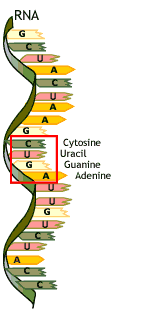

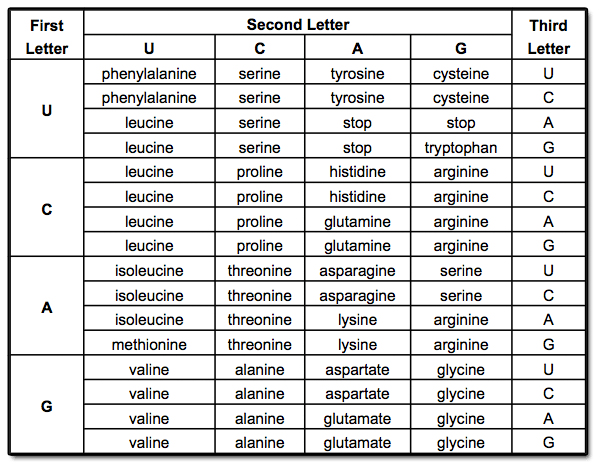

What is the correct amino acid sequence for the mRNA code AUGCCAGUAUGA
Met-Pro-Ala-Val
Met-Pro-Val
Tyr-Gly-His
Tyr-Gly-Arg-His
What is the location in the cell for translation?
nucleus
mitochondria
cytoplasm
chloroplast

What is the purpose of strand "A"?
For DNA replication
To make more DNA
To serve as a template for the synthesis of mRNA
To carry the genetic information to the cytoplasm
Which of the following is a codon?
ATC
A
AUC
AU
How many codons equals 1 amino acid?
1
2
3
4

Which molecule carries the anticodon?
mRNA
rRNA
DNA
tRNA

A polypeptide (protein chain) is a sequence of ____________________ held together by a _______________ bond.
amino acids; peptide
proteins; hydrogen
fatty acids; ionic
fatty acids; covalent
The tRNA carries the ____________________ which matches the _________________ on the mRNA strand.
anticodon; codon
codon; anticodon
amino acid; DNA
anitocodon; nucleotide
Protein Synthesis is
the process in which cells follow a series of steps to create proteins
DNA replication -> Transcription -> Translation
DNA is copied from mRNA, which is used as a template for the instructions to make protein
All of the above!
Where are proteins assembled (put together) in a cell?
Nucleus
Ribosome
Cell Membrane
Muscles
What is the last step of transcription?
close DNA
Detach ribosome
connect it
stop ribosome
Which is bigger?
nucleotide
nucleic acid
Which of these does not happen in the nucleus?
Translation
Transcription
Replication


How many amino acids will FIFTEEN codons code for?
three
five
fifteen
thrity
Molecule that makes up proteins (monomer of proteins)
Ribosome
rRNA
Ribose
Amino acid



