
NEW
Font size
 Worksheets
TEKS 6.12A & 6.12C
Total questions: 65
Worksheet time: 49mins
A producer
Eats grass
Makes its own food
Does not need food(energy)
Is a primary consumer
A primary consumer
makes its own food
eats other animals
is a carnivore
consumes the producer
An animal that only feeds on plants is called
Vegetarian
Herbivore
Carnivore
Vegan
Carnivores
Animals that feeds on meat and plants
An animal that doesn't like meat
An animal that feeds on meat
An animal that gets energy from the sun
Omnivores
Animals that feeds on meat and plants
An animal that doesn't like meat
An animal that feeds on meat
An animal that gets energy from the sun
A producer always
eats other producers
gets energy from the sun
is a herbivore
is a plant
Which animal is an omnivore?
Bear
Horse
Shark
Lion
Which animal is an herbivore?
Bear
Horse
Shark
Lion
Which animal is a carnivore?
Bear
Horse
Shark
Human


Which is the correct order of the levels of organization from simple to complex?
A population is __________________.
all organisms in an area that belong to the same species
all of the different species living together in an area
an individual living thing
all of the biotic and abiotic non-living factors in an area
A ecosystem is __________________.
all organisms in an area that belong to the same species
all of the different species living together in an area
an individual living thing
all of the living and non-living factors in an area

What is the largest level of ecological organization that can be observed in the image?
Species
Population
Community
Ecosystem

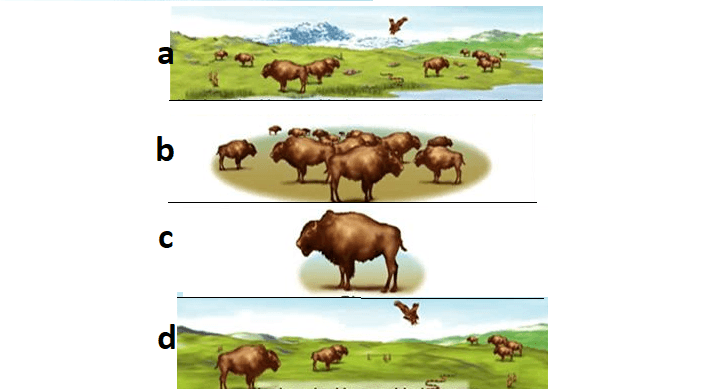
Which represents an organism?
a
b
c
d
Which is a biotic component of the ecosystem?
water
oxygen
temperature
whale
Which is an abiotic component of the ecosystem?
tree
rotten log
nitrogen
toad
Which are abiotic factors in an ecosystem?
water & air
water & lizards
air & zebras
water & lizards
Which of the following is an abiotic factors in an aquatic ecosystem?
algae
coral
water
fish
At which level are abiotic factors introduced?
organism
community
population
ecosystem
True or False: Only biotic factors are included in the levels - organism, population, & community.
True
False
Which is the best description of an ecosystem?
an area with living organisms that contains only abiotic components
an area with living organisms that contains only biotic components
an area with living organisms that contains biotic and abiotic components that interact with each other
an area with living organisms that contains biotic and abiotic components that do not interact with each other
Which of the following interactions best describes an organism interacting with a BIOTIC part of the ecosystem?
bird flying through the air
deer drinking water
plants using sunlight to make their own food
squirrel using a log as shelter
If an ecosystem experiences a drought (no water/rain for a long period of time), what would most likely happen?
populations of predators would increase
animals would die, but plants would not be affected
populations in the grassland will move away or die
the amount of grass would increase
Which is the correct relationship between abiotic and biotic factors in an ecosystem?
abiotic factors depend on biotic factors
biotic factors rely on abiotic factors to grow and survive
biotic factors give abiotic factors the nutrients they need to live
none of the above
An organism is __________________.
all organisms in an area that belong to the same species
all of the different species living together in an area
an individual living thing
all of the biotic and abiotic non-living factors in an area
A community is __________________.
all organisms in an area that belong to the same species
all of the different species living together in an area
an individual living thing
all of the biotic and abiotic non-living factors in an area

The following image is an example of a(n) ____________.
organism
population
community
ecosystem

The following image is an example of a(n) ____________.
organism
population
community
ecosystem

The following image is an example of a(n) _____________.
organism
population
community
ecosystem

The following image is an example of a(n) ___________.
organism
population
community
ecosystem
Abiotic factors are _______________.
living things
non-living things
Biotic factors are _________________.
living things
nonliving things

What is eaten by both the owl and the bird?
A. Grass
B. Mice
C. Grasshopper
D. Grain

What is the role of sunflowers?
A. producer
B. consumer
C. decomposer
D. prey

What would happen if the owl population decreased?
A. The owl population would increase
B. The insect population would decrease
C. The mouse population would decrease
D. The mouse population would increase
What is the original source of energy in a food web?
Decomposers
Consumers
Producers
The Sun

The diagram shows a food web. Which of the following gets its energy directly from a producer?
The Sun
Plants
Deer
Snake

In the food web shown, which are the producers?
the prairie grass and plant seeds
plant seeds and the mountain lion
the prairie grass and the squirrel
the robin and deer

In the food web diagram, what do the arrows represent?
The life cycle of each organism
How one organism changes to another
How food is produced by many organisms
The flow or transfer of energy through an ecosystem
Temperature is a _________factor
Biotic
Abiotic
living
cool
Soil is an example of a
Biotic factor
Abiotic factor
competition
herbivorous
What abiotic factor do plants provide animals?
sunlight
temperature/climate
water
oxygen

Which of these organisms is considered to be a producer?
grass
gazelle
fox
coyote

Which of these organisms is the apex predator?
Owl
Mouse
Grasshopper
Grass

