wayground logo

Free Printable Worksheets

NEW

Font size

S
M
L
XL
Worksheets

Sound & Light Quiz

Total questions: 80

Worksheet time: 44mins
Name
Class
Date
1.
What happens to a wave when it meets a surface or boundary?
a)
It disappears
b)
It bounces back
c)
It speeds up
d)
It changes color
2.
What is diffraction?
a)
Bending of waves around an edge
b)
Bouncing back of waves
c)
Change in wave speed
d)
Combining of waves
3.
What is the Doppler Effect?
a)
Change in wave speed
b)
Change in the observed frequency of a wave
c)
Bending of light
d)
Reflection of sound waves
4.
What type of wave is sound?
a)
Transverse wave
b)
Longitudinal wave
c)
Surface wave
d)
Electromagnetic wave
5.
What is constructive interference?
a)
Waves cancel each other out
b)
Waves combine to form a higher amplitude
c)
Waves bend around corners
d)
Waves reflect off surfaces
6.
What is the primary factor that determines the pitch of a sound?
a)
Amplitude
b)
Frequency
c)
Wavelength
d)
Speed
7.
What is the speed of sound in air?
a)
340 m/s
b)
3.0 × 10⁸ m/s
c)
1500 m/s
d)
1200 m/s
8.
What is the relationship between frequency and period?
a)
Directly proportional
b)
Inversely proportional
c)
No relationship
d)
Equal
9.
What is the role of the cochlea in hearing?
a)
Amplifies sound
b)
Transmits sound to the brain
c)
Converts sound waves into nerve impulses
d)
Filters out background noise
10.
What is the electromagnetic spectrum?
a)
A range of sound frequencies
b)
A range of light frequencies and wavelengths
c)
A type of wave
d)
A measurement of wave speed
11.
What type of lens is a magnifying glass?
a)
Concave lens
b)
Convex lens
c)
Flat lens
d)
Biconcave lens
12.
What is the primary function of the outer ear?
a)
Amplifying sound
b)
Directing sound waves to the eardrum
c)
Transmitting sound to the brain
d)
Filtering sound
13.
What is the phenomenon called when light bends as it passes through different mediums?
a)
Reflection
b)
Refraction
c)
Diffraction
d)
Interference
14.
What is the unit of frequency?
a)
Decibel
b)
Hertz
c)
Meter
d)
Second
15.
What happens to light when it passes through a prism?
a)
It reflects
b)
It disperses into colors
c)
It absorbs
d)
It speeds up
16.
What is the main purpose of sonar?
a)
To amplify sound
b)
To determine distances and locate objects
c)
To create images
d)
To measure sound intensity
17.
What is the role of rods and cones in the eye?
a)
To focus light
b)
To detect light and color
c)
To transmit sound
d)
To amplify images
18.
What is the relationship between intensity and amplitude of a sound wave?
a)
Intensity is independent of amplitude
b)
Higher amplitude means higher intensity
c)
Lower amplitude means higher intensity
d)
They are inversely related
19.
What is a standing wave?
a)
A wave that travels in one direction
b)
A wave that does not move
c)
A wave formed by the interference of two waves
d)
A wave that reflects off a surface
20.
What is the speed of light in a vacuum?
a)
3.0 × 10⁸ m/s
b)
340 m/s
c)
1500 m/s
d)
1200 m/s
21.
What is the primary difference between reflection and diffraction of waves?
a)
Reflection involves bouncing back, while diffraction involves bending around edges
b)
Reflection only occurs with light waves
c)
Diffraction only happens with sound waves
d)
Reflection and diffraction are exactly the same phenomenon
22.
When waves combine and create a higher amplitude, this is called:
a)
Destructive interference
b)
Constructive interference
c)
Wave cancellation
d)
Wave amplification
23.
What does SONAR stand for?
a)
Sound Oscillation Navigation And Ranging
b)
Sound Navigation And Ranging
c)
Sonic Observation Navigation And Reflection
d)
Sound Observation Navigation And Resonance
24.
Which part of the electromagnetic spectrum has the longest wavelengths?
a)
Gamma rays
b)
X-rays
c)
Radio waves
d)
Infrared waves
25.
What is wave-particle duality?
a)
The ability of light to act sometimes as a wave and sometimes as a particle
b)
A type of mirror reflection
c)
A method of sound transmission
d)
A way of measuring wave frequency
26.
What determines the pitch of a sound?
a)
Wave amplitude
b)
Wave frequency
c)
Wave speed
d)
Wave length
27.
What is the range of human hearing?
a)
10 Hz to 10,000 Hz
b)
20 Hz to 20,000 Hz
c)
5 Hz to 5,000 Hz
d)
50 Hz to 50,000 Hz
28.
What causes the sensation of color in human perception?
a)
The wavelength of light reflected by an object
b)
The intensity of light
c)
The speed of light
d)
The temperature of light
29.
What percentage of the sun's energy is emitted as UV rays?
a)
5%
b)
9%
c)
15%
d)
20%
30.
What is the speed of light in a vacuum?
a)
3.0 × 10⁷ m/s
b)
3.0 × 10⁸ m/s
c)
3.0 × 10⁶ m/s
d)
3.0 × 10⁹ m/s
31.
Which part of the ear first receives sound waves?
a)
Cochlea
b)
Eardrum
c)
Semicircular canals
d)
Pinna
32.
What is resonance?
a)
A type of wave reflection
b)
When two objects vibrate at different frequencies
c)
When two objects naturally vibrate at the same frequency
d)
A method of sound absorption
33.
What determines the loudness of a sound?
a)
Wavelength
b)
Frequency
c)
Amplitude
d)
Speed
34.
What is the fundamental frequency?
a)
The lowest possible wave frequency
b)
The natural vibration frequency of an object
c)
The average wave frequency
d)
The maximum wave frequency
35.
What creates the sensation of heat from infrared waves?
a)
Molecular rotation
b)
Wave amplitude
c)
Electron excitation
d)
Photon emission
36.
What percentage of refraction occurs in the cornea?
a)
50%
b)
60%
c)
70%
d)
80%
37.
What is the order of colors in the visible spectrum from longest to shortest wavelength?
a)
VIBGYOR
b)
ROYGBIV
c)
BGYOR
d)
YORVBIG
38.
What type of lens brings light inward?
a)
Concave lens
b)
Diverging lens
c)
Convex lens
d)
Flat lens
39.
Which cranial nerve carries hearing signals to the brain?
a)
Cranial Nerve II
b)
Cranial Nerve VII
c)
Cranial Nerve VIII
d)
Cranial Nerve X
40.
What is the threshold of pain for sound intensity?
a)
100 dB
b)
110 dB
c)
120 dB
d)
130 dB
41.
What cranial nerve transmits visual information?
a)
CN I
b)
CN II
c)
CN VIII
d)
CN X
42.
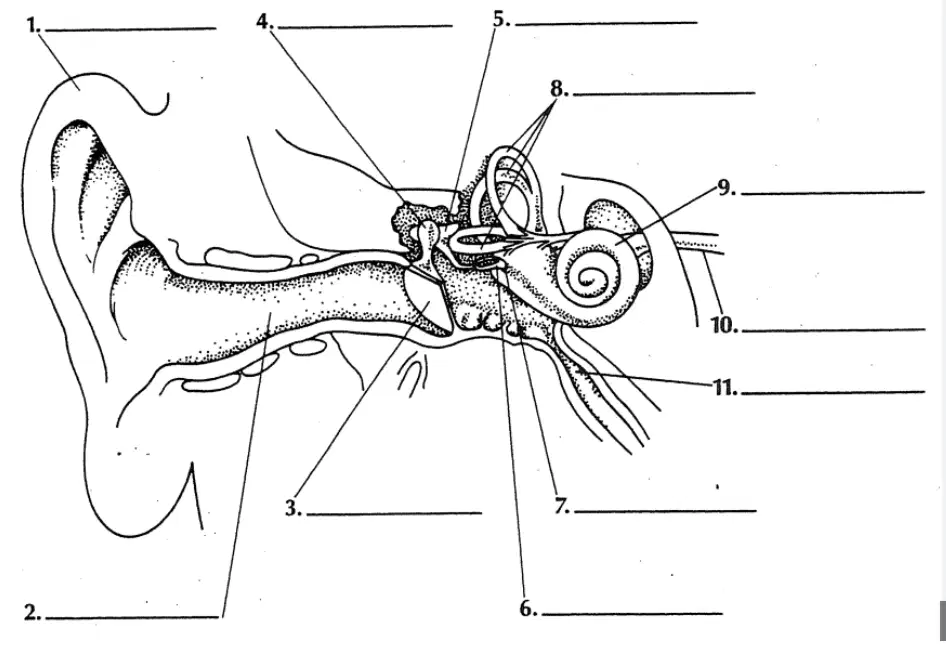
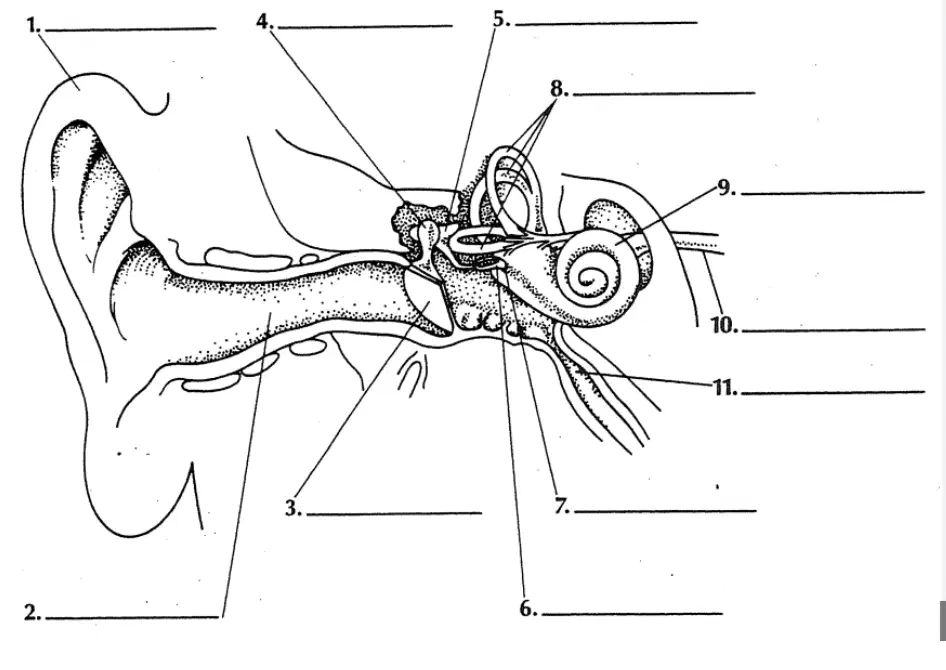
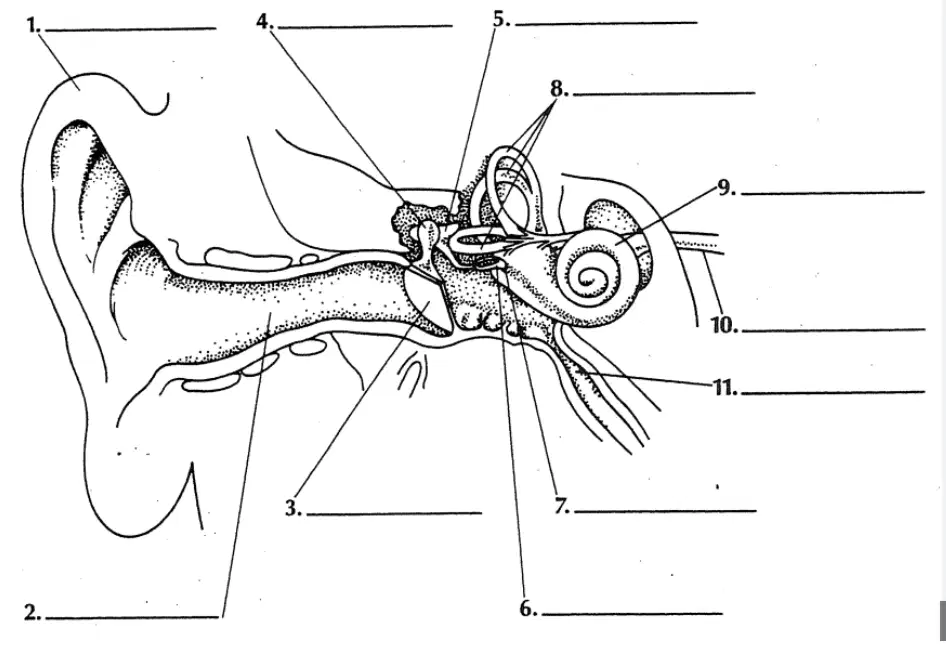
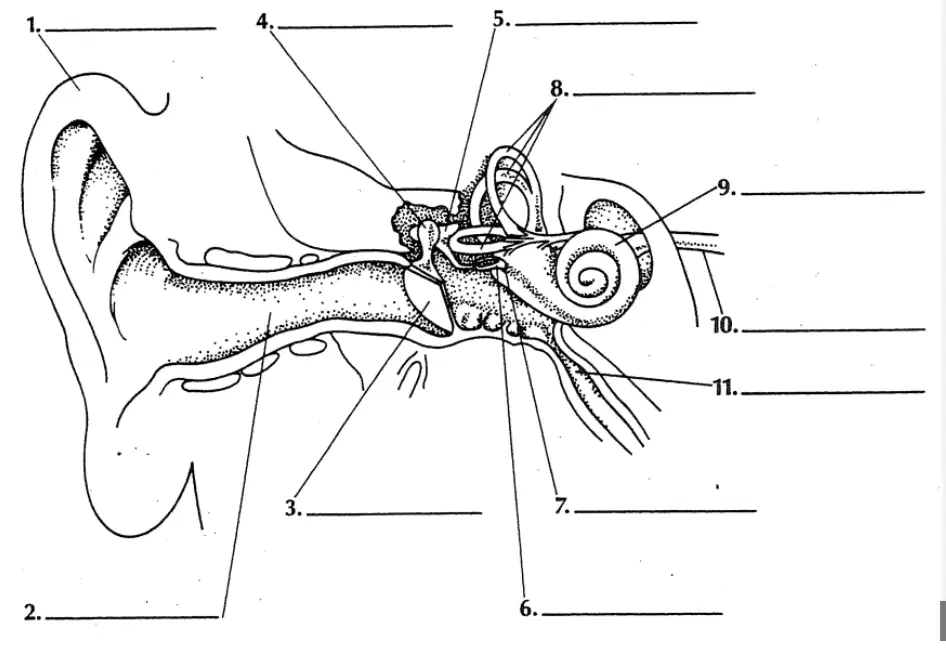
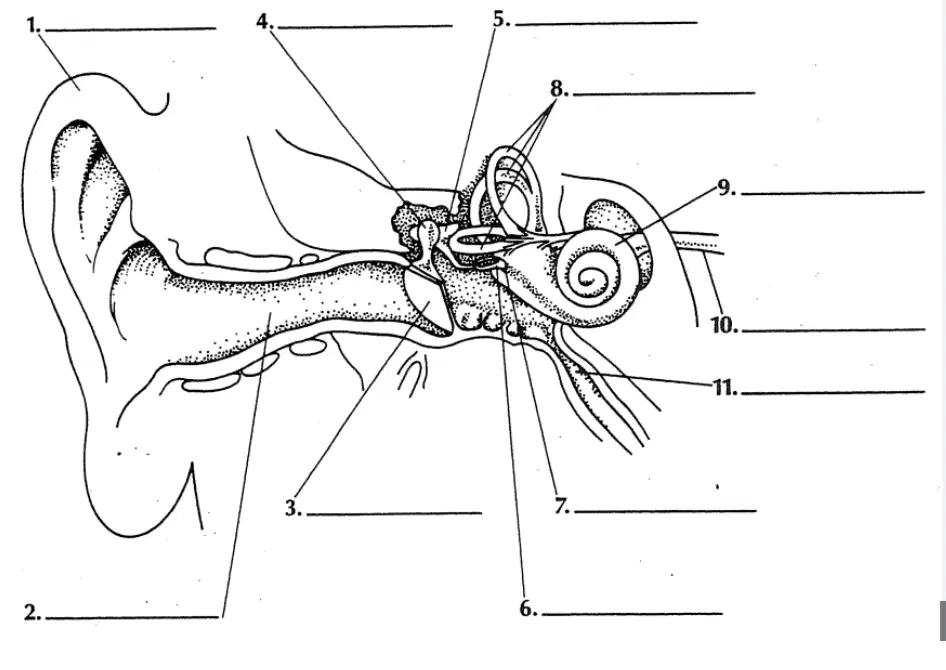
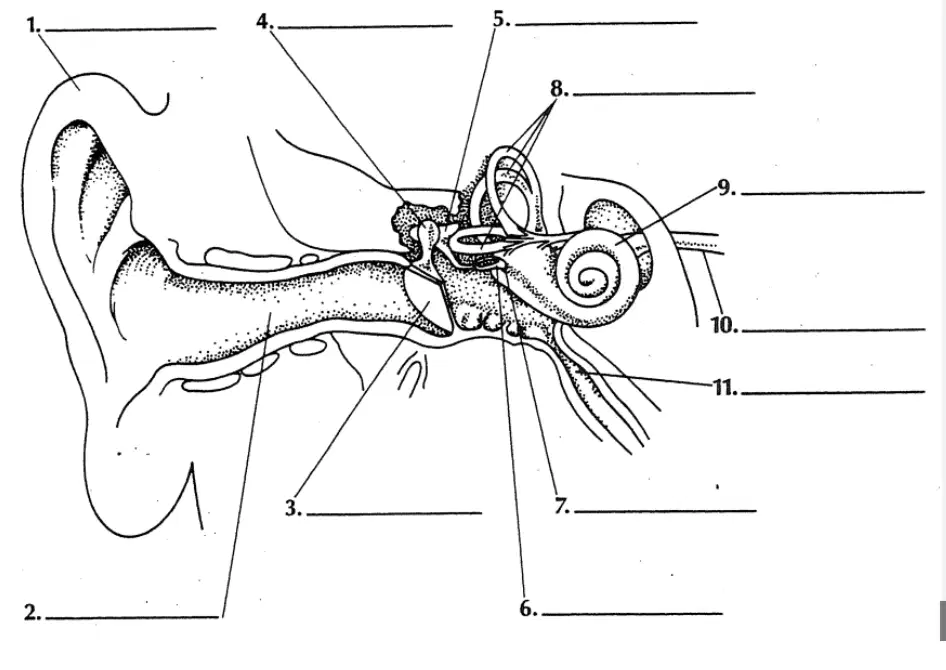
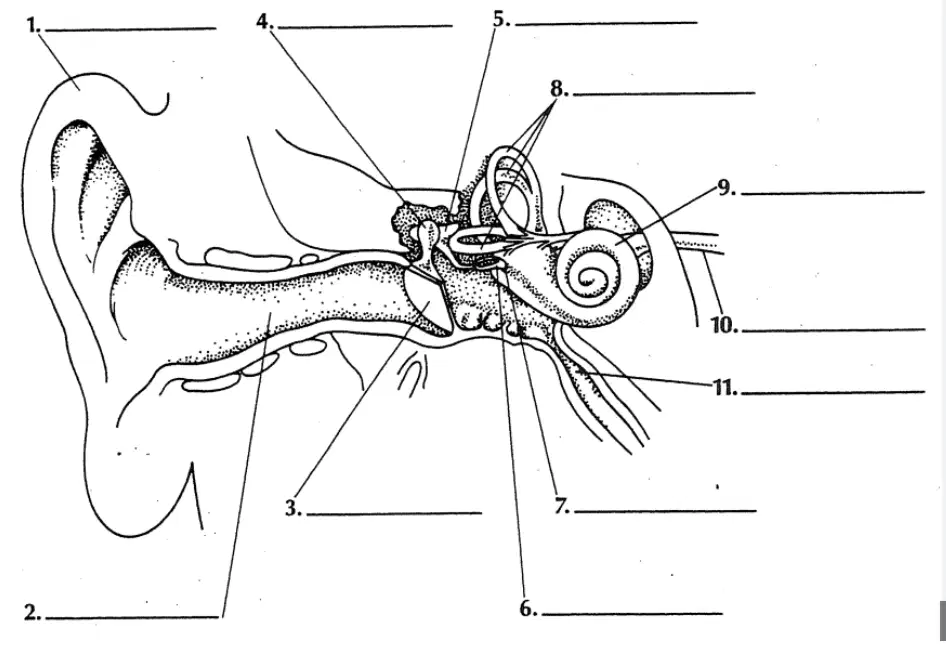
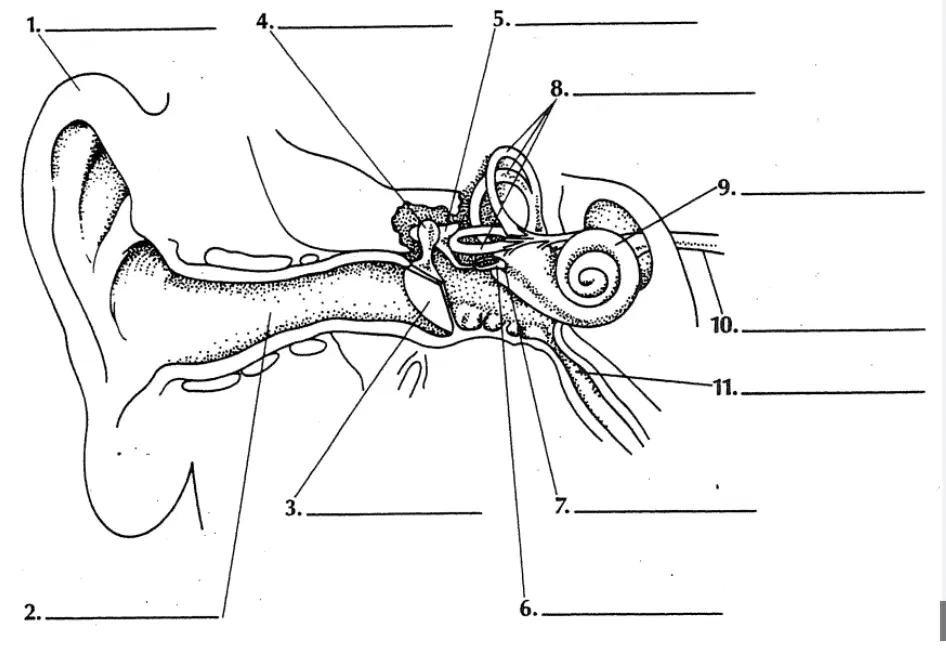
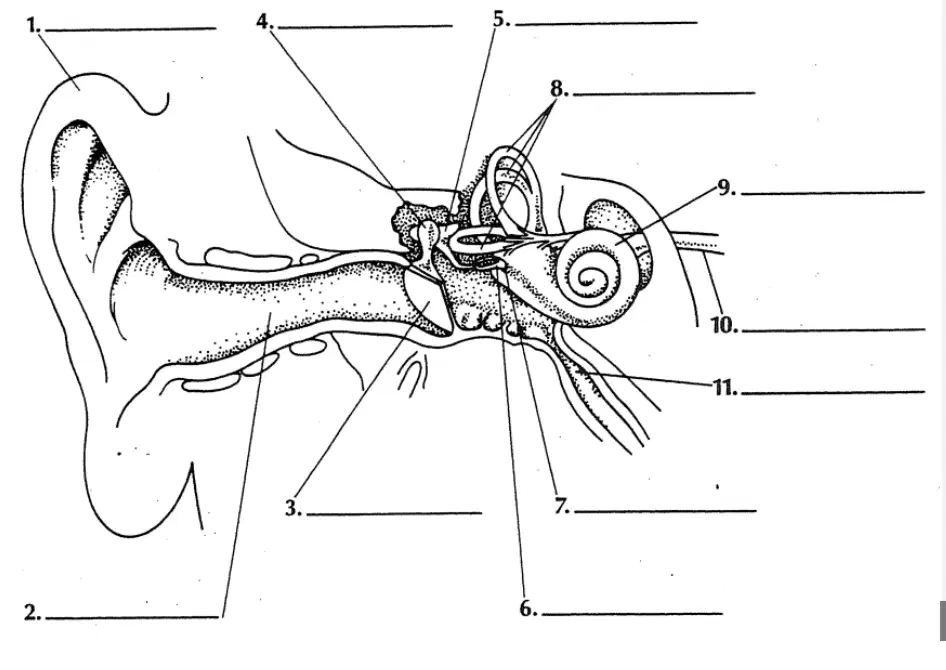
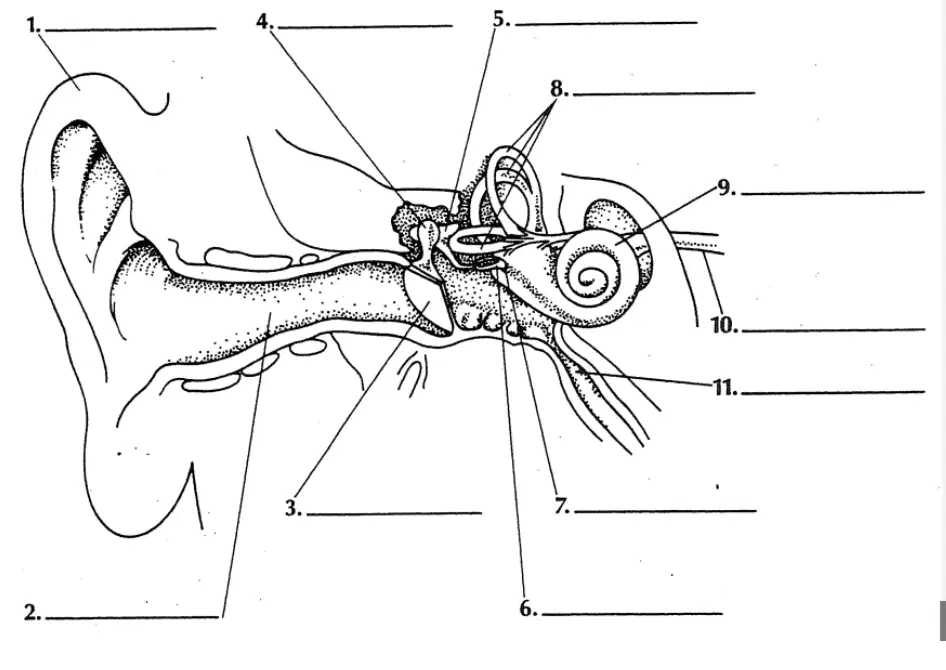
What is # 1 in the diagram?
a)
Pinna
b)
Ear canal
c)
Tympanic membrane
d)
Incus
e)
Stapes
43.
What is # 2 in the diagram?
a)
Ear canal
b)
Tympanic membrane
c)
Incus
d)
Stapes
e)
Malleus
44.
What is # 3 in the diagram?
a)
Tympanic membrane
b)
Ear canal
c)
Incus
d)
Stapes
e)
Malleus
45.
What is # 4 in the diagram?
a)
Malleus
b)
Ear canal
c)
Tympanic membrane
d)
Incus
e)
Stapes
46.
What is # 5 in the diagram?
a)
Incus
b)
Ear canal
c)
Tympanic membrane
d)
Stapes
e)
Malleus
47.
What is # 6 in the diagram?
a)
Stapes
b)
Ear canal
c)
Tympanic membrane
d)
Incus
e)
Malleus
48.
What is # 8 in the diagram?
a)
Semicircular canals
b)
Ear canal
c)
Tympanic membrane
d)
Incus
e)
Stapes
49.
What is # 9 in the diagram?
a)
Cochlea
b)
Ear canal
c)
Tympanic membrane
d)
Incus
e)
Stapes
50.
What is # 10 in the diagram?
a)
vestibulocochlear nerve (CN VIII)
b)
Ear canal
c)
Tympanic membrane
d)
Incus
e)
Stapes
51.
What is # 11 in the diagram?
a)
eustachian tube
b)
Ear canal
c)
Tympanic membrane
d)
Incus
e)
Stapes
52.
What do rods detect in the eye?
a)
Color
b)
Movement
c)
Black and white light
d)
Depth perception
53.
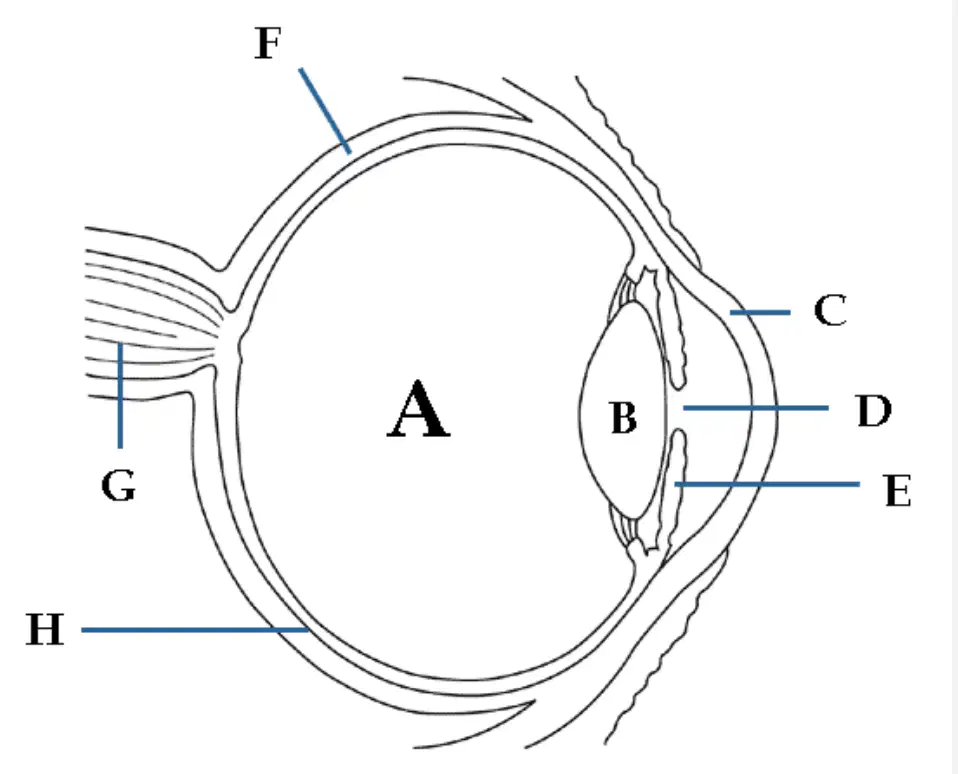
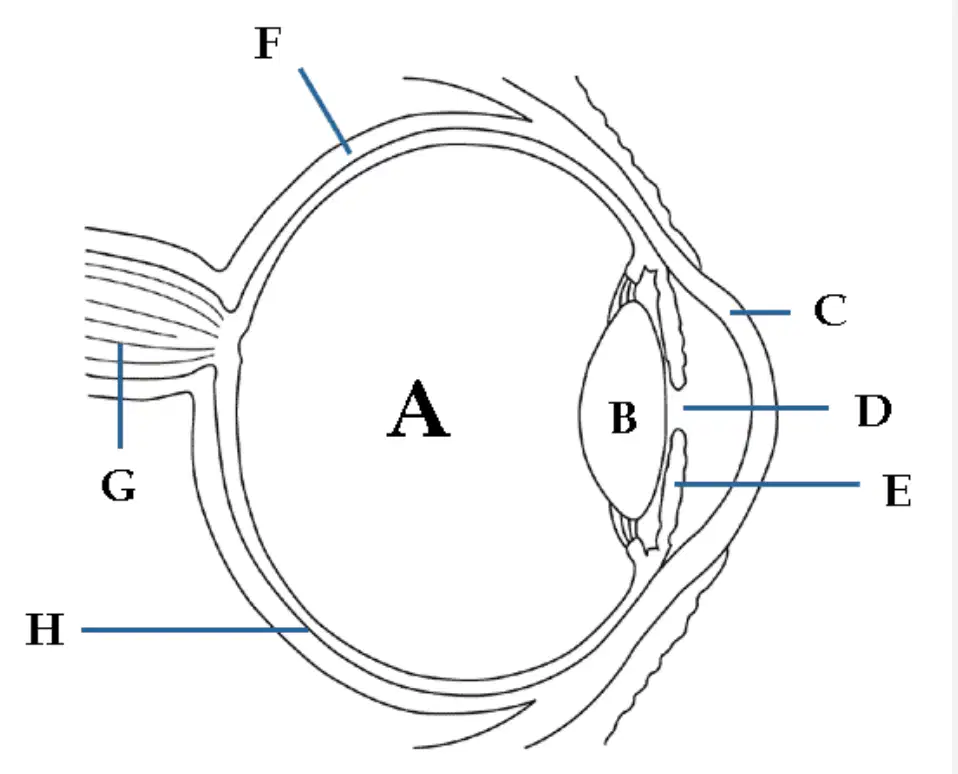
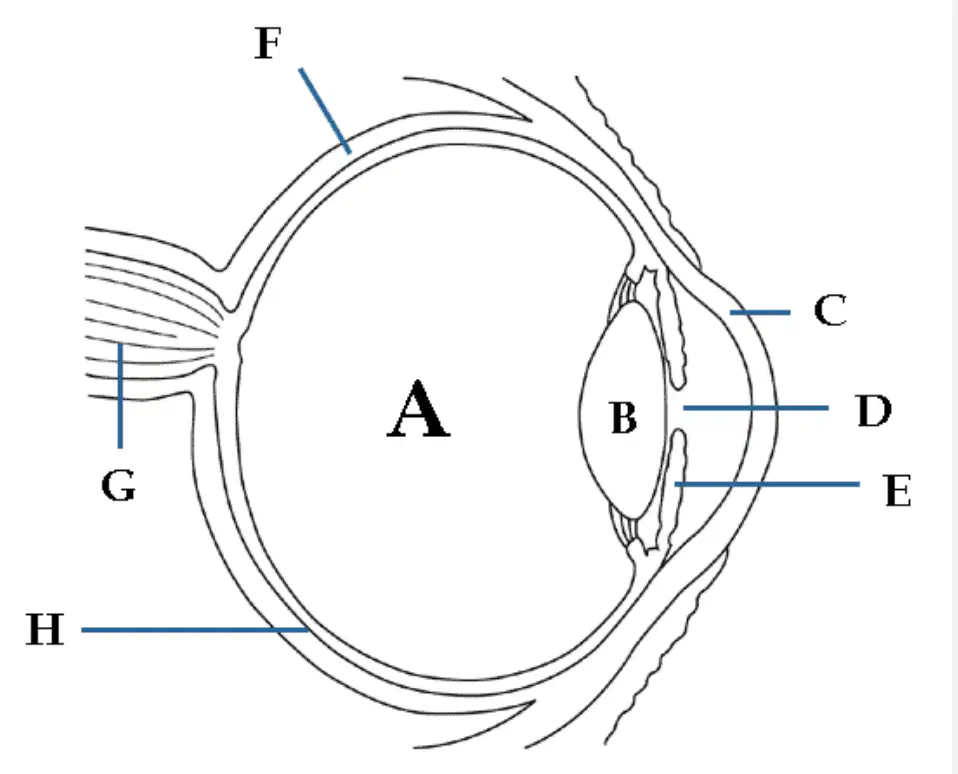
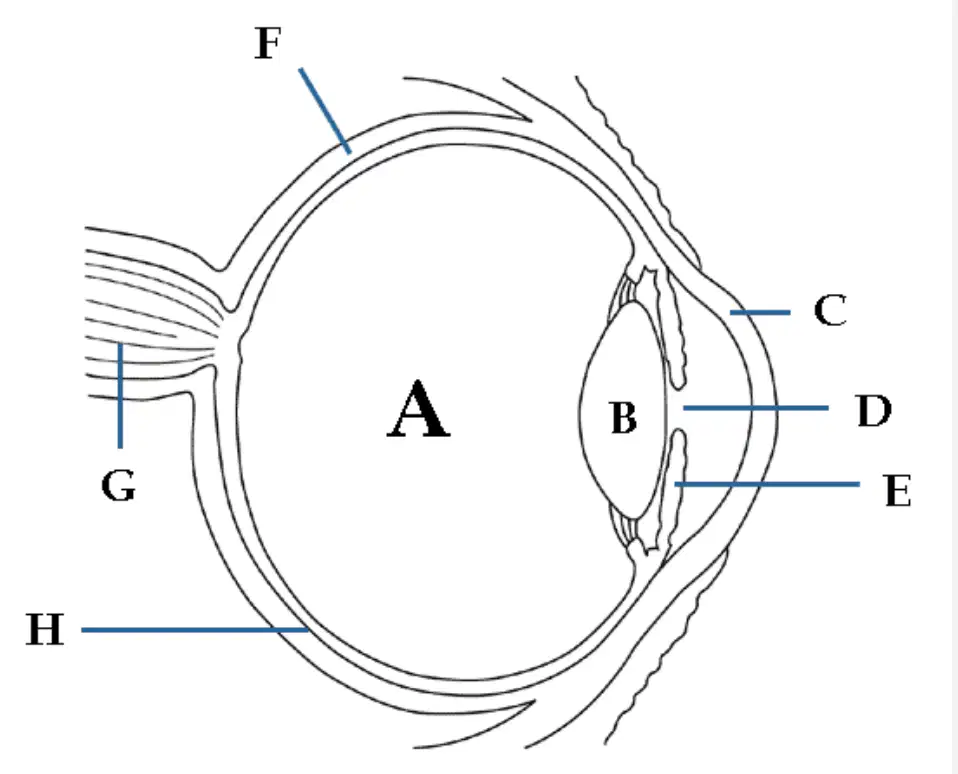
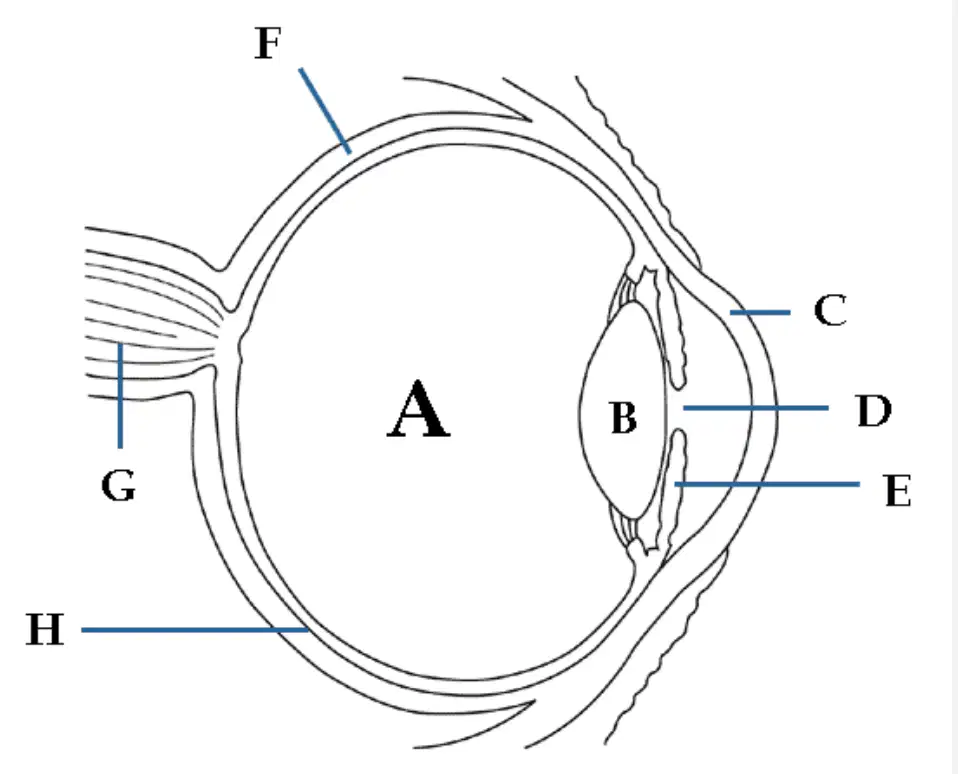
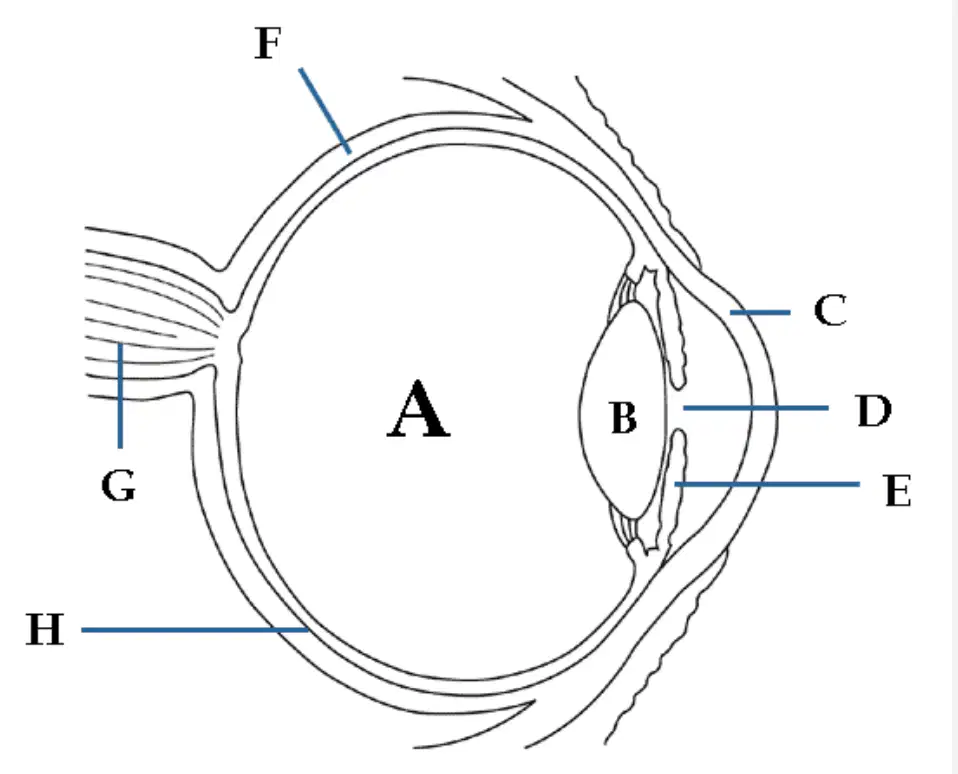
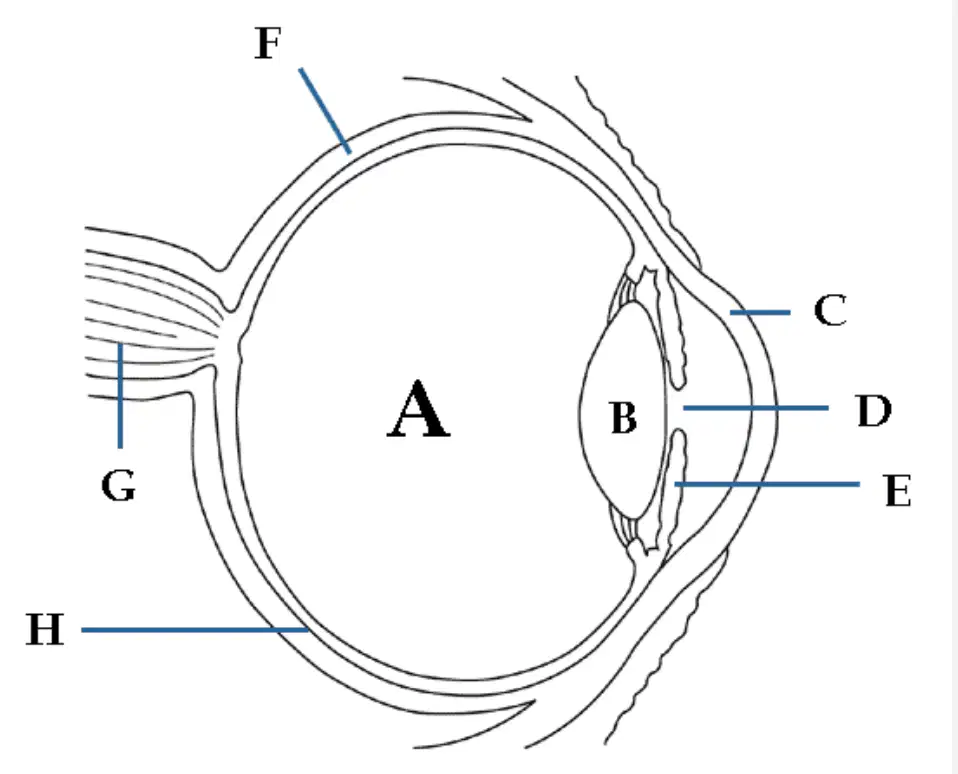
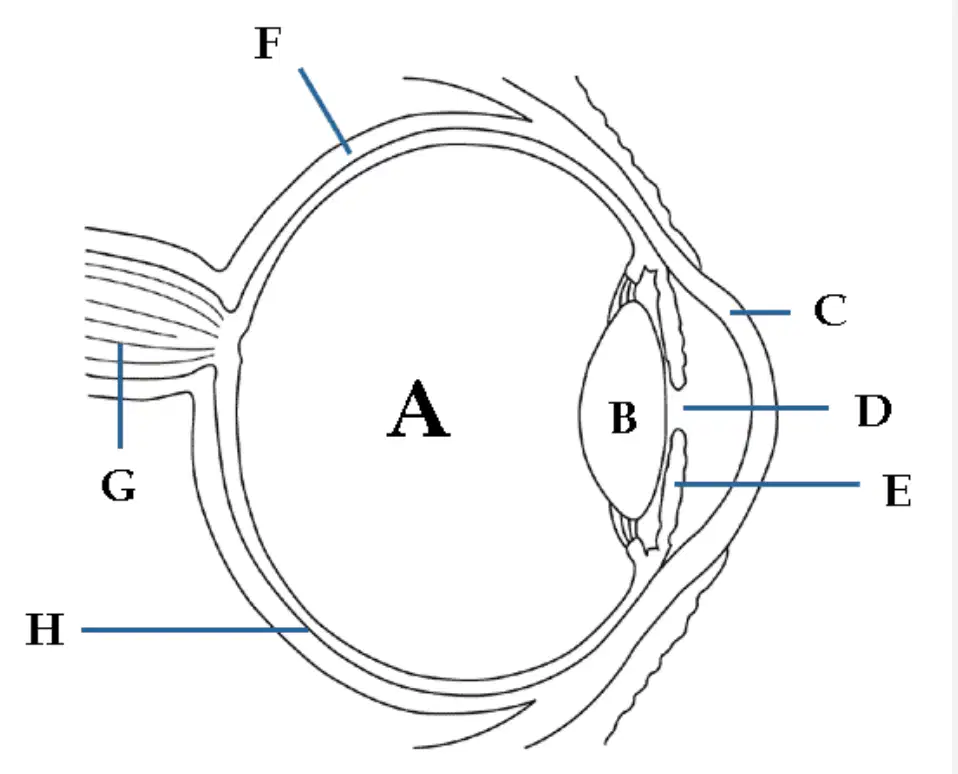
What is structure A?
a)
Vitreous Humour
b)
Cornea
c)
Pupil
d)
Iris
e)
Lens
54.
What is structure B?
a)
Lens
b)
Cornea
c)
Pupil
d)
Iris
e)
Vitreous Humour
55.
What is structure C?
a)
Cornea
b)
Pupil
c)
Iris
d)
Vitreous Humour
e)
Lens
56.
What is structure D?
a)
Pupil
b)
Cornea
c)
Iris
d)
Vitreous Humour
e)
Lens
57.
What is structure E?
a)
Iris
b)
Cornea
c)
Pupil
d)
Vitreous Humour
e)
Lens
58.
What is structure F?
a)
Sclera
b)
Cornea
c)
Pupil
d)
Iris
e)
Vitreous Humour
59.
What is structure G?
a)
Optic Nerve (CN II)
b)
Cornea
c)
Pupil
d)
Iris
e)
Vitreous Humour
60.
What is structure H?
a)
Retina
b)
Cornea
c)
Pupil
d)
Iris
e)
Vitreous Humour
61.

What is the Doppler effect?

a)

Interference of two waves

b)

Absorption of sound waves

c)

Reflection of waves off a surface

d)

Change in wave frequency due to motion

62.

Which part of the ear is responsible for balance?

a)

Auditory nerve

b)

Semicircular canals

c)

Eardrum

d)

Cochlea

63.

What is the unit of frequency?

a)

Newton

b)

Decibel

c)

Pascal

d)

Hertz

64.

What phenomenon demonstrates the wave-particle duality of electrons?

a)

Compton scattering

b)

Photoelectric effect

c)

Electron diffraction

d)

Pair production

65.

What would you call this?

a)

Bounce back

b)

Reflection

c)

Diffraction

d)

Refraction

66.

What type of wave behavior is shown in this image?

a)

Reflection

b)

Refraction

c)

Diffraction

d)

Constructive Interference

67.

What is the phenomenon called when a wave changes direction as it passes from one medium to another?

a)

Reflection

b)

Refraction

c)

Diffraction

d)

Absorption

68.

What is the speed of light in a vacuum?

a)

3×10⁸m/s3 \times 10^8 \, \text{m/s}

b)

1.5×10⁸m/s1.5 \times 10^8 \, \text{m/s}

c)

2×10⁸m/s2 \times 10^8 \, \text{m/s}

d)

4×10⁸m/s4 \times 10^8 \, \text{m/s}

69.
Which letter represents wavelength?
a)
A
b)
B
c)
C
d)
D
70.

Which of the following is an example of a transverse wave?

a)

Sound wave

b)

Light wave

c)

Seismic P-wave

d)

Water wave

71.

All waves carry ________ as they travel from one place to another.

a)

matter

b)

space

c)

energy

d)

water

72.

Which of the following is NOT a property of waves?

a)

Wavelength

b)

Mass

c)

Frequency

d)

Amplitude

73.

How does sound travel through a medium?

a)

By transferring energy through electromagnetic waves

b)

By the movement of particles in a vacuum

c)

By the vibration of particles in the medium

d)

By changing the temperature of the medium

74.

Sonar is often used to find sunken ships underwater. Sonar is the process of using _____ waves and bouncing them off of solid objects to locate their position.

a)

imaging

b)

infrared

c)

light

d)

sound

75.

This is showing which type of wave?

a)

Compression

b)

Transverse

c)

electromagnetic

d)

This is not a wave

76.
What kind of waves can travel through space?
a)
electromagnetic waves
b)
compressional waves
c)
longitudinal waves
d)
sound waves
77.

a form of electromagnetic radiation that does NOT require a medium to pass through

a)

sound wave

b)

light wave

c)

transverse wave

d)

compressional wave

e)

longitudinal wave

78.

Which head motion represents yaw?

a)

Yes

b)

No

c)

Huh?

d)

Sleep

79.

Which head motion represents pitch?

a)

Yes

b)

No

c)

Huh?

d)

Burrito

80.

Which head motion represents roll?

a)

Yes

b)

No

c)

Huh?

d)

Cookies?