
 Worksheets
APES - Unit 2 Review Bank
Total questions: 153
Worksheet time: 1hrs 17mins
Which is evidence of biodiversity?
clonal reproduction within a population
the number of individuals within a region
the number of ecosystems and habitats in a region
a large number of one species in a region
A population is better able to respond to environmental change if
it contains many individuals with high genetic diversity.
it contains a large number of individuals but low genetic diversity.
it has evolved more recently.
it has migrated to its current habitat.
The number of species on Earth that have been identified is approximately
10 billion.
1 billion.
100 million.
2 million.
Although scientists have not yet identified all species on Earth, they estimate that the total number of species is approximately
50 – 100 billion.
5 – 10 billion.
5 – 100 million.
1 – 2 million.
Two square km is equal to how many square meters?
200,000
2,000,000
20,000,000
200,000,000
Five square miles is equal to how many acres? (1 square mile = 640 acres)
320
2,500
3,200
32,000
Seventy-five square kilometers is equal to how many square miles? (1 km = 0.6214 mile)
28.96
2,890
5,625
39,600
Twenty square kilometers is equal to how many hectares? (1 hectare = 10,000 square meters)
20,000
200
2,000
200,000
Fifteen hundred acres is closest to how many hectares? (1 hectare = 2.47 acres)
60
300
600
3,000
A farmer plants 20,000 acres of corn, which is equal to how many hectares?
8,000
10,000
25,000
45,000
If a forest is cleared at a rate of 875 acres per day, approximately how many hectares per year are being cleared? (2.47 acres = 1 hectare)
2,160 hectares
319,000 hectares
3,500 hectares
129,000 hectares
If land is cleared at a rate of 456 hectares per week, approximately how many acres per year are being cleared? (2.47 acres = 1 hectare)
180 acres
9,500 acres
58,600 acres
66,400 acres
A farmer is going to expand his land by 450 acres. Calculate the size of the farmer’s expansion in hectares (1 hectare = 2.47 acres).
100 hectares
180 hectares
450 hectares
900 hectares
A farmer is going clear 180 acres at a rate of 6 acres per day. Which is another way to write the farmer’s rate of clearance?
180 hectares per month
94 acres per month
72 acres per month
42 acres per month
Which factor is most relevant when determining the diversity of an ecosystem?
The number of organisms present
The number of species present
The amount of land the ecosystem covers
The interactions between producers and consumers
Which question might a scientist use to determine whether a group of organisms constitute a species?
Do they share the same habitat as other groups of organisms?
Do they exhibit sexual or asexual reproduction?
Can they interbreed with others from the same group?
Are they dominant or rare in their occupied habitat?
Current estimates for the number of species on Earth range between
1 million–2 million.
1 billion–2 billion.
10 million–20 million.
100 million–1 billion.
Which is used to measure the diversity of an ecosystem?
Species extinction rate
Species evenness
Fitness of organisms
Ratio of predator species to prey species
Which is the best description of species evenness?
How evenly spread out a particular species is within an ecosystem
The number of species within an ecosystem
The number of organisms present within an ecosystem
The relative dominance of each species within an ecosystem
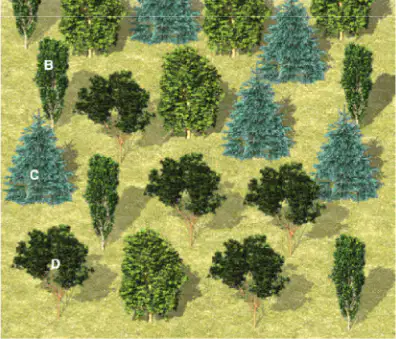
Which is the best description of the two communities shown?
Community 1 has a higher evenness but lower richness than Community 2.
Community 1 has a higher evenness and equal richness to Community 2.
Community 2 has a higher evenness and higher richness than Community 1.
Community 2 has a higher evenness but lower richness than Community 1.
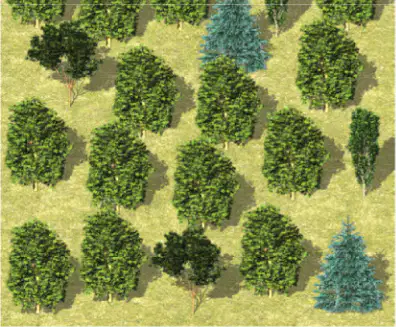
Which is an accurate comparison of the two communities shown?
Communities 1 and 2 have the same species richness.
Communities 1 and 2 have the same species evenness.
Community 2 has a higher species evenness than Community 1.
Community 1 has a higher species richness than Community 2.

The table lists the number of individuals of each species found within four field communities. Which community is most diverse overall?
Community 1
Community 2
Community 3
Community 4

Which community has the highest species evenness?
Community 1
Community 2
Community 3
Community 4

Which community has the lowest species evenness?
Community 1
Community 2
Community 3
Community 4

Which community would be least vulnerable to the effects of environmental disturbances?
Community 1
Community 2
Community 3
Community 4
The number of species in a given area is known as
species richness.
phylogeny.
species evenness.
dominance.
Why is it challenging to estimate the number of species on Earth?
The number of newly evolved species is constantly more than the number going extinct
New species exist in places that are hard to see or access
Most species are now extinct.
The number of invasive species is spreading across the planet.
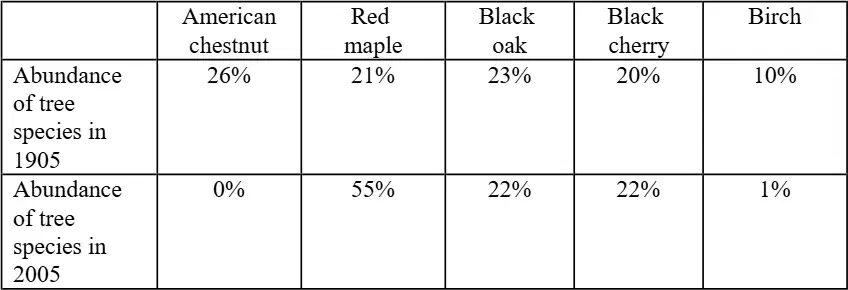
In temperate deciduous forests of North America, American chestnut trees have disappeared due to a fungal disease. In one forest, researchers have surveyed the trees for over 100 years. The table shows the percent abundance of tree species in the forest during the summers of 1905 and 2005. Considering only the data presented in the table, which of the following has changed between 1905 and 2005?
Species evenness
Both species richness and species evenness
Genetic diversity
Total number of trees
When North American beavers build a dam on a river, they convert part of the river to wetland. Soon after the dam is built, many species of insects and snails begin to colonize the wetland. Eventually, the beavers attract mates, breed, and produce three to four offspring per year. Which of the following have increased because of these activities?
Total biomass of organisms
Species evenness and species richness
Ecosystem diversity, genetic diversity, and phenotypic diversity
Genetic diversity, ecosystem diversity, and species diversity
Which refers to the variety of ecosystems within a region?
Species evenness
Genetic diversity
Species diversity
Ecosystem diversity
Which statement regarding biodiversity is most accurate?
Less diverse ecosystems are more likely to withstand and recover from disturbances because their food webs are less complex.
Diversity always benefits ecosystems unless it includes invasive species.
Humans always cause ecosystems to lose biodiversity.
Biodiversity can be used as a measure to check on change in ecosystems.
Which species would be most vulnerable to environmental changes?
Species with a large population
Niche generalists
Niche specialists
Species with rapid reproductive rates
Climate change poses a threat to niches of living organisms and to their survival. Niche ____ are more likely to survive changing climate conditions because ____.
specialists; they have a variety of food sources and acceptable temperature ranges
specialists; they are more populous on Earth
generalists; they have a variety of food sources and acceptable habitats
generalists; they have less competition
A koala’s diet is mainly composed of eucalyptus leaves. Although eucalyptus leaves are low in nutritional value and poisonous to many animals, koalas inhabit eucalyptus woodlands and generally sleep on the trees themselves. In this example the koala is most likely
a. a niche generalist.
b. a habitat specialist.
c. both niche specialist and habitat specialist.
d. a habitat generalist.
Ecosystem services
are the processes by which life-supporting resources are produced.
are services provided to the environment by humans.
are valued for their beauty.
refer to abiotic features of the environment.
Benefits that nature provides to humans are known as
ecosystem feedbacks.
positive feedbacks.
essential functions.
ecosystem services.
The intrinsic value of an ecosystem is
the cost of maintaining and conserving an ecosystem.
the value of an ecosystem as determined through a cost-benefit analysis.
the value of an ecosystem dependent on human benefit.
the value of an ecosystem independent of any human benefit.
Which is an ecosystem service that is used to calculate instrumental value?
Support systems
Geological formation
Biological extinction
Soil erosion
When a spruce tree is harvested so the wood can be used to build a house, the tree is providing
a cultural service.
a provision.
an intrinsic value.
a monetary unit.
Human waste is often dumped in the ocean. Microbial organisms in marine ecosystems can break down organic waste into less harmful components. This is an example of
a. a cultural service.
b. an ecosystem provision.
c. a regulating service.
d. an intrinsic value.
Bees are important to ecosystems and humans because they provide
a. a supporting service through the pollination of crops.
b. a regulating service that increases crop yields.
c. a support system through the pollination of food crops.
d. a support system through promoting biodiversity of crops.
The aesthetic value of an ecosystem provides
a supporting service.
a regulating service.
an intrinsic value.
a cultural service.
A friend is choosing between two nearly identical houses. One house is on the shore of a lake, and the other is a mile away from the nearest lake. The house on the lake costs $6,000 more because of the ____ the lake provides.
regulating services
support systems
resilience
cultural services
Which of the following would be considered a provision service of an ecosystem?
Ecological cycling of nutrients
High decomposition rates, adding nutrients to the soil
High net primary production
Use of lumber from a forest
Products obtained from nature that humans can use such as lumber, medicines and food crops are
ecological benefits.
provisions.
supplies.
services.
Processes that help to balance ecosystems, such as balancing nutrient cycling, are known as
provisions.
regulating services.
support systems.
resilience.
The aesthetic beauty of a forest is an example of
resilience.
a regulating service.
a cultural service.
a provision.
Which is an example of a cultural ecosystem service?
Food
Medicinal products
Natural tourist attractions
Timber
If an ecosystem is seen as intrinsically valuable,
it provides provisions, such as crops.
it is widely appreciated for its aesthetic beauty.
it is used primarily as a tool to achieve a goal.
it is considered worth protecting, no matter the benefit to humans.
Which is an example of preserving an ecosystem for maintaining regulating services?
Protecting trees to help reduce atmospheric carbon levels
Maintaining national parks to increase government revenue
Providing habitat for pollinators in orchards and farms
Slowing deforestation to find new pharmaceutical drugs
Madagascar and the Seychelles are both islands in the western Indian Ocean. Madagascar is over 1,000 times larger than the Seychelles. Using the theory of island biogeography an ecologist would predict that
there is greater species richness on Madagascar.
there is less species richness on Madagascar.
there is a higher species density in the Seychelles.
the species richness is the same on both islands.
You are on a town committee formed to determine the borders for a new local nature park. You explain that according to the theory of island biogeography, if the committee wishes to promote species richness it should
isolate the park by building a wall around its borders.
exclude all invasive species.
increase the distance between the park and all human activity.
increase the size of the park.
Which would be considered when determining the fundamental niche of a species?
Reproductive rate
pH tolerance
Species density
Genetic diversity
If you were studying the fundamental niche of a bird species, you might investigate
its competitors.
its predators.
to which diseases the species is susceptible.
the places where it builds its nests.
Two species that have a high degree of niche overlap will most likely
compete intensely.
speciate.
interbreed.
be a predator-prey pair.
Earthworms live in many grass and forest ecosystems, and burrow into the soil. They ingest organic matter and travel between soil horizons. These traits, taken collectively, refer to the ____ of the earthworm.
niche
habitat
community profile
ecosystem profile
The loblolly pine requires a minimum temperature to grow and thrive. Under current conditions, it is common in the southeastern region of the United States. If average temperatures increase throughout the United States, how would you expect the distribution of the loblolly pine to change?
Spread south
Spread north
Spread east
Spread west
Approximately what percent of species that have ever lived on Earth are thought to be extinct?
33 percent
50 percent
85 percent
99 percent
How might a meteorite landing on Earth lead to a worldwide, mass extinction?
A collision would produce a dust cloud that blocks sunlight, reducing photosynthesis.
A collision would crush a large number of organisms, reducing population sizes.
A collision would destroy a large area of habitat, reducing population sizes.
A collision would produce a large dust cloud, reducing overall air quality.
According to the fossil record, the number of genera of plants and animals that have been present on Earth has
steadily increased over the last 500 million years.
steadily decreased over the last 500 million years.
varied greatly over the last 500 million years.
been decreasing since humans evolved.
Which are factors most likely to increase extinction rates?
An increase in habitat size coupled with introduction of predators
Natural selection and artificial selection
Allopatric and sympatric speciation
Habitat destruction and introduction of invasive species
The fundamental niche of a species can include
the amount of sunlight available.
the presence of competitors.
the amount of naturally occurring viruses.
the ratio of predator species richness to prey species richness.
An East African wildebeest population inhabits open plains and grasslands in the Serengeti. The grass plains in East Africa have a temperature range from 50 degrees to 90 degrees Fahrenheit and the average monthly rainfall is between 1 and 6 inches. The wildebeest’s predators include lions and crocodiles. These features describe characteristics of the wildebeest’s
fundamental niche.
range of tolerance.
distribution.
realized niche.
Ecological research within the state of New York has examined how the aspen tree’s habitat will be significantly diminished following projected scenarios of future climate warming. In this example, climate warming will alter the aspen’s
range of tolerance.
fundamental niche.
realized niche.
growth rates.
How many known mass extinctions have occurred since the evolution of complex life 500 million years ago?
3
4
5
6
When interspecific competition occurs between two species with the same realized niche
the two species will engage in commensalism.
one species will perform better and drive the other to extinction.
the two species will form a symbiotic relationship.
the two species will engage in resource sharing.
Which is true about an ecosystem that is highly resistant to disturbances?
The ecosystem bounces back to its original state quickly.
The disturbance changes the flow of energy but not matter.
There are no major impacts on the flows of energy or matter.
There are no changes in the populations or communities of the ecosystem.
Which ecosystems are likely to be the most diverse?
Ecosystems experiencing high levels of disturbance
Ecosystems experiencing intermediate levels of disturbance
Ecosystems experiencing low levels of disturbance
Ecosystems experiencing no disturbance
Which example supports the intermediate disturbance hypothesis?
Low species diversity in the Arctic is the result of no ecological disturbances.
Forests that are prone to natural forest fires have a greater diversity of species.
The biodiversity in a coral reef is diminished following the opening of fishing grounds.
Forests with no disturbances have the highest level of species diversity.
A researcher has been studying coral reef species diversity for the past two decades. In the first decade, she observed zero hurricanes and the species diversity on the reef remained the same. However, in the last decade, the reef experienced a few minor hurricanes. The researcher recently discovered an increase in the species diversity in the coral reef. These results could support
the occurrence of global climate change.
the first law of thermodynamics.
the intermediate disturbance hypothesis.
the theory of natural selection.
After a forest fire, a badly damaged ecosystem recovered rapidly. This ecosystem has
high resistance.
low resistance.
high resilience.
low resilience.
An ecosystem containing a forest that has been clear-cut showed an immediate and dramatic decrease in the amount of nutrients and energy that were cycled in the ecosystem. This ecosystem has
high resistance.
low resistance.
high resilience.
low resilience.
Researchers conducted breeding experiments on a newly discovered species. Which of the following findings would provide evidence against Darwin’s theory of evolution by natural selection?
Differences in traits are associated with differences in survival.
Individuals produce many offspring, not all of which survive.
Differences in traits are not associated with the ability to reproduce.
Differences in traits can be passed on from parent to offspring.
Which of the following is a key requirement of Darwin’s theory of natural selection?
Phenotypes are resistant to change.
Environmental changes that affect parents are unlikely to affect offspring.
The genotype of an organism determines its phenotype.
Differences in traits are associated with differences in the ability to survive and reproduce.
Which is a non-random process that evolution can occur through?
Mutation
Artificial selection
Genetic drift
Founder effects
Which is a change in the genetic composition of a population as a result of descending from a small number of colonizing individuals?
The founder effect
Inbreeding depression
Gene flow
The bottleneck effect
Which is an example that can reverse the founder effect?
Desert plants growing extensive root systems to better absorb water
Hummingbirds evolving a long and narrow beak to obtain nectar
Carnivorous plants evolving cup-like leaves to catch and drown insects
The breeding of Florida panthers with Texas panthers to increase genetic variation
Using living organisms and fossils, Charles Darwin developed the idea that evolution can occur through
gene flow.
artificial selection.
random mutation.
natural selection.
A population of birds exists on an island and consists of four phenotypes: 38 blue birds, 15 black birds, 29 red birds, and 18 white birds. What percent of the population consists of both red individuals and white individuals?
29 percent
44 percent
47 percent
53 percent
A population of mice originally consisted of 7 white individuals and 3 black individuals. After a random mating event, there are now 20 mice. Of these 20, 18 are white and 2 are black. By what percentage did the black mice decrease after the mating event?
10 percent
20 percent
50 percent
90 percent
Which is the best description of evolution?
The genetic change within a population over one generation
The growth of an individual from birth to adulthood
The increased reproduction of a population
The genetic change within a population over time
If a bird of a species that normally has green feathers produces an offspring with blue feathers, this is most likely the result of
a. a genetic mutation.
b. evolution.
c. natural selection.
d. natural variation.
Which cellular process can create genetic diversity?
Respiration
Protein synthesis
Lethal mutations
Recombination
Which statement about mutations is correct?
All mutations are harmful.
Mutation generally involves a complete restructuring of DNA.
All mutations prevent live birth.
Mutations may be caused by environmental factors such as UV radiation.
What is the process by which part of one chromosome breaks off and attaches to another chromosome?
Mutation
Reattachment
Recombination
Genetic merging
Which of the following would be the best example of an individual’s phenotype?
Having two recessive genes for blue eyes
Having two dominant genes for brown eyes
Having a mutated gene for eye color
Having brown eyes
Which of the following is true about an individual’s phenotype?
It should be identical to at least one parent’s phenotype.
It may be affected by the environment.
It is the genetic make-up of the individual.
It is a mix of parental genotypes.
_____ is a trait that improves an individual’s fitness.
An advantage
An adaptation
A mutation
A phenotype
Which directly causes evolution to occur?
Any modification in animal behavior
Parental care of offspring
Death of animals following a disease outbreak
Loss of habitat
Which process can be controlled most directly by humans?
Natural selection
Artificial selection
Genetic drift
Mutation
Which is the best example of artificial selection?
Bees pollinate different species of flowers.
Finches adapt to different sources of food on different islands.
An isolated population of frogs develops a phenotype distinct from the original population.
Humans breed horses for speed.
Which two scientists are credited with developing the theory of evolution by natural selection?
Watson and Crick
Darwin and Wallace
Mendel and Darwin
Shannon and Simpson
Researchers conduct breeding studies to examine how quickly evolution is occurring for particular species. Which is a finding that would support the occurrence of rapid evolution?
Individuals produce an excess of offspring.
Offspring all have similar traits.
Changes in offspring during one generation are never observed again in subsequent generations.
Parents produce many offspring with a wide variety of phenotypic traits.
Which process of evolution has a stronger effect on small populations?
Mutation
Artificial selection
Genetic drift
Recombination
When a population suddenly reduces in size from habitat loss, natural disaster, or other environmental changes, and its subsequent genetic variation is affected, we say it has experienced
the founder effect.
geographic isolation.
genetic drift.
the bottleneck effect.
Which reduces biodiversity of an ecosystem?
Habitat loss
Evolution
Founder effect
Intermediate disturbances
The change in genetic composition of a population over time is called
evolution.
phenotype.
genotype.
mutation.
What occurs when a small group from a population colonizes a new area?
Genetic drift
Bottleneck effect
Sympatric speciation
Founder effect
The physical expression of an organism’s genes is called its
genotype.
phenotype.
natural selection.
founder effect.
If a small population loses genotypes by chance over time, it has experienced
genetic diversity.
the founder effect.
allopatric speciation.
genetic drift.
Which will always decrease genetic variation?
Bottleneck effect
Mutation
Genetic drift
Natural selection
You are studying the regrowth of a clear-cut forest. During your first expedition you observe a beetle species in which 50 percent of the population has a brown exterior coloration and 50 percent has a green exterior coloration. Five years later you return to the same spot to study the beetles. However, you now observe that 75 percent of the beetles have a brown exterior. This is an example of
microevolution.
macroevolution.
genotypes.
species diversity.
Macroevolution refers to evolution that
affects only an organism’s phenotype.
cannot be seen on a micro level.
gives rise to new species, genera, families, classes, or phyla.
alters the genetic makeup of the species, without creating a new species.
In evolutionary biology, the term fitness refers to
individuals that can reproduce.
organisms that spend more time moving than others in their species.
a species that survives and reproduces.
an individual’s ability to survive and reproduce.
A river contains two species of trout—brown trout and rainbow trout. Brown trout survive in temperatures between 40 and 73 degrees Fahrenheit. Rainbow trout survive in temperatures between 60 and 78 degrees Fahrenheit. The population of rainbow trout is much larger than the population of brown trout. A cold spell causes the river water temperature to fall to 58 degrees. The rainbow trout begin to die and the brown trout populations are unaffected. This is because brown trout have
a. a smaller population size.
b. larger range of tolerance with regard to temperature.
c. an adaptation to be able to survive in warm water.
d. resilience to any variability in temperature changes.
A subset of individuals from a mainland population of lizards was caught in a flood and survived by swimming to a nearby island. Over many generations, they evolved different traits from their mainland counterparts, including more webbing on their feet and flaps to keep water out of their nostrils while swimming. The island population cannot breed with the mainland population and is now a separate species. This an example of a founder effect and
a. a bottleneck effect.
b. sympatric speciation.
c. microevolution.
d. allopatric speciation.
A population of rabbits lives in a meadow with a depression that runs through the middle. The depression fills in with water and becomes a river that separates the population into two groups. Over a very long period the two populations develop into entirely different species, no longer capable of reproducing with each other. This is an example of
mutation.
sympatric speciation.
the bottleneck effect.
allopatric speciation.
Which results in greater biodiversity without geographically isolating a part of a population?
The founder effect
The bottleneck effect
Allopatric speciation
Sympatric speciation
If allopatric speciation occurs after a population has split into two distinct populations, what would happen if the two species were reunited after many generations?
The two populations would not be able to interbreed.
The two populations would be able to breed and produce fertile offspring.
Individuals that shared similar phenotypes would be able breed.
The two new populations would breed and produce a polyploidy.
Under what conditions would sympatric speciation most likely occur?
Geographic isolation
Bottleneck effect
Inbreeding depression
Polyploidy
Which set of conditions is most conducive to evolution?
Gradual environmental change and high genetic variation
Extremely rapid environmental change and bottleneck effects
Large population sizes and low genetic diversity
Short generation time and small population size
Which would result in the highest rate of evolution for a species?
A rapidly changing environment that outpaces the generation time of the species
A population with high genetic variation
A long generation time
Few variations of phenotypes and genotypes
Which is more likely to lead to species extinction instead of species evolution?
Large population sizes
Rapid environmental change
High genetic variation
Slow environmental change
Which factor would lead to the most rapid rate of evolution?
Large population size
Genetically modified organisms
Natural selection
Long generation time
The removal of all beavers, a well-known ecosystem engineer, from a particular habitat is likely to
increase biodiversity.
decrease biodiversity.
cause some species to relocate nesting sites.
reduce the number of trees in the habitat.
A species that plays a major role in determining the structure of its ecological community is
a predator.
a mutualistic species.
the most abundant species.
a keystone species.
Because the black rhinoceros is a keystone species
removal of the rhinoceros would cause drastic changes in the ecological structure of its community.
it lives in large cooperative herds that dominate other species in its community.
it eats more than any other species in its community.
its populations are larger than populations of other organisms in its community.
Ecologist Paul Ehrlich likened species in a community to rivets (i.e. screws) holding together an airplane: airplanes can lose some of their rivets with no ill effects, but may suffer catastrophic failures if one too many are lost. We could extend this analogy to state that some rivets are so crucial that they must be retained for the integrity of the airplane. These “crucial” rivets represent
climax species.
keystone species.
pioneer species.
primary producers.
A certain species of herbivore represents just 3 percent of the biomass in its ecosystem. We might classify this as a keystone species if its elimination
allowed an even rarer species to increase in numbers and take its place.
caused the abundance of plants in the ecosystem to increase.
caused the diversity of the plant community to sharply decrease.
reduced competition among other herbivore species.
Which statement is most accurate regarding the effects of ecological succession on soil formation?
Early ecological succession increases the rate of soil formation.
Early ecological succession decreases the rate of soil formation.
Soil depth decreases during early succession and increases during late succession.
Soil depth increases during early succession and decreases during late succession.
The Mauna Loa volcano of Hawaii frequently releases lava that kills many surrounding plants. After the lava hardens, plant life returns to the mountainside. This is known as
logistic growth.
secondary succession.
primary succession.
a density-independent factor.
When all vegetation is removed from a site by human activity or by natural forces such as volcanic activity, ____ species are the first to colonize the site.
prokaryotic
pioneer
climax
deciduous
During primary succession,
the number of tree species declines.
pioneer species give way to annual, short-lived species.
more carbon is released into the environment than is stored by plants.
total biomass tends to increase.
____ succession begins on bare rock after glaciers have passed, or on newly formed volcanic islands.
Primary
Secondary
Climax
Pioneer
The first plant community that forms on bare rock often includes organisms such as
grasses and weeds.
broad-leaf trees and conifers.
lichens and mosses
woody shrubs and conifers.
After a forested area is clear-cut, what type of succession occurs?
primary
secondary
pioneer
climax
Which characterizes pioneer plant species involved in primary succession?
Low tolerance to sunlight
High nutrient requirements
Produces large seeds that require animal dispersal
Rapid growth and short lifespan
Over 12,000 years ago at the end of the last ice age, the Laurentide Ice Sheet began melting and retreating in North America. The melt water and glacial erosion created glacial lakes across the northern half of the United States. Following the formation of a glacial lake, algae and phytoplankton in the lake begin to grow and reproduce rapidly. This is an example of
biodiversity.
primary succession.
secondary succession.
tertiary succession.
Several areas of a forest are cleared of trees for agricultural use. Some of the fields are used to grow crops whereas the other fields are grazed by livestock. Several years later, all the fields are abandoned to allow repopulation by plants and trees. Which of the follow is correct?
Species diversity in the grazed land will increase more rapidly than species diversity in the cropland.
The cropland will undergo primary succession whereas the grazed land will undergo secondary succession.
Both types of fields will undergo secondary succession.
The cropland will undergo secondary succession whereas the grazed land will undergo primary succession.
What is a potential problem with referring to an area as a climax community?
Density-independent factors can incite further episodes of succession beyond the climax.
Communities rarely change once they have been established for a long enough time.
It has a narrow definition and is only applicable to old growth forests.
It suggests that late-stage communities are no longer changing.
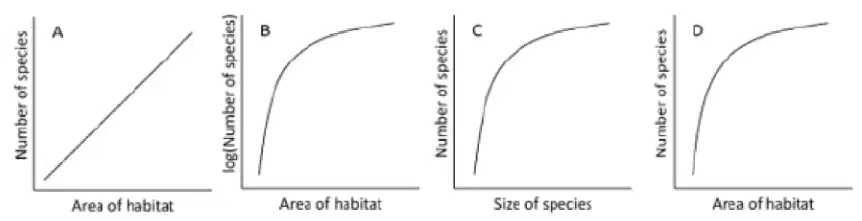
Which graph depicts the most common form of the species-area curve?
Graph A
Graph B
Graph C
Graph D
When species richness is measured on a log scale, the species-area curve takes the form of
a straight line with a positive slope.
a curved line increasing rapidly at first and then plateauing.
a flat line with a zero slope.
a straight line with a negative slope.
For any set of islands within a region, researchers have observed that the slope of the species-area curve is generally the same across the planet. What does this observation suggest?
Species richness does not generally change with island size.
Islands of similar size are likely to have the same number of species regardless of where those islands are found on Earth.
Species richness increases with island size in a very predictable manner.
Island size is unrelated to species richness except in tropical regions.
The species-area curve is primarily used to predict
the number of species in any isolated habitat.
the density of a population within an ecosystem.
the amount of area needed to support a particular species.
the number of organisms in any isolated habitat.
Relative to large islands, small islands are likely to have
many herbivores and few predators.
herbivores that do not compete for resources.
a high biodiversity of herbivores and low biodiversity of plants.
longer food chains.
How might you experimentally measure the species-area curve in a given region?
Measure the total number of herbivores on islands of various sizes
Measure the total number of plants on islands of various sizes and distances from the mainland
Measure the total species richness of insects on islands of various sizes at similar distances from the mainland
Measure the total species richness of plants on an island, remove all the plants from the island, and record the number of plants that eventually recolonize

Based on the size of each island and the distance of each island from the mainland, which island is likely to have the greatest rate of species extinction?
Island A
Island B
Island C
Island D

Based on the size of each island and the distance of each island from the mainland, which island is least likely to experience species extinction following a natural disaster (e.g., a hurricane)?
Island A
Island B
Island C
Island D
What would be the shape of the species-area curve for this set of islands?
A straight line with a negative slope
A curve that rapidly decreases along the x-axis and eventually reaches a minimum
A curve that rapidly increases along the x-axis and eventually reaches a maximum
A curve that rises, reaches a maximum, and then rapidly falls
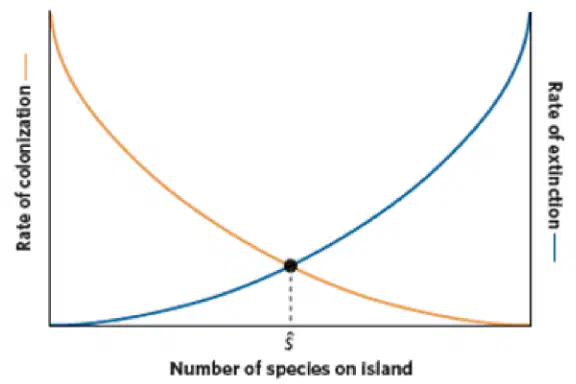
What does Ŝ in the graph represent?
The predicted number of species on an island of a particular size and distance to the mainland
The predicted number of species on an island if either colonization or extinction rates increased
The approximate size of an island, given known rates of colonization and extinction
The approximate distance of an island from the mainland, given known rates of colonization and extinction
To test the theory of island biogeography, a researcher creates a series of twenty 10-m^2 grassland plots aligned in a 4 x 5 grid. Each plot is separated from adjacent plots by a 1-m gravel path. All plots have the same diversity and biomass of grasses. The researcher fumigates all plots to remove insects. The researcher colonizes one of the corner plots (Plot A) with 20 different species of insect common to the study area. Based on the theory of island biogeography, the research predicts that plots farthest from Plot A will be colonized by fewer species. Within several months, all plots are colonized with the same diversity of insect species regardless of the distance between the plot and the first colonized plot. What is one reason that these results do not support the researcher's prediction?
The theory of island biogeography only applies to islands surrounded by water
The plots are all the same size, so the theory of island biogeography does not apply
The plots are too close to each other
Plot A is the same size as the other plots
Why are animal species native to islands often more vulnerable to invasive species?
Animal species on islands generally lack an ability to adapt to any environmental change.
Animal species on islands tend to be generalist consumers whereas invasive species tend to be specialists.
Animal species on islands have generally experienced a substantial period of time without evolution.
Animal species on islands often lack immunity to diseases carried by invasive species.
After removing all species from a group of islands, the theory of island biogeography predicts that
all islands will eventually be recolonized by the same species as were previously on the islands.
only islands close to the mainland will be repopulated.
all islands will eventually be recolonized with the same number of species as were previously on the islands.
all islands will be recolonized by a mixture of invasive and native species.
After taking a soil core, a researcher uses carbon dating to estimate the age of pollen grains embedded within a layer of that core. Suppose that the plant which produced the pollen grains happened to consume more carbon-14 than other plants. Without knowing that information, the research would likely
overestimate the age of the pollen.
underestimate the age of the pollen.
misidentify the species of plant associated with the pollen.
observe more radioactivity from other carbon isotopes.
What would be an example of a random disruption?
El-Niño years
Meteor strikes
Forest fires
Hurricanes
Environmental disruptions that have a small spatial extent
are periodic.
are episodic.
often occur due to natural phenomena instead of anthropogenic activity.
are typically of a short duration.
Foraminifera in marine soil cores provide evidence for which major shift in the Earth’s climate over the past several million years?
Atmospheric temperature rise
Increased intensity of storms
Rising sea levels
Rising CO2 levels
The concentration of gases inside air bubbles within ice cores from Antarctica indicate that
both atmospheric temperature and CO2 concentrations are higher now than ever before.
atmospheric CO2 concentrations have exhibited very large fluctuations over the past 400,000 years.
the total amount of oxygen in the atmosphere has steadily decreased over the past 400,000 years.
there were several, small extinction events over the past million years.
A researcher examines the understory plants of a forest. What observation would provide evidence that the forest experiences periodic fires?
Fewer understory plant species but greater tree species than unburned forests
Thick layers of leaf litter and woody debris
Lower insect abundance relative to unburned forests
Greater overall plant diversity relative to unburned forests
Bird migration is a consequence of
periodic disruptions.
episodic disruptions.
annual migration.
random disruptions.
What is the difference between ecosystems with high and low resilience?
Ecosystems with high resilience can withstand substantially more disturbances than ecosystems with low resilience.
Ecosystems with high resilience typically have shorter and less complex food webs than ecosystems with low resilience.
Ecosystems with high resilience are more isolated than ecosystems with low resilience.
Ecosystems with high resilience return to their original state faster than ecosystems with low resilience.
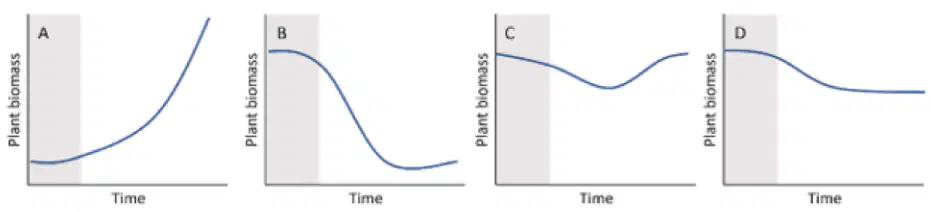
The graphs represent measurements of plant biomass through time in four different ecosystems. For each graph, the area in gray represents time before a major disturbance. Which graph represents an ecosystem with both high resistance and high resilience?
Graph A
Graph B
Graph C
Graph D
Before the evolution of humans, episodic increases in atmospheric temperatures were likely due to subtle shifts of Earth’s orbit closer to the sun. What is a likely cause of high atmospheric CO2 concentrations during this warmer period?
release of CO2 from the ocean
burning of fossil fuels
growth of plant biomass
an increase in greenhouse gas concentrations

