Wayground logo

Free Printable Worksheets

Font size

S
M
L
XL
Worksheets

Evolution Review

Total questions: 73

Worksheet time: 2hrs 35mins
Name
Class
Date
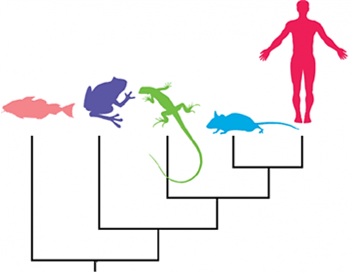
1.

What is the human most closely related to?

a)

Fish

b)

mouse

c)

Salamander

d)

Human

2.

Which group of animals on this tree are most closely related to birds?

a)

Saurischian dinosaurs

b)

Ornithischian dinosaurs

c)

Crocodiles

d)

None of these are related to birds

3.

Where is the alligator and T. rex's common ancestor?

a)

Point A

b)

Point B

c)

Point C

d)

Point D

4.
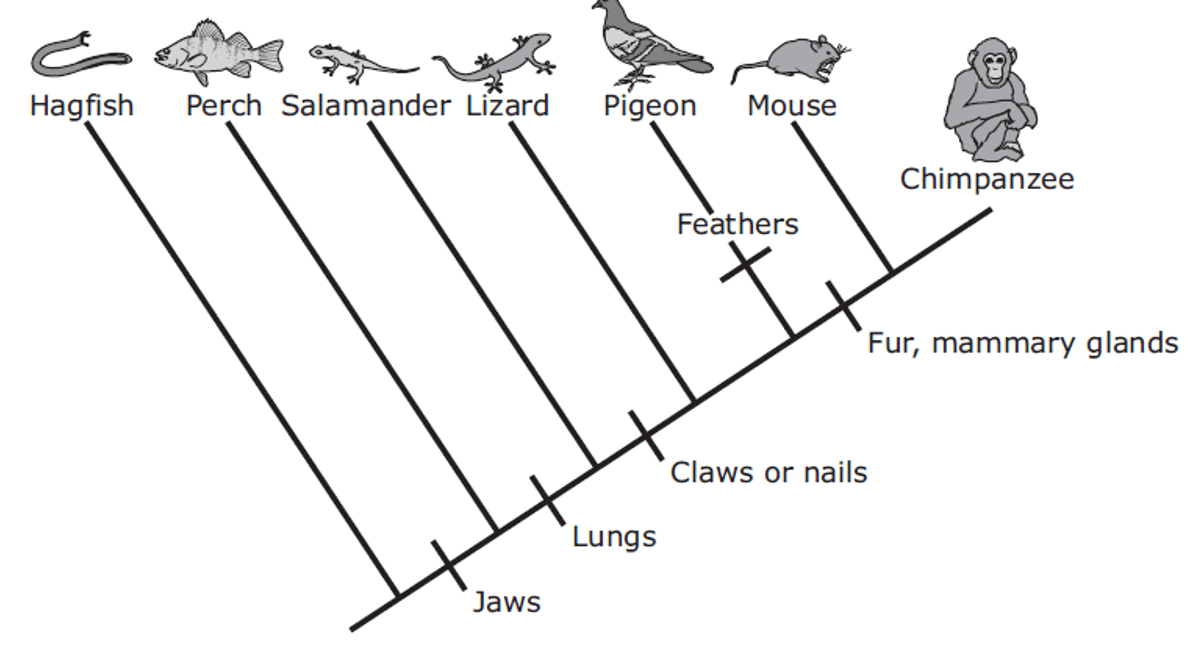
All the animals to the right of the hagfish would have the common characteristic of -
a)
Fur
b)
Claws or nails
c)
Lungs
d)
Jaws
5.

The diagram below represents possible genetic relationships between groups of organisms.

Which statement is a valid conclusion that can be drawn from the diagram?

a)

Insects are more complex than mammals.

b)

Earthworms and sea stars have a common ancestor.

c)

Snails appeared on Earth before corals.

d)

Sponges were the last new species to appear on Earth.

6.

What is the purpose of a cladogram?

a)

To map the ancestral relationships and shared traits of different organisms.

b)

To trace the inherited traits of a single species over time.

c)

To check the likelihood of an offspring having a particular trait.

d)

To monitor mutations that arise among different populations.

7.

What do both the squirrel and lion have in common that the other animals do not?

a)

They are both vertebrates

b)

They both have lungs

c)

They are both mammals

d)

They both lose their canine teeth.

8.

What do amphibians, birds, prosimians and humans all have in common? Check all that apply.

a)

Hair

b)

Endothermic

c)

Eukaryotic

d)

Tetrapod

e)

Vertebrate

9.

Which letter represents the most recent common ancestor of sponges and mushrooms?

a)

A

b)

B

c)

C

d)

D

e)

E

10.

Which trait should go where A is on the cladogram?

a)

eyes

b)

feet

c)

lips

d)

hat

11.

Which organism goes in the B position?

a)
b)
c)
d)
12.

According to the diagram, what was the last common ancestor of organisms 2 and 3?

a)

A

b)

B

c)

C

d)

D

13.

Using the diagram, is organism 4 MORE closely related to organism 3 or 5?

a)

3

b)

5

14.

Using the cladogram, which two organisms are more closely related Lizards and Newts OR Lamreys and Sharks

a)

Newts and Lizards

b)

Lampreys and Sharks

15.

Which trait(s) do conifers have?

a)

vascular tissue only

b)

vascular tissue and seeds

c)

vascular tissue, seeds and flowers

d)

seeds only

16.

Of the choices listed, which species is the oldest?

a)

H

b)

D

c)

C

d)

A

17.

"Endosymbiosis" means

a)

Living together

b)

Entering together

c)

Living separately

d)

Joining together

18.

The theory of Endosymbiosis explains

a)

The origin of eukaryotes

b)

How bacteria live

c)

How species develop

d)

Why cells rely on one another

19.

____________ & _________________ are organelles that definitely arose from endosymbiosis.

a)

Nucleus and cell membrane

b)

Chloroplast and mitochondria

c)

Mitochondria and nucleus

d)

Cell wall and chloroplast

20.

What are evidence to support endosymbiotic theory?

a)

Mitochondria is found outside the cells

b)

Mitochondria and chloroplast can divide independently

c)

Mitochondria and chloroplast have their own cell membrane

d)

Mitochondria and chloroplast have their own genetic material

21.

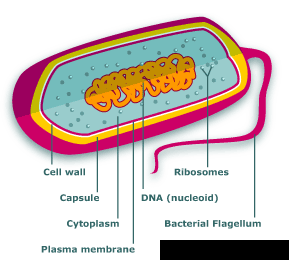
Bacteria are an example of a _________ cell.

a)

Eukaryotic

b)

Prokaryotic

c)

animal

d)

plant

22.
Are prokaryotes multicellular or unicellular? 
a)
Multicellular
b)
Unicellular
23.

Why type of cell does not contain membrane bound organelles?

a)

Animal Cells

b)

Prokaryotic Cells

c)

Eukaryotic Cells

d)

Plant Cells

24.
Which type of cell? It has DNA, Ribosomes, Cell Membrane, but no nuclues. 
a)
Prokaryote
b)
Eukaryote
25.

Which of the following characteristics make mitochondria and chloroplasts different from other organelles?

a)

They are much bigger

b)

The are found in both prokaryotic and eukaryotic cells.

c)

They both make ATP

d)

They were once free-living prokaryotes

26.

Which of the following is evidence to support the endosymbiotic theory?

a)

Prokaryotes have the same number and types of enzymes as eukaryotes.

b)

Mitochondria and chloroplasts have their own DNA, which is similar to prokaryotic DNA.

c)

All eukaryotic cells have a double-layered membran composed of phosplipids and proteins.

d)

Fossil evidence shows that the first forms of life were prokaryotic cells.

27.
Structures that are similar to function. 
a)
Homologous 
b)
Analogous 
c)
Vestigial 
d)
DNA
28.
Studying the similarities in organisms development 
a)
DNA
b)
Embryonic 
c)
Vestigial 
d)
Homologous 
29.
The survival of the fittest 
a)
Natural selction
b)
Evolution 
c)
Mimic 
d)
Camouflage 
30.
The changes of species over time
a)
Embryonic 
b)
Natural selection 
c)
Mimicry 
d)
Evolution 
31.
Which layer is the youngest
a)
1
b)
2
c)
3
d)
4
32.
Which layer is the oldest
a)
B
b)
A
c)
E
d)
C
33.
Study of embryos of various organisms to show a common ancestor because of similarities in development
a)
natural selection
b)
embryology
c)
speciation
d)
evolution
34.
Structures with the same parts have different functions; suggests that organisms share a common ancestry
a)
vestigial structures
b)
homologous structures
c)
adaptive radiation
d)
fossil
35.
Two organisms that are closely related would have
a)
very similar DNA sequence
b)
exactly the same DNA sequences
c)
no proteins in common
d)
completely different DNA sequence
36.
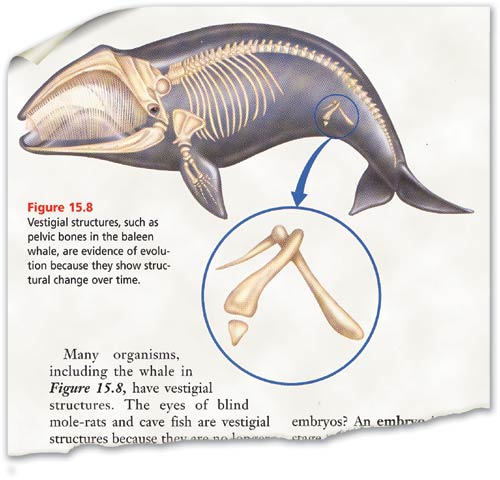
The hind leg bones in a whale are examples of
a)
homologous structures
b)
analogous structures
c)
fossils
d)
vestigal structures
37.
Which is not evidence for evolution?
a)
many animals have homologous structures due to common ancestry
b)
Many animals have vestigial structures from an ancestor
c)
We can observe changes in life forms by observing the fossil record
d)
All of these are evidence for evolution
38.

How do fossils support evolution?

a)

The fossil record provides evidence that organisms have changed over time.

b)

Individual species disappear and reappear in the fossil record over time.

c)

The fossil record provides evidence that all organisms developed at the same time.

d)

Organisms in the fossil record are identical to living organisms.
39.
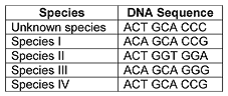
According to this data, the unknown bacterial species is most closely related to: 
a)
Species I
b)
Species II
c)
Species III
d)
Species IV
40.
The diagram illustrates an embryonic stage of two organisms.

Which of the following can be determined by observing the embryos shown in the diagram
a)
The organisms share a common ancestry.
b)
The organisms belong to the same genus.
c)
The organisms are native to the same geographic areas.
d)
The organisms will grow into anatomically similar adults.
41.
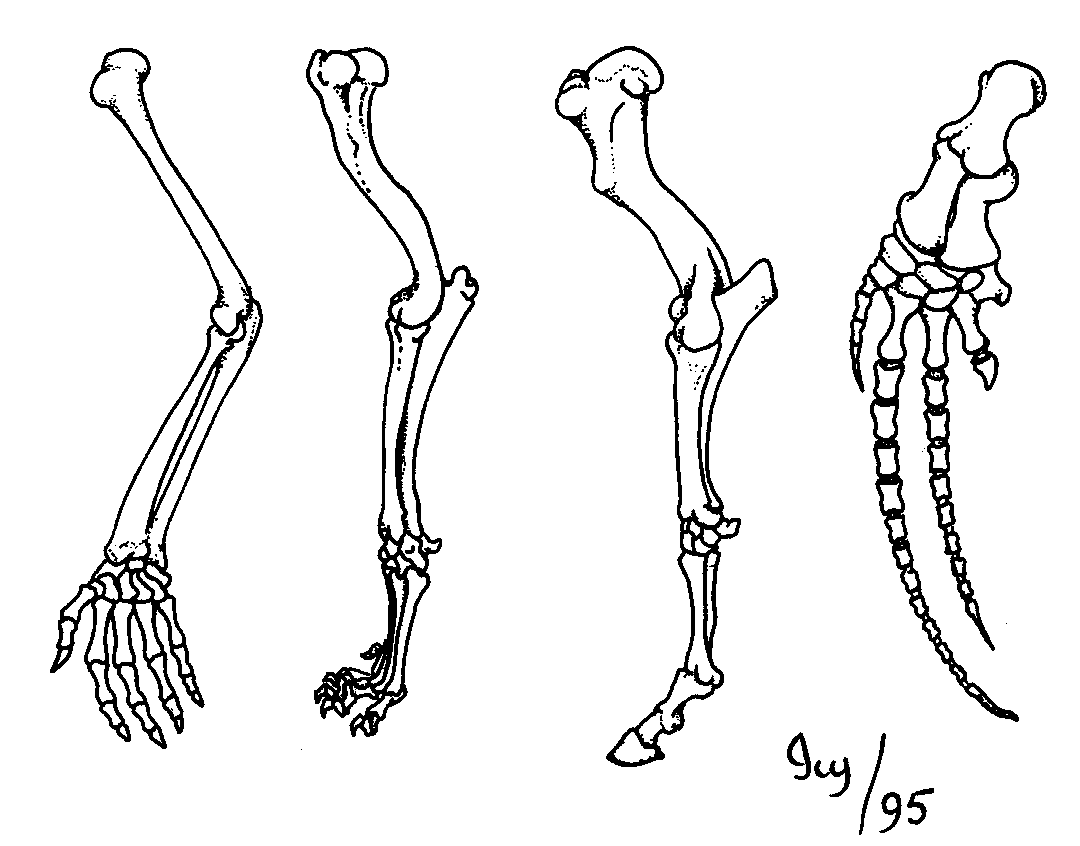
Humans, birds, whales, and lizards all have similar arm bones. What is the reason for this?
a)
The function of these bones is the same in all animals
b)
They live in similar environments
c)
They have a common ancestor
d)
All organisms resemble humans
42.

Vestigial structures

a)

structures that perform a similar function but are not similar in origin

b)

remnants of once-important structures that have slowly lost all or most of their function

c)

features found in different organisms that share structural similarities but may have very different functions

d)

preserved remains of an organism

43.
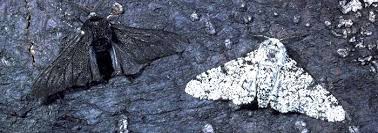
Predict which moth would increase in population
a)
light 
b)
dark
44.

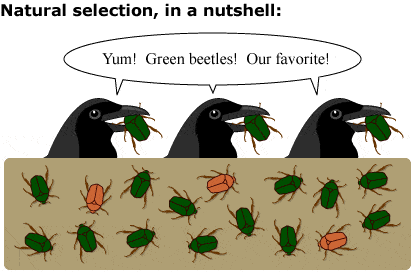
How do you "win" at natural selection?

a)

survive

b)

go extinct

c)

survive & reproduce

45.

What word describes a trait that helps an organism survive in its environment?

a)

natural selection

b)

mutation

c)

camouflage

d)

adaptation

46.
Which organisms are most likely to survive?
a)
the best adapted
b)
the fastest
c)
the strongest
d)
the most domesticated (tamed)
47.
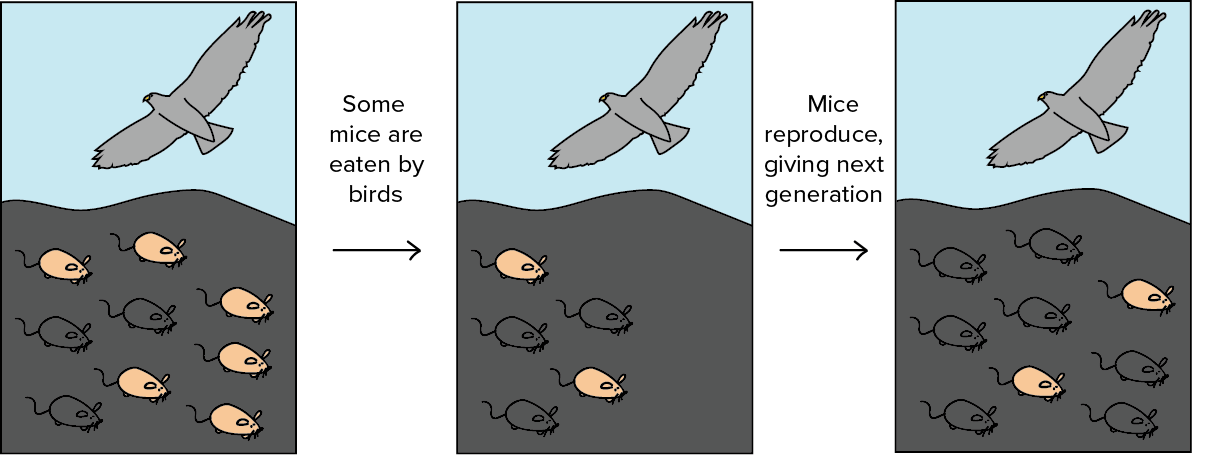
Why is the mouse population changing over time?
a)
The light mice can reproduce more successfully than the dark mice
b)
The hawks eat more dark mice than light mice because the dark mice taste better
c)
The hawks eat more light mice than dark mice because they can see the light mice more easily
d)
The hawks eat more dark mice than light mice because they can see the dark mice more easily
48.
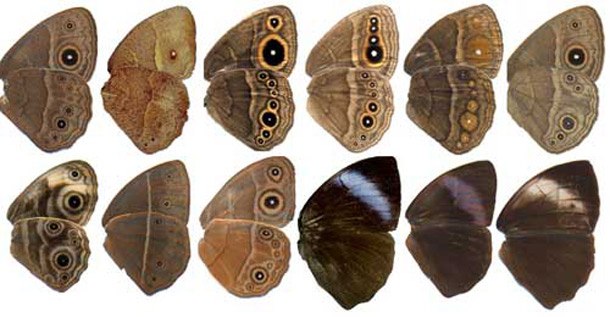
These moths are all the same species. The differences between their wings is an example of ________________
a)
Natural Selection
b)
Variation
c)
Homeostasis
d)
Extinction
49.
Which of the following explains adaptation.
a)
An individual organism changes to meet its needs in the environment. These changes pass down to their offspring.
b)
The species as a whole changes their characteristics.
c)
Beneficial traits allow organism to survive and pass on those traits
d)
New characteristics arise in a species as needed.  If these traits are helpful, they are passed down.
50.
A large herd of goats lives in a field full of poison ivy.  Some goats are able to eat the poison ivy while others have become sick when they eat it. Over time the herd as a whole will tend to
a)
Become more likely to eat poison ivy.
b)
Become less likely to eat poison ivy.
c)
Not change in the proportion of goats that can and can not eat poison ivy.
d)
Eat all the poison ivy and leave only plants all the goats can eat.
51.
What is another name for natural selection?
a)
survival of the smartest
b)
survival of the fastest
c)
survival of the biggest
d)
survival of the fittest
52.

Individuals undergo evolution.

a)

True

b)

False

53.
Which of the following is a factor in natural selection?
a)
Individuals of species compete with one another to survive.
b)
All species are genetically diverse.
c)
Individuals better able to adapt to changes leave more offspring.
d)
All are correct 
54.
Starting in 1954, commercial fishers in the northwest Pacific were paid by weight, rather than by the individual fish, for pink salmon. The fishers increased the use of a type of net that selectively catches larger fish.  Which of the following effects did this change in fishing technique most likely have on the salmon population over the next 20 years?
a)
The average body size of the salmon population decreased significantly.
b)
The average body size of the salmon population increased significantly.
c)
The average body size of the males in the salmon population increased, and the females stayed the same.
55.

Charles Darwin observed that finches of different species on the Galápagos Islands have many similar physical characteristics, this supports the hypothesis that these finches

a)

are twins

b)

acquired traits through use and disuse.

c)

all eat the same type of food.

d)

descended from a common ancestor.

56.

This term refers to the total genetic information found in a population; the complete collection of all the alleles found in a population

a)

Gene library

b)

Genome

c)

Gene pool

d)

Allele pool

57.

This is one of the mechanisms of evolution; it occurs when individuals move into or out of a population, either by physically arriving or leaving, or by being born or dying

a)

Gene flow / genetic drift

b)

Founder effect

c)

Natural selection

d)

Microevolution

58.

This occurs when a large population is drastically reduced by an event such as a natural disaster; the population's new gene pool only contains alleles from the survivors

a)

Founder effect

b)

Bottleneck effect

c)

Meteor effect

d)

Natural selection

59.

This is the process that ultimately creates new variations and changes in DNA; leads to the creation of new alleles

a)

Mutation

b)

Microevolution

c)

Natural selection

d)

Gene flow / genetic drift

60.

Today, the Afrikaner population has an unusually high frequency of the gene that causes Huntington's Disease, because the Dutch colonists happened to carry that gene with unusually high frequency.

a)

Gene flow

b)

Natural Selection

c)

Bottleneck Effect

d)

Founder Effect.

61.
a)

gene flow

b)

natural selection

c)

bottleneck effect

d)

founder effect

62.

A bee carrying pollen from one flower population to another flower population.

a)

gene flow

b)

natural selection

c)

bottleneck effect

d)

founder effect

63.
a)

gene flow

b)

natural selection

c)

bottleneck effect

d)

founder effect

64.

Which of the following statements about gene flow is TRUE?

a)

Gene flow is a result of individuals that breed in an old location

b)

Gene flow is a result of migrating individuals that breed in a new location

c)

Gene flow is not a result of migrating individuals that breed in a new location

d)

None of the statements are true

65.

In order for the genetic drift to occur, what is the necessary parameter?

a)

The population must be large.

b)

The population must be small.

c)

The population must be under environmental stress.

d)

The population must be sterile.

66.

How do evolution directly affected by the gene flow?

a)

It doesn’t contribute to evolution

b)

It introduces new alleles into a population.

c)

It reduces the number of members in a population.

d)

It changes the environment in which a population resides.

67.
This scientist came up with the idea of natural selection.
a)
Jean Baptiste Lamarck
b)
Gregor Mendel
c)
Charles Darwin
d)
Thomas Malthus
68.
Survival of the fittest or when favorable adaptations reproduce faster is called what?
a)
Evolution
b)
Adaptation
c)
Natural selection
d)
Fossilization
69.
Ostrich wings are examples of
a)
homologous structures
b)
vestigial structures
c)
adaptations
d)
traits
70.
Why do embryologist study embryos?
a)
to see if they are related
b)
to understand adaptations
c)
to determine the age
d)
to learn what parents are vestigial
71.
The environment around Manchester, England, changed during the Industrial Revolution.  How did this change affect peppered moths living in the area?
a)
Natural selection favored moths with dark wings because predators could not see them on the soot-colored trees.
b)
Natural selection favored moths with white wings that were easy for predators to see.
c)
Natural selection favored moths with white wings because predators could not see them on the soot-colored trees.
d)
Natural selection caused moths with white wings to become extinct.
72.
When an organism completely dies out, it is called.....
a)
Adaption
b)
Extinction
c)
Fossilization
d)
Mutation
73.
All the individuals of a species that live in a particular area are called a
a)
variation
b)
population
c)
fossil
d)
group