
 Worksheets
GC: Solutions Review
Total questions: 134
Worksheet time: 2hrs 14mins

Using the provided solubility graph, place the following substances in the proper type of solution formed in 100 g of water.
50 g of KCl at 90°C
50 g of KCl at 60°C
48 g KNO3 at 60°C
80 g KNO3 at 48°C
65 g KNO3 at 70°C
25 g of NaCl at 0°C
10 g SO2 at 60°C
130 g of KI at 0°C
70 g of NH4Cl at 88°C
60 g of HCl at 45°C

Organize these options into solid or gas based on their solubility curves given in the graph.
NaNO3
KI
NaCl
HCl
SO2
NH3
KClO3
NH4Cl

Which of the following will create a supersaturated solution containing 30 grams of KClO3?
Heat the water to 62°C.
Heat the water to 70°C, then let cool to 25°C.
Heat the water to 30°C, then let in cool to 20°C.
Heat the water to 50°C.

At approximately what temperature can 115 g of NaNO3 be dissolved in 100 g of water to create a saturated solution?
(a) °C
How much KCl can be dissolved in 100 g of water at 75°C to form a saturated solution?
(a) g
How many grams of HCl can be dissolved in 50 grams of water at 30°C? (Give the answer to the ones place.)
(a) g
How many grams of NH4Cl can be dissolved in 200 grams of water at 70°C? (Give the answer to the ones place.)
(a) g
What temperature do I have to heat 100 grams of water in order to dissolve 120 grams of NaNO3? (Give the answer to the ones place.)
(a) °C

Placing 100 g of NH3 in 100 g of water at 0°C will result in (a) dissolving.
Placing 50 g of NH4Cl in 100 g of water at 60°C will result in (a) dissolving.
What will occur when more of a solute is placed in a saturated solution?
The temperature of the solution will rise.
The solute will dissolve, creating a supersaturated solution.
The solute will sink to the bottom of the container.
The solvent will absorb the solute and decrease its energy.

Why will 90 grams of NH4Cl never be able to dissolve in 100 g of water?
The water will reach its boiling point before it can dissolve the NH4Cl.
The sample of NH4Cl is hydrophobic and can never dissolve in water.
NH4Cl is a gas, and gases cannot dissolve in water.
The NH4Cl can dissolve in 100 grams of water, but only as a supersaturated solution.

At what temperature can equal masses of KCl and HCl be dissolved in 100 grams of water? (Give the answer to the ones place.)
(a) °C
A solution occurs when the (a) is (b) in a (c) .
There are three types of solutions that can be made. Each type of solution is (a) dependent. (b) solution is formed when there is more solute than the solvent can normally contain. (c) solution is formed when more solute can be added to the solution. (d) solution occurs when the solvent cannot take in any more solute.
What does a solubility curve represent?
The change in solubility of a salt with pressure
The color change of salts when dissolved
The boiling points of various substances
The graphical representation of solubility over a range of temperatures
Some water is added to an empty glass. A sugar cube is then dropped in and dissolved. The water is the (a) and the sugar is the (b) .
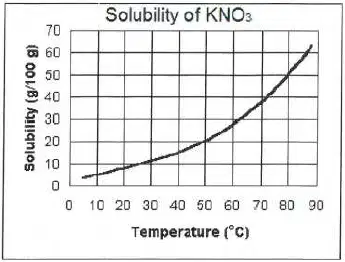
What happens to a solution of KNO3 that is saturated at 50°C when it is cooled quickly to 10°C?
Extra solute falls out of solution
The solution is not changed
The solution becomes unsaturated
The solution becomes supersaturated
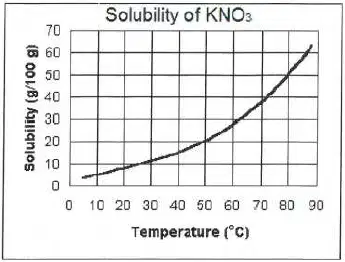
How many grams of KNO3 will dissolve in 100 grams of water at 50°C to make a saturated solution?
20 g
10 g
60 g
50 g
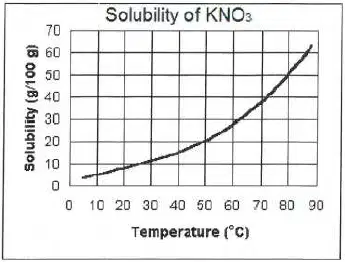
How many grams of KNO3 can dissolve in 300 grams of water at 50 °C?
60 g
50 g
20 g
10 g
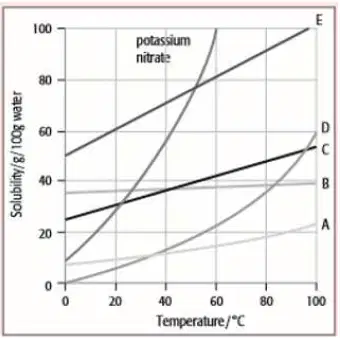
A solution contains 15.0 g of compound D in 100 g of water at 60°C. This solution would be (a) .
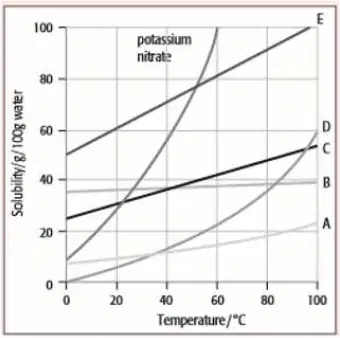
A researcher dissolves 60.00 g of compound E in 100 g of water at 20.0°C. The researcher allows the solution to cool in a refrigerator to 5°C and finds precipitate has formed on the bottom of the beaker. The solution is considered to be (a) .
What mass of NaNO3 is needed to prepare 225 mL of a 1.55 M solution of NaNO3?
29.6 g
0.132 g
4.10 g
0.244 g
12.3 g
A sample containing (a) grams of CaBr2 are needed to prepare 4.65 L of a 7.65 M solution?
How many moles of HCl are present in 40.0 mL of a 0.035 M solution?
0.0060 mol HCl
0.0014 mol HCl
0.012 mol HCl
0.0012 mol HCl
A sample containing (a) moles of sodium chloride are there in 250 mL of a 1.20 M solution of NaCl?
If 60.0 mL of a 1.5 M HCl solution is put into a flask and diluted with water to make 2.0 L of solution, what is the molarity of the final solution?
0.080 M
0.045 M
0.020 M
3.0 M
0.18 M
A student was asked to prepare exactly 250. mL of a 0.500 M aqueous potassium hydroxide solution. What mass of potassium hydroxide (molar mass = 56.10 g/mol) must the student dissolve in the 250. mL of solution?
14.0 g
28.1 g
3.0 g
7.01 g
56.1 g
How many mL of a 0.75 M KOH solution should be added to a 500 mL flask to make 500 mL of a 0.300 M KOH solution?
200 mL
250 mL
500 mL
50 mL
A volume of (a) mL of 12.0 M HCl are needed to make 2.0 L of 0.40 M HCl solution?
Thomas poured 25 mL of 0.50 M HCl into a large bottle. He then added enough water so that the new (diluted) concentration was 0.10 M HCl. How much water did Thomas add?
100 mL
75 mL
25 mL
50 mL
125 mL
When the ions CO32− , Cl− , NO3− , Na+ , NH4+ , Fe2+ are mixed in aqueous solution, what substance is likely to form an insoluble precipitate?
ClNO3
Na2CO3
NH4Cl
FeCO3
NH4NO3
If the solubility of a solid increases with temperature, a supersaturated solution of this solid could be prepared by doing what to a saturated solution?
slowly heating
slowly cooling
rapidly heating
rapidly cooling
adding more solute
Polarity is related to an uneven distribution of (a) in molecules. In a solution, polar molecules interact (b) with nonpolar molecules.
Potassium chloride will dissolve in water but not in oil.
True: because KCl is an ionic compound
and water is polar; whereas oil is nonpolar.
True: because KCl is an ionic compound
and water is nonpolar, whereas oil is polar.
False: because KCl is an ionic compound
and water is polar; whereas oil is nonpolar.
False: because KCl is an ionic compound
and water is nonpolar, whereas oil is polar.
Hydrogen bonding occurs when a hydrogen atom bonded to N, O, or F is attracted to another molecule's N, O or F atom. Which of the following can participate in hydrogen bonding?
CBr4
NO2
H2S
NH3
All matter has London forces, but dipole-dipole and hydrogen bonding are so much stronger that when they are present, we can effectively ignore London forces. Which of these ONLY has London forces?
I2
NH3
OCl2
CH3Cl
Dipole-dipole attractions occur between polar molecules. Which of these molecules is polar?
H2
HCl
Cl2
Br2

A Lewis structure for acetone is shown above. What type of intermolecular forces will be present between the molecules of acetone in a pure sample of acetone? Select all that apply.
ion-dipole attractions
dipole-dipole attractions
hydrogen bonding
London forces
The weaker the intermolecular forces of a substance, the _____________ the boiling point.
higher
lower
Which of the following explains the very high melting and boiling point of water?
Strong dipole-dipole attractions between water molecules
Strong hydrogen bonds between water molecules
London dispersion forces between water molecules
Dipole-induced dipole attractions between water molecules
London forces are stronger in atoms or molecules with more electrons in the electron cloud, and weaker in atoms or molecules with fewer electrons in the electron cloud. Which of the following has the strongest London forces?
F2
Br2
I2
Cl2
London forces are stronger in atoms or molecules with more electrons in the electron cloud, and weaker in atoms or molecules with fewer electrons in the electron cloud. Which noble gas has the highest boiling point?
Which of the following intermolecular forces can all types of matter participate in?
London dispersion forces
dipole-dipole forces
hydrogen bonding
ion-dipole attractions
dipole-induced dipole attractions
Which of these molecules can participate in dipole-dipole attractions? Select all that apply.
Br2
P4
I2
PCl3
CO
London forces are stronger in atoms or molecules with more electrons in the electron cloud, and weaker in atoms or molecules with fewer electrons in the electron cloud. Which of the following molecules would have the lowest boiling point?
Propane is a gas at room temperature, while bromine is a liquid at room temperature. Which statement correctly explains these observations?
Bromine has weaker intermolecular forces than propane does
Bromine has greater molecular polarity than propane does
Bromine has weaker molecular polarity than propane does
Bromine has stronger intermolecular forces than propane does
Which intermolecular force increases with increasing size of the electron cloud?
London forces
dipole-dipole forces
hydrogen bonding
none of the above
Which intermolecular force between molecules of H2CCl2 is the strongest?
dispersion forces
dipole-dipole forces
hydrogen bonding
none of the above

Which numbered arrow in the image above points to a hydrogen bond?
1
2
3
4
The stronger the intermolecular forces of a substance, the _____________ the melting point.
higher
lower
Which of the following molecules would have the highest boiling point?

The strongest intermolecular attractions for this compound is
Dipole-dipole
London dispersion
Hydrogen bonds
dipole-induced dipole attractions
Which of the following molecules can participate in London dispersion forces?
HCN
CH4
SO3
NH3
Which substance has the weakest intermolecular forces?
Substance A, boiling point of 75 °C
Substance B, boiling point of 105 °C
Substance C, boiling point of 25 °C
Substance D, boiling point of 45 °C

Which type of IMF is responsible for the attraction pictured above?
Dipole-Dipole Interaction
Ion-Dipole Interaction
Hydrogen Bonds
Covalent Bond
Ionic Bond

Which type of IMF is responsible for the attraction pictured above?
dipole-dipole attraction
ion-dipole attractiom
hydrogen bonds
covalent bond
ionic bond

What are dipole-dipole attractions?
an intermolecular attraction that results from the electrons constant motion and the resulting dipole that occurs
the intermolecular force in which a hydrogen atom is bonded to a atom with high electronegativity and the hydrogen is attracted to the lone pair of another molecule
an intermolecular force that is created by the uneven sharing of electrons in molecules
the intermolecular forces that result between an ion and a molecule with a dipole.
Which molecule has the strongest intermolecular forces?
H-F
H-Cl
Br-Br
Cl-I

Which type of IMF is responsible for the attraction pictured above?
Dipole-dipole attraction
Ion-dipole attraction
Hydrogen bonds
Covalent bond
Ionic bond

(a) are based on the temporary clustering of electrons inside of molecule.
A compound has the molecular formula C30H62. The compound is known to have nonpolar molecules and exists as a solid at room temperature. Which is the biggest factor responsible for the properties of this compound?
ion-molecule attractions
London dispersion forces
dipole-dipole attractions
hydrogen bonding
Which of the following will NOT participate in hydrogen bonding in a pure sample of that compound?


There is an attraction between a highly partially positive hydrogen atom of one molecule to the highly partially negative atom of another molecule.
There is an attraction between a highly partially negative hydrogen atom of one molecule to the highly partially positive atom of another molecule.
Which molecule: Br2, HCl, H2S, or NH3, will most likely have London dispersion forces as the MOST important IMF considered when determining melting/boiling points?
Br2, it only has dispersion forces when interacting
HCl, it can participate in dipole-dipole interactions and also dispersion forces
H2S, it can participate in dipole-dipole interactions and also dispersion forces
NH3, it can participate in hydrogen bonding and also dispersion forces

Which of the arrows show hydrogen bonds between the methanol molecules illustrated here?
A
B
C
D
E
Organize these options into the right categories.
Ionic
Polar Covalent
Nonpolar Covalent
Metallic
London Dispersion
Dipole-dipole
Hydrogen Bonding
Ion-Dipole
There are two forces that affect the interaction of atoms and molecules. The (a) are the attractions that occur between molecules, which can be a factor in determining if the compound is a solid, liquid or a gas.
There are two forces that affect the interaction of atoms and molecules. The (a) are the attractions that occur within molecules, which is a factor in determining what type of molecule is formed.
Organize the following intermolecular forces from weakest to strongest.
London Dispersion
Dipole-dipole
Hydrogen Bonding
Ion-Dipole
The strength of intermolecular forces occur how strong the (a) is in the molecule.
An instantaneous dipole is weak because the dipole is (a) , forming as (b) randomly move around.
The force beween MOLECULES of HCl which contains two polar molecules woudl be
dipole-dipole
hydrogen bonding
London dispersion
Ionic bond
The force between molecules of F2 which is a nonpolar molecule (electrons are shared) would be:
Dipole-Dipole
Hydrogen bonding
London dispersion
Ionic bond
Identify the IMF exist in CH4
dipole-dipole forces
London dispersion
ion-dipole forces
hydrogen bonding
Identify the IMF exist in NH3
London dispersion
ion-dipole forces
dipole-dipole forces
hydrogen bonding
To form a hydrogen bonding, hydrogen needs to attract to the highly electronegative elements such us (a) , (b) , (c) .
Hydrogen bonding is a special case of .
(a)
Which of the following has the lowest boiling point?
PH3
H2O
SiH4
NH3
Does NH3 or PH3 have a higher boiling point?
(Hint: identify the types of IMF's present for each)
NH3 because it has the strongest IMF's
PH3 because it has the strongest IMF's
NH3 because it has the weakest IMF's
PH3 because it has the weakest IMF's
(a) is an intermolecular force of attraction that occurs when a
temporary dipole of one atom induces polarity in a neighboring atom. They form due to random fluctuations in the density of the electron cloud surrounding the nucleus. The weakest type of intermolecular force.
Which image depicts molecules that will have ion-dipole as its strongest type of intermolecular force?


Which type of IMF is responsible for the attraction pictured above?
Dipole-Dipole Interaction
Ion-Dipole Interaction
Hydrogen Bonds
Covalent Bond
Ionic Bond
A molecule of H2S will have (a) attraction with another molecule of H2S?

The following molecule has which IMF as its strongest force of attraction?
London dispersion
Dipole-Dipole
Hydrogen bonds
Ion-Dipole
The following molecule is (a) .
What intermolecular force is most present between two molecules of HCl?
Dipole-Dipole
London dispersion
Hydrogen bonds
Ionic
What type of intermolecular force is most present between two molecules of HF?
Dipole-Dipole
London dispersion
Hydrogen bonds
ionic
Rank these in order of strength (from strongest to weakest):
London dispersion
hydrogen bond
dipole-dipole attraction
dipole-dipole>hydrogen bond>London
London>dipole-dipole>hydrogen bond
hydrogen bond>dipole-dipole>London
London>hydrogen bond>dipole-dipole
Identify the IMF that exist most in HBr
London dispersion
hydrogen bonding
dipole-dipole forces
ion-dipole forces

Intermolecular forces for: CO2
Dispersion Force
Dipole dipole
Hydrogen bonding
Ion dipole
Larger electron cloud = more LD forces = ___________
more polarizable
less polarizable
weaker dipole-dipole
ionic attraction
Dipole-dipole forces get stronger as...
the molecule is more polar
the molecule is less polar
the LDF increases
the distance between the molecules increases
Boiling point and melting point _________ as IMFs increase
increase
decrease
do not change
have no connection
Vapor pressure and volatility ________ as IMFs increase
increase
decrease
do not change
have no connection
Which of these are true for ionic solids?
high melting points
not conductive as a solid
conduct as a liquid or (aq)
conductive as a solid
low melting points
Which of the following are true of metallic bonds?
always between metals
always conductive
hardness varies
sometimes conductive
bond between metal and non-metal
When a molecular solid melts or boils...
the IMFs break
the covalent bonds break
the ions lose polarization
the molecules become more polarized
Put these IMFs in order from weakest to strongest
London Dispersion Forces
dipole-dipole
H-bonding
When you make a dilution, which of these values remains constant?
The molarity (M)
The total moles of solute
The volume (V)
The concentration
How do we make a dilution?
Add more solute
Remove solute
Remove solvent
Add more solvent
A solution that has water as the solvent is called a(n).....
Aqueous Solution
Water-Based Solution
Organic Solution
Dilute Solution
As we dilute a solution.....
The volume increases and the molarity (M) increases
The volume increases and the molarity (M) decreases
The volume decreases and the molarity (M) increases
The volume decreases and the molarity (M) decreases
What is the molarity of a solution containing 400. g of CuSO4 (M: 159.62 g/mol) in 4.0 L of solution?
10. M
1.6 M
0.63 M
0.010 M
How many moles of solute are present in 50.0 mL of 0.20M KNO3?
10. moles solute
0.050 moles solute
1.0 moles solute
0.010 moles solute
How many mL of stock solution of 2.00M NaCl do you need to prepare 100. mL of 0.150M NaCl?
7.50 mL
15.0 mL
1330 mL
200. mL
How many mL of 1.0M KBr solution would you need to prepare 250 mL of a 0.20M dilution?
180 mL
1300 mL
50. mL
5.0 mL
What would the molarity of a solution be if you took 10. mL of a 13M stock solution and made a 300. mL solution?
390M
230M
0.43M
0.26M
You are adding a chlorine solution to a swimming pool. The stock solution of chlorine is 1000. M. Your swimming pool (75,000 L) needs to be at a concentration of 0.10 M. How much of the stock solution should you add?
7500 L
.75 L
750 L
7.5 L
You need to make 200 mL of a 0.20 M aqueous solution of sodium chloride. The only available solution is 1.0 M. Determine how to make the needed dilution.
Add 160 mL to the initial volume
Add 160 grams to the initial volume
Evaporate 160 mL from the initial volume
the experiment cannot be conducted with the materials provided
A dilution is when (a) is (b) the volume of stock solution.
Calculate the molarity in a solution containing 40.0 g of NaCl dissolved in 500.0 mL of H2O.
0.08 M
12.5 M
1.37 M
0.74 M
Calculate the grams of NaOH present in 10.0 mL of a 2.0 M NaOH solution.
0.80 grams
2000 grams
0.30 grams
5.0 grams
Molarity is (a) per (b) .
A solution is made by dissolving 0.50 mole of NaCl in enough water to give a final volume of 400.0 mL. What is the molarity of the solution?
0.10 M
0.40 M
1.25 M
2.33 M
A 0.500 M solution of NaOH, which contains 0.750 mole of solute, would have a volume, in milliliters
0.667 mL
1200 mL
1500 mL
2100 mL
What volume, in milliliters, of 10.0 M NaOH is needed to prepare 300 mL of 2.00 M NaOH by dilution?
0.067 mL
60.0 mL
100 mL
125 mL
If 0.775 L of 1.00 M NaOH is diluted to 1.00 L, the resulting solution contains
0.225 mol NaOH
0.775 mol NaOH
1.25 mol NaOH
2.45 mol NaOH
Calculate the volume of a 5M solution that contains 10 moles of NaOH
0.5 L
1 L
2 L
4 L
What is a concentrated solution?
a solution that has a large amount of solute in a large volume of solvent
a solution that has an equal amount of solute in the same volume of solvent
a solution that has a small amount of solute in a large volume of solvent
a solution that has a large amount of solute in a small volume of solvent
Find the molarity of 186.55 g of sucrose, C12H22O11 in 250 mL of water.
2.18 M
0.746 M
1.18 M
0.545 M
How many grams of AgNO3 are needed to prepare 0.125M solution in 250 mL of water?
.03g
0.5g
5.3g
84.9g
125.0 mL of 2.00 M calcium hydroxide solution is diluted to a concentration of 1.50 M. How many mL of water was added to the original volume?
167 mL
42.0 mL
93.8 mL
0.0240 mL
What is the concentration when 1.8 moles of NaOH are dissolved in 250 mL of water?
450 M
0.0072 M
7.2 M
0.45 M

What is the molar concentration of the saturated solution of potassium nitrate at 30°C?
(a)

