
 Worksheets
K and E Test Review
Total questions: 81
Worksheet time: 9hrs 35mins
For a reaction system at equilibrium, LeChatelier’s principle can be used to predict the
activation energy for the system
type of bonds in the reactants
effect of a stress on the system
polarity of the product molecules
In terms of entropy and energy, systems in nature tend to undergo changes toward
lower entropy and lower energy
lower entropy and higher energy
higher entropy and lower energy
higher entropy and higher energy
Based on Table I, what is the ΔH value for the production of 1.00 mole of NO2(g) from its elements at 101.3 kPa and 298 K?
33.2 kJ
-33.2 kJ
132.8 kJ
-132.8 kJ
Systems in nature tend to undergo changes toward
lower energy and lower entropy
lower energy and higher entropy
higher energy and lower entropy
higher energy and higher entropy
A chemical reaction occurs when reactant particles
are separated by great distances
have no attractive forces between them
collide with proper energy and proper orientation
convert chemical energy into nuclear energy
Given the balanced equation representing a reaction:
CH4(g) + 2O2(g) → CO2(g) + 2H2O(g) + energy
Which change in reaction conditions will increase the frequency of effective collisions between reactant molecules?
decreasing the pressure of the reactants
decreasing the temperature of the reactants
increasing the concentration of the reactants
increasing the volume of the reactants
The energy absorbed and the energy released during a chemical reaction are best represented by a
cooling curve
heating curve
kinetic energy diagram
potential energy diagram
The amount of randomness of the atoms in a system is an indication of the
entropy of the system
polarity of the system
excited state of the atoms
ground state of the atoms
A reaction is most likely to occur when the colliding particles have proper orientation and
mass
volume
half-life
energy

Given the equation representing a chemical reaction at equilibrium in a sealed, rigid container:
When the concentration of H2(g) is increased by adding more hydrogen gas to the container at constant temperature, the equilibrium shifts
to the right, and the concentration of HI(g) decreases
to the right, and the concentration of HI(g) increases
to the left, and the concentration of HI(g) decreases
to the left, and the concentration of HI(g) increases

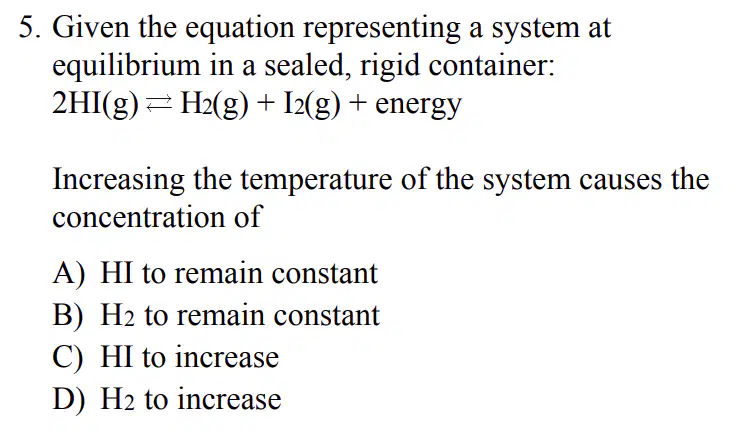
ANSWER QUESTION IN THE IMAGE
A
B
C
D

ANSWER QUESTION IN THE IMAGE
A
B
C
D

ANSWER QUESTION IN THE IMAGE
A
B
C
D

ANSWER QUESTION IN THE IMAGE
A
B
C
D
ANSWER QUESTION IN THE IMAGE
A
B
C
D

ANSWER QUESTION IN THE IMAGE
A
B
C
D

ANSWER QUESTION IN THE IMAGE
A
B
C
D

ANSWER QUESTION IN THE IMAGE
A
B
C
D

ANSWER QUESTION IN THE IMAGE
A
B
C
D

ANSWER QUESTION IN THE IMAGE
A
B
C
D

ANSWER QUESTION IN THE IMAGE
A
B
C
D

ANSWER QUESTION IN THE IMAGE
A
B
C
D

ANSWER QUESTION IN THE IMAGE
A
B
C
D

ANSWER QUESTION IN THE IMAGE
A
B
C
D

ANSWER QUESTION IN THE IMAGE
A
B
C
D

ANSWER QUESTION IN THE IMAGE
A
B
C
D

ANSWER QUESTION IN THE IMAGE
A
B
C
D

ANSWER QUESTION IN THE IMAGE
A
B
C
D

ANSWER QUESTION IN THE IMAGE
A
B
C
D

ANSWER QUESTION IN THE IMAGE
A
B
C
D

ANSWER QUESTION IN THE IMAGE
A
B
C
D

ANSWER QUESTION IN THE IMAGE
A
B
C
D

ANSWER QUESTION IN THE IMAGE
A
B
C
D

ANSWER QUESTION IN THE IMAGE
A
B
C
D

ANSWER QUESTION IN THE IMAGE
A
B
C
D
How is ΔH determined?
H (PE)of reactants - H (PE) of products
H (PE) of reactants + H of (PE) products
H (PE) of products - H (PE) of reactants
H (PE) of products + H (PE) of reactants
Which describes an exothermic reaction?
ΔH is negative and the products have more potential energy than the reactants.
ΔH is negative and the products have less potential energy than the reactants.
ΔH is positive and the products have more potential energy than the reactants.
ΔH is positive and the products have less potential energy than the reactants.
CO2(g) → CO2(l) is
endothermic with increased entropy.
exothermic with increased entropy.
endothermic with decreased entropy.
exothermic with decreased entropy.
How many kJ of heat are absorbed when 2 mol of C2H4 are formed?
157.2
26.2
52.4
104.8
Activation energy is required for
only exothermic chemical reactions
only endothermic chemical reactions
all chemical reactions
both endothermic and exothermic chemical reactions
An inhibitor changes the rate of reaction by increasing the
activation energy and a catalyst changes the rate of reaction by increasing the activation energy.
potential energy and a catalyst changes the rate of reaction by increasing the activation energy.
activation energy and a catalyst changes the rate of reaction by lowering the activation energy.
activation energy and a catalyst changes the rate of reaction by lowering the potential energy.
Which reaction will most likely occur spontaneously?
exothermic with decreased entropy
endothermic with increased entropy
exothermic with increased entropy
exothermic with decreased entropy
Which shows a decrease in entropy for each change?
solid, liquid, gas
solid, gas, liquid
gas, solid, liquid
gas, liquid, solid
2H2(g) + O2(g) → 2H2O(l) would be expected to have a faster reaction rate than Pb2+(aq) + S2-(aq) → PbS(aq).
true
false, aqueous solutions already have the substance dissolved in it and the ions separated so there will be more effective collisions.
false, there is no way to make a valid prediction
In a gaseous system, temperature remaining constant, an increase in pressure will
decrease the reaction rate
increase the reaction rate
increase the activation energy
decrease the activation energy
Dynamic equilibrium is when
the rate of products being formed is greater than the rate of reactants being formed.
the rate of products being formed is less than the rate of reactants being formed.
concentration of products is equal to the concentration of reactants
the rate of products being formed equals the rate of reactants being formed.
When any reaction reaches equilibrium the concentration of reactants
are equal to the concentration of the products
becomes constant.
begin increasing
begin decreasing
At what pressure would H2 gas be the least soluble in 100 g of water?
1 atm
2 atm
3 atm
4 atm
A sample of ethanol in a closed flask at 273 K is in equilibrium with its vapor. This is a
solution equilibrium
distillation equilibrium
phase equilibrium
chemical equilibrium
A solution of propanone is in a covered container that is 1/2 full. Which description is the best?
neither evaporation and condensation occur
both evaporation and condensation occur
only evaporation occurs
only condensation occurs
A solution equilibrium exists in a solution that is
supersaturated
unsaturated
dilute
saturated
You add more NaCl to a saturated solution of NaCl at a constant temperature. The concentration of this solution
remains the same
increases
decreases
increases then decreases
A(g) + B(g) ↔ C(g) + D(g) + heat
Which will shift this equilibrium to the left making more reactants?
Increasing [A]
decreasing pressure
decreasing [C]
increasing temperature
Given A(g) + B(g) ↔ C(g) + D(g) + heat, at constant temperature and pressure, an increase in [D] will cause a
a decrease in [A]
a decrease in [B]
a decrease in [C]
increase in [C]
CO2(g) ↔ CO2(aq)
What will increasing the the temperature of this system do to the solution equilibrium (saturated solution).
no effect
shift the equilibrium to the left favoring CO2 (g) making it less soluble.
shift the equilibrium to the right favoring CO2 (aq) making the gas more soluble.
2CO2(g) ↔ 2CO(g) + O2(g)
In which direction will the equilibrium shift if the [CO2] is increased and why?
to the right favoring the products because adding more CO2 will make more effective collisions between the CO2 molecules and therefore produce more CO and O2.
to the left favoring the reactants because adding more CO2 will make less effective collisions between the CO2 molecules and therefore produce less CO and O2.
no effect
2NH3(g) + 91.8 ↔ N2(g) + 3H2(g)
Would an increase in temperature shift the equilibrium to the left or right and why?
left because their will be more effective collisions between the NH3 molecules, therefore more products will be made.
left because their will be less effective collisions between the NH3 molecules, therefore more products will be made.
right because there will be more effective collisions between the NH3 molecules, therefore more products will be made.
none of the above are correct
H2(g) + Br2(g) + heat ↔ 2HBr(g)
Which stresses will shift the equilibrium to the right?
Increasing, temperature, increasing the [H2], increasing the [Br2], decreasing the [HBr], increasing pressure
decreasing temperature, decreasing the [H2], decreasing the [Br2], increasing the [HBr]
Increasing temperature, increasing the [H2], increasing the [Br2], decreasing the [HBr]
Increasing temperature, decreasing the [H2], increasing the [Br2], increasing the [HBr]
CO2(s) + heat ↔ CO2(g)
What effect will increasing the temperature have on the entropy of the system and why?
It will decrease entropy because it will cause more effective collisions between the CO2(s) molecules causing it to sublime more and become a gas.
It will increase entropy because it will cause more effective collisions between the CO2(s) molecules causing it to sublime more and become a gas.
It will increase entropy because it will cause less effective collisions between the CO2(s) molecules causing it to sublime more and become a gas.
none are correct
The PE of the products is higher than the PE of the reactants. Which statement is true?
It is endothemic.
It is exothemic.
It is endothemic and exothermic.
It is neither endothemic and exothermic.
A(g) + B(g) ↔ AB(g) + 55.4 KJ
If the activation energy for the forward reaction is 10 kJ, what is the activation energy for the reverse reaction?
55.4 kJ
45.4 kJ
65.4 kJ
There isn't enough information provided to calculate that.

Write the chemical equation for the reaction including the energy term on the correct side of the arrow.
A + B + 20 kJ ↔ C + D
A + B ↔ C + D + 40 kJ
A + B ↔ C + D + -20 kJ
A + B ↔ C + D + 20 kJ
2C(s) + H2(g) → C2H2(g)
According to Reference Table I, this reaction is ______ and energy is ______.
exothermic, released
endothermic, absorbed
both endothermic and exothermic, absorbed
neither endothermic and exothermic, constant
2C(s) + H2(g) → C2H2(g)
If 2 moles of C2H2(g) is produced, how many kJ of heat is absorbed or released?
454.8 kJ
227.4 kJ
113.7 kJ
682.2 kJ

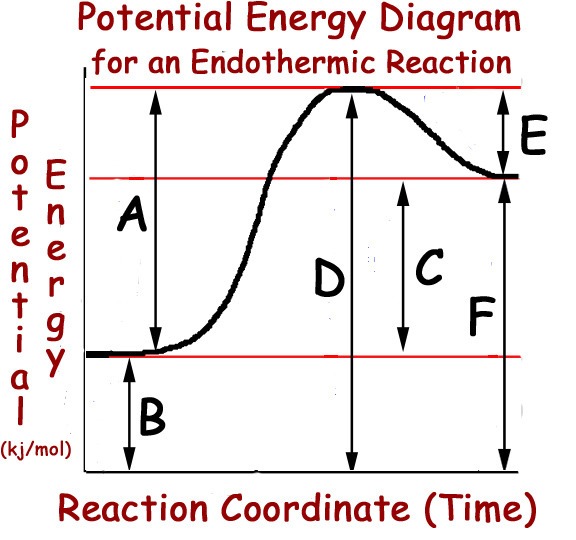
Which letter represents ΔH? Is it an endothermic or exothermic reaction?
C, endothermic
C, exothermic
B, endothermic
B, exothermic

The dotted line represents
the lowered activation energy due to the addition of an inhibitor.
the lowered activation energy due to the addition of a catalyst.
the higher activation energy due to the addition of a catalyst.
the higher activation energy due to the addition of an inhibitor.
N2(g) + 3H2(g) <--> 2NH3(g) + ENERGY
Which change causes the equilibrium to shift to the right?
N2(g) +O2(g) +182.6 KJ <--> 2 NO(g)
Which change would cause an immediate increase in the rate of the forward reaction?

Which interval on this diagram represents the difference between the potential energy of the products and the potential energy of the reactants?
Given the reaction at equilibrium:
C2 + D2(g) <-->2 CD(g) + energy
Which change will cause the equilibrium to shift?
increase in pressure
addition of a noble gas
addition of heat
addition of a catalyst
N2O4(g) <--> 2NO2(g)
Which statement describes this reaction at equilibrium?

Which has to be true for a reaction to occur?
Collisions with enough energy
Collisions with the correct orientation
Activation Energy
All of the other choices

