
 Worksheets
Mostly Electrochemistry & Redox
Total questions: 104
Worksheet time: 3hrs 28mins
. What is conserved during a chemical reaction?
mass, only
neither mass nor charge
both mass and charge
charge, only
Which reaction occurs at the anode in an electrochemical cell?
saponification
oxidation
esterification
reduction
Which statement describes the two types of reactions that occur in operating electrochemical cells?
Nonspontaneous reactions occur in voltaic cells, and spontaneous reactions occur in electrolytic cells.
Nonspontaneous reactions occur in electrolytic cells, and nonspontaneous reactions occur in voltaic cells.
Spontaneous reactions occur in voltaic cells, and nonspontaneous reactions occur in electrolytic cells.
Spontaneous reactions occur in electrolytic cells, and spontaneous reactions occur in voltaic cells.
A collision between reactant particles is most likely to result in a reaction when the particles have proper orientation and proper
charge
energy
mass
radius
Which statement accurately describes particles of an ideal gas, according to the kinetic molecular theory?
The distance between the gas particles is much greater than the size of the particles
As the gas particles collide, the total energy of the system increases
The gas particles have strong intermolecular forces
The gas particles move in a circular motion
As the elements in Group 2 in the periodic table are considered in order of increasing atomic number, there is a general increase in
stability
atomic radius
electronegativity
first ionization energy
During the operation of a voltaic cell, the cell produces
electrical energy spontaneously
chemical energy spontaneously
electrical energy nonspontaneously
chemical energy nonspontaneously
Which statement explains why Group 18 elements are stable and unreactive?
They are all gases
They have low melting points.
Their valence electron shell has reached a full octet.
They have high ionization energies
In a redox reaction, which particles are lost and gained in equal numbers?
electrons
neutrons
hydroxide ions
hydronium ions
What is the oxidation state for a Mn atom?
0
+7
+3
+4
Which compounds are classified as electrolytes?
KNO₃ and H₂SO₄
KNO₃ and CH₃OH
CH₃OCH₃ and H₂SO₄
CH₃OCH₃ and CH₃OH
Which half-reaction correctly represents reduction?
Ag --> Ag+ + e-
F2 --> 2 F- + 2e-
Au3+ + 3e- --> Au
Fe2+ + e- --> Fe3+

In any redox reaction, the substance that undergoes reduction will
lose electrons and have a decrease in oxidation number
lose electrons and have an increase in oxidation number
gain electrons and have a decrease in oxidation number
gain electrons and have an increase in oxidation number
Sn(s) → Sn4+(aq) + 4e−
What is the oxidation number of carbon in NaHCO3?
What is oxidation number of Cr in Cr2O72-?
-2
+2
+6
+12
What is the oxidation state of H in H2?
+2
+1
0
None of the above
H in NaH ?
+1
0
-1
None of the above
Mg + PbCl2 --> MgCl2 + Pb. Which statement correctly describes the oxidation and reduction that occur?
Mg is oxidized and Cl- is reduced
Mg is oxidized and Pb+2 is reduced
Mg is reduced and Cl- is oxidized
Mg is reduced and Pb+2 is oxidized
Cl2 + 2e- --> 2Cl - is an example of:
a chemical reaction
redox
oxidation
reduction
4Fe + 3O2 --> 2Fe2O3
In the reaction Zn + H2O --> ZnO2 + H2
which element, if any, is oxidized?
Zn0
Zn+2
O-2
H20
None

What element is being reduced?
I0
H+1
S+4
O-2

What element is being Oxidized?
I0
H+1
S+4
O-2
The following chemical equation represents the extraction of silicon from quartz using coke.
SiO2 + C → Si + CO2
What is the change in oxidation number of silicon?
+2 to 0
+4 to 0
0 to +2
0 to +4
Mg → Mg2+ + 2e–
In the reaction Zn + 2HCl --> ZnCl2 + H2
which element, if any, is oxidized?
Zinc
Hydrogen
Chlorine
None
What is the oxidation number of oxygen in oxygen gas, O2 ?
-2
0
-1
+1
What is the oxidation number of C in SrCO3?
-4
+2
-6
+4
What is the oxidation number of chlorine in HClO?
Remember Chlorine goes a little crazy and can act out of character when it's with oxygen...
0
-1
+1
+5
Which energy conversion shown below takes place in a voltaic cell?
Electrical to chemical
Mechanical to chemical
Mechanical to electrical
Chemical to electrical
Which would be an accurate half-equation at the anode for aluminum?
Al3+ + 3e- --> Al
Al --> Al3+ + 3e-
Al3+ --> Al + 3e-
Al + 3e- --> Al3+
Which would be an accurate half-equation at the cathode for aluminum?
Al3+ + 3e- --> Al
Al --> Al3+ + 3e-
Al3+ --> Al + 3e-
Al + 3e- --> Al3+
Reduction occurs at the
anode
cathode

A diagram of a chemical cell and an equation are shown below.
Pb(s) + Cu2+(aq) → Pb2+(aq) + Cu(s)
When the switch is closed, electrons will flow from
the Pb(s) to the Cu(s)
the Cu(s) to the Pb(s)
the Pb2+(aq) to the Pb(s)
the Cu2+(aq) to the Cu(s)

Which statement identifies the part of the cell that conducts electrons and describes the direction of electron flow as the cell operates?
Remember who to consult when deciding who the anode is. Electrons are LOST at the anode therefore they must lave the anode; that's where they are produced (such as in oxidation half reactions)
Electrons flow through the salt bridge from the Ni(s) to the Zn(s).
Electrons flow through the salt bridge from the Zn(s) to the Ni(s).
Electrons flow through the wire from the Ni(s) to the Zn(s).
Electrons flow through the wire from the Zn(s) to the Ni(s).

Which statement correctly describes the direction of flow for the ions in this cell when the switch is closed?
Ions move through the salt bridge from B to C, only.
Ions move through the salt bridge from C to B, only.
Ions move through the salt bridge in both directions.
Ions do not move through the salt bridge in either direction.

When the switch is closed, which group of letters correctly represents the direction of electron flow?
A) A → B → C → D
B) A → F → E → D
C) D → C → B → A
D) D → F → E → A

Base your answer to the question on the diagram of the voltaic cell.
Based on the given equation, the balanced half-reaction that occurs in half-cell 1 is
Pb(s) → Pb2+(aq) + 2e-
2Ag(s) → 2Ag+(aq) + 2e-
Pb2+(aq) + 2e- → Pb(s)
2Ag+(aq) + 2e- → Ag(s)

What is the role of the salt bridge in a voltaic cell? (Check all that apply)
To allow the movement of water molecules between the two half cells
To allow the movement of electrons between the half cells
To allow the movement of ions to maintain charge neutrality
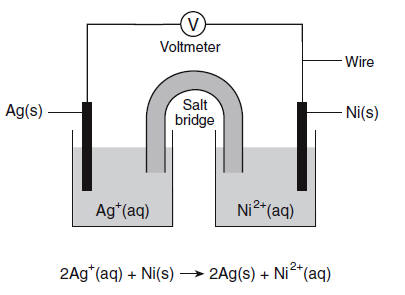
Consider the diagram of a voltaic cell represented here. What reaction occurs at the anode?
Chem is CONSTANT analysis! As pointed out in class, please make sure you are evaluating what is in front of you and not assuming i.e., which side left orright is which anode.
Ag+ + e- →Ag
Ag → Ag+ + e-
Ni2+ + 2e- → Ni
Ni → Ni2+ + 2e-

A power source is required for this cell to operate because the REDOX reaction is:
nonspontaneous and converts electrical energy to chemical energy
spontaneous and converts electrical energy to chemical energy
nonspontaneous and converts chemical energy to electrical energy
spontaneous and converts chemical energy to electrical energy

In the electrochemical cell shown, the Ni(s) is the:
anode and increases in mass as the cell operates
anode and decreases in mass as the cell operates
cathode and increases in mass as the cell operates
cathode and decreases in mass as the cell operates

The purpose of the salt bridge is to allow (a) to flow to maintain neutrality as the cell operates.

This diagram represents:
a voltaic cell that converts chemical energy to electrical energy
an electrolytic cell that converts chemical energy to electrical energy
a voltaic cell that converts electrical energy to chemical energy
a electrolytic cell that converts electrical energy to chemical energy

According to reference Table J, which of the following reactions would occur spontaneously?
A
B
C
D

Which of the following half reactions represents reduction?
a
b
c
d
Which of the following half reactions represents oxidation?
a
b
c
d

Which species has been oxidized in the reaction shown?
Co(s)
Cu+1(aq)
Cu(s)
Co+3(aq)

In the REDOX reaction shown, silver (Ag) has:
lost electrons resulting in oxidation
gained electrons resulting in oxidation
lost electrons resulting in reduction
gained electrons resulting in reduction
All REDOX reactions are examples of _______ transfer reactions.
neutron
ion
electron
proton


A key is plated with nickel as shown in the diagram below.
A) voltaic cell; a chemical change produces electrical energy
B) electrolytic cell; a chemical change produces electrical energy
C) voltaic cell; electrical energy produces a chemical change
D) electrolytic cell; electrical energy produces a chemical change
Based on Table J, which ionic equation represents a spontaneous reaction that can occur in a voltaic cell?
A) Fe(s) + Mg²⁺(aq) → Fe²⁺(aq) + Mg(s)
B) Fe²⁺(aq) + Mg²⁺(aq) → Fe(s) + Mg(s)
C) Fe(s) + Mg(s) → Fe²⁺(aq) + Mg²⁺(aq)
D) Fe²⁺(aq) + Mg(s) → Fe(s) + Mg²⁺(aq)
In which kind of cell are the redox reactions made to occur by an externally applied electrical current?
galvanic cell
chemical cell
voltaic cell
electrolytic cell

The diagram shows a key being plated with copper in an electrolytic cell. Given the reduction reaction for this cell:
Cu²⁺(aq) + 2e⁻ → Cu(s)
this reduction occurs at
A, which is the anode
A, which is the cathode
B, which is the anode
B, which is the cathode

Write the balanced half-reaction for the reduction that occurs in this electrolytic cell.
This is an electrolytic (reduction). These special cells have the negative ion serving as the anode (getting oxidized)...
Cl2 + 2e⁻ → 2Cl⁻
Cl2 → 2Cl⁻ + 2e⁻
2Na⁺ + 2e⁻ → 2Na
2Na⁺ → 2Na + 2e⁻

Refer to diagram
Solutions, such as solution X, are always used in electrochemical cells.
What is the general term used to describe these solutions.
Electrolyte
Electrons
Photons

What is happening at the Fe electrode/Half Cell 2
Not sure which electrode is the cathode or anode - consult table j!
Fe atoms are being reduced to Fe+2 ions
Fe+2 ions are being oxidized to Fe atoms
Fe+2 ions are being reduced to Fe atoms
Fe atoms are being oxidized to Fe+2 ions
What occurs to the mass of copper electrode in the following reaction?
Zn/Zn2+ // Cu2+/Cu
Don't know which anode is which - who you gonna call?
increases
decreases
remains the same
The electrode that contains the item to be electroplated
Anode
Cathode
Which type of substance will conduct
electricity the best after dissolving in water?
metallic
ionic
network covalent
molecular covalent
The energy change in voltaic cell is ______________.
kinetic energy --> electrical energy
electrical energy --> chemical energy
chemical energy --> electrical energy
electrical energy --> kinetic energy
Write the balanced half-reaction for the reduction that occurs in this electrolytic cell.
Cl2 + 2e⁻ → 2Cl⁻
Cl2 → 2Cl⁻ + 2e⁻
2Na⁺ + 2e⁻ → 2Na
2Na⁺ → 2Na + 2e⁻

What type of electrochemical cell is shown?
oxidation cell
electrolytic cell
reduction cell
voltaic cell

In this electrolytic cell, electrode A is designated as the
anode and is positive
anode and is negative
cathode and is positive
cathode and is negative

Which type of cell does the diagram represent?
electrolytic, with the anode at A
electrolytic, with the cathode at A
voltaic, with the anode at A
voltaic, with the cathode at A
As the pH of a solution is changed from 3 to 1, the concentration of hydronium ions
decreases by a factor of 100
decreases by a factor of 20
increases by a factor of 20
increases by a factor of 100
As the pH of a solution changes from 2 to 5, the concentration of hydronium ions
decreases by a factor of 30
decreases by a factor of 1000
increases by a factor of 1000
increases by a factor of 30
Which relationship is present in a solution that has a pH of 6?
[H3O+] = [OH-]
[H3O+] > [OH-]
[H3O+] < [OH-]
[H3O+] + [OH-] = 7
Given the equation representing a reaction:
3CuCl2(aq) + 2Al(s) --> 3Cu(s) + 2AlCl3(aq)
The oxidation number of copper changes from
+1 to 0
+2 to 0
+2 to +1
+6 to +3

1
2
3
4

7. Electroplating is an electrolytic process that can be used to coat metal objects with a less reactive metal. The diagram below shows an electroplating cell that includes a power source connected to a copper rod and a bracelet made from a different metal. The rod and bracelet are in an aqueous copper(II) sulfate solution.
Identify the electrode that attracts the Cu2+ ions as the cell operates.
(a)

8. Electroplating is an electrolytic process that can be used to coat metal objects with a less reactive metal. The diagram below shows an electroplating cell that includes a power source connected to a copper rod and a bracelet made from a different metal. The rod and bracelet are in an aqueous copper(II) sulfate solution.
Write a balanced half reaction equation for the REDUCTION of Cu2+ that occurs in this cell.
(a)

The diagram and ionic equation below represent an operating voltaic cell:
1. from Ni(s) through the wire to Mg(s)
2. from Mg(s) through the wire to Ni(s)
3. from Ni2+(aq) ions through the salt bridge to Mg2+(aq) ions
4. from Mg2+(aq) ions through the salt bridge to Ni2+(aq) ions
Which ionic equation represents a spontaneous reaction that can occur in a voltaic cell?
Cu(s) + Zn(s) Cu2+(aq) + Zn2+(aq)
Cu(s) + Zn2+(aq) Cu2+(aq) + Zn(s)
Cu2+(aq) + Zn(s) Cu(s) + Zn2+(aq)
Cu2+(aq) + Zn2+(aq) Cu(s) + Zn(s)
Based on Reference Table F, which of these salts is the best electrolyte?
sodium nitrate
magnesium carbonate
silver chloride
barium sulfate
Which is a redox reaction?
HCl + KOH KCl + H2O
4 HCl + MnO2 MnCl2 + 2 H2O + Cl2
2 HCl +CaCO3 CaCl2 + H2O + CO2
2 HCl + FeS FeCl2 + H2S
Given the balanced ionic equation representing a reaction:
2 Al3+(aq) + 3 Mg(s) 3 Mg2+(aq) + 2 Al(s)
In this reaction, electrons are transferred from
Al to Mg2+
Al3+ to Mg
Mg to Al3+
Mg2+ to Al

Which process is represented by this diagram?
chromatography
distillation
electrolysis
polymerization
Which process requires energy to decompose a substance?
electrolysis
neutralization
sublimation
synthesis
Given the balanced equation representing a reaction: Ni(s) + 2HCl(aq) → NiCl₂(aq) + H₂(g). In this reaction, each Ni atom
loses 1 electron
loses 2 electrons
gains 1 electron
gains 2 electrons
According to Reference Table F, which compound is most soluble in water?
BaCO3
BaSO4
ZnCO3
ZnSO4

Identify the electrode that attracts the Cu2+ ions as the cell operates.
The bracelet (cathode) attracts the Cu2+ ions.
The anode attracts the Cu2+ ions.
The salt bridge attracts the Cu2+ ions.
The electrolyte attracts the Cu2+ ions.

Write a balanced half-reaction equation for the reduction of Cu2+ ions that occurs in this cell.
Cu2+ + 2e- → Cu(s)
Cu(s) → Cu2+ + 2e-
Cu2+ → Cu(s) + 2e-
Cu(s) + 2e- → Cu2+

