
 Worksheets
Exploring Energy and Waves Quiz
Total questions: 128
Worksheet time: 32hrs 0mins
What is the basic unit of mass in the metric system?
Gram
Meter
Liter
Second
Which element has the chemical symbol "O" on the periodic table?
Oxygen
Gold
Osmium
Silver
What is the formula for calculating work?
W=F×d
W=m×v
W=F/d
W=m+a
Which of the following is NOT a type of mechanical wave?
Sound wave
Water wave
Light wave
Seismic wave
Which of the following is a form of kinetic energy?
A moving car
A stretched rubber band
A battery
A book on a shelf
What is the SI unit for force?
Newton
Joule
Watt
Pascal
Which part of the electromagnetic spectrum has the shortest wavelength?
Gamma rays
Infrared
Radio waves
Visible light
Which of the following is a safety rule in the science lab?
Wear safety goggles
Eat food during experiments
Taste chemicals to identify them
Ignore spills
Which of the following is a property of sound waves?
They require a medium to travel
They travel fastest in a vacuum
They are transverse waves
They do not carry energy
What is the formula for density?
Density=VolumeMass
Density=Mass×Volume
Density=MassVolume
Density=Mass+Volume
Convert 2500 milliliters (mL) to liters (L).
2.5 L
0.25 L
25 L
250 L
If a block has a mass of 200 g and a volume of 50 cm³, what is its density?
4 g/cm³
0.25 g/cm³
150 g/cm³
10000 g/cm³
Which of the following best describes the difference between mechanical and electromagnetic waves?
Mechanical waves require a medium; electromagnetic waves do not.
Electromagnetic waves require a medium; mechanical waves do not.
Both require a medium to travel.
Neither require a medium to travel.
A student balances the following chemical equation: __H2+__O2→__H2O . What are the correct coefficients?
2, 1, 2
1, 2, 2
2, 2, 1
1, 1, 2
Which type of energy is stored in the bonds of molecules?
Chemical energy
Thermal energy
Nuclear energy
Mechanical energy
A force of 10 N is applied to move a box 5 meters. How much work is done?
50 J
2 J
15 J
5 J
A sound wave travels through air, water, and steel. In which medium does it travel fastest, and why?
Steel, because particles are closest together
Air, because it is less dense
Water, because it is a liquid
Air, because it is a gas
A student is given a sample with a mass of 120 g and a volume of 60 mL. The student claims the density is 0.5 g/mL. Is the student correct? Explain your reasoning.
No, the correct density is 2 g/mL
Yes, the density is 0.5 g/mL
No, the correct density is 1 g/mL
Yes, the density is 2 g/mL
You are given a mixture of sand and iron filings. Using your knowledge of lab safety and separation techniques, describe a safe method to separate the two substances.
Use a magnet to attract the iron filings, wearing gloves and goggles
Pour water to dissolve both substances
Heat the mixture until it separates
Taste each substance to identify them
A student needs to convert 5 kilometers (km) to meters (m) for a lab report. What is the correct conversion and how should the student show their work?
5 km × 1000 = 5000 m; show multiplication by 1000
5 km ÷ 1000 = 0.005 m; show division by 1000
5 km × 100 = 500 m; show multiplication by 100
5 km ÷ 100 = 0.05 m; show division by 100
What is the definition of amplitude in a transverse wave?
The distance between two consecutive crests
The height from the rest position to the crest
The number of waves passing a point per second
The distance between two consecutive troughs
Which of the following best describes frequency in a wave?
The height of the wave
The distance between two crests
The number of waves passing a point per second
The time taken for one wave to pass
How does the wavelength of a wave relate to its frequency?
Longer wavelengths have higher frequencies
Shorter wavelengths have lower frequencies
Longer wavelengths have lower frequencies
Wavelength and frequency are unrelated
Which type of electromagnetic wave is commonly used in radiation therapy?
Radio waves
Microwaves
Gamma rays
Infrared waves
What is one application of ultraviolet waves?
Cooking food
Sterilizing medical equipment
Broadcasting radio signals
Heating homes
Explain how fiber optics use electromagnetic waves for communication.
They use sound waves to transmit data
They use visible light to transmit data through glass fibers
They use radio waves to transmit data wirelessly
They use microwaves to transmit data over long distances
Compare gravitational potential energy and kinetic energy.
Both depend on the object's speed
Gravitational potential energy depends on height, while kinetic energy depends on speed
Both depend on the object's height
Gravitational potential energy depends on speed, while kinetic energy depends on height
Which of the following is an example of chemical potential energy?
A moving car
A stretched rubber band
A battery
A rock at the top of a hill
Describe how energy is conserved in an electrical circuit.
Energy is lost as it moves through the circuit
Energy is transformed from electrical to light and heat energy
Energy is created within the circuit
Energy is destroyed when the circuit is complete
In a food web, how is energy transferred between organisms?
Energy is transferred through the consumption of plants and animals
Energy is transferred through the air
Energy is transferred through water
Energy is transferred through sunlight
What happens to the energy of a roller coaster as it moves from the top of a hill to the bottom?
Potential energy is converted to kinetic energy
Kinetic energy is converted to potential energy
Energy is lost as heat
Energy is created
Which of the following best describes elastic potential energy?
Energy stored in chemical bonds
Energy stored due to an object's position
Energy stored when an object is stretched or compressed
Energy due to an object's motion
How does the use of microwaves in wireless technology work?
Microwaves are used to cook food
Microwaves transmit data over short distances
Microwaves are used to sterilize equipment
Microwaves are used to observe astronomical objects
What is the role of X-rays in astronomical observations?
To observe the surface of planets
To detect high-energy phenomena in space
To measure the temperature of stars
To map the distribution of galaxies
Explain how photosynthesis demonstrates the conservation of energy.
Energy is created from sunlight
Energy is transformed from light to chemical energy in glucose
Energy is destroyed during the process
Energy is transferred from plants to the soil
Compare and contrast the use of electromagnetic waves in wireless technologies and fiber optics.
Both use sound waves for data transmission
Wireless technologies use radio waves, while fiber optics use light waves
Both use microwaves for data transmission
Wireless technologies use light waves, while fiber optics use radio waves

Sound intensity is defined as:
The wavelength of a sound wave
The source of a sound wave
The energy of a sound wave
The frequency of a sound wave
The (a) is a unit of sound intensity.
Which of the following images shows a change in frequency?


Which of the following images shows a change in amplitude?
What is the wavelength of a wave?
The length of one wave cycle.
The height of the wave.
The number of waves that pass through a certain distance/time.
The loudness of a wave.
Draw in one example of a wavelength on this wave model.

Draw a model of a wave that is quiet and low-pitch.

Draw a model of a sound wave that is loud and high-pitch.


Which option best describes the wave shown here?
Quiet and high-pitch
Loud and high-pitch
Quiet and low-pitch
Loud and low-pitch
Noise-induced hearing loss depends on what two factors?
Loudness of sound and length of exposure
Loudness of sound and the wavelength of the sound wave
Pitch of sound and the length of exposure
Loudness of sound and pitch of sound
Generally, you can listen to a sound at 90 decibels for 8 hours before being at risk for noise-induced hearing loss. How long can you listen to a sound at 95 decibels?
8 minutes
6 hours
7 hours
4 hours
What is NOT a suggestion you would give to someone to decrease their risk of noise-induced hearing loss?
Wear ear protection such as ear plugs or noise-cancelling headphones
Stand closer to sources of loud noises -- the sounds are less intense there!
Avoid unnecessary exposure to loud noises

From 0-4, with 0 being very unconfident and 4 being very confident, how ready do you feel to take the assessment tomorrow?
0
1
2
3
4

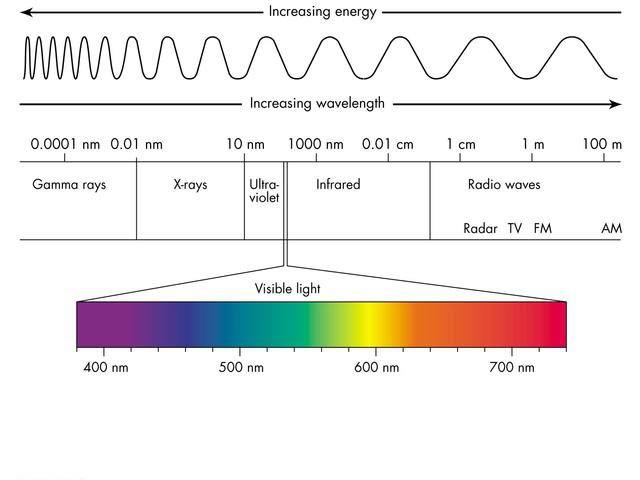
What is the correct order of the visible light spectrum starting with the longer wavelength?
Red, yellow, orange, blue, violet, indigo
Violet, indigo, blue, green, yellow, orange, red
Green, yellow, blue, indigo, red, orange
Red, orange, yellow, green, blue, indigo, violet


Which color has the longest wavelength?
Yellow
Red
Green
Purple

Quasars are extremely distant celestial bodies. Investigators using a special telescope determined that a certain quasar was emitting waves with a frequency of 1.41 x 10⁹ Hz. Using the electromagnetic spectrum provided, investigators were most likely using a telescope that detects -
microwaves
visible light
x-rays
gamma rays

Scientists observed a celestial object emitting a wavelength of 3 x 10⁻¹⁰m. What type of telescope did the scientists have to use to view this?
Radio wave
Infrared ray
X-ray
Gamma Ray
Scientists observed a celestial object emitting waves with a frequency of 1.41 x 10⁸ Hz. What type of telescope did the scientists have to use to view this object?
Radio wave
Microwave
X-ray
Ultraviolet wave
The frequency of an x-ray is --
1.41 x 10⁻¹⁰ Hz
1.41 x 10¹⁸ Hz
1.41 x 10¹⁰ Hz
1.41 x 10⁻¹⁸ Hz
The wavelength of an infrared ray is --
10-5 m
1012 Hz
105 m
10-12 Hz
Scientists observed a celestial object emitting a wavelength of 3 x 10³m. What type of telescope did the scientists have to use to view this?
Radio wave
Infrared ray
X-ray
Gamma Ray
Convert the following number to scientific notation: 43,000,000
43x10⁶
4.3×10⁷
430×10⁵
4.3×10⁻⁷
12,000,000
345,000
Convert the following number to scientific notation: 520,000,000
52 x 107
5.2 x 10⁷
5.2 x 10⁸
0.52 x 10⁹
Convert the following number to scientific notation: .000457
457 x 106
457 x 10-6
4.57 x10⁴
4.57 x 10⁻⁴
True or False: Scientific notation is made up of two number parts. The second part is a power of 10.
True
False
If the exponent is a positive number the original number was...
a really big number.
a really small number.
If the exponent is a negative number the original number was...
a really large number.
a really small number.
.000457
4.2 x 10⁴
8.15 x 10⁶
What is an example of Electric Energy
Apple
Rubber Bands
Car Battery
Table
Which statement is true?
Oranges contain Elastic Energy
Food contains Chemical Energy
Phone on the table doesn't contain Gravitational Energy
Radiator contains Nuclear Energy

What type(s) of energy does a fridge contain?
Sound Energy
Thermal Energy
Mechanical Energy
All of the above
Which is Potential Energy?
Radiant Energy
Mechanical Energy
Chemical Energy
Sound Energy
Heat Energy is called:
Radiant Energy
Chemical Energy
Thermal Energy
Mechanical Energy
Energy is found in many different forms, but it can be classified into two distinct categories: kinetic energy and ________________ energy.
electrial
potential
radiant
thermal
When a firecracker explodes, stored chemical energy turns into sound and light energy. What other type of energy is also released?
mechanical
potential
electrical
thermal
Potential energy is energy of position and is also sometimes called ______________ energy.
stored
chemical
radiant
elastic
Electrical Energy is
kinetic energy
potential energy
Elastic Energy is
Kinetic Energy
Potential Energy
Sound Energy is
Kinetic Energy
Potential Energy

Identify the type of energy represented by the illustration.
thermal energy
chemical energy
nuclear energy
elastic energy
Energy is the ability to do work or cause changes.
True
False
Vibrations produce _______ energy.
chemical
sound
potential
light
Objects with a higher temperature have particles that are vibrating _______.
faster
slower
Pushing a filing cabinet across the room is an example of ________ energy.
light
thermal
chemical
mechanical


How much liquid is represented?
56 mL
50.6 mL
58 mL
50.8 mL

Which of the three blocks has the greatest density?
A
B
C

In this image, a ping pong ball is floating in water. Select all correct statements.
The ping pong is less dense than the water
The water is less dense than the ping pong
If the ping pong ball was bigger, it would eventually sink
To stay above water is to _____.
Sink
Float
To stay below the water is to _____.
Sink
Float

This object ______ in water.
Sinks
Floats



