
 Worksheets
Chemistry Final Review
Total questions: 160
Worksheet time: 9hrs 4mins
CaC₂(s) + H₂O(l) --> C₂H₂(g) + Ca(OH)₂(aq)
12.00 moles of NaClO3 will produce how many grams of O2?
How many grams of potassium chloride (KCl) can be produced from 356 g of potassium bromide (KBr)?
About how many grams of H2O will be produced from 150 grams of Fe2O3?
How many moles of hydrogen are needed to react with 2 moles of nitrogen?
How many moles of hydrogen are needed to react with 2 moles of nitrogen?
2NaOH(aq) + H2SO4(aq) --> 2H2O(l) + Na2SO4(aq)
How many grams of sodium sulfate will be formed if you start with 200 grams of sodium hydroxide?
How many moles of oxygen are produced when 6.7 moles of KClO3 decompose completely?
151 grams of Al2O3 are produced. How many grams of Al was needed in the reaction? Al + O2 -------> Al2O3 balance first.
79.91 g
22.4 liters
57.8 g
142.8 g
What is the mole-to-mole ratio for hydrogen and oxygen in the balanced equation: 2 H2 + O2 -> 2 H2O?
1:2
1:1
3:1
2:1

How many moles of H2O are produced when 4 moles of O2 react? 2 H2 + O2 -> 2 H2O
8 mol
2 mol
6 mol
10 mol

What is the mass of NaCl produced when 2.2 moles of Na react with excess Cl2?
2 Na + Cl2 → 2 NaCl
molar mass of NaCl = 58.44 g/mol
128.57 g
58.65 g
117.3 g
234.6 g

How many moles of CO2 are produced when 5.6 grams of C6H12O6 react?
C6H12O6 + 6 O2 → 6 CO2 + 6 H2O
Molar mass C6H12O6 = 180.18 g/mol
2.5 mol
1.5 mol
0.186 mol
0.5 mol
What is the Law of Conservation of Mass?
It states that matter cannot be created or destroyed.
It states that energy cannot be created or destroyed.
It states that matter can be created or destroyed.
It states that sound can be created or destroyed.
Fe + S --> FeS
Example: H2
N2+O2--> _NO
Mg + __HCl ---> MgCl2 + H2
Al + O2 → 2Al2O3
2H2 + O2 --> 2H2O
4Fe + 3O2 --> 2Fe2O3
NaHCO3 --> Na2CO3 + H2O + CO2
2CH3OH + 3O2 --> 2CO2 + 4H2O
The coefficient in 3H2O is
6
5
2
3

What are the coefficients that would properly balance this equation?
__Ca + __H2O --> __Ca(OH)2 + __H2
2,1 --> 2,1
1,2 --> 1,1
1,2 --> 2,4
1,2 --> 2,1
What are the coefficients that would properly balance this equation?
__H2 + __S --> __H2S
1,1 --> 1
2,2 --> 2
1,2 --> 1
1,2 --> 2
Balance the the following equation.
__Zn+__HCl -->__ZnCl2 +__H2
1,1,2,1
1,1,1,2
1,2,1,1
2,1,1,1
Mn + _ HNO3 → Mn(NO3)2 + H2
What creates pressure?
gas molecules spinning
gas molecules colliding with container walls
potential energy
electrons
What is the mathematical expression for Boyle's Law?
P1V1=P2V2
V1P1=V2P2
P2V2=P1V1
P1V2=P2V1
When using Charles' Law if you double volume, what happens to temperature?
it remains constant
it triples
it is divided by 2
it is doubled also
What temperature scale must we use in the Gas Laws?
Rankine
Fahrenheit
Kelvin
Celsius
How many kpa are in 1.01 bar?
760
101.3
14.7
1
How do we measure an increase in kinetic energy?
volume
temperature
Liters
none of the above
What happens to pressure as we in crease kinetic energy?
it decreases
it remains constant
it increases
none of the above
If you place a balloon in a refrigerator what will happen to the volume?
it will decrease
it will increase
it will remain constant
none of the above
Why does the volume decrease in the previous question?
because the molecules slow down their spinning
because temperature and pressure decrease with a decrease in kinetic energy and collisions
because of a decrease in potential energy
none of the above
What gas law should you use to describe the balloon in the last two questions
Charles' Law
Boyles Law
Dalton's Law
Combined Gas Law
How many (partial pressures) gasses can we have in Dalton's Law?
5
10
100
an infinite number of (partial pressures) gases
What happens to pressure at higher elevations?
it increases
it decreases
Why does the pressure decrease as we reach higher elevations?
the air molecules have more kinetic energy
there are less air molecules
the air molecules have less kinetic energy
there are more air molecules

In the picture when the pistons rise the volume of the cylinder decreases. What happens to the pressure and temperature?
The temperature will decrease and, therefore, the pressure will decrease.
The collisions between molecules and the container walls will increase causing an increase in pressure. The temperature will decrease because the kinetic energy decreases.
The collisions between molecules and the container walls will increase causing an increase in pressure. The temperature will because the kinetic energy will increase.
The temperature and pressure are not related.

What causes a hot air balloon to rise?
An increase in temperature causes an increase in pressure that causes an increase in volume which causes the air in the balloon to be more dense than the air around it.
An increase in temperature causes an increase in pressure that causes an increase in volume which causes the air in the balloon to be less dense than the air around it.
As the temperature of the gas increases it escapes the balloon similarly to the gas leaving a rocket. This forces the balloon into the air.
The increase in kinetic energy due to a temperature increase causes the atoms to lose protons and become helium. Helium is lighter than the air surrounding the balloon and this causes it to rise.
A sample of gas has a volume of 2.0 liters at a pressure of 1.0 atmosphere. When the volume increases to 4.0 liters at constant temperature, what will be the resulting pressure of the sample?
0.25 atm
0.50 atm
1.0 atm
2.0 atm
A rigid cylinder contains a sample of gas at STP. What is the pressure of this gas after the sample is heated to 410 K?
0.50 atm
0.67 atm
1.0 atm
1.5 atm
Every time matter changes from a liquid to a gas, the matter also experiences a change in the
molecular motion
total molecular mass
size of the molecules
total number of molecules
The Kinetic Molecular Theory of Matter states that the higher the temperature, the faster the ____.
Particles that make up a substance move.
Bonds between atoms break down.
Molecules of gas rush together.
Lighter molecules within a substance clump together.
As the temperature of a fixed volume of a gas increases, the pressure will ____.
varies inversely
decrease
not change
increase
At what temperature will 0.654 moles of neon gas occupy 12.30 liters at 1.95 atmospheres?
447 K
50.3 K
412 K
36.7 K
Find the final temperature of a sample of nitrogen gas at constant pressure if it starts at 27 °C and changes volume from 600 mL to 700 mL.
350 K
257 K
315 K
1400 K
Which postulate of KMT explains why the scent of fresh coffee in the morning fills up every room in the house?
All particles are infinitely small and the size of a particle is negligible compared to the container that it holds.
The particles of gas are in constant motion and move in straight lines.
The particles of gas do not exert any force of attraction or repulsion on each other. There is no energy loss during a collision.
The mean kinetic energy of the particles is directly proportional to their absolute temperature.
A sample of a pure substance in the form of a liquid is heated until it changes into a gas. Which of the following statements best describes the difference between the molecules of the pure sample in the liquid state and the molecules of the pure sample in the gas state?
The molecules in the gas state will have more kinetic energy and be closer together than the molecules in the liquid state.
The molecules in the gas state will have more kinetic energy and be farther apart than the molecules in the liquid state.
The molecules in the gas state will have less kinetic energy and be closer together than the molecules in the liquid state.
The molecules in the gas state will have less kinetic energy and be farther apart than the molecules in the liquid state.
What is the molar volume of any gas at STP?
22.4 L
2.24 L
224 L
6.02 x 10^23 L
According to the KMT, increasing the temperature of particles will
give off energy
increase motion
decrease volume
increase pressure
According to the KMT, the particles of the different states of matter differ in what two key aspects?
volume and mass
density and extention of interactions
temperature and freedom of motion
freedom of motion and extent of interactions
How doe the particles in a gas behave?
Neatly organized without any movement.
Move around trapped in a small volume and with the same surrounding particles.
Move fast enough to break attractions and pushing other particles out of the way.
Move freely in a straight line until they collide with another particle.
In which state of matter are the particles the farthest apart?
gas
liquid
solid
A student inflates a balloon with helium then places it in the freezer. The student should expect
the balloon's volume to increase
the balloon's volume to decrease
the balloon's moles to increase
the balloon's moles to decrease
If a hairspray can is heated, what can be expected of the pressure of the gas inside the can?
The pressure will increase
The pressure will decrease
The pressure will remain constant
The pressure will equalize
CuCl2 + NaOH → Cu(OH)2 + NaCl
Which product is insoluble?
CuCl2(aq) + NaOH(aq) → Cu(OH)2(s) + NaCl(aq)
Which of the following reactions does NOT have a net ionic equation?
C9H20 + O2 --> CO2 + H2O
AgNO3 + CaCl2 --> AgCl + Ca(NO3)2
NH4I + PbOH --> NH4OH + PbI2
Fe(NO3)2 + KOH --> KNO3 + FeOH
Which of the following shows the correct net ionic equation for the reaction of Ba(MnO4)2(aq) + (NH4)2SO4?
Ba2+ + SO42- --> BaSO4
2NH4+ + 2MnO4- --> 2NH4MnO4
Ba + MnO4- --> Ba(MnO4)2
2MnO4- + SO42- --> BaSO4
Which of the following shows the correct net ionic equation for Fe(NO3)2 + KOH
Fe3+ + OH- --> Fe(OH)3
Fe2+ + OH- --> Fe(OH)2
2NO3- + 2K+ --> 2KNO3
Fe2+ + 2OH- --> Fe(OH)2
What is the precipitate in the net ionic equation of CuClO4 + ZnI2
CuI
Zn(ClO4)2
ZnClO4
CuI2
In this equation,
CuCl2+ NaOH → Cu(OH)2 + NaCl
Which product is insoluble?
copper(II) hydroxide
sodium chloride
sodium hydroxide
copper(I) hydroxide
What do we call the substance that is being dissolved?
Solute
Solvent
Concentration
Electrolyte
What do we call the substance that is doing the dissolving?
Solute
Solvent
Concentration
Electrolyte
Kool aid is the perfect refreshment on a hot summer day. What is the solvent in this delicious mixture?
Kool aid
Water
Kool aid is the perfect refreshment on a hot summer day. What is the solute in this delicious mixture?
Kool aid
Water
What is the universal solvent?
Water
Milk
Salt
Sugar

What can be found on the y-axis of this solubility graph?
grams of solute
Temperature
moles of solute
mL of solute
What can be found on the x-axis of this solubility graph?
grams of solute
Temperature
moles of solute
mL of solute
Which of the following can increase the solubility of a solution?
Stirring
Decreasing temperature
Adding more solute
Evaporation

If 60 g of KCl were placed in 100 g of water at 60° C, what kind of solution would be formed?
Saturated
Supersaturated
Unsaturated
Nonsaturated
If 30 g of K2Cr2O7 were placed in 100 g of water at 50° C, what kind of solution would be formed?
Saturated
Supersaturated
Unsaturated
Nonsaturated
If 20 g of KClO3 were placed in 100 g of water at 80° C, what kind of solution would be formed?
Saturated
Supersaturated
Unsaturated
Nonsaturated
At what temperature do NaCl and KCl have the same solubility?
10°C
30°C
50°C
70°C
A solution that contains more of the dissolved material than could be dissolved under normal circumstances.
Saturated
Supersaturated
Unsaturated
Nonsaturated
The amount of solute added is below what the substance can dissolve.
Saturated
Supersaturated
Unsaturated
Nonsaturated

Which statement is true of the three solutions?
Solution C is more soluble in water when compared to Solution A.
Solution C is less soluble in water when compared to Solution B.
Solution C is the least soluble in water when compared to Solutions A and B.
Solution B is the least soluble in water when compared to Solutions A and C.
If 20 g of KNO3 were placed in 100 g of water at 10° C, what kind of solution would be formed?
Saturated
Supersaturated
Unsaturated
Nonsaturated
If 60 g of Pb(NO3)2 were placed in 100 g of water at 60° C, what kind of solution would be formed?
Saturated
Supersaturated
Unsaturated
Nonsaturated
Hot chocolate is a great treat on a cold and dreary day. What is the solvent in this delicious mixture?
Hot Cocoa Mix
Milk
Hot chocolate is a great treat on a cold and dreary day. What is the solute in this delicious mixture?
Hot Cocoa Mix
Milk
A solute is added to water and a portion of the solute remains undissolved. When equilibrium between the dissolved and undissolved solute is reached, what type of solution is present?
Saturated
Supersaturated
Unsaturated
Nonsaturated
What is the main purpose of acid-base titrations?
To test if reactants react.
To calculate the concentration of unknown analyte.
To calculate the concentration of known analyte.
To test quality of reactants.
What is the role of an indicator in a reaction?
To help reactants react successfully.
To bind to the analyte to form a products.
To show when the reaction has reached or past the equivalence point.
To provide a surface for the reaction to occur.
What is an equivalence point?
It is the point when enough analyte has been added.
It is the point when the amount of added titrant is equal to the amount of analyte in the solution.
It is the point when the volume of titrant is equivalent the volume of analyte.
It is the point when the concentration of titrant added is equivalent to the volume of analyte.

Ascorbic acid, H2C6H6O6(s), is a diprotic acid with K1 = 7.9 × 10⁻⁵ and K2 = 1.6 × 10⁻¹². In a 0.005 M aqueous solution of ascorbic acid, which of the following species is present in the lowest concentration?
H3O+(aq)
H2C6H6O6(aq)
HC6H6O6-(aq)
C6H6O62-(aq)
In the titration of a weak acid of unknown concentration with a standard solution of a strong base, a pH meter was used to follow the progress of the titration. Which of the following is true for this experiment?
The [H+] at the equivalence point equals the ionization constant of the acid.
The pH at the equivalence point depends on the indicator used.
The graph of pH versus volume of base added rises gradually at first and then much more rapidly.
The graph of pH versus volume of base added shows no sharp rise.

Which of the following best approximates the Ka value for this weak acid?
1 x 10⁻⁴
1 x 10⁻⁵
5x 10⁻⁶
5 x 10⁻⁷
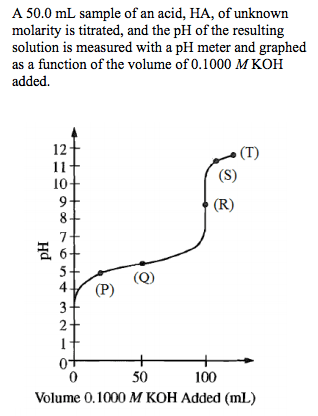
Which point on the titration curve corresponds to the point at which the moles of the added strong base are equal to the moles of the weak acid initially present?
Q
R
S
T
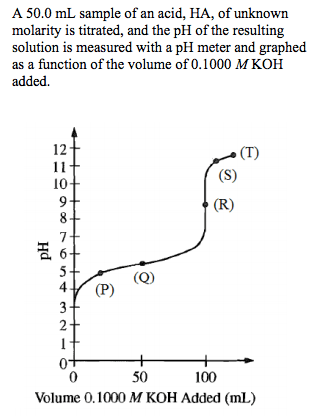
At point P in the titration, which of the following species has the highest concentration?
HA
A–
H3O+
OH–
Which of the following best represents a 0.100-molar solution of H2SO4 in water?
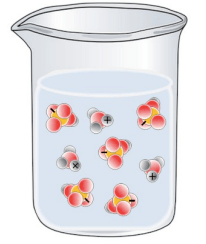
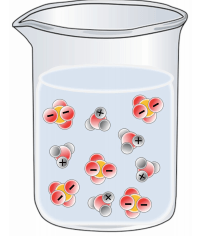
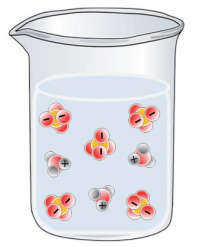
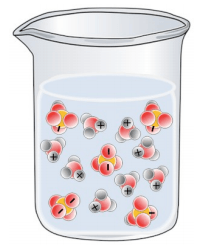
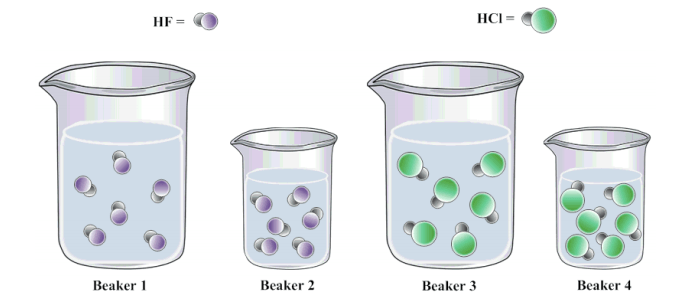
Equal moles of the indicated acids are dissolved in the amounts of water shown in the beakers below. In which solution will the percent ionization of the acid be the lowest?
Beaker 1
Beaker 2
Beaker 3
Beaker 4
Equal volumes of 0.10-molar H3PO4 and 0.20-molar KOH are mixed. After equilibrium is established, the type of ion in solution in largest concentration, other than the K+ ion, is
H2PO4 –
HPO4 2–
PO4 3–
OH-
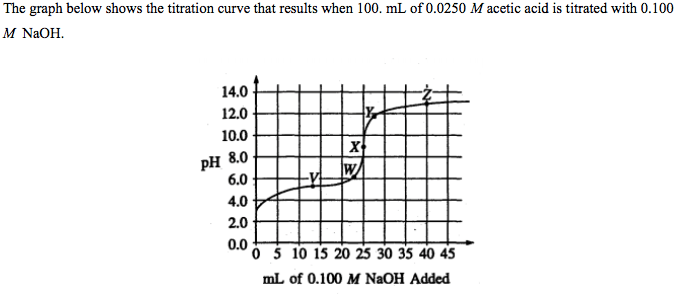
What part of the curve corresponds to the optimum buffer action for the acetic acid/acetate ion pair?
Point V
Point Z
Along all of section WY
Along all of section YZ
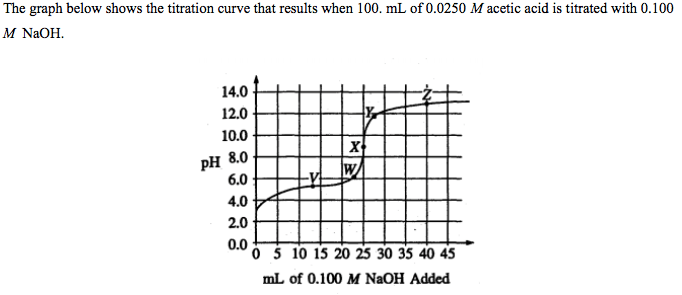
Which of the following indicators is the best choice for this titration?
Methyl orange (pH range of color change is 3.2 - 4.4)
Methyl red (pH range of color change is 4.8 - 6.0)
Bromothymol blue (pH range of color change is 6.1 - 7.6)
Phenolphthalein (pH range of color change is 8.2 - 10.0)

The table shows the pH of several solutions. Which solution is the most acidic?
vinegar
milk
water
bleach
Zn(OH)2 is an example of a...
acid
base
salt
water
H3PO4 is an example of a ...
acid
base
salt
non-electrolyte
Four substances were tested for pH, lemon juice (pH 2), baking soda (pH 9), bleach (pH 12), and milk (pH 6). Which of the following correctly lists the substances from most basic to acidic?
lemon juice, milk, baking soda, bleach
bleach, baking soda, milk, lemon juice
milk, lemon juice, baking soda, bleach
baking soda, bleach, lemon juice, milk

At what pH would all three indicators appear as yellow?
1.7
2.7
4.7
8.7
Phenolphthalein is pink in an aqueous solution having a pH of
2
7
5
12
Based on the results of testing colorless solutions with indicators, which solution is MOST acidic?
a solution in which bromthymol blue is blue
a solution in which bromcresol green is blue
a solution in which phenolphthalein is pink
a solution in which methyl orange is red
If a solution has a pH of 1.5, then litmus would turn
red
purple
blue
yellow
If a solution has a pH of 10, then methyl orange would turn
red
yellow
orange
blue

According to the diagram, what is the color of bromcresol green at the pH of the mouth?
Yellow
Blue
Green
Red
According to the diagram, which part of the digestive system has the most basic enviroment?
Mouth
Stomach
Pancreas
Small intestine
Which pair of compounds represents one Arrhenius acid and one Arrhenius base?
CH3OH and NaOH
CH3OH and HCl
HNO3 and NaOH
HNO3 and HCl
A solution with a pH of 7.8 is first tested with bromthymol blue and then with phenolphthalein. What is the color
of each indicator in this solution?
Bromthymol blue is yellow and phenolphthalein is colorless.
Bromthymol blue is blue and phenolphthalein is colorless.
Bromthymol blue is yellow and phenolphthalein is pink.
Bromthymol blue is blue and phenolphthalein is pink.
The compound KOH can be described as an
Arrhenius acid and an electrolyte
Arrhenius base and an electrolyte
Arrhenius acid and a nonelectrolyte
Arrhenius base and a nonelectrolyte
What is the color of the indicator thymol blue after it is added to an aqueous solution of vitamin C, also known ascorbic acid?
Yellow
Blue
Red
Pink
Which indicator, when added to a solution, changes color from yellow to blue as the pH of the
solution is changed from 5.5 to 8.0?
bromcresol green
bromthymol blue
litmus
methyl orange
According to the diagram, which indicator would turn yellow at the pH of the pancreas?
methyl orange
bromthymol blue
bromcresol green
litmus
Which substance is always a product when an Arrhenius acid in an aqueous solution reacts with an
Arrhenius base in an aqueous solution?
HBr
KBr
H2O
KOH
What type of reaction is Fe + Cl2 → FeCl3
Synthesis
Decomposition
Single Replacement
Combustion
None of these
What type of reaction is C2H2 + O2 → CO2 + H2O
Synthesis
Decomposition
Single Replacement
Combustion
None of these
What type of reaction is BF3 + Li2SO3 → B2(SO3)3 + LiF
Synthesis
Decomposition
Single Replacement
Combustion
None of these
What type of reaction is Ag2O → Ag + O2
Synthesis
Decomposition
Single Replacement
Combustion
None of these
What type of reaction is C5H10 + O2 → CO2 + H2O
Synthesis
Decomposition
Single Replacement
Combustion
None of these
What type of reaction is Zn + HCl → H2 + ZnCl2
Synthesis
Decomposition
Single Replacement
Combustion
None of these
What type of reaction is H2 + N2 → NH3
Synthesis
Decomposition
Single Replacement
Combustion
None of these
What type of reaction is (NH2)3PO4 + Pb(NO3)4 → NH4NO3 + Pb3(PO4)4
Synthesis
Decomposition
Single Replacement
Combustion
None of these
What type of reaction is FeBr3 + H2SO4 → HBr + Fe2(SO4)3
Synthesis
Decomposition
Single Replacement
Combustion
None of these
What type of reaction is Fe + H2SO4 → H2 + FeSO4
Synthesis
Decomposition
Single Replacement
Combustion
None of these
What type of reaction is Mg + Br2 → MgBr2
Synthesis
Decomposition
Single Replacement
Combustion
None of these
What type of reaction is KClO3 → KCl + O2
Synthesis
Decomposition
Single Replacement
Combustion
None of these
What type of reaction is K2CO3 → K2O + CO2
Synthesis
Decomposition
Single Replacement
Combustion
None of these
What type of reaction is CH4 + O2 → CO2 + H2O
Synthesis
Decomposition
Single Replacement
Combustion
None of these
What type of reaction is NaOH + HCl → H2O + NaCl
Synthesis
Decomposition
Single Replacement
Combustion
None of these
What type of reaction is SeCl6 + O2 → SeO2 + Cl2
Synthesis
Decomposition
Single Replacement
Combustion
None of these

