
 Worksheets
Earth Cycles & Life Over Time Review
Total questions: 93
Worksheet time: 1hrs 10mins
Which of the following is NOT a natural resource?
wood
cotton
oil
plastic
coal
A _____________________ is a natural resource that we can replace faster than we use it up.
renewable resource
nonrenewable resource
synthetic material
made made product
ASPHALT: Rock or NOT Rock?
Rock
NOT Rock

What does naturally occurring mean?
It means that it can't come from something once living.
It means that it has a definite volume and shape. So, its particles are tightly packed together.
I don't know.
It means that the substance must occur in nature. So, it can't be created by humans.
Although cement, brick, steel, and glass all come from substances found in the Earth’s crust, they are NOT classified as minerals because___________________.
They are organic
They have a crystalline structure.
They can be a liquid
They are not naturally occurring
True or False: Minerals make up rocks.
True
False
Weathering is the process of -
Moving sediment from one place to another
Dropping or leaving sediment in a location
Breaking down rocks into sediment
An example of chemical weathering is -
Ice wedging
Oxidation
Animals burrowing
Crashing waves
An example of physical weathering is -
Plant roots and leaves releasing acids
Carbonic acid dissolving limestone
Large temperature changes
Lichens growing on rocks

Ice wedging is an example of -
Physical weathering
Chemical weathering
Both physical AND chemical weathering

These rocks were made smooth by wind blowing smaller rock particles across their surface. This is an example of:
ice wedging
chemical weathering
acid rain
abrasion
A metal statue slowly turning green after years of being outside is an example of:
mechanical weathering
chemical weathering
What is sediment?
the process of rocks being broken down and carried away
bits of rock, sand, and silt caused by the weathering of rocks
the top layer of the soil
decaying plant or animal material
_____________________ is the movement of soil and rock by wind, water, ice, and gravity.
Weathering
Erosion
Deposition

Burning wood is an example of a...
physical change
chemical change
Caves being formed by acid rain dissolving underground limestone are examples of what?
chemical weathering (carbonation)
chemical weathering (oxidation)
physical weathering (frost action)
physical weathering (plant action)

This image shows the process of
Carbonation
Hydration
Abrasion
Frost action
Select the forms of weathering that are physical
oxidation
frost action
abrasion
carbonation
Select the forms of weathering that are chemical
oxidation
frost action
abrasion
carbonation

________ is the process in which rocks and soil are dropped.
weathering
erosion
oxidation
deposition
Wegener used the fit of the continents as evidence to support his hypothesis of Continental Drift.
true
false
Wegener used matching matching fossils of the same organisms on different continents as evidence to support his hypothesis of Continental Drift.
true
false
Wegener used matching rock types and ages across different continents as evidence to support his hypothesis of Continental Drift.
true
false

Sunlight is
renewable
nonrenewable

Wind is
renewable
nonrenewable
Resources that are not able to be reproduced as quickly as they are used are called _____.
renewable resources
replaceable resources
non renewable resources
non replaceable resources
Geothermal energy uses heat from ____ to produce electricity.
the earth
coal
oil
natural gas
Which renewable resource gets its direct energy from the sun?
Geothermal
Solar
Wind
Hydrogen

What are fossil fuels?
Dinosaur bones
Resources made from once living organisms
Combination of different rocks
Gas Stations

Which of the following is the oldest?
Layer L
Intrusion D
Intrusion H
Layer E

The youngest material of the ocean floor is found at mid-ocean _________.
ridges
trenches
basins
rifts
Which term is defined as the age of a rock given as the number of years since the rock formed?
Relative Age
Geology
Absolute Age
Law of Superposition

Which layer is OLDER? Layer M or Intrusion P?
Layer M
Intrusion P

Which of the following correctly lists the layers in order from oldest to youngest?
A, B, C, D, E
E, B, C, D, A
E, D, C, B, A
C, B, A, D, E

Name this type of boundary
Convergent boundary
Divergent Boundary
Transform
Volcanoes
Sedimentary rock layers are created in which fashion:
vertical
horizontal
diagonal
circular

According to the law of superposition, the oldest fossils are found
At the top of the rock layers
Near the bottom of the rock layers
In the middle of the rock layers
Somewhat near the surface
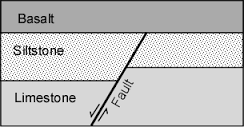
What are the relative ages of the features in order from oldest to youngest?
Limestone, Basalt, Fault, Siltstone
Siltstone, Fault, Basalt, Limestone
Limestone, Fault, Basalt, Siltstone
Limestone, Siltstone, Fault, Basalt

Which layer is OLDER? Layer E or Fault H?
Layer E
Fault H
What is known as the age of a rock or fossil described in comparison to that of another rock or fossil.
Relative Age
Absolute Age
Parent Isotope
Half-LIfe

Which of the following is the oldest?
Layer L
Intrusion D
Intrusion H
Layer E

Which of the following correctly lists the layers in order from oldest to youngest?
A, B, C, D, E
E, B, C, D, A
E, D, C, B, A
C, B, A, D, E

The squirrel in the picture is using an adaptation called
camouflage
hibernation
migration
retention
Differences in traits are called:
natural selection
genetic variations
artificial selection
adaptations
Survival of the Fittest and Evolution were proposed by what scientist?
Charles Darwin
Albert Einstein
Steven Hawking
Isaac Newton
Which organisms are most likely to survive?
the best adapted
the fastest
the strongest
the most domesticated (tamed)
Do organisms "decide" to evolve and change?
Yes, they know they need to change to survive
No, they change because of natural selection
What is a trait?
a color
the quality or characteristic of an organism
the DNA of an organism
when mutations cause extra limbs.

Coloring or another physical characteristic that help an organism blend in with its environment
mimicry
camouflage
hibernation
migration

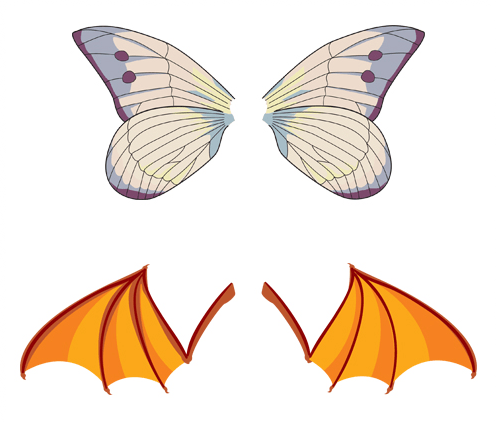
Penguin flipper and fish fin
Homologous
Vestigial
Analogous
None of the above
body parts that perform a similar function but differ in structure
homologous structures
analogous structures
vestigial structures
comparative anatomy

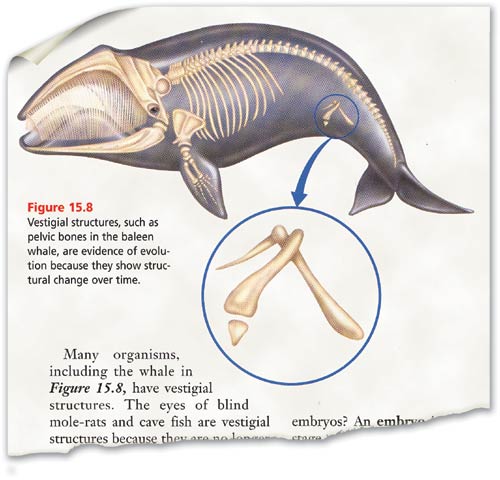
Whales have pelvic bones. What type of structure does this best represent?
Homologous structure
Analogous structure
Vestigial structure
None of the above
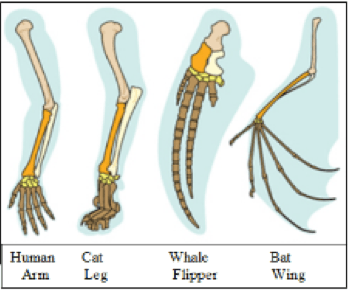
The bones in the figure above are-
Evidence of a common ancestor
Evidence that animals can walk
Evidence that fossils are old
Evidence of nothing



The analysis of embryos can prove...
fossils
extinction
common ancestry
What evidence is most important when using relative dating?
the half-life of a radioactive element
the position of sediment in petrified rock
the types of minerals in a petrified fossil
the position of fossils in sedimentary rock layers
What is Plate Tectonics?
movement of the Earth in space
movement of the oceans against Earth's land
movement of the Earth around the sun
movement of the pieces of Earth's crust
What are plates?
pieces of the Earth's moon
pieces of rock and dust floating in space
pieces of the Earth's core
pieces of Earth's crust
What layer of Earth is made of magma?
inner core
outer core
mantle
crust
Why did other scientists did no believe in Wegener’s theory?
He could not explain how the continents moved
He didn’t have evidence
His data was wrong
He didn’t use the right technology to gather data

When plates are moving towards each other, this is called:
Transform
Convergent
Divergent
Volcanic

When the plates are sliding along one another in opposite directions:
Transformation
Volcanic
Convergent
Divergent

When plates are moving away from each other.
Convergent
Volcanic
Divergent
Transform

Volcanoes and Mountains are formed from
Divergent Plate Boundaries
Transform Boundaries
Volcanic Boundaries
Convergent Boundaries

Earthquakes occur along a ___________.
Fault Line
Mountain Chain
Sea Floor Spreading
Base of a Volcano

Divergent Boundaries cause
Volcanoes
Mountains
Sea Floor Spreading
Earthquakes
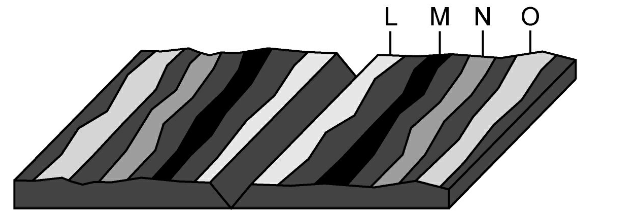

What is the underlying force that drives plate tectonics?
earthquakes
volcanoes
ocean tides
convection currents
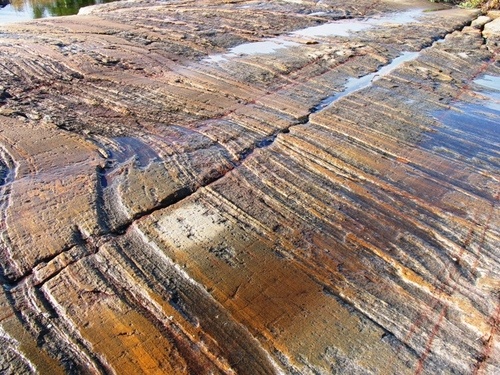
What does the theory of continental drift state?
The continents were once joined in a super-continent and have moved over time.
Continents are stationary and do not move.
The Earth is broken into lithospheric plates that move due to convection currents.
none of the above


Which type of rock is made from lava or magma cooling?
igneous
sedimentary
metamorphic


Fossils are found in ____________ rocks.
metamorphic
magma
igneous
sedimentary


Which type of rock forms from heat and extreme pressure?
Igneous
Sedimentary
Organic
Metamorphic

