
 Worksheets
Biology EOC Exam Study Guide (district)
Total questions: 77
Worksheet time: 39mins

Which statement best compares and contrasts prokaryotic cells and eukaryotic cells using the word bank?
Prokaryotic cells have a nucleus, while eukaryotic cells do not.
Eukaryotic cells have a nucleus, while prokaryotic cells do not.
Both prokaryotic and eukaryotic cells have a nucleus.
Neither prokaryotic nor eukaryotic cells have a nucleus.
Complete the chart on the cell organelles: What is the function of the Nucleus and which cell types (Animal, Plant, Bacteria) have it?
Function: Contains genetic material (DNA) and controls cell activities. Cell Type: Animal, Plant.
Function: Produces energy for the cell. Cell Type: Animal, Bacteria.
Function: Synthesizes proteins. Cell Type: Plant, Bacteria.
Function: Stores water and nutrients. Cell Type: Animal, Plant, Bacteria.
Complete the chart on the cell organelles: What is the function of the Cell membrane (Plasma membrane) and which cell types (Animal, Plant, Bacteria) have it?
Function: Regulates what enters and leaves the cell; provides protection and support. Cell Type: Animal, Plant, Bacteria.
Function: Produces energy for the cell; found only in animal cells. Cell Type: Animal.
Function: Stores genetic material; found only in plant cells. Cell Type: Plant.
Function: Synthesizes proteins; found only in bacteria. Cell Type: Bacteria.
Complete the chart on the cell organelles: What is the function of the Cell wall and which cell types (Animal, Plant, Bacteria) have it?
Function: Provides structure and protection. Cell Type: Plant, Bacteria.
Function: Produces energy. Cell Type: Animal, Plant.
Function: Controls cell activities. Cell Type: Animal, Bacteria.
Function: Stores genetic material. Cell Type: Plant, Animal.

What is the name of the organelle labeled 3 in the Plant Cell?
Vacuole
Mitochondria
Chloroplast
Nucleus
Define monomer.
A monomer is a small molecule that can join together with other small molecules to form a polymer.
A monomer is a large molecule made up of repeating units.
A monomer is a type of enzyme that speeds up reactions.
A monomer is a complex carbohydrate found in plants.
Define polymer.
A polymer is a large molecule made up of repeating subunits called monomers.
A polymer is a small molecule that cannot be broken down.
A polymer is a type of metal alloy.
A polymer is a single atom with unique properties.
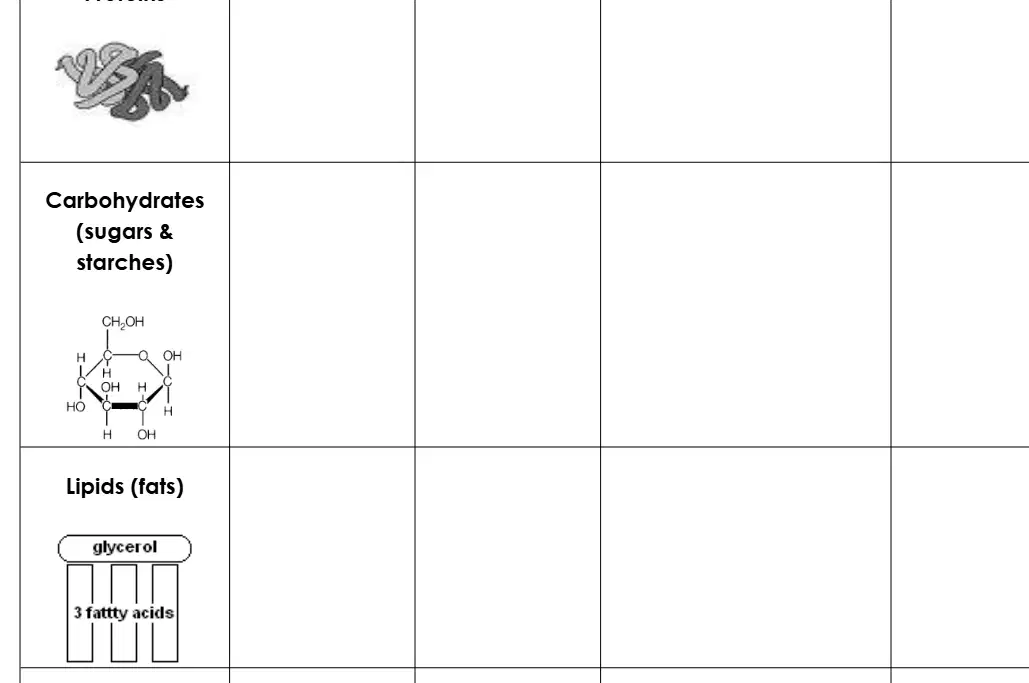
What are the subunits (monomers) of proteins?
Amino acids
Fatty acids
Nucleotides
Monosaccharides
What are the elements found in proteins?
Carbon, hydrogen, oxygen, nitrogen (sometimes sulfur)
Carbon, hydrogen, oxygen, phosphorus
Carbon, hydrogen, oxygen, calcium
Carbon, hydrogen, oxygen, magnesium
What are the functions of proteins?
Builds and repairs tissues, enzymes, hormones, immune function, transport
Provides only energy for the body
Stores genetic information
Regulates blood sugar levels only
What are some examples of proteins?
Enzymes, antibodies, hemoglobin, insulin
Starch, cellulose, glycogen, chitin
DNA, RNA, ATP, NADH
Fatty acids, triglycerides, phospholipids, steroids
What are the subunits (monomers) of carbohydrates (sugars & starches)?
Monosaccharides (simple sugars like glucose)
Amino acids (building blocks of proteins)
Fatty acids (components of lipids)
Nucleotides (building blocks of nucleic acids)
What are the elements found in carbohydrates (sugars & starches)?
Carbon, hydrogen, oxygen
Carbon, nitrogen, sulfur
Hydrogen, nitrogen, phosphorus
Oxygen, sulfur, potassium
What are the functions of carbohydrates (sugars & starches)?
Main source of energy, structural support in plants
Store genetic information, catalyze reactions
Build muscle, transport oxygen
Insulate the body, store long-term energy
What are some examples of carbohydrates (sugars & starches)?
Glucose, starch, cellulose, glycogen
Hemoglobin, insulin, keratin, collagen
DNA, RNA, ATP, NADH
Cholesterol, triglycerides, phospholipids, steroids
What are the subunits (monomers) of lipids (fats)?
Glycerol and fatty acids
Amino acids
Nucleotides
Monosaccharides
What are the elements found in lipids (fats)?
Carbon, hydrogen, oxygen
Carbon, nitrogen, sulfur
Hydrogen, nitrogen, phosphorus
Oxygen, sulfur, phosphorus
What are the functions of lipids (fats)?
Long-term energy storage, insulation, makes up cell membranes
Immediate energy source, genetic information storage, hormone production
Structural support, oxygen transport, enzyme catalysis
Water transport, mineral storage, nerve impulse transmission
What are some examples of lipids (fats)?
Fats, oils, waxes, phospholipids, steroids
Proteins, amino acids, nucleic acids, enzymes
Sugars, starches, cellulose, glycogen
Vitamins, minerals, water, fiber
What are the subunits (monomers) of nucleic acids?
Nucleotides
Amino acids
Fatty acids
Monosaccharides
What are the elements found in nucleic acids?
Carbon, hydrogen, oxygen, nitrogen, phosphorus
Carbon, hydrogen, sulfur, calcium, potassium
Oxygen, nitrogen, magnesium, sodium, chlorine
Hydrogen, oxygen, iron, zinc, copper
What are the functions of nucleic acids?
Store and transmit genetic information
Provide structural support to cells
Catalyze chemical reactions
Serve as a primary energy source
What are some examples of nucleic acids?
DNA, RNA
Glucose, Fructose
Hemoglobin, Myoglobin
Cholesterol, Triglyceride
The relationship between nucleic acids and proteins is that:
Nucleic acids store genetic information that is used to synthesize proteins.
Proteins store genetic information for nucleic acids.
Nucleic acids and proteins have the same function in cells.
Proteins are made up of nucleic acids.
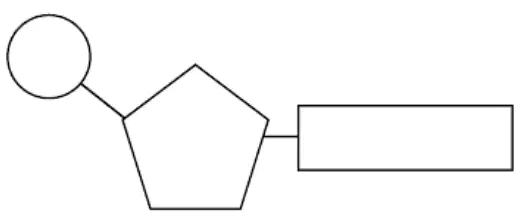
Label the 3 parts of the nucleotide on the model to the right:
Circle: phosphate group; Pentagon: deoxyribose sugar; Rectangle: nitrogen base
Circle: nitrogen base; Pentagon: phosphate group; Rectangle: deoxyribose sugar
Circle: deoxyribose sugar; Pentagon: nitrogen base; Rectangle: phosphate group
Circle: phosphate group; Pentagon: nitrogen base; Rectangle: deoxyribose sugar
2. In a DNA molecule... Adenine (A) pairs with ____________________
Thymine (T)
Cytosine (C)
Guanine (G)
Uracil (U)
3. In a DNA molecule... Cytosine (C) pairs with ____________________
Guanine (G)
Adenine (A)
Thymine (T)
Uracil (U)
What bonds hold together the nitrogenous bases?
Hydrogen bonds
Covalent bonds
Ionic bonds
Peptide bonds
What part of the DNA molecule makes up the rungs of the double helix?
Nitrogen bases
Phosphate groups
Deoxyribose sugars
Hydrogen ions
What part of the DNA molecule makes up the backbone?
Deoxyribose sugar and phosphate group
Nitrogenous bases only
Amino acids and ribose
Fatty acids and glycerol
Find the complementary DNA strand for AGC CAT GTA TAC
TCG GTA CAT ATG
AGC CAT GTA TAC
AGG CTA GAT TAC
TCG GAT CAT TAG
DNA replicates itself to ensure that:
Each new cell receives an exact copy of genetic material
Proteins are synthesized correctly
Energy is produced in the cell
The cell membrane is formed
Multicellular organisms begin as masses of cells called _______ ______________. These cells are ______________________ since they do not have specific jobs. During ____________________, variations in __________ expression results in genes being switched on or off which determines the function of cells and ultimately their ___________________________.
stem cells, undifferentiated, differentiation, gene, specialization
nerve cells, specialized, mutation, protein, division
muscle cells, differentiated, replication, hormone, growth
blood cells, programmed, translation, enzyme, reproduction
Put the following terms in order based on the central dogma of biology: trait, protein, RNA, DNA, amino acids
DNA → RNA → amino acids → protein → trait
DNA → amino acids → RNA → protein → trait
RNA → DNA → protein → amino acids → trait
Trait → protein → amino acids → RNA → DNA
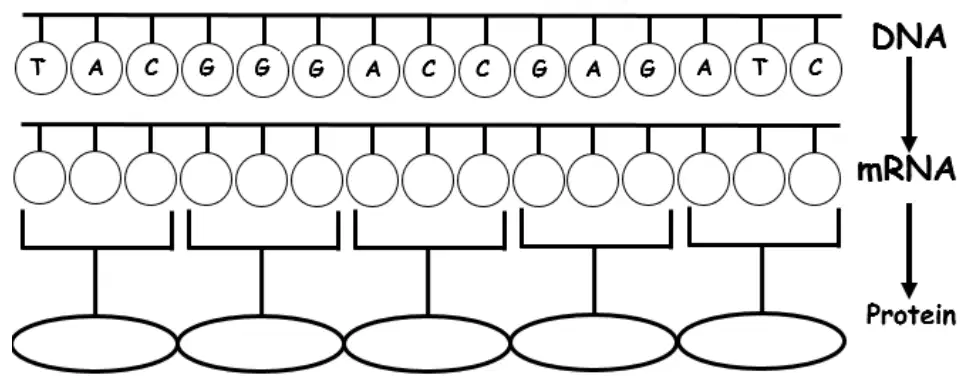
7. What is the correct transcription and translation of the given DNA strand?
Option A: mRNA: AUG CGA UUU, Protein: Met-Arg-Phe
Option B: mRNA: UAC GCU AAA, Protein: Tyr-Ala-Lys
Option C: mRNA: GGC UUA CCG, Protein: Gly-Leu-Pro
Option D: mRNA: CCG AAU GGA, Protein: Pro-Asn-Gly
What type of bond holds the amino acids together?
Peptide bond
Ionic bond
Hydrogen bond
Disulfide bond
A strand of DNA with the sequence AAC AAG CCC undergoes a mutation and the first A is substituted for a C. How will this mutation affect the amino acid sequence?
one amino acid will change
two amino acids will change
all of the amino acids will change
the amino acids will remain the same
Which of the following are causes of mutations?
Exposure to radiation, chemical mutagens, and errors during DNA replication
Balanced diet, regular exercise, and adequate sleep
Vaccination, antibiotics, and hand washing
Photosynthesis, respiration, and transpiration
A mutation in only your body cell such as your heart cell can be passed on to your children.
True
False
1. An enzyme is also called a biological ____________________.
catalyst
acid
protein
solvent
What is the function of an enzyme?
To speed up chemical reactions in the body
To store genetic information
To provide structural support to cells
To transport oxygen in the blood
An enzyme is classified as a type of ________________ so its monomers are __________ ____________.
protein; amino acids
lipid; fatty acids
carbohydrate; monosaccharides
nucleic acid; nucleotides
4. Enzymes and their substrates fit together like a ________ and a ________. This shows how they are specific. Each enzyme can fit with only ________ type of substrate.
lock; key; one
pen; paper; two
shoe; sock; many
book; shelf; several
Define activation energy.
Activation energy is the minimum amount of energy required to start a chemical reaction.
Activation energy is the energy released when a reaction is completed.
Activation energy is the energy required to break all bonds in a molecule.
Activation energy is the energy stored in the products of a reaction.
What do enzymes do to the activation energy of a chemical reaction?
Lower (decrease) the activation energy.
Raise (increase) the activation energy.
When enzymes change shape and stop working they are said to be _________________
denatured
activated
hydrated
replicated
Two factors that affect enzyme activity are ____________________ and _________
temperature; pH
light; sound
pressure; humidity
salinity; wind
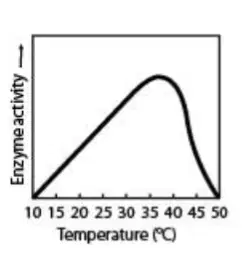
A group of students conducts research on enzyme activity and collects the data shown in the graphs seen to the left. According to the graphs... What is the optimum temperature?
37°C
25°C
50°C
10°C
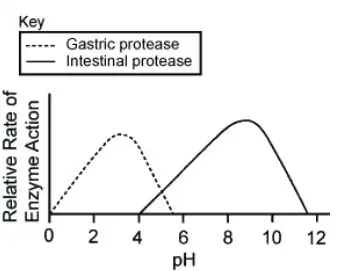
What is the optimum pH for gastric protease?
The optimum pH for gastric protease is about 2.
The optimum pH for gastric protease is about 7.
The optimum pH for gastric protease is about 9.
The optimum pH for gastric protease is about 5.
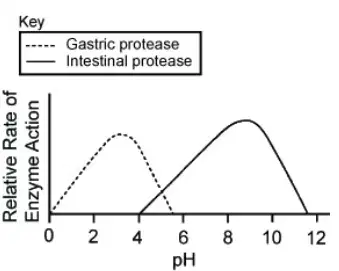
What is the optimum pH for intestinal protease?
The optimum pH for intestinal protease is about 8.
The optimum pH for intestinal protease is about 2.
The optimum pH for intestinal protease is about 5.
The optimum pH for intestinal protease is about 10.
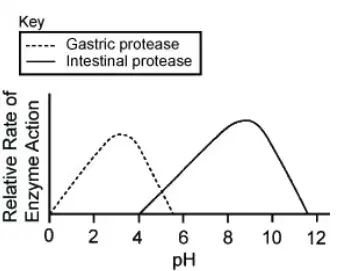
At what pH do both enzymes show some activity?
Both enzymes show some activity at pH 4-5.
Both enzymes show some activity at pH 2-3.
Both enzymes show some activity at pH 7-8.
Both enzymes show some activity at pH 9-10.
Enzymes are types of proteins.
True
False
Enzymes slow down the rate of chemical reactions.
True
False
Each enzyme is specific, it only works on one type of substance.
True
False
Enzymes become denatured (melt) at high temperatures.
True
False
Enzymes can be denatured by a change in pH.
True
False
Enzymes can not be reused.
True
False
Enzymes speed up reactions by lowering activation energy.
True
False
Enzymes are proteins made of building blocks called amino acids.
True
False
Proteins are made in the mitochondria of cells.
True
False
The term semi-permeable describes the cell membrane because it:
Allows only certain substances to pass through
Allows all substances to pass through freely
Prevents all substances from passing through
Has no effect on substance movement
A concentration gradient is:
the difference in the concentration of a substance across a space
the movement of water across a membrane
the process of cell division
the breakdown of glucose in cells
Direction of movement (Active Transport): low to _______ (__________ the gradient)
high, against
low, with
high, with
low, against
ATP needed? (Active Transport): Yes or No
Yes
No
Sometimes
Only in plants
Transport protein needed? (Active Transport): Yes or No
Yes
No
Sometimes
Only during diffusion
A cell with 5% salt concentration is placed in a solution with a 20% salt concentration. Osmosis occurs. What will happen to the cell?
The cell will shrink
The cell will swell
The cell will stay the same size
No change will occur
While cleaning a saltwater aquarium, students placed the aquarium plants in a container of distilled 100% water. What effect will this have on the plant cells?
The plant cells will swell and may burst due to water intake.
The plant cells will shrink due to water loss.
The plant cells will remain unchanged.
The plant cells will become more rigid.
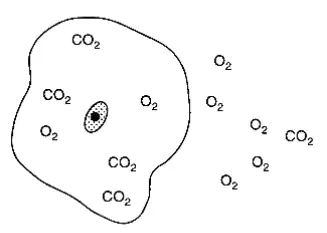
The model to the right shows a picture of a cell (the nucleus is the little circle in the middle) and the concentration of carbon dioxide gas (CO2) and oxygen gas (O2) across the cell membrane. Based on this information, circle the correct answer choice to make the sentence true.
O2 will ENTER / EXIT the cell.
CO2 will ENTER / EXIT the cell.
Both of these gasses will pass through the cell membrane via OSMOSIS / DIFFUSION.
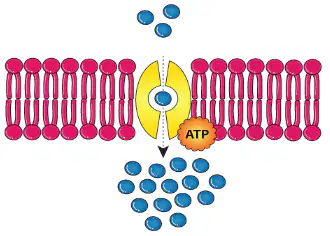
The model to the right is representing which type of transport?
Active transport
Passive transport
Which of the following best outlines the difference between a positive and negative feedback mechanism?
Positive feedback amplifies changes while negative feedback counteracts changes.
Positive feedback counteracts changes while negative feedback amplifies changes.
Both feedback mechanisms amplify changes.
Both feedback mechanisms counteract changes.
Temperature regulation in the body is an example of a negative feedback mechanism because:
It amplifies changes in body temperature.
It maintains a stable internal environment by reversing changes in temperature.
It causes body temperature to fluctuate wildly.
It only works when the body is cold.
ATP is:
A type of protein
A type of carbohydrate
Adenosine triphosphate
A type of vitamin
ATP and ADP differ in which of the following ways?
ATP has three phosphate groups, while ADP has two.
ATP is a protein, while ADP is a carbohydrate.
ATP contains no phosphate groups, while ADP does.
ATP and ADP have the same number of phosphate groups.
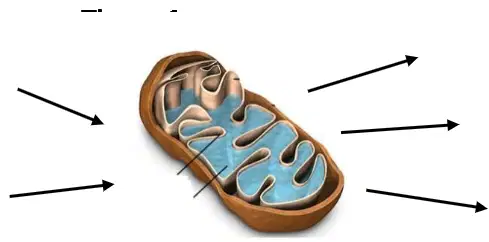
Which organelle is modeled in Figure 1 and why is the folded inner membrane important to its function?
Mitochondrion; the folded inner membrane increases surface area for energy production.
Chloroplast; the folded inner membrane stores sunlight for photosynthesis.
Nucleus; the folded inner membrane protects genetic material.
Ribosome; the folded inner membrane helps in protein synthesis.
Which of the following are factors that can affect the rate of photosynthesis?
Light intensity, carbon dioxide concentration, temperature
Soil type, wind speed, humidity
Leaf color, root length, stem thickness
Rainfall, altitude, soil pH
Compare and contrast aerobic and anaerobic respiration by completing the chart below. Write the bolded terms in the correct columns.
Aerobic: with O₂, more, mitochondria Anaerobic: without O₂, less, cytoplasm
Aerobic: without O₂, less, cytoplasm Anaerobic: with O₂, more, mitochondria
Aerobic: with O₂, less, cytoplasm Anaerobic: without O₂, more, mitochondria
Aerobic: without O₂, more, cytoplasm Anaerobic: with O₂, less, mitochondria
What type of anaerobic respiration occurs in human muscle cells?
Lactic acid fermentation
Alcoholic fermentation
Acetic acid fermentation
Butyric acid fermentation

