
 Worksheets
Semester 2 Review T/F
Total questions: 92
Worksheet time: 5hrs 36mins
The first step in the formation of the Grand Canyon was DEPOSITION
TRUE
FALSE
The last step in the formation of the Grand Canyon was UPLIFT
TRUE
FALSE
Constructive forces build up land features, like beaches
TRUE
FALSE
Destructive forces break down features of the landscape, creating things like canyons
TRUE
FALSE
In a landscape, the oldest rock features will be at the bottom, lowest down in the profile
TRUE
FALSE
Any feature that cuts through rock layers (fault, other rock, etc) must be older than the layers that it cuts through
TRUE
FALSE
When a city does not have enough water to provide for all of its needs this is known as physical water scarcity
TRUE
FALSE
Agriculture uses the greatest volume of water, followed by human need, and industry uses the least
TRUE
FALSE
The independent variable is the one that you as the scientist change
TRUE
FALSE
The dependent variable is the one that you as the scientist change
TRUE
FALSE
Controlled variables are variables that you keep constant (the same) throughout your experiment so they do not have any affect on your results
TRUE
FALSE
Erosion is an example of a destructive force
TRUE
FALSE
Weathering is an example of a constructive force
TRUE
FALSE
Based on the maps we examined, the East Coast has a greater water supply than the West Coast
TRUE
FALSE
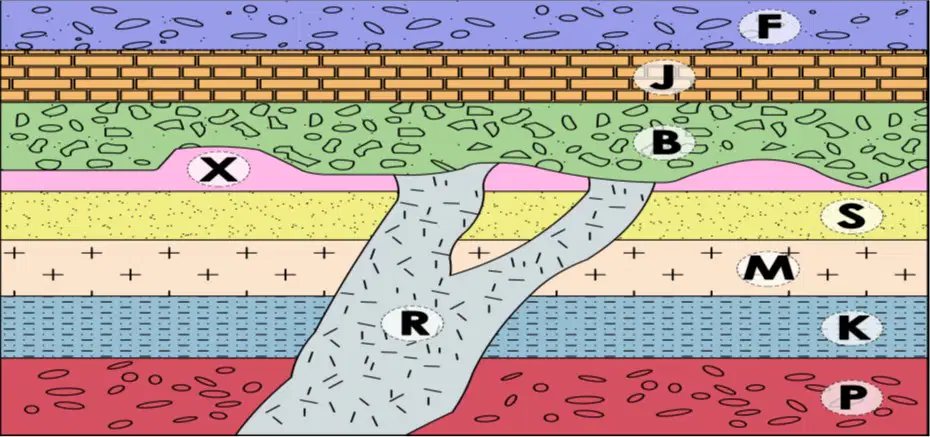
Layer R is newer/younger than Layers P, K, M, S, and X
TRUE
FALSE
Dams transfer water from where it is located to where it is needed most
True
False
Technology advances have helped us to better meet our water needs
True
False
Our water usage has generally increased over time
True
False
Water supply is the amount of water available for us to access
True
False
Desalination is the process of removing salt and other particles from water to create more fresh water for us to use
True
False
About 50% of the water on Earth is available as fresh water for us to use
True
False
Ground water is stored under the surface and is referred to as "aquifers"
True
False
Water is equally distributed across the state of California
True
False
Glaciers are a main "input" of water into the Colorado River
True
False
Albedo is how reflective a surface is
TRUE
FALSE
Surfaces with a HIGH albedo absorb a lot of solar energy
TRUE
FALSE
The level of albedo is dependent on color of the surface
TRUE
FALSE
Surfaces with a high albedo will get very hot in the Sun
TRUE
FALSE
A feedback loop has features that do NOT affect one another at all
TRUE
FALSE
A POSITIVE feedback loop amplifies/magnifies the effect
TRUE
FALSE
A NEGATIVE feedback loop amplifies/magnifies the effect
TRUE
FALSE
As temperatures warm, glaciers melt, this decreases albedo, which increases temperatures further... this is an example of a positive feedback loop
TRUE
FALSE
Temperatures must be below freezing at all times in order for glaciers to exist in an area
TRUE
FALSE
Enough snowfall is one of the main factors that contributes to an area having glaciers
TRUE
FALSE
The number of glaciers in Glacier National Park has remained the same for the last several decades
TRUE
FALSE
Glaciers completely melt and reform every year
TRUE
FALSE
Glaciers can partially melt and change in size with the seasons, but they do not completely melt every year
TRUE
FALSE
Milankovitch cycles are the main reason glaciers are melting now
TRUE
FALSE
Carbon dioxide is the main greenhouse gas we focus on when looking at recent climate change
TRUE
FALSE
Carbon dioxide is the ONLY greenhouse gas, no other gases in the atmosphere are considered greenhouse gas
TRUE
FALSE
One of the main ways we learn about carbon dioxide level in the past is by studying ice core samples taken from glaciers
TRUE
FALSE
The only thing that can be learned from ice cores is the past level of carbon dioxide, they do not indicate anything else
TRUE
FALSE
Climate models can tell us about the past but not the future
TRUE
FALSE
Climate models are computer simulations that use past data to predict future outcomes
TRUE
FALSE
The carbon cycle contains both living and nonliving components, meaning carbon is found in both living and nonliving things
TRUE
FALSE
Carbon is in constant motion through the carbon cycle, it does not get stored for longer periods of time at any given part in the cycle
TRUE
FALSE
Current climate change is due to human factors only, not natural ones
TRUE
FALSE
Current climate change is due to natural factors only, not human ones
TRUE
FALSE
The current drastic rise in greenhouse gas emissions such as carbon dioxide are causing global temperatures to rise
TRUE
FALSE
Global climate change (warming) could lead to increased drought and also flooding
TRUE
FALSE
There are ways that we as humans can alter what we are doing to eliminate or lessen the increase in global temperatures and the associated implications
TRUE
FALSE

As our sun continues through its life cycle, it will _________ and turn into a _______________.
gradually get smaller and smaller until it dies out/ black hole
Gradually get larger until its outer layers drift off/ white dwarf
become denser and denser/ protostar
become hotter and hotter blue/ hypergiant.

All stars begin their life in a
Main Sequence
Nebula
Protostar
Black Dwarf

Our sun is a ____________ star.
main sequence
massive star
supernova
red giant

Average size stars will turn into a _____ star next.
protostar
red giant
supergiant
black hole
A massive star can end it's life as a ______ or ___________.
neutron star/black hole
main sequence star/ nebula
supernova
nebula
red giant
supergiant

The Sun is the biggest star in the sky.


What is the name of the explosion at the death of a massive star?
Supergiant
Supernova
Black Hole
Nebula

What is the diagram called that shows the relationship between star size and temperatures?
bar graph
HR diagram
star chart
Star diagram

Stars are classified by their brightness and temperature on the H-R diagram. How would you describe a white dwarf star, compared to most other stars?
A white dwarf has a lower temperature and is brighter than most stars.
A white dwarf has a higher temperature and is brighter than most stars.
A white dwarf has a lower temperature and is not as bright as most stars.
A white dwarf has a higher temperature and is not as bright as most stars.

Where does the sun fit on the H-R Diagram?
The sun is a giant star.
The sun is a supergiant star.
The sun is a white dwarf star.
The sun is a main sequence star.
What property of a star will determine whether it ends as a white dwarf, a neutron star or a black hole?
The star’s distance from the Earth.
The number of planets orbiting the star.
The star’s mass will determine its final stage.
The star’s shape will determine its final stage.

Stars are classified by their brightness and temperature on the H-R diagram. How would you describe a supergiant, compared to most other stars?
A supergiant has a lower temperature and is brighter than most stars.
A supergiant has a higher temperature and is brighter than most stars.
A supergiant has a lower temperature and is not as bright as most stars.
A supergiant has a higher temperature and is not as bright as most stars.
The process by which stars create heavier elements from lighter ones is referred to as
fission.
fusion.
a chemical reaction.
a physical change.
Which of the following would NOT be useful information for helping to classify stars?
the constellation they are a part of
the mass of the star
the amount of light given off by a star
the color of the star

Stars are classified by their brightness and temperature on the H-R diagram.
Which statement is true based upon the H-R diagram?
A supergiant has a lower temperature and is brighter than a white dwarf.
A supergiant has a lower temperature and is less bright than a white dwarf.
A supergiant has a higher temperature and is less bright than a white dwarf.
A supergiant has a higher temperature and is brighter than a white dwarf.
What will the most massive stars become when they are no longer undergoing nuclear fusion?
black holes
neutron stars
white dwarf stars
main sequence stars

Use the diagram below to answer the question.
How does the sun compare to other stars on the H-R diagram?
The sun is very dim and has low temperature.
The sun is average brightness and temperature.
The sun is very bright and has low temperature.
The sun is very bright and has high temperature.
Objects moving towards us appear REDDER
True
False
The Big Bang Theory describes the origins of the Universe
True
False
The Nebular Model describes the origins of our solar system
True
False
The leading theory for how the Universe will end is that expansion will stop and it will collapse back in on itself, returning to the massive dense mass from which it started
True
False
A NEBULA is a cloud of gas and dust from which stars and planets can form
True
False
The farther away a galaxy is the more it is redshifted and the faster it is moving
True
False
Just like the universe is expanding, galaxies themselves are also expanding (growing bigger)
True
False
The two main pieces of evidence for the Big Bang are redshift and cosmic background radiation
True
False
There are 5 criteria that an object must meet to be considered a planet
True
False
Heavy bombardment is still occurring today
True
False
The Earth formed layers (especially a core) BEFORE the impact that created the moon
True
False
The moon formed AFTER heavy bombardment ended (hint: does it have craters?)
True
False
The age and frequency of craters on the moon shows us when heavy bombardment ended
True
False
Scientists know when the Earth cooled by looking at Chondrite samples
True
False
Scientists know when the solar system formed by looking at Chondrite samples
True
False
Scientists know that Mars, Earth and the moon all formed around the same time by studying rock samples from each
True
False
The heavy bombardment period brought rocks from other objects in space (Mars, chondrites, etc.) to Earth and that is how we have them to study
True
False
The moon has a core identical to Earth
True
False
The solar system began to form 13.8 billion years ago
True
False
In the Nebular Theory, a star forms first and the the planets begin to form after that
True
False

