
NEW
Font size
 Worksheets
Part 2- Final review: Phot,Cellular Respiration - Genetics
Total questions: 77
Worksheet time: 39mins
The ______ take in carbon dioxide.
leaves
roots
flowers
stems
The leaves have a tiny green substance inside of them called ______.
chlorophyll
hemoglobin
glucose
keratin
The chlorophyll changes the water and carbon dioxide into a food that plants need called ______.
glucose
starch
cellulose
oxygen
Once photosynthesis happens the leaves give off ______ into the air.
oxygen
carbon dioxide
nitrogen
hydrogen
Which of the following are the correct reactants and products for photosynthesis?
Reactants: CO₂ and H₂O; Products: C₆H₁₂O₆ and O₂
Reactants: O₂ and C₆H₁₂O₆; Products: CO₂ and H₂O
Reactants: CO₂ and O₂; Products: H₂O and C₆H₁₂O₆
Reactants: H₂O and O₂; Products: CO₂ and C₆H₁₂O₆
The chemical formula for water is?
H2O
CO2
O2
NaCl
The chemical formula for carbon dioxide is?
CO2
CO
C2O
O2C
The chemical formula for glucose is?
C6H12O6
C2H5OH
C12H22O11
CH4
The chemical formula for oxygen is?
O2
O3
CO2
O
What is the goal of photosynthesis?
Make glucose
Produce oxygen only
Absorb carbon dioxide only
Release energy from glucose
Break down food
The process of photosynthesis takes place mostly in the ______ of the plants.
leaves
roots
stems
flowers
Cellular respiration takes place in both ______ and ______.
plants, animals
plants, fungi
animals, bacteria
bacteria, viruses
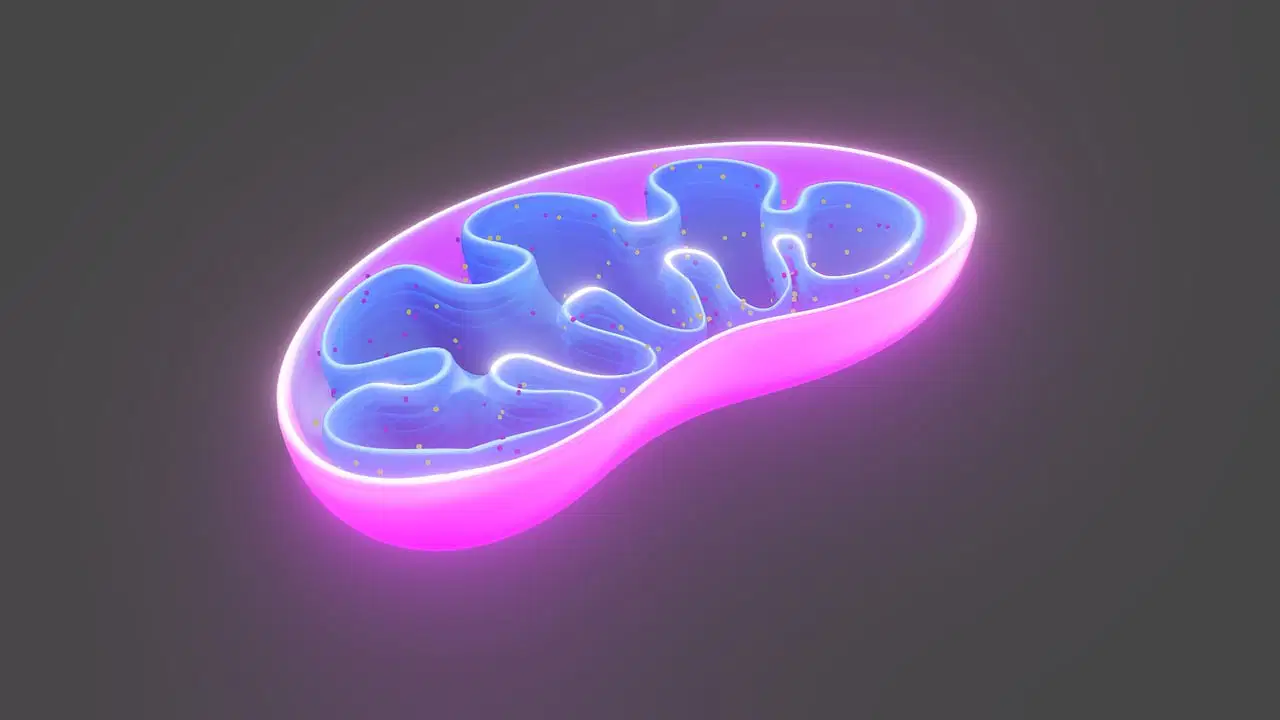
The name of this organelle is the?
Mitochondria
Chloroplast
Nucleus
Ribosome
Fill in the missing blanks with the chemical formulas for the cellular respiration reaction. 6O2 + ______ (enzymes) → 6H2O + ______ + ATP = body energy
C6H12O6, 6CO2
C2H5OH, 6CO2
C6H12O6, 6O2
C2H12O6, 6CO2
What is the goal of cellular respiration?
ATP = body energy
DNA replication
Protein synthesis
Oxygen production
The main jobs of the human nervous system are to receive information, maintain homeostasis, and _________?
respond to stimuli
digest food
produce hormones
filter blood
The smallest part of the nervous system is called the nerve cells or a ________.
Neuron
Axon
Dendrite
Glia
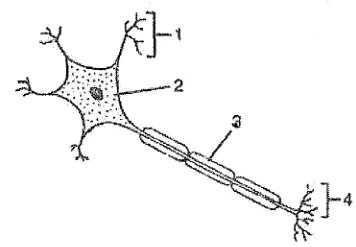
Label the nerve cell diagram: 1, 2, 3, 4.
1. dendrite, 2. center/nucleus, 3. axon, 4. axon tips
1. axon, 2. dendrite, 3. center/nucleus, 4. axon tips
1. axon tips, 2. axon, 3. dendrite, 4. center/nucleus
1. center/nucleus, 2. axon, 3. axon tips, 4. dendrite
The Central nervous system contains the? ______ and the ______.
brain, spinal cord
heart, lungs
liver, kidneys
stomach, intestines
The message carried by the neuron is called the _________.
nerve impulse
axon terminal
myelin sheath
dendrite
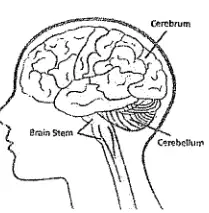
Define the function of each part of the brain:
a. Cerebrum - Responsible for higher brain functions such as thought and action b. Cerebellum - Coordinates voluntary movements and balance c. Brain stem - Controls basic life functions such as breathing, heartbeat, and blood pressure
a. Cerebrum - Controls balance and coordination b. Cerebellum - Responsible for higher brain functions such as thought and action c. Brain stem - Controls digestion and excretion
a. Cerebrum - Regulates breathing and heart rate b. Cerebellum - Controls language and memory c. Brain stem - Coordinates voluntary movements and balance
a. Cerebrum - Controls reflex actions b. Cerebellum - Responsible for vision and hearing c. Brain stem - Controls emotions and reasoning
What is the purpose of the human respiratory system?
Bring in oxygen to body and carbon dioxide out
Digest food and absorb nutrients
Pump blood throughout the body
Transmit nerve signals
During inhalation what happens to the chest cavity?
It expands and gets bigger.
It contracts and gets smaller.
It remains the same size.
It fills with liquid.
During exhalation what happens to the chest cavity?
It contracts and gets smaller.
It expands and gets larger.
It fills with air and rises.
It remains the same size.
Where does gas exchange occur? Which structure?
The alveoli
The trachea
The bronchi
The diaphragm
What structures do you use for mechanical digestion? (use the digestive system slides)
Teeth
Stomach acid
Pancreas
Esophagus
What helps with the start of chemical digestion in our mouth?
Saliva
Teeth
Tongue
Esophagus
What are the wave-like motions in our digestive system called?
Peristalsis
Diffusion
Osmosis
Fermentation
The majority of our nutrients are absorbed by which organ?
Small intestines
Stomach
Large intestines
Esophagus
The Central nervous system contains the? ______ and the _______.
brain, spinal cord
heart, lungs
liver, kidneys
stomach, intestines
What is the purpose of the human respiratory system?
Bring in oxygen to body and carbon dioxide out
Digest food and absorb nutrients
Pump blood throughout the body
Transmit nerve signals
During inhalation what happens to the chest cavity?
It expands and gets bigger.
It contracts and gets smaller.
It remains the same size.
It fills with liquid.
During exhalation what happens to the chest cavity?
It contracts and gets smaller.
It expands and gets larger.
It fills with air and rises.
It remains the same size.
Trace the pathway of air through the body when you inhale: use the words to help, use arrows to show the flow of air - larynx, trachea, mouth, bronchi, alveoli.
Mouth → larynx → trachea → bronchi → alveoli
Mouth → trachea → larynx → bronchi → alveoli
Mouth → bronchi → trachea → larynx → alveoli
Mouth → larynx → bronchi → trachea → alveoli
What is the other name for windpipe?
Trachea
Esophagus
Bronchi
Larynx
Where does gas exchange occur? Which structure?
The alveoli
The bronchi
The trachea
The diaphragm
What structures do you use for mechanical digestion?
Teeth
Esophagus
Liver
Pancreas
What helps with the start of chemical digestion in our mouth?
Saliva
Teeth
Tongue
Esophagus
What are the wave-like motions in our digestive system called?
Peristalsis
Osmosis
Diffusion
Fermentation
The majority of our nutrients are absorbed by which organ?
Small intestines
Stomach
Large intestines
Esophagus
Which organ produces bile to help aid in digestion?
liver
kidney
pancreas
stomach
The human circulatory system is also called the?
Cardiovascular system
Respiratory system
Digestive system
Nervous system
Our circulatory system carries 3 things, what are they? Think! N.O.W.
Nutrients, oxygen, waste
Nerves, organs, water
Neutrons, oil, wax
Nitrogen, ozone, water
The main organ in our circulatory system is the?
Heart
Liver
Lung
Kidney
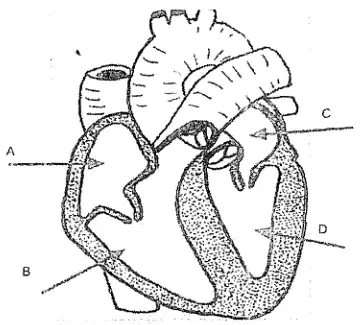
Label the parts of the heart A-D: right ventricle, right atrium, left ventricle, left atrium.
A. right atrium, B. right ventricle, C. left atrium, D. left ventricle
A. right ventricle, B. right atrium, C. left ventricle, D. left atrium
A. left atrium, B. left ventricle, C. right atrium, D. right ventricle
A. left ventricle, B. left atrium, C. right ventricle, D. right atrium
The Atrium ______ blood.
receives
pumps
filters
destroys
The Ventricles ______ blood.
pump
store
filter
absorb
The arteries carry blood ______ from the heart to the body.
away
towards
inside
around
The veins carry blood back from the ______ to the heart.
body
lungs
brain
stomach
What is a community?
All the living organisms in the ecosystem.
All the non-living things in the ecosystem.
Only the plants in the ecosystem.
Only the animals in the ecosystem.
What is a population?
Same organisms.
Different species living together.
A group of rocks.
A collection of water bodies.
All energy on the earth comes from the?
Sun
Moon
Wind
Earth's core
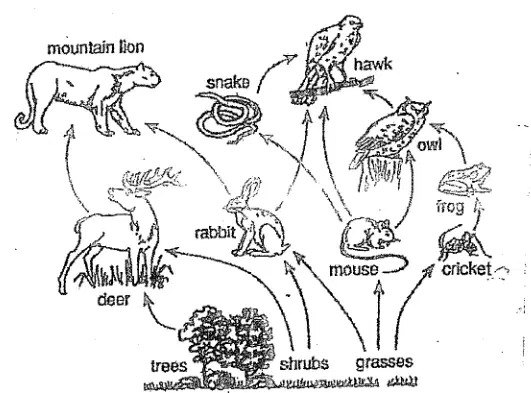
The deer, mouse, rabbit and cricket are all examples of ________ or 1st consumers.
herbivores
carnivores
omnivores
decomposers
The trees, shrubs and grasses are an important part of the food web because they are the ________.
producers
consumers
decomposers
predators

Which organisms would directly lose a food source if all the mice died of a disease?
Owl, snake, hawk
Grass, rabbit, deer
Frog, grasshopper, butterfly
Tree, mushroom, algae
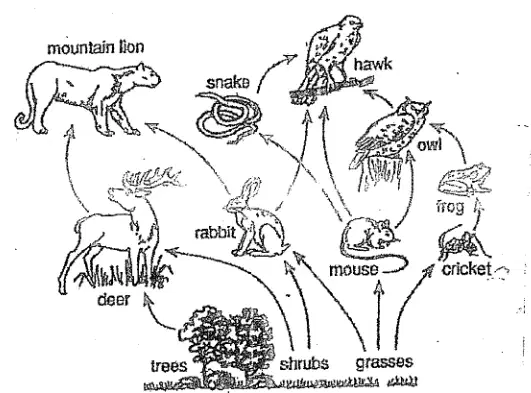
According to this food web, the rabbit is an ________.
herbivore
carnivore
omnivore
decomposer
8. Animals that eat animals are called?
Carnivore
Herbivore
Producers
Insectivore
In the food chain: Grass -> Insect -> Robin -> Hawk, which population would be the biggest?
Grass
Insect
Robin
Hawk
What is mutualism? Give an example.
Mutualism is a symbiotic relationship where both organisms benefit. Example: Shark/remora (+/+).
Mutualism is a relationship where one organism benefits and the other is harmed. Example: Tick/dog (+/-).
Mutualism is a relationship where one organism benefits and the other is unaffected. Example: Barnacle/whale (+/0).
Mutualism is a relationship where both organisms are harmed. Example: Lion/hyena (-/-).
What is commensalism? Give an example.
Commensalism is a symbiotic relationship where one organism benefits and the other is unaffected. Example: Bird/tree (+/0)
Commensalism is a relationship where both organisms are harmed. Example: Lion/deer (-/-)
Commensalism is a symbiotic relationship where both organisms benefit. Example: Bee/flower (+/+)
Commensalism is a relationship where one organism benefits and the other is harmed. Example: Tick/dog (+/-)
What is parasitism? Give an example.
Parasitism is a symbiotic relationship where one organism benefits and the other is harmed. Example: Tick/deer (+/-)
Parasitism is a relationship where both organisms benefit equally. Example: Bee/flower (+/+)
Parasitism is a relationship where neither organism is affected. Example: Cow/grass (0/0)
Parasitism is a relationship where both organisms are harmed. Example: Lion/tiger (-/-)
What is DNA, and how is it organized in our cells?
DNA is the directions or "code of life" and is organized in chromosomes.
DNA is a type of protein found in the cell membrane.
DNA is a sugar molecule that provides energy to cells.
DNA is a gas that helps in cellular respiration.
What is a chromosome?
A chromosome is coiled up DNA.
A chromosome is a type of protein.
A chromosome is a cell organelle that produces energy.
A chromosome is a liquid found in the nucleus.
What are traits?
Traits are features we inherit.
Traits are types of food we eat.
Traits are places we visit.
Traits are games we play.
Where do we inherit our traits from?
We inherit our traits from our family (mom, dad, grandparents).
We inherit our traits from our friends.
We inherit our traits from our teachers.
We inherit our traits from the environment.
A phenotype is ________.
A phenotype is a physical trait, e.g., blue eyes.
A phenotype is a type of genetic mutation, e.g., sickle cell anemia.
A phenotype is a type of protein, e.g., hemoglobin.
A phenotype is a type of cell, e.g., neuron.
How do you represent a genotype?
A genotype is represented by 2 letters.
A genotype is represented by numbers only.
A genotype is represented by a single letter.
A genotype is represented by colors.
How much of your traits are inherited from each of your parents (out of 100%)?
50% from each parent.
25% from each parent.
75% from each parent.
100% from each parent.
Do your parents get to choose which traits they give you?
No.
Yes, they can pick any trait.
Only if they want to.
They can choose some traits.
What is a recessive trait?
A recessive trait is the trait that is hidden or overpowered.
A recessive trait is always visible in the organism.
A recessive trait is the trait that is always dominant.
A recessive trait is the trait that determines blood type.
What is a dominant trait?
A dominant trait is the trait that hides or overpowers.
A dominant trait is the trait that is always recessive.
A dominant trait is the trait that is never expressed.
A dominant trait is the trait that only appears in plants.
For every trait you can make how many genotypes?
3
1
2
4
If a person has 2 uppercase letters for their genotype then they have the: dominant or recessive trait? Circle one.
dominant
recessive
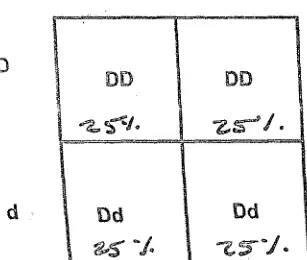
Using the Punnett Square below, show the possible children that can result from a woman who has the genotype DD and a man who has the genotype Dd. Fill in each box with the genotype AND phenotype. Symbol for the dominant allele: D. Symbol for the recessive allele: d. Cross: DD (woman) x Dd (man).
All children will have dimples. Genotypes: DD, DD, Dd, Dd. Phenotype: 100% with dimples.
Half the children will have dimples, and half will not. Genotypes: DD, Dd, dd, dd. Phenotype: 50% with dimples, 50% without.
All children will not have dimples. Genotypes: dd, dd, dd, dd. Phenotype: 100% without dimples.
Three children will have dimples, and one will not. Genotypes: DD, Dd, Dd, dd. Phenotype: 75% with dimples, 25% without.
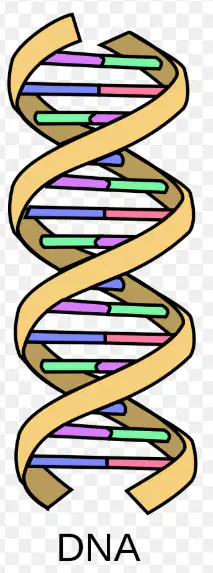
DNA is a twisted ladder its official name is a?
single staircase
spiral
double helix
single helix
In a DNA molecule the steps or rungs of the ladder are made up of?
sugar
legos
phosphates
nitrogen bases
In a strand of DNA, the 4 nitrogen bases match up a particular way. Which base matches with A or adenine?
G= guanine
C= cytosine
T= thymine

