
 Worksheets
All Quizizz In One
Total questions: 80
Worksheet time: 40mins
Which of the following describes weather for a particular area?
Cold Decembers.
Typically rainy and cloudy.
Warm in the summer.
Sunny on June 19
Which of the following describes climate for a particular area?
August weather is generally quite warm.
Yesterday it was 47 degrees outside.
Tomorrow it will be clear and sunny.
The humidity is less than one percent.
Which of the following describes weather for a particular area?
Tomorrow it will be overcast with a 50% chance of rain.
January weather is generally mild.
It is typically rainy and cloudy this time of year.
Summers are usually quite warm.
Which of the following has the least impact on a region's climate?
population
latitude
mountains
elevation
Everett receives about 38 inches of rain per year. Sequim, about 50 miles west of Everett, receives only 12 inches per year. The best explanation for this is:
Sequim is at the same latitude.
Sequim is next to Puget Sound.
Sequim is close to the Pacific Ocean.
Sequim is in the rain shadow of the Olympic Mountains.
Mt. Kilimanjaro in Central Africa has glaciers on it. This is because:
It is far from the equator.
It is close to the Indian Ocean, so it receives lots of snow.
It has a high elevation.
It is very cloudy in Africa, so there is not much sunlight to melt the glaciers.
Which substance generally decreases its temperature the slowest?
water
sand
soil
There's no difference
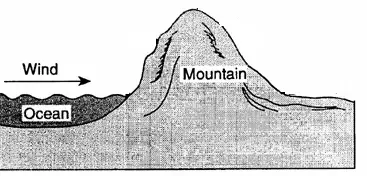
A high coastal mountain range is on the western coast of a continent. Warm moist air blows from west to east over the mountains. From this information, you would expect the western side of the mountain range to __________ compared to the eastern side of the mountain range.
be colder in the winter
be similar in weather
have drier weather
be warmer in the summer
have more rain
Two students decided to study the effect of elevation on climate. Red Mountain has an elevation of 6,120 feet. Green Mountain has an elevation of 4,525 feet. The two mountains are land locked and at the same latitude. What would the students most likely find out if they studied climate at the tops of the mountains?
Red Mountain is sunnier than Green Mountain.
There is almost no difference between Red Mountain and Green Mountain.
Red Mountain has colder temperatures than Green Mountain.
Red Mountain has warmer temperatures than Green Mountain.
Red Mountain is cloudier than Green Mountain.
Two cities are located at about the same latitude. City A is located on an island in the ocean, and city B is located in the middle of a continent. Both cities are at the same elevation above sea level. All other aspects of their physical environment are the same. Which is probably true about cities A and B?
The two climates would be the same because the cities are at the same latitude and elevation.
City A would have warmer summers and cooler winters than city B.
City A would have less precipitation than city B.
City A would have cooler summers and warmer winters than city B.
One reason Spokane has colder winters than Everett is:
Everett is closer to the equator than Spokane.
Spokane is closer to the arctic than Everett.
Spokane is a larger city than Everett.
Everett is at a lower elevation than Spokane.
Spokane is near a large river.
What is a rain shadow?
The areas that don’t get much rain because of shadows.
The windward side of a mountain where there is less precipitation.
The leeward side of the mountains that gets much less precipitation.
Places where the rain leaves shadows, making areas appear darker.
What is the difference between climate and weather?
time scale of observations
accuracy of prediction
kinds of measurements
size of the area
Suppose you have two cities surrounded by land with similar elevation and geographic features. The main difference between them is that city A is at 20 degrees N. latitude and city B is at 60 degrees N. latitude. How will the climates of the two cities differ?
The climates will be similar because they are not near the ocean. City A with the lower latitude will be warmer.
City A will have more extreme weather- hotter summers and colder winters.
City B with the higher latitude will be warmer.
City B will have more extreme weather- hotter summers and colder winters.
City A with the lower latitude will be warmer.
Which of the following factor has the greatest impact on our weather and climate in Everett?
near water
elevation
ocean currents
Wind
Which of the following factor has the greatest impact on weather and climate in Spokane?
ocean currents
elevation
near water
wind
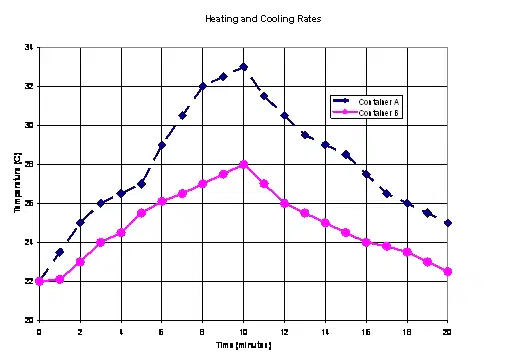
In the heat transfer lab, you generated a graph that may have looked something like this. Container A was filled with gravel and container B was filled with water. Which of the following would be a correct conclusion for your experiment?
Gravel heats up faster and cools down slower than water.
Gravel heats up and cools down faster than water.
Gravel heats up slower and cools down faster than water.
Gravel heats up and cools down slower than water.
Gravel and water heat and cool at the same rate.
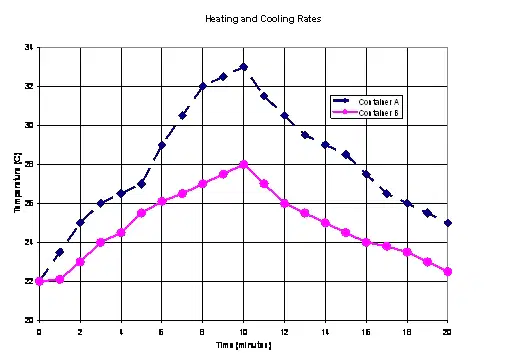
In the heat transfer lab, you generated a graph that may have looked something like this. Container A was filled with gravel and container B was filled with water. In this experiment, the manipulated variable is the:
amount of light.
type of material in each container.
type of container.
measurement times.
temperature recorded in each container.
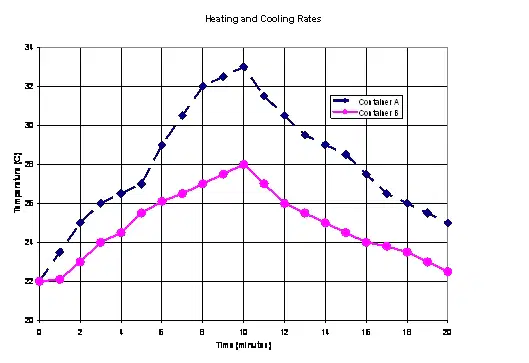
In the heat transfer lab, you generated a graph that may have looked something like this. Container A was filled with gravel and container B was filled with water. In this experiment, the responding variable is the:
amount of light.
type of material in each container.
type of container.
measurement times.
temperature recorded in each container.
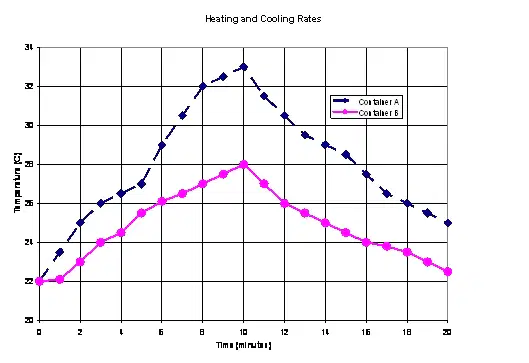
In the heat transfer lab, you generated a graph that may have looked something like this. Container A was filled with gravel and container B was filled with water. In this experiment, an important controlled variable is the:
temperature recorded in each container.
type of water used.
distance from light source for each container.
the type of gravel used.
person reading the thermometer.
Ice-core data provide climate records up to _______________ of years before present.
several thousands
several tens of thousands
several hundreds of thousands
several millions
Which of the following statements is true of average global temperature?
It has only started changing in the past few hundred years.
It has cooled and warmed several times over the past few hundred thousand years.
It has been cooling steadily for the past hundred thousand years.
It has been warming steadily for the past hundred thousand years.
We know nothing about global temperature before people set up weather stations around the world in the 1800s.
One way scientists use ice cores to understand climate change is by measuring the ____________ of different ice layers.
composition
temperature
thickness
density
The main reason scientists study paleoclimates is because:
it helps them know when certain animals went extinct.
they are interesting to know about.
it helps us better understand what can happen to climate in the future.
they want to know what the weather was like when they were born.
ice cores in Antarctica are hard to drill.
While studying tree rings from a Douglas Fir tree, you notice that some of the rings are thicker than others. What probably caused the thicker rings?
The tree got fatter as it got older.
As the tree became older it absorbed more nutrients.
The tree grew slower because of lack of sunlight.
The tree grew faster because of warmer temperatures.
Tree rings tell us the type of species but nothing else.
Why do tree rings come in pairs with one light ring and one dark ring?
Light rings are warm climates and dark rings are cool climates.
Light rings are spring growth and dark rings are summer/fall growth.
The light/dark rings keep the nutrients in the tree balanced.
Light rings are cool climates and dark rings are warm climates.
The light/dark rings represent a 2-year growth cycle.
Bubbles of air found in ice cores can tell us about:
the shape of foraminifera shells.
the amount of carbon dioxide in the atmosphere.
how many fossil fuels have been burned over time.
types of pollen during a specific time period.
ancient temperature, if a thermometer is put in the bubble.
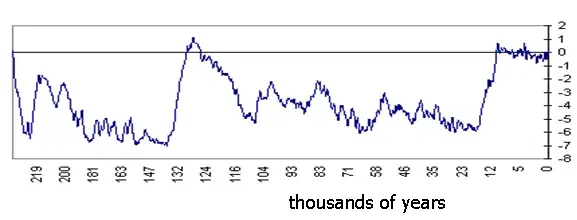
The graph below shows ice core records from Antarctica. Which time interval represents the longest uninterrupted glacial period (ice age)?
12,000 to zero thousand years ago
132,000 to 124,000 years ago
181,000 to 135,000 years ago
210,000 to 190,000 years ago
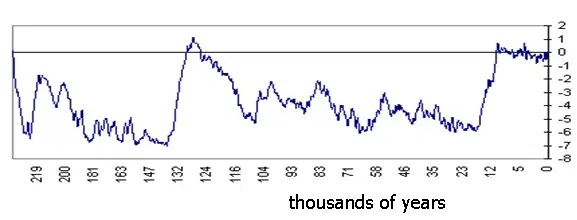
The graph shows ice core records from Antarctica. Which time interval represents the longest interglacial period (ice age)?
12,000 to zero thousand years ago
104 to 23 thousand years ago
132 to 104 thousand years ago
181 to 132 thousand years ago
219 to 181 thousand years ago
What is a climate proxy?
An indirect method of learning about past climate.
A specific time period of climate change.
A scientific tool for studying climate.
Fake climate data.
Thermometer measurements over long time periods.
What is an interglacial?
A period of time in between ice ages.
Chips of ice with air bubbles that tell us about climate.
Parts of glaciers that break off into the ocean.
A period of time when much of Northern America was covered in ice.

The diagram represents a core sample of a lake bottom sediment. Each layer represents 2,000 years. Which layer represents the oldest sediments?
A
B
C
D
E

Using the information obtained from the lake pollen sediment, how would you characterize the climate during the time period represented by sediment layer B?
cooler
warmer
moderate to cool
moderate to warm
Scientists use pollen cores to learn about past climates by:
analyzing pollen types to see what plants were present during a particular time.
determining how much sediment was deposited along with the pollen.
identifying the isotopes in the pollen.
analyzing the amount of CO2 in sediment layers.
Tree rings formed during an ice age:
would probably be thinner than average.
would probably be thicker than average.
would probably be lighter in color.
would probably be darker in color.
can only tell us how old a tree is.
One way scientists use ice cores to understand climate change is by measuring:
the temperature of the ice.
pollen spores found in the ice.
fossil shells trapped in the ice.
the amount of carbon dioxide in air bubbles.
the density of the ice.
If the Earth did not tilt on its axis, which would be true?
There would be more glaciers at high elevations.
There would be no seasonal changes.
Seasons would be more extreme in winter and summer.
Northern Hemisphere summers would be hotter.
The Northern Hemisphere summer always occurs when the:
Earth’s rotational axis changes to 23.5°.
south end of the Earth’s axis is pointed toward the sun.
north end of the Earth’s axis is pointed toward the sun.
Earth wobbles on its axis.
northern hemisphere is closest to the sun.
If the tilt of the Earth’s axis were much greater than it is now, which of the following would happen?
Winters would be colder and summers would be hotter.
Each of the four seasons would be shorter.
There would be no seasonal changes.
Each of the four seasons would be longer.
Seasons would become very unpredictable.
Which of the following is NOT a factor to explain Earth's long-term climate changes?
The latitude of the Earth's poles.
The shape of the Earth's orbit.
The wobble of the Earth's axis.
The wobble of the Earth's orbit.
The tilt of the Earth's axis.
Compared to the rest of the year, in December the Northern Hemisphere is:
much farther from the sun.
wobbling more on its axis.
getting the same amount of sunlight.
getting less direct sunlight.
getting more direct sunlight.
The wobble of the Earth on its axis is called:
precession.
eccentricity.
obliquity.
insolation.
When is the length of the day about the same as the night almost everywhere?
The tilt of the Earth means that the days are always longer in the southern hemisphere than in the northern hemisphere.
Approximately March 22, the Spring Equinox.
It is not possible because it is always dark at the North Pole.
At the Equinox and the Solstice.
Approximately June 21, the Summer Solstice.
The combined effects of the axial and orbital precession cycle affect:
the phases of the moon.
the shape of the Earth's orbit about the Sun.
the shape of the Moon's orbit about the Earth.
the degree of tilt of the Earth's rotation axis.
the amount of sunlight reaching the Earth.
The change of the Earth's orbit from near circular to somewhat elliptical is called:
eccentricity.
obliquity.
precession.
insolation.
The change of the Earth's tilt over tens of thousands of years is called:
insolation
precession
eccentricity
obliquity
The amount of sunlight reaching earth because of a combination of factors is called:
obliquity
eccentricity
precession
insolation
The Milankovitch Cycles describe the combined effects of:
insolation, orbital variations and the inverse-square law on climate.
obliquity, eccentricity and precession on insolation.
radiation, obliquity and insolation on climate.
precession, eccentricity and obliquity on the tilt of the Earth.
How does the Gulf Stream affect London, England?
London is warmer than it should be, based on its latitude.
London is colder than it should be, based on its latitude.
The Gulf Stream has no affect on London’s climate.
Snowier than it should be, based on its latitude.
Drier than it should be, based on its latitude.
If the Gulf Stream stopped flowing, how would the climate of northern European cities like London change?
The climate would not change.
The climate would get drier.
The climate would get warmer.
The climate would get colder.
The climate would produce more rain instead of snow.
Thermohaline ocean circulation is primarily caused by:
the rotation of the earth and the Coriolis Effect.
CO2 concentration in the ocean.
wind and precipitation.
temperature and salinity of ocean water.
El Nino.
Which of the following statements about currents is generally true?
Currents traveling toward the poles are warm and currents traveling toward the equator are cold.
Currents traveling toward the equator are warm and currents traveling toward the poles are cold.
Currents flow in the direction of the Earth's rotation.
Current directions pretty much stay the same over time.
Which of the following statements about climate and plate tectonics is false?
Land masses cause currents to change direction.
Antarctica has always been at the South Pole.
Ocean currents are affected by the position of the continents.
The continents were closer together 100 million years ago than they are today.
Movements of South American, African, and Australian continents since the Eocene epoch have resulted in the movement of the continents away from Antarctica. The movements affected global climate mostly because:
changes in continental positions affected Earth's axial tilt.
the continents drifted to higher latitudes.
isolation of Antarctica melted Antarctic glaciers.
Antarctic Ocean currents stopped flowing northward.
How do ocean currents play a role in the energy balance of the Earth?
Higher levels of energy in very dense salty water allow more salt to be transferred to the equator.
Higher levels of energy in very dense salty water allow more salt to be transferred to the poles.
Higher latitudes receive more energy from the sun, and the excess energy is transferred by currents toward the equator.
Lower latitudes receive more energy from the sun, and the excess energy is transferred by currents toward the poles.
The North Atlantic Deep Water (NADW) is:
colder than the Antarctic Bottom Water.
the driver of the global ocean conveyor belt.
less salty than the gulf stream due to iceberg formation.
more dense than the Antarctic Bottom Water.
How could the global ocean conveyor belt be disrupted?
Less dense waters won't sink, so the NADW will not form as much.
Global warming can decrease the density of the North Atlantic waters.
Melting sea ice can reduce the amount of salt in surface waters.
All of the choices.
Ocean currents affect climate because they:
transfer energy from one part of the Earth to another.
produce upwelling when currents collide.
can carry dissolved gases to different latitudes.
All of the choices.
Plate tectonics can affect climate because:
pressure in plates can be released under the ocean, increasing ocean temperatures.
plate movement can cause tsunamis that change currents.
plate position affects direction of current flow.
All of the choices.
How do volcanoes affect climate?
Eruptions emit dust particles that can cool the atmosphere.
Eruptions can release carbon dioxide which can warm the atmosphere.
The weathering of volcanoes can take carbon dioxide out of the atmosphere.
All of the choices.
Comparing data on atmospheric carbon dioxide and global temperatures, scientists have concluded that:
There is a correlation between CO2 and global temperature.
There is no relationship between CO2 and global temperature.
CO2 is the only factor that affects global climate.
Increasing temperatures cause CO2 concentrations to increase.
CO2 concentration and temperature are both determined by the amount of methane in the atmosphere.
What is the carbon cycle?
An environmentally friendly type of bicycle.
A circular carbon formation found in sedimentary rocks.
Repeated layers of carbon dioxide gas found in ice cores.
The movement of carbon atoms over time through different substances.
The balance of carbon dioxide and oxygen has been upset by:
burning fossil fuels and deforestation.
increasing human population.
large scale deforestation.
excessive burning of fossil fuels.
increasing human population and deforestation.
Which of the following activities will actually decrease atmospheric CO2?
Switching from coal to natural gas.
Buying a hybrid car.
Eating less meat.
Walking or riding a bike to school instead of driving.
Planting new forests.
Increased levels of greenhouse gases in the atmosphere result in:
destruction of the atmosphere.
destruction of the ozone layer.
greater absorption of the ultraviolet radiation by the atmosphere.
greater absorption of the infrared radiation by the atmosphere.
The Greenhouse Effect:
allows life to exist on planets that have carbon dioxide in the atmosphere.
is due to the light absorbing properties of some atmospheric gases.
negatively impacts life on Earth.
keeps the geosphere from absorbing and emitting thermal energy.
All of the choices.
Which of the following are carbon sources (i.e., they add carbon to the atmosphere)?
deforestation and animal respiration
burning fossil fuels and photosynthesis
plant and animal metabolism
changing ocean currents
Which of the following are carbon sinks (i.e., they remove carbon from the atmosphere and store it in other spheres)?
soda pop manufacturing
making carbon based plastics
reforestation and animal respiration
oceans and plant respiration
plant respiration and volcanoes
Which of the following is NOT a greenhouse gas?
water vapor
oxygen
carbon dioxide
methane
Which of the following will increase the amount of carbon dioxide added to the atmosphere?
Cutting down trees.
Building more oil refineries.
Replacing your hybrid with an SUV.
All of the choices.
None of the choices.
How do cows contribute to global warming? Choose the most scientifically accurate answer.
Cows eat all the plants that remove CO2 from the atmosphere.
Cows release methane during digestion.
Cows do not cause global warming, people do.
Raising cattle uses land that could be used to grow trees.
Cows drive Hummers when farmers aren’t looking.
Which set of processes use oxygen and release carbon dioxide to the air?
plant and animal respiration.
animal respiration and using natural gas.
volcanic eruptions and weathering rocks.
photosynthesis and cow digestion.
photosynthesis and decaying leaves.
As the climate cools, ice sheets grow larger. Ice reflects solar radiation, and so the Earth absorbs less heat. This results in the Earth becoming cooler, which leads to more ice forming. This is an example of:
a positive feedback loop.
a negative feedback loop.
the Greenhouse Effect.
a climate proxy.
Weathering uses up carbon dioxide, which causes the temperature to drop. When the temperature drops, weathering rates slow down, using up less carbon dioxide. Carbon dioxide increases and temperatures start to rise. This is an example of:
a positive feedback loop.
a negative feedback loop.
the Greenhouse Effect.
the Erosion Effect.
the Coriolis Effect.
People living in China and India are buying more cars as they get better jobs and earn more money. Previously, many Chinese and Indian citizens used bicycles and trains for transportation. How will their change in transportation affect global climate?
Global temperatures might decrease, because the large vehicles will absorb less heat than the surrounding land.
Global temperatures could increase, since more carbon dioxide will be added to the atmosphere.
There will be no effect on global climate, just on demand for cars.
Rainfall will probably increase, since more carbon dioxide will be added to the atmosphere.
The populations are increasing so rapidly that human body heat will increase global temperatures.
Paving land to increase development in cities contributes to:
lower temperature readings.
a reduction in greenhouse gases.
satellite interference.
the heat-island effect.
Which of the following factors is likely NOT included in computer climate models?
phases of the moon
methane
orbital variations
carbon dioxide
global temperature
The ways that different factors interact in global climate are called:
feedback loops.
orbital variations.
insolation.
climate models.
heat-island effects.
How can climate models be tested using historical data?
Determine if there used to be global warming.
Determine greenhouse gas levels over time.
Find out if they predict present-day climate.
Find out when the next snowstorm will hit Everett.
In the Pacific Northwest, warmer global temperatures would NOT lead to:
more extreme weather events.
the North Atlantic Deep Water decreasing.
increased precipitation.
southward agricultural shift.

