
 Worksheets
Organic Evolution Test #1 E
Total questions: 99
Worksheet time: 50mins
According to Mendel's Law of Segregation, how many gene copies does each individual have, and what happens to these copies during gamete production?
Each individual has one gene copy, and both go to one gamete
Each individual has two gene copies, and they segregate so one copy goes to each gamete
Each individual has three gene copies, and they all go to one gamete
Each individual has two gene copies, and both go to each gamete
Fill in the blank: The Law of Segregation states that each individual has ____ gene copies and they segregate during gamete production (one copy goes to each gamete).
two
four
one
three
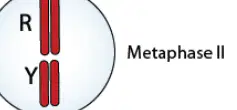
Refer to the diagrams showing the segregation of alleles during meiosis. Which stage shows the separation of alleles for each gene?
Metaphase I
Metaphase II
Both Metaphase I and II
None of the above
According to Mendel's Law of Independent Assortment, during gamete production, genes for different traits segregate independently of each other.
True
False
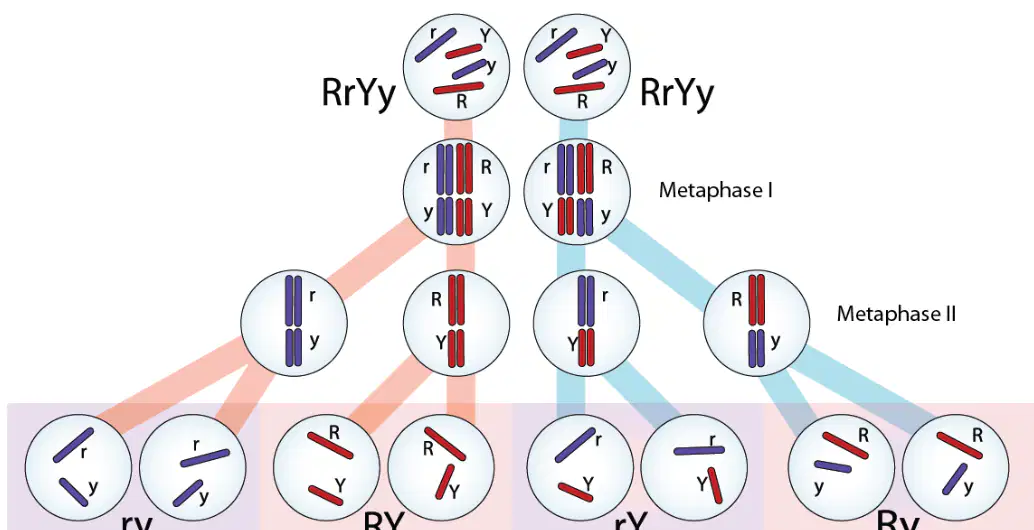
What is the principle of independent assortment as described in the diagram?
Different genes assort (are passed into gametes) independently because they are located on different chromosomes which align randomly at the metaphase plate during meiosis I.
Genes on the same chromosome always assort independently regardless of their position.
Independent assortment only occurs during mitosis, not meiosis.
All genes are inherited together as a single unit regardless of chromosome alignment.
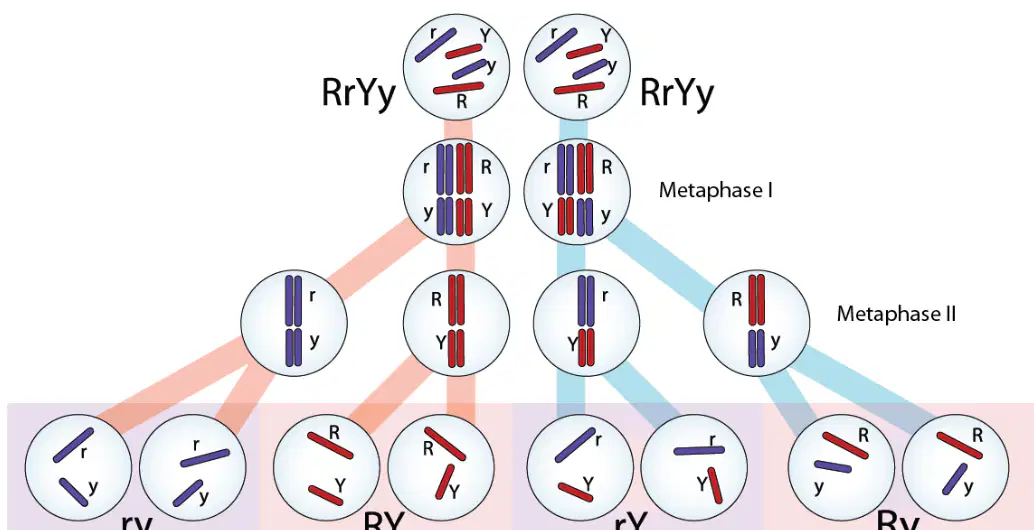
Refer to the diagram. Which of the following gamete combinations can be produced from a parent with genotype RrYy?
A) RY, Ry, rY, ry
B) RR, YY, rr, yy
C) Rr, Yy, Ry, rY
D) RY, rY, Ry, rY
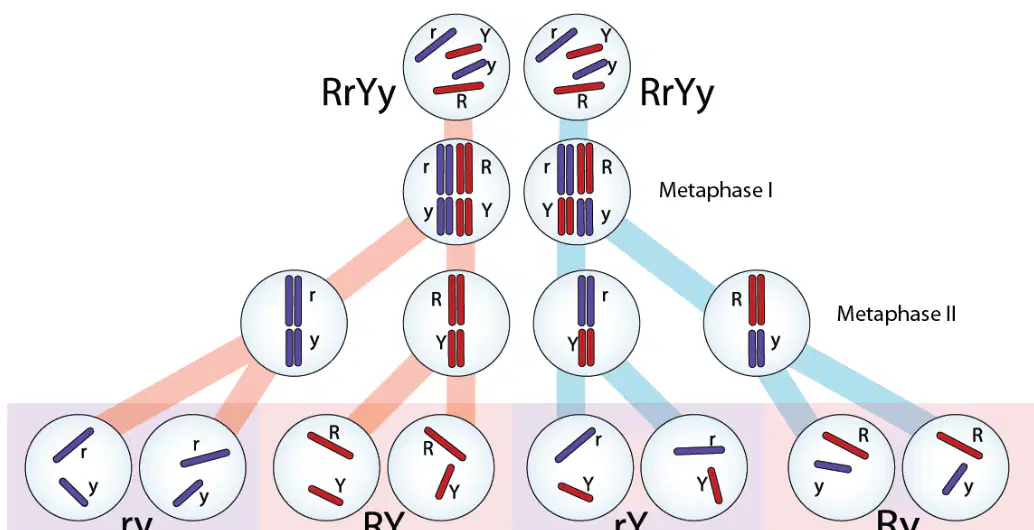
During which phase of meiosis does the independent assortment of genes occur, as shown in the diagram?
Metaphase I
Prophase II
Anaphase I
Telophase II
Which term is defined as the fundamental unit of heredity, codes for a functional product (protein or RNA)?
gene
enzyme
chromosome
lipid
Which term refers to the specific place on the chromosome where a gene (or set of genes) is located (physical location)?
locus
allele
chromatid
centromere
Which term describes variant forms of a gene, or variant nucleotide sequences at a particular locus?
allele
chromosome
genotype
phenotype
What is the ultimate source of variation for natural selection (NS)?
Mutation
Genetic drift
Natural selection
Gene flow
Mutation is any alteration in the _______ sequence of a genome.
nucleotide
protein
lipid
carbohydrate
Which of the following can result in mutations?
Errors in DNA replication
Failure to repair damage
Both A and B
None of the above
Mutations must occur in the _______ (progenitors of gametes) to be transmitted to offspring.
germ line
somatic cells
mitochondria
cytoplasm
Recombination during meiosis can generate variation on which selection can act.
True
False
Which of the following is considered the raw material for evolution?
Mutation
Natural selection
Adaptation
Migration
Fill in the blank: ________ are heritable mechanisms that alter gene expression without changes to DNA sequence.
Epigenetic inheritance
Genetic drift
Point mutation
Gene duplication
Which of the following best describes the mechanisms underlying the transmission of acquired traits across generations?
Genetic mutations
Epigenetic inheritance
Natural selection
Genetic drift
Epigenetic Inheritance: Case study Observation was made that the children & grandchildren of surviving prisoners of the Civil War had increased mortality. The sons of ex-POWs imprisoned in the worst camps were 1.11 times more likely to die than the sons of non-POWs (and 1.09 times more likely to die than the sons of ex-POWs imprisoned in better conditions). Daughters were: Choose the correct answer.
More likely to die
Less likely to die
Not affected
Affected the same as sons
This can be explained by which of the following?
By providing a logical reasoning
By ignoring the facts
By making random guesses
By avoiding the explanation
According to the case study on epigenetic inheritance, what process did researchers use to deduce the cause?
Random sampling
Process of elimination
Genetic sequencing
Psychological testing
Which of the following was NOT considered a possible factor in the case study on epigenetic inheritance?
Socioeconomic cause
Psychological cause
Genetic cause
Environmental pollution
Fill in the blank: The researchers found no supporting statistical evidence for the ________ cause in the case study on epigenetic inheritance.
socioeconomic
genetic
environmental
nutritional
What was the final conclusion about the cause in the epigenetic inheritance case study?
Socioeconomic cause
Psychological cause
Genetic cause
Sex linked epigenetic cause
Chromosomes consist of ______ (DNA + histone proteins).
chromatin
cytoplasm
ribosomes
centrioles
When chromosomes are condensed, what happens to gene expression?
It increases
It decreases
No gene expression occurs
It stays the same
Often epigenetic mechanisms result in modification to DNA or ______ that changes chromatin structure.
histones
lipids
carbohydrates
nucleotides
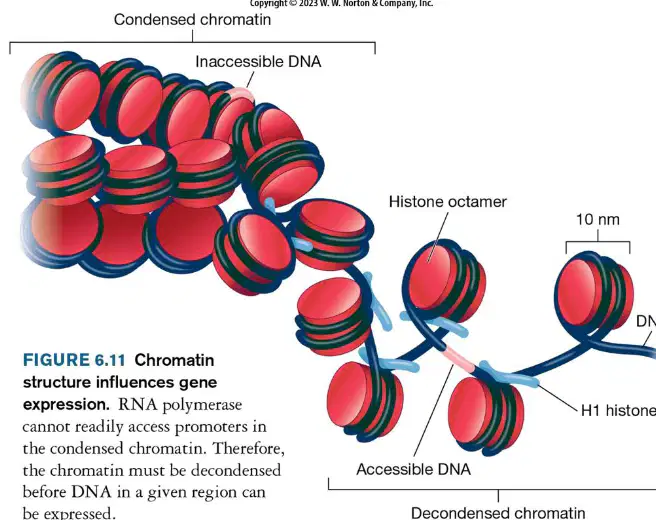
Refer to the diagram showing condensed and decondensed chromatin. Which form of chromatin allows RNA polymerase to access promoters and express genes?
A) Condensed chromatin
B) Decondensed chromatin
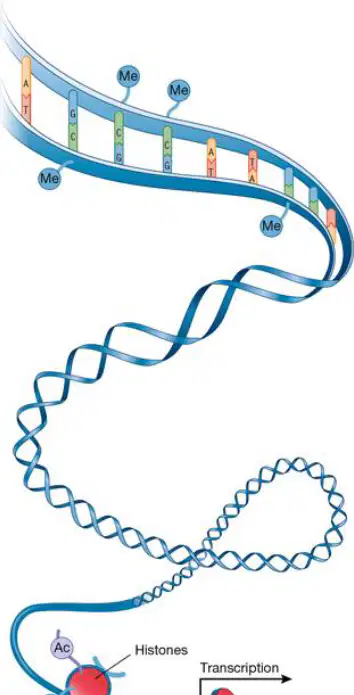
What is added to a C-G base pair during DNA methylation?
Phosphate group
Methyl group
Acetyl group
Hydroxyl group
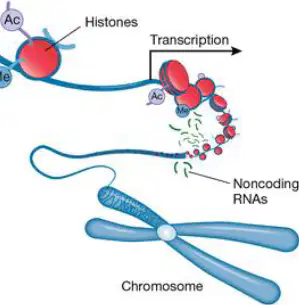
Refer to the diagram and text about DNA methylation. DNA methylation results in DNA being inaccessible to ________ factors.
transcription
translation
replication
mutation
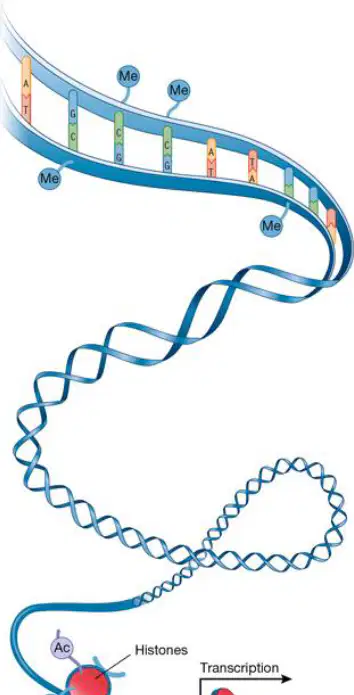
What is the effect of DNA methylation on gene expression?
Turns genes "on"
Turns genes "off"
Increases gene expression
Has no effect on gene expression
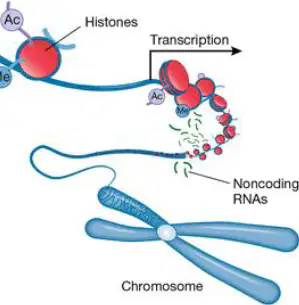
DNA methylation also alters the binding of other proteins important for _______ structure.
chromatin
membrane
cytoplasmic
ribosomal
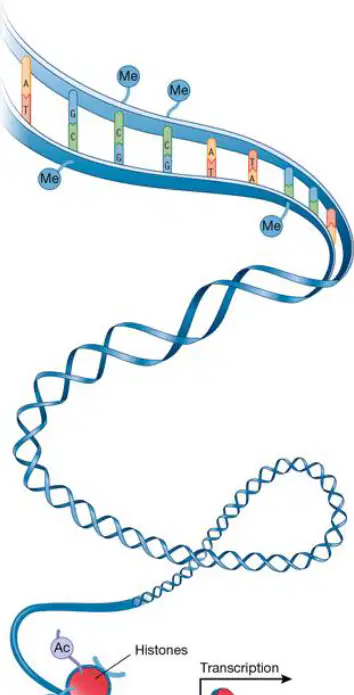
What is the result of the addition of an acyl group to histones?
De-condensation of chromatin
Condensation of chromatin
Inhibition of DNA replication
Increase in histone methylation
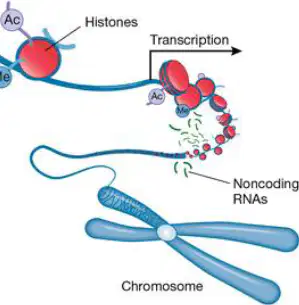
What effect does histone modification have on gene expression?
Turns genes 'on'
Destroys the DNA
Prevents cell division
Causes mutations
How many nucleotide changes are fixed in Homo sapiens, and how many of these change the amino acid? Fill in the blanks: ______ nucleotide changes are fixed in Homo sapiens, but only about ______ change the amino acid.
30,000; 100
3,000; 1,000
300,000; 10,000
10,000; 5,000
Is it easy or difficult to determine the role of non-coding DNA in gene expression? Fill in the blank: It is ______ to determine the role of non-coding DNA, but differences likely affect gene expression.
very difficult
very easy
not important
always obvious
What method is used to examine differences in gene expression between Neanderthals and modern humans? Fill in the blank: ______ maps are used to examine differences in gene expression between Neanderthals and modern humans.
DNA methylation
Protein folding
Chromosome painting
Gene splicing
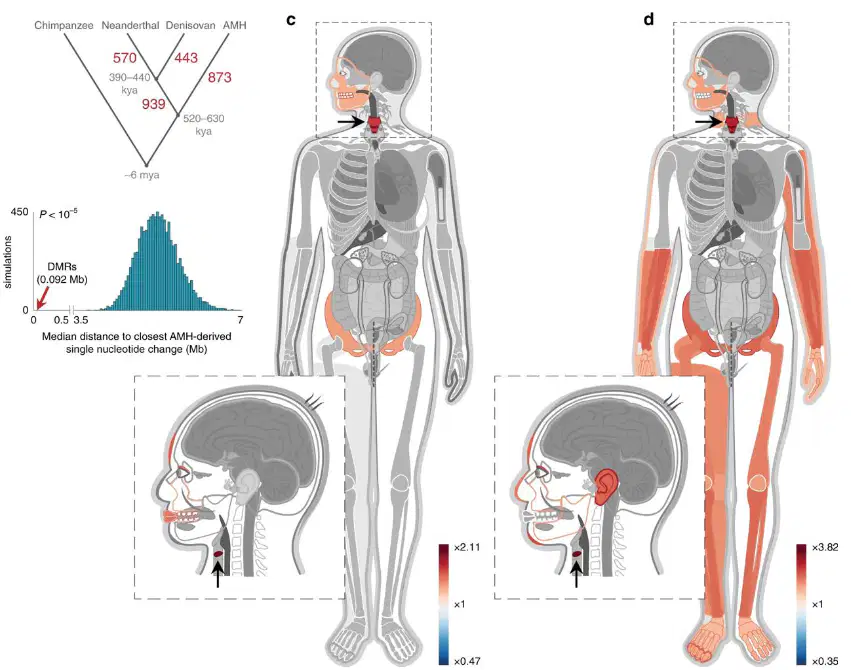
Gokhman et al, 2020 identified differentially methylated regions (DMRs) between the ______ groups.
human
mouse
yeast
plant
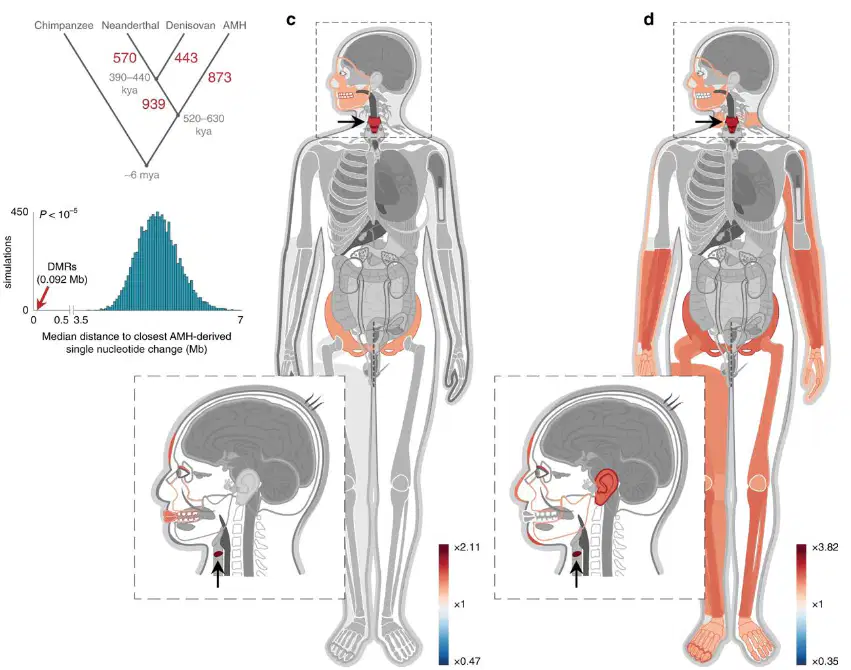
Genes associated with vocal and facial anatomy differ in DNA methylation patterns in modern humans, compared to ______ and ______. (Fill in the blanks)
Neanderthals; Denisovans
Chimpanzees; Gorillas
Australopithecus; Homo erectus
Homo sapiens; Cro-Magnon
Epigenetic changes are important for evolution.
True
False
Only in plants
Only in animals
Epigenetic changes are important for evolution and can be inherited.
True
False
Only important for evolution, not inherited
Only inherited, not important for evolution
Fill in the blank: One type of DNA mutation is _________.
Point mutations
Carbohydrate synthesis
Mitochondrial division
Protein folding
Fill in the blank: One type of DNA mutation is _________.
Insertion/deletions
Photosynthesis
Mitosis
Transcription factors
Fill in the blank: One type of DNA mutation is _________.
Gene duplication/Genome duplication
Photosynthesis
Mitosis
Osmosis
What is a point mutation?
Alteration of a single base in a DNA sequence
Deletion of a DNA segment
Duplication of a gene
Insertion of a chromosome
Which type of mutation is approximately twice as frequent as the other?
Transversions
Transitions
Fill in the blank: Transitions are (~2x) more frequent than _________
transversions
replications
insertions
deletions
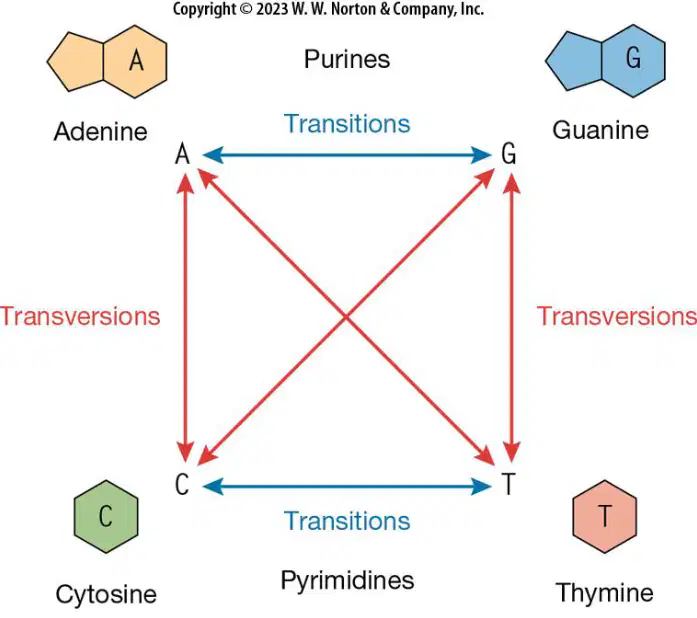
According to the diagram, which type of mutation occurs between Adenine and Guanine?
Transition
Transversion

According to the diagram 'Point Mutations: Consequences', what is the result of a 'No mutation' in the DNA sequence?
The new codon encodes a different amino acid
The new codon encodes the same amino acid
Serine protein produced
The new codon is a stop codon
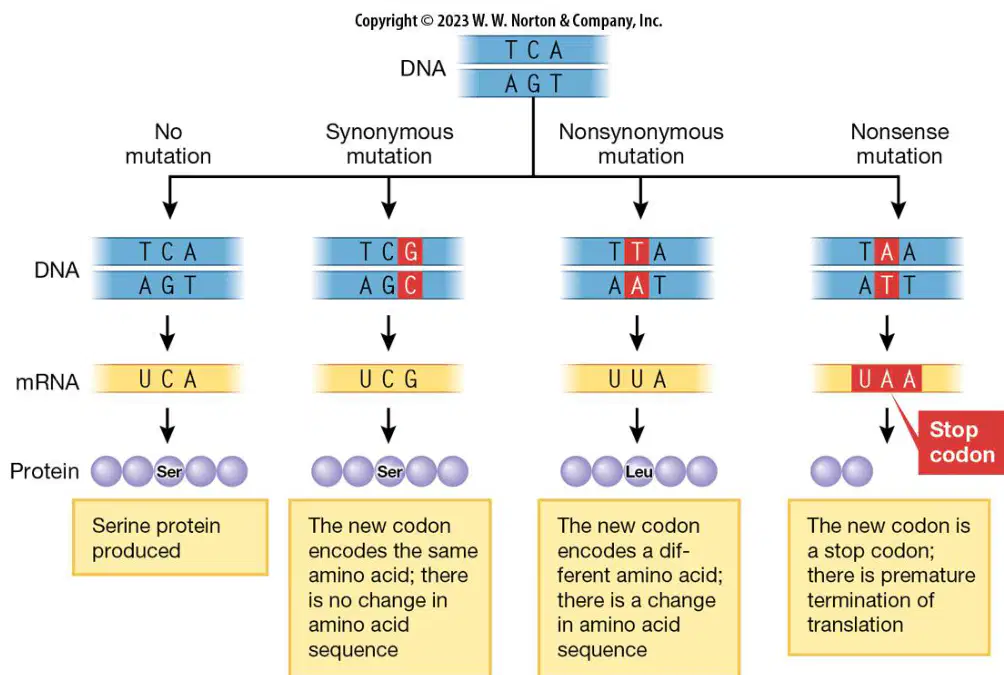
According to the diagram 'Point Mutations: Consequences', what is the result of a 'Synonymous mutation' in the DNA sequence?
The new codon encodes the same amino acid; there is no change in amino acid sequence
The new codon encodes a different amino acid
The new codon is a stop codon
Serine protein produced
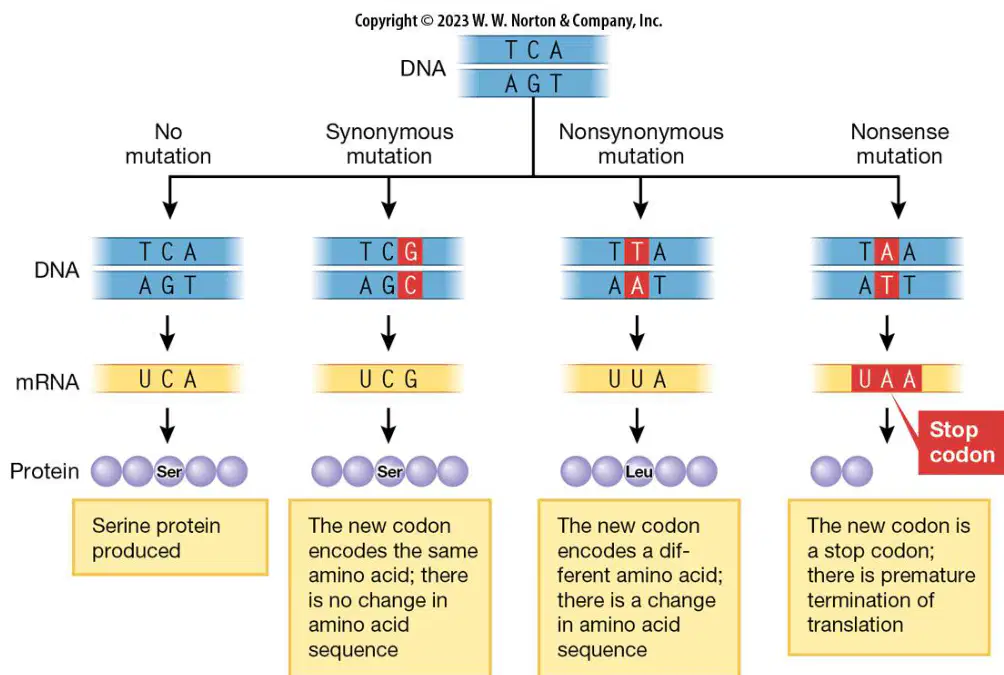
According to the diagram 'Point Mutations: Consequences', what is the result of a 'Nonsynonymous mutation' in the DNA sequence?
The new codon encodes the same amino acid
The new codon encodes a different amino acid; there is a change in amino acid sequence
The new codon is a stop codon
Serine protein produced
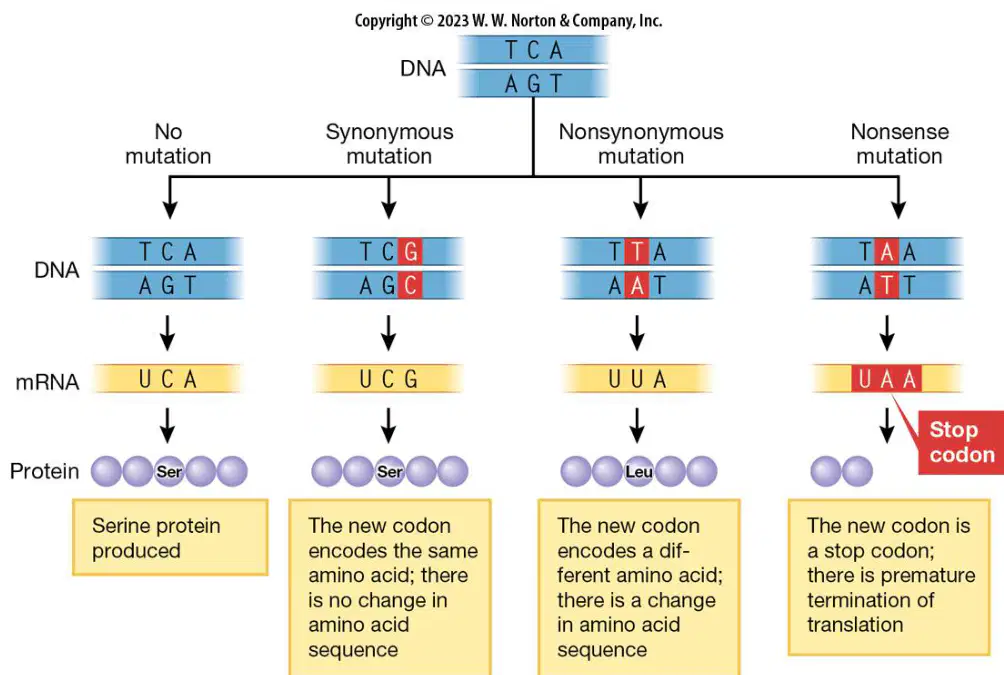
According to the diagram 'Point Mutations: Consequences', what is the result of a 'Nonsense mutation' in the DNA sequence?
The new codon encodes the same amino acid
The new codon encodes a different amino acid
The new codon is a stop codon; there is premature termination of translation
Serine protein produced
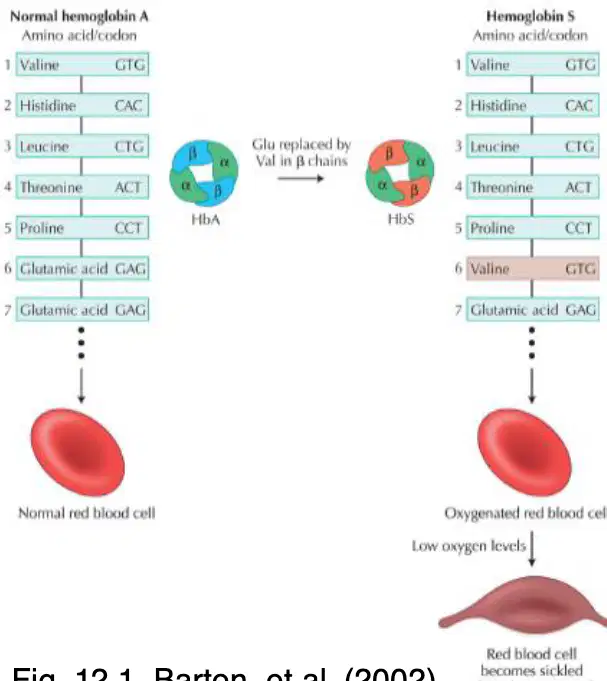
Refer to the diagram showing the amino acid sequence for normal hemoglobin A and hemoglobin S. Which amino acid is replaced in hemoglobin S compared to normal hemoglobin A?
Valine
Glutamic acid
Histidine
Proline
In sickle cell anemia, which codon replaces the normal GAG codon in the hemoglobin gene?
CAC
CTG
GTG
ACT
Fill in the blank: In sickle cell anemia, the red blood cell becomes ________ when deoxygenated.
sickled
round
elongated
fragmented
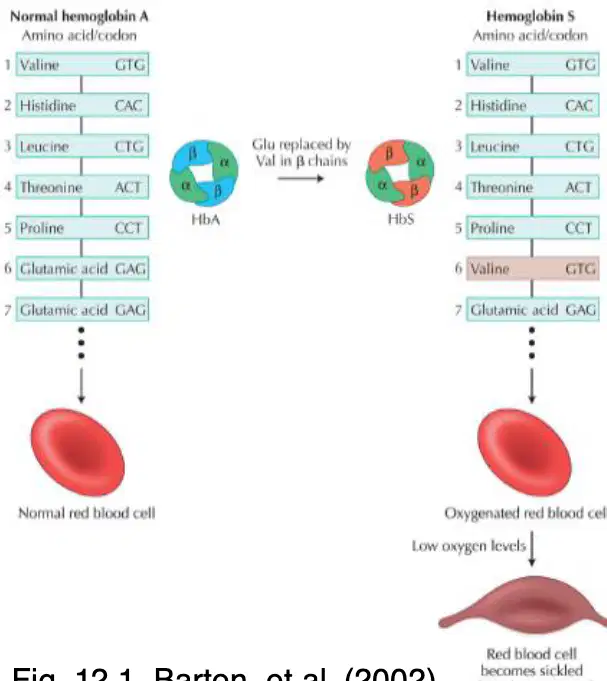
In sickle cell anemia, valine replaces glutamic acid in the hemoglobin beta chain.
True
False
Fill in the blank: One type of mutation is _________.
Point mutations
Carbohydrate synthesis
Photosynthesis
Mitosis
Fill in the blank: _________ are mutations that involve the addition or removal of genetic material.
Insertion/deletions
Point mutations
Silent mutations
Missense mutations
Fill in the blank: _________ or _________ is a type of mutation where genetic material is duplicated.
Gene duplication/Genome duplication
Point mutation/Frameshift mutation
Translocation/Inversion
Deletion/Insertion
What are insertion-deletion (indel) mutations?
Mutations where the DNA sequence is unchanged
Mutations where 'Daughter' DNA has a different number of base pairs in a particular region than the 'Parental' DNA
Mutations that only involve substitution of bases
Mutations that do not affect the number of base pairs
Fill in the blank: Insertion-deletion (indel) mutations are when 'Daughter' DNA has a ________ number of base pairs in a particular region than the 'Parental' DNA.
different
same
double
half
Based on the DNA sequences shown, which species has the largest deletion compared to the others?
Sp.1
Sp.2
Sp.3
Sp.4
What are insertion-deletion (indel) mutations?
Mutations where 'Daughter' DNA has the same number of base pairs as 'Parental' DNA
Mutations where 'Daughter' DNA has a different number of base pairs in a particular region than the 'Parental' DNA
Mutations that do not affect the number of base pairs
Mutations only caused by environmental factors
Indel mutations are often caused by errors in DNA replication, especially in which type of sequences?
Unique sequences
Repetitive sequences
Protein-coding sequences
Non-coding sequences

Refer to the diagram showing DNA sequences for Sp.1 to Sp.4. Which species (Sp.1, Sp.2, Sp.3, Sp.4) shows evidence of a deletion event compared to the others?
Sp.3 and Sp.4 show evidence of a deletion event (missing base pairs compared to Sp.1 and Sp.2).
Sp.1 and Sp.2 show evidence of a deletion event (missing base pairs compared to Sp.3 and Sp.4).
Only Sp.1 shows evidence of a deletion event (missing base pairs compared to the others).
All species show the same number of base pairs, so no deletion event is evident.
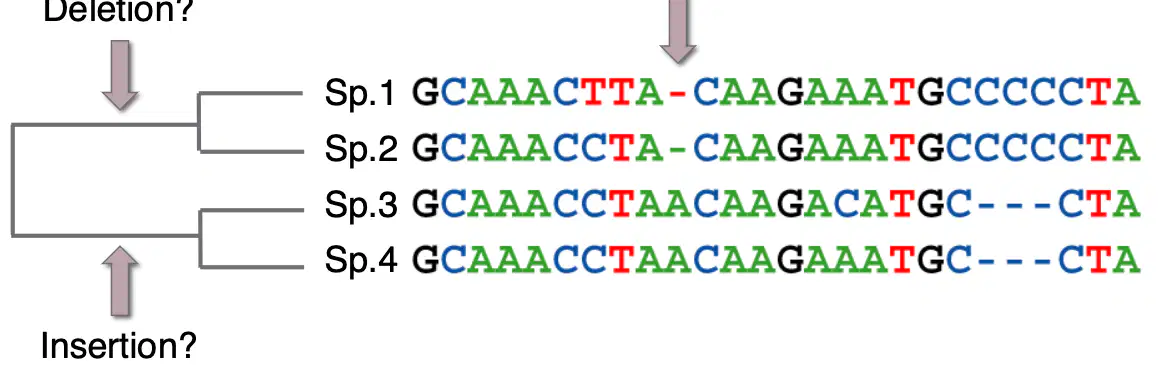
Refer to the diagram showing DNA sequences for Sp.1 to Sp.4. Which species shows evidence of an insertion event compared to the others?
Sp.1 and Sp.2 show evidence of an insertion event (extra base pairs compared to Sp.3 and Sp.4).
Sp.3 and Sp.4 show evidence of an insertion event (extra base pairs compared to Sp.1 and Sp.2).
All species show evidence of an insertion event.
None of the species show evidence of an insertion event.
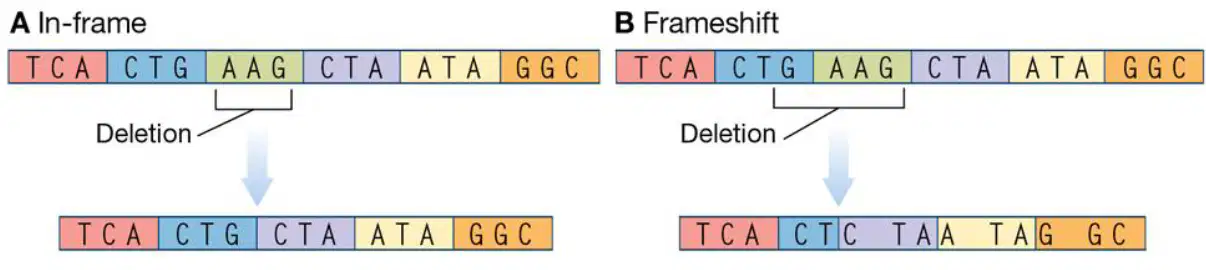
What can result from indel (insertion/deletion) mutations in a protein?
Frameshift mutations
Insertion/deletion of amino acids (if in multiples of 3)
Premature stop codons (nonsense mutations)
All of the above

Fill in the blank: A deletion that is not a multiple of 3 nucleotides results in a ________ mutation.
frameshift
missense
silent
nonsense

Based on the diagram, which type of deletion (in-frame or frameshift) is more likely to cause a premature stop codon?
Frameshift
In-frame
Silent
Missense
Fill in the blank: One type of mutation is _________.
Point mutations
Cell division
Photosynthesis
Osmosis
Fill in the blank: _________ are mutations that involve the addition or removal of genetic material.
Insertion/deletions
Point mutations
Silent mutations
Missense mutations
Fill in the blank: _________ or _________ is a type of mutation involving the duplication of genetic material.
Gene duplication/Genome duplication
Point mutation/Frameshift mutation
Translocation/Inversion
Deletion/Insertion
What is gene duplication? Fill in the blank: Gene duplication is the generation of an extra copy of a _____?
locus
chromosome
protein
enzyme
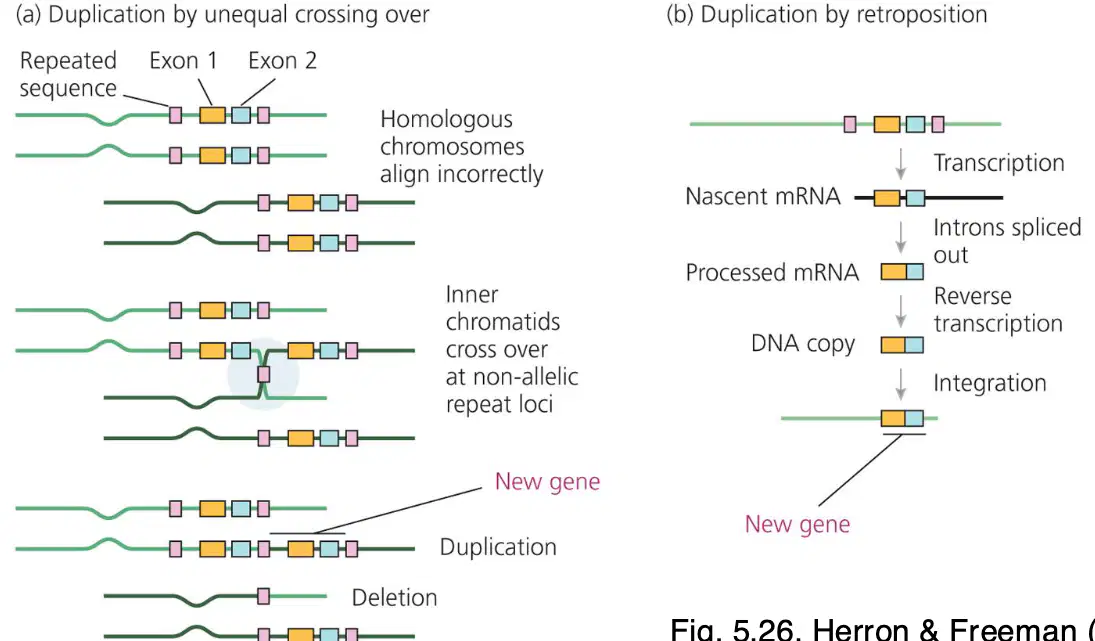
Which of the following is a mechanism for gene duplication?
Unequal crossing over
Equal crossing over
DNA methylation
Chromosome inversion
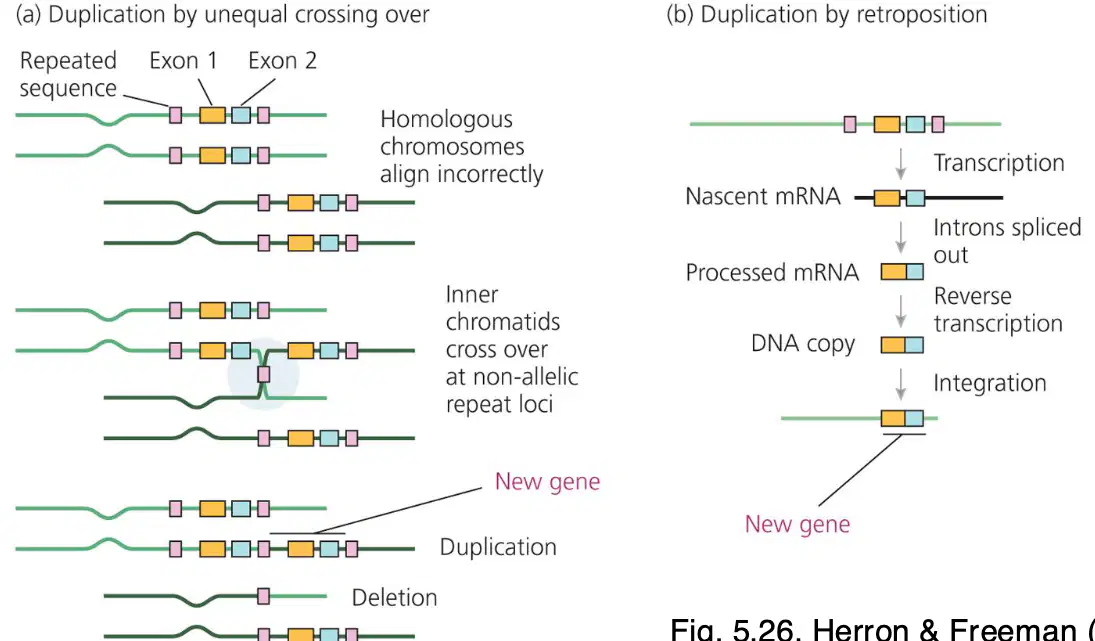
Which process involves the creation of a new gene through the integration of a DNA copy made from processed mRNA?
Duplication by unequal crossing over
Duplication by retroposition
Gene deletion
Chromosome translocation

In duplication by unequal crossing over, what is the result when homologous chromosomes align incorrectly and cross over at non-allelic repeat loci?
Deletion only
Duplication and deletion
Inversion
Translocation
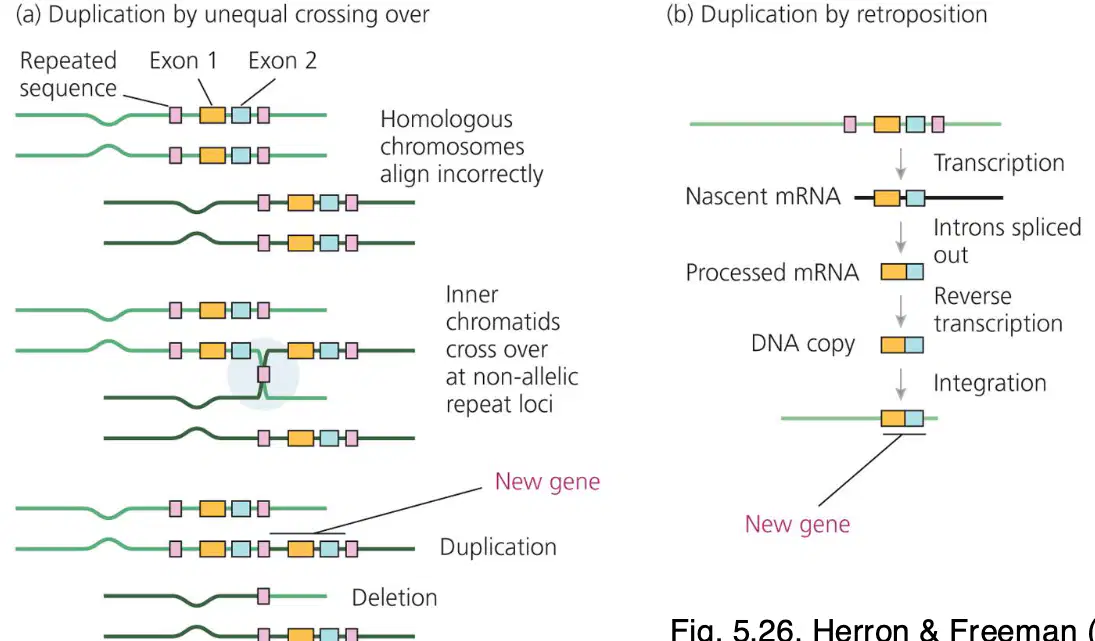
List the steps involved in duplication by retroposition as shown in the diagram.
Transcription, introns spliced out, reverse transcription, integration
Replication, translation, integration, splicing
Transcription, translation, replication, integration
Reverse transcription, splicing, translation, integration
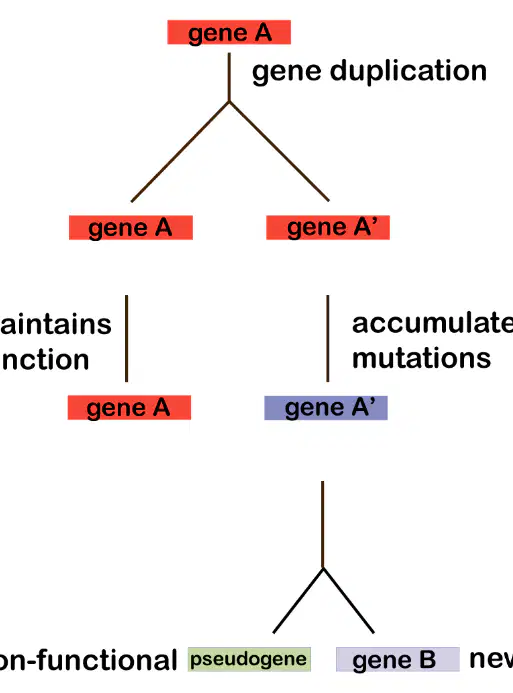
According to the classical model shown in the diagram, what is the first step that happens to gene A?
Gene deletion
Gene duplication
Gene silencing
Gene recombination
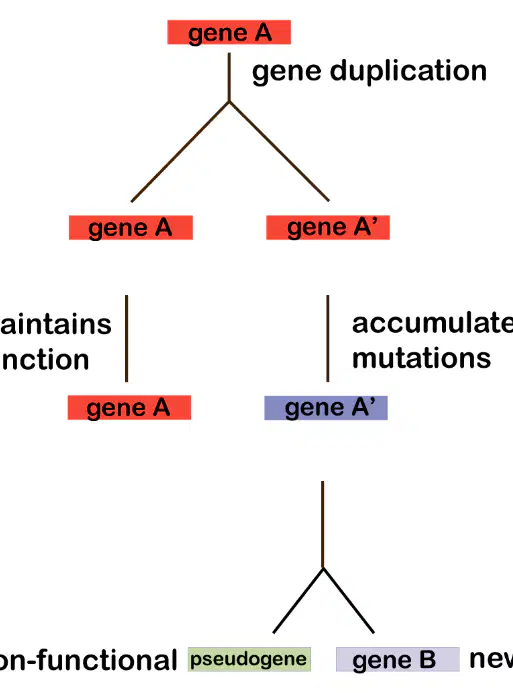
In the classical model, after gene duplication, one copy of the gene maintains its function. What happens to the other copy (gene A')?
It is deleted
It accumulates mutations
It is silenced
It becomes non-functional immediately
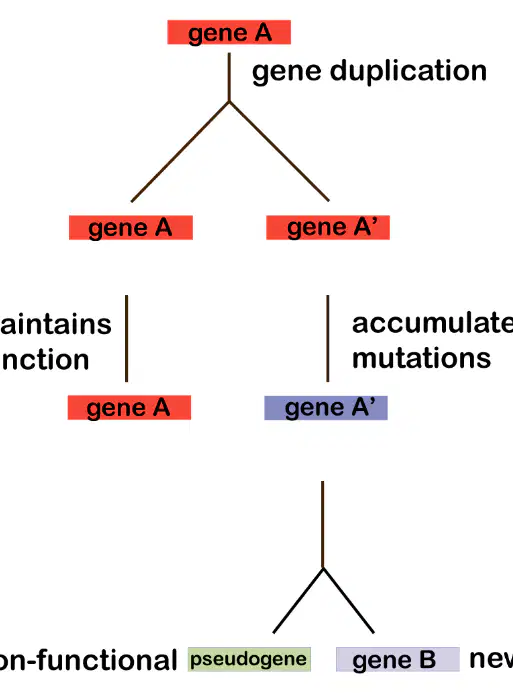
Fill in the blank: In the classical model, a duplicated gene that accumulates mutations can become non-functional (pseudogene) or acquire a ________.
new function
similar sequence
regulatory element
mutation
Review of basic _______ biology/mendelian genetics.
molecular
cellular
behavioral
ecological
Mutation is the ultimate source of genetic variation.
True
False
There are multiple different types of mutations. Which of the following is NOT a type of mutation?
Point
Photosynthesis
Gene duplications
Chromosome inversions
Indels
Each type of mutation has potentially _______ consequences.
different
identical
irrelevant
predictable
Most new mutations that alter fitness are expected to be beneficial.
True
False
Fill in the blank: Deleterious mutations with a weak negative effect on fitness are more common in _________
fruit flies
humans
bacteria
plants
Fill in the blank: Deleterious mutations with a strong negative effect on fitness are more common in _________.
humans
bacteria
plants
viruses
What is hypothesized to be the reason for the difference in the fitness effects of mutations between fruit flies and humans?
Differences in complexity
Differences in diet
Differences in habitat
Differences in lifespan
Fitness Effects of Mutations: Are mutations random with respect to fitness?
Yes
No
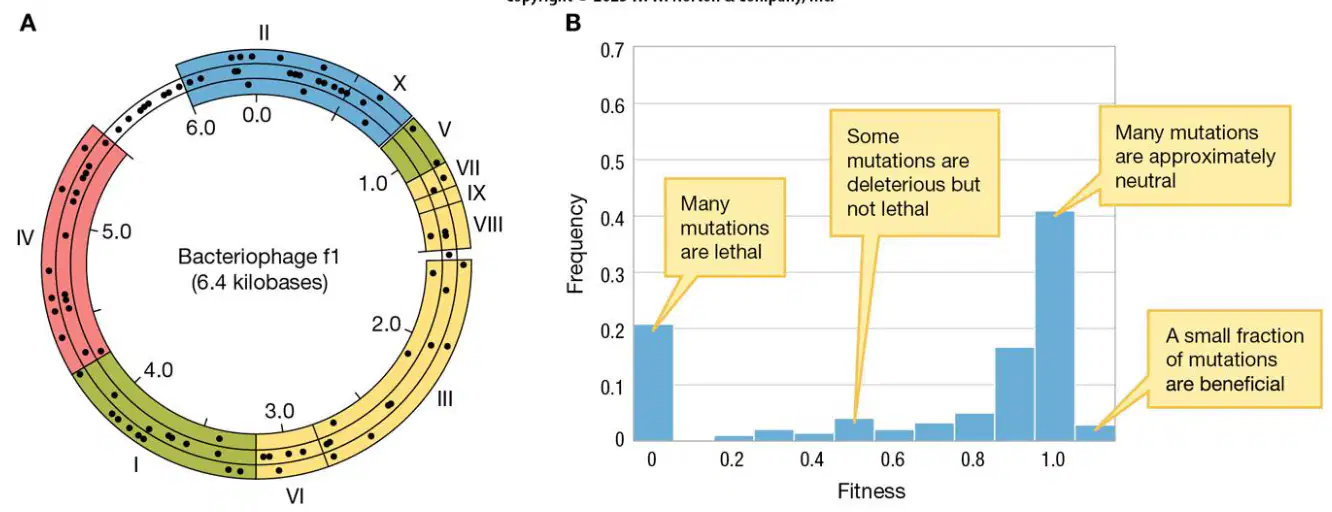
Fitness Effects of Mutations: Which type of mutations are more common?
Beneficial mutations
Lethal/deleterious mutations
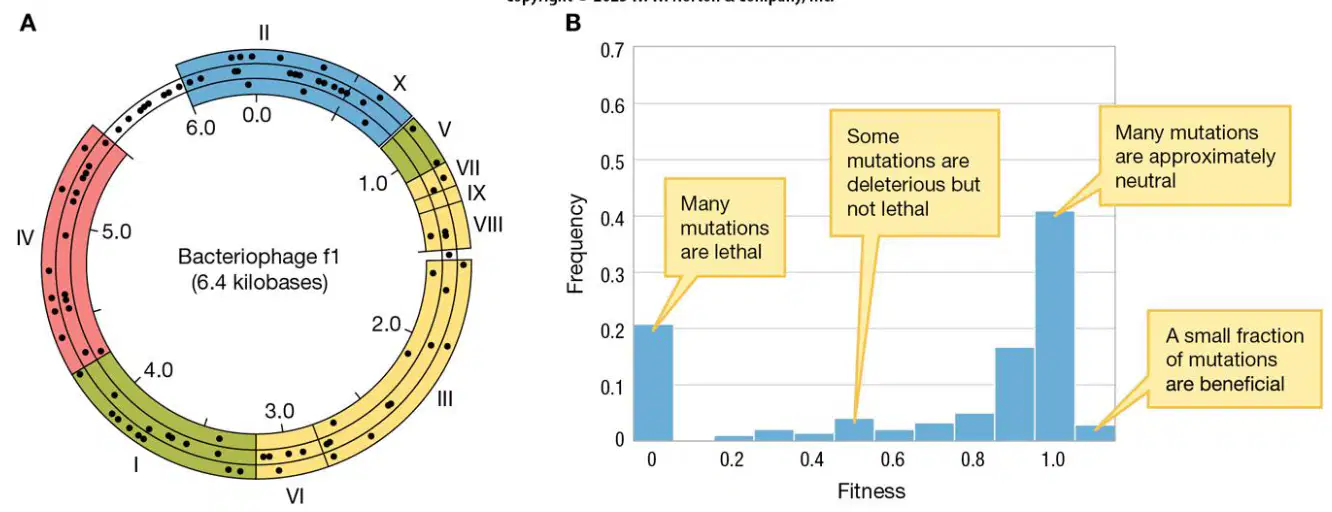
Many mutations are ________ but not lethal.
deleterious
beneficial
neutral
adaptive
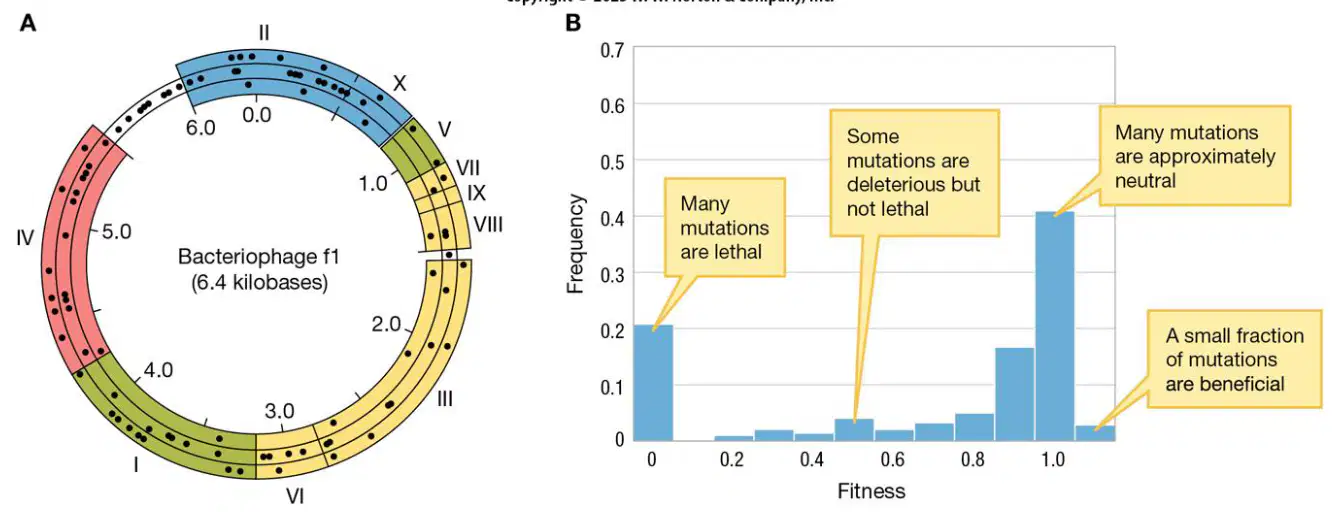
Fitness Effects of Mutations: Fill in the blank. Many mutations are approximately ________.
neutral
lethal
beneficial
deleterious
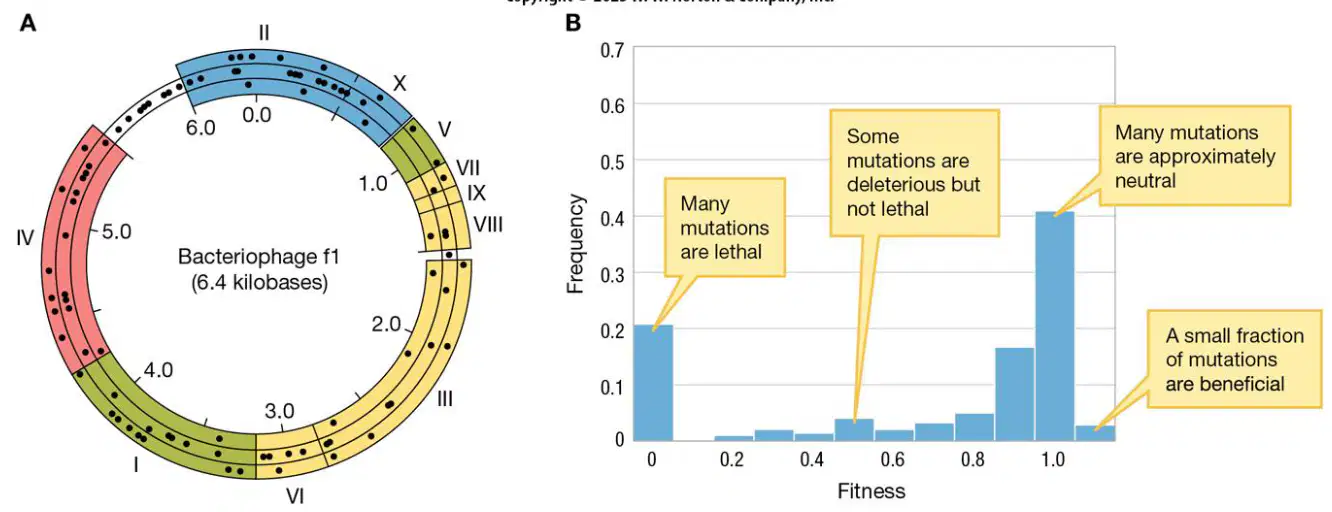
Fitness Effects of Mutations: True or False: A small fraction of mutations are beneficial.
True
False
According to the image, how many new point mutations does every human inherit?
~1 dozen
~2 dozen
~3 dozen
~4 dozen
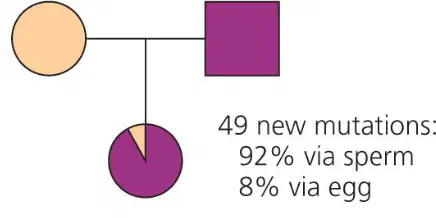
In Family 1 (Western/Northern European from Utah, USA), what percentage of new mutations are inherited via sperm?
8%
36%
64%
92%
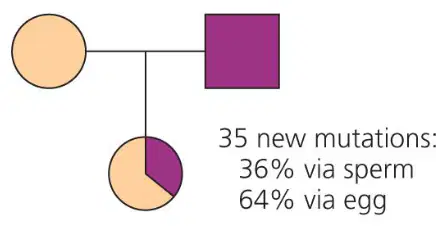
In Family 2 (Yoruban from Ibadan, Nigeria), what percentage of new mutations are inherited via egg?
8%
36%
64%
92%
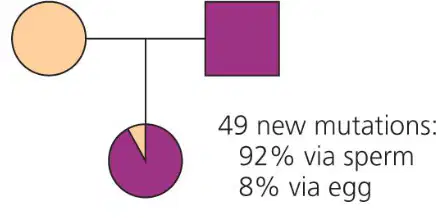
Fill in the blank: In Family 1, there are ___ new mutations, with 92% via sperm and 8% via egg.
49
32
61
25
Where is RNASE1 produced and what is its function?
RNASE1 is produced in the pancreas and is an endonuclease that digests RNA (antiviral properties).
RNASE1 is produced in the liver and is a protease that digests proteins.
RNASE1 is produced in the stomach and is a lipase that digests fats.
RNASE1 is produced in the kidney and is a hormone that regulates blood pressure.
What is unusual about the diet of the Douc langur?
The Douc langur has an unusual diet, consisting primarily of leaves and a specialized four chamber stomach.
The Douc langur eats mostly insects and small mammals.
The Douc langur survives mainly on fish and aquatic plants.
The Douc langur feeds exclusively on fruits and seeds.

