
 Worksheets
Cosmos
Total questions: 108
Worksheet time: 1hrs 10mins
Students conduct an investigation to observe the Sun's movement. Which safety procedure should students following during this investigation?
Wear gloves and goggles
Keep loose hair tied back
Never look directly at the Sun
Record all data in science notebooks
Plants are known as producers because they produce their own food. How do producers receive the energy for this process?
By consuming soil nutrients
By absorbing sunlight
By releasing water
By producing oxygen
You use this instrument to measure temperature.
sieve
hot plate
anemometer
thermometer

What is a type of chemical weathering?
rain
ice
acid rain
snow
All of the following are true about fossil fuels EXCEPT:
They are renewable resources.
They are the remains of dead plants and animals.
They were formed over a long period of time.
They often contribute to pollution of the atmosphere.

Look at the flow chart and complete the missing link.
condensation
cooling
compaction
melting
Energy produced from sunlight is called ______ energy and is considered a ______ resource.
geothermal, nonrenewable
solar, nonrenewable
hydroelectric, renewable
solar, renewable

The food web represents organisms in a field. What role do raccoons play in this food web?
Prey
Producers
Consumer
Decomposer

At which stage in the life cycle of a plant are seeds produced?
Young plant
Sprouting seed
Seedling
Mature plant
Which two traits best help a cactus conserve water in the dry conditions of a West Texas desert ecosystem?
Large flowers and sweet fruit
Sweet fruit and sharp spines
Sharp spines and waxy stems
Waxy stems and large flowers
Many types of plants grow in a forest ecosystem. How do plants affect the air that forest animals breathe?
Plants use oxygen from the air to make food.
Plants release pollution into the air
Plants release energy from the sun into the air
Plants take in carbon dioxide and release oxygen
What is the primary cause of the Earth's seasons?
The distance of the Earth from the Sun
The tilt of the Earth's axis
The rotation of the Earth on its axis
The shape of the Earth's orbit
Which layer of the Earth is composed mostly of liquid iron and nickel?
Crust
Mantle
Outer Core
Inner Core
What is the process by which water vapor turns into liquid water in the atmosphere?
Evaporation
Condensation
Precipitation
Sublimation
Which of the following best explains why ocean currents are important to global climate?
They distribute heat around the planet
They increase the salinity of seawater
They cause earthquakes and tsunamis
They are responsible for the tides
What is weathering?
Process of breaking rocks into smaller pieces.
A shift in weather patterns.
Process by which mountains are formed.
Process by which seasons change.
What types of rocks are formed by weathering?
Metamorphic Rocks
Igneous Rocks
Sedimentary Rocks
Volcanic Rocks
What are the two types of Destructive forces?
Weathering / Warming
Weathering / Erosion
Weathering / Water
Weathering / Climate
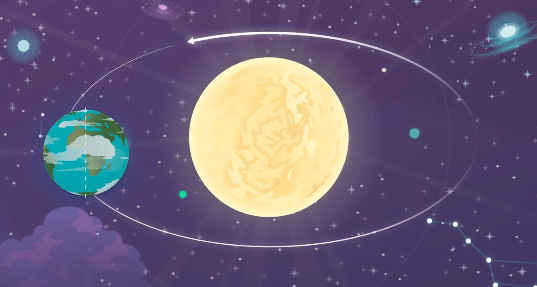
How long does it take for the Earth to make one full orbit around the Sun?
one day
one week
one month
one year
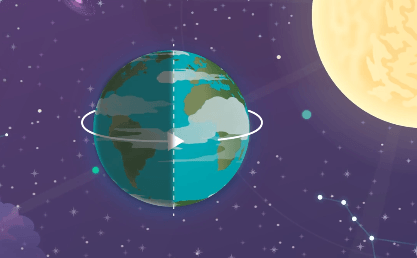
The Earth is rotating on its axis, creating _____
the 12 months
the years
the seasons
day and night

As the Earth travels around the Sun, it creates a pattern that makes _____
the months
the years
the seasons
day and night
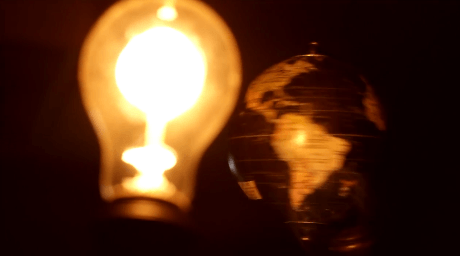
When the Earth completes a full orbit around the Sun, it has completed _____ rotations or days
7
30
91
365
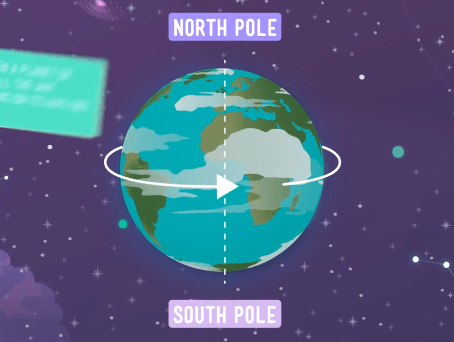
The spinning movement of the Earth about its axis is called the Earth's _____
revolution
rotation
precession
orbit
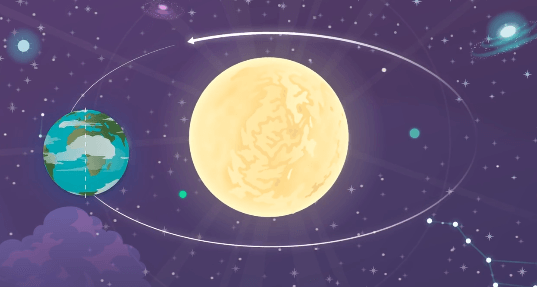
The movement of the Earth around the Sun is called its _____
revolution
rotation
precession
gyration

When the part of the world that you're living in is leaning towards the Sun, its _____
winter
spring
summer
fall

The invisible line that passes through the North Pole and the South Pole is called Earth's ____
axis
equator
ecliptic
prime meridian

When the part of the world that you're living in is leaning away from the Sun, its _____
winter
spring
summer
autumn
What is the primary cause of earthquakes?
Tectonic plate movements
Volcanic eruptions
Tidal forces
Solar flares
Which layer of the Earth is liquid?
Crust
Mantle
Outer core
Inner core
What is the main component of the Earth's atmosphere?
Oxygen
Nitrogen
Carbon Dioxide
Argon

Which 2 planets in our Solar System don't have any natural satellites?
Jupiter & Pluto
Neptune & Mars
Mercury & Venus
Earth & Saturn

Natural satellites are also called (a) .
What are the types of satellites?
Artificial & Homemade
Natural & Organic
Natural & Artificial
What is the name of the Earth's natural satellite?
Moon
Sun
The International Space Station
Satellites that pass over the north and south pole, have an orbit called
Equatorial orbit
Polar orbit
What do natural and artificial satellites have in common?
The do not have anything in common
They send information to the Earth
They orbit celestial bodies
They float outer space with no direction
The Moon is an example of what type of satellite
Man made
Natural
Currently, there are over 2,787 active _________ satellites orbiting the Earth.
Natural
Artificial
Artificial satellites can be used to study the mountains, oceans and weather on Earth.
True
False
Artificial satellites are launched into space on rockets
True
False
A machine that orbits in space
Industry
Satellite
What is the primary function of communication satellites?
To provide weather data
To enable global positioning
To facilitate telecommunication
To observe distant galaxies
Which of the following is a characteristic of geostationary satellites?
They orbit the Earth in 24 hours
They pass over the poles
They are used for deep space exploration
They have elliptical orbits
What is the main difference between natural and artificial satellites?
Natural satellites are made by humans
Artificial satellites orbit the Sun
Natural satellites are celestial bodies like moons
Artificial satellites do not orbit planets
Which type of satellite is primarily used for GPS navigation?
Weather satellites
Communication satellites
Navigation satellites
Astronomical satellites
By far the most abundant element in the giant (jovian) planets is
helium
hydrogen
oxygen
nitrogen
silicon
The element that can act like a metal when it is under tremendous pressure and is probably responsible for Jupiter’s magnetism is
gold
helium
hydrogen
water
Which of the following characteristics distinguishes Uranus from the other giant planets?
It has more than one moon.
Its atmosphere is made of gases.
It rotates on an axis tilted almost 90 degrees to the circle of its orbit.
Its orbit is significantly tilted relative to the orbits of the other planets.
Its magnetic axis does not lie in the same direction as its rotation axis
Both Jupiter and Saturn
have liquid metallic hydrogen in their interiors.
have rings.
emit more energy than they absorb from the sun.
have belt and zone circulation.
All of these
Europa has few craters because
it is protected from impacts by Jupiter’s gravity.
it does not have a solid surface.
it has erased craters nearly as fast as they formed.
its surface is not strong enough to support craters.
it keeps one face always pointed toward Jupiter which screens it from incoming meteorites.
Saturn’s rings are
composed of ice particles.
in the plane of the planet’s equator.
within the planet’s Roche limit.
All of these
None of these
Uranus and Neptune do not contain liquid metallic hydrogen because they
are not massive enough.
do not contain enough hydrogen.
rotate too slowly.
are too far from the sun.
have magnetic fields that are much too weak.
What features are abundant on Jupiter's moons Callisto and Ganymede and almost absent on Europa and Io?
volcanoes
markings that show the surface is made of ice
impact craters
lakes and pools of liquid ammonia
rings
The body in the solar system that is most active volcanically is
Earth.
Neptune.
Io.
Mars.
Ganymede.
What is the cause of many volcanic/geyser-like eruptions on the moon Io?
Its surface is at the triple point of methane, where it can be gas/liquid/solid.
Jupiter’s magnetic field causes huge bolts of lightning to hit Io and heat the surface.
The gravitational stress of being so close to Jupiter and its other large moons heats Io’s insides.
There is a metallic magnetic layer inside Io which is explosive.
How does the mass of Jupiter compare with that of the other planets?
It is slightly larger and more massive than Saturn.
It is similar to that of the Earth and Venus.
It is twice as massive as all other planets combined.
It is almost as massive as Saturn.
It is about a tenth the mass of the Sun.
What would Jupiter have needed to have become a star?
more moons
more mass
a slower rotation, like the Sun
a different chemical composition
a higher density
What is thought to be the cause of Io's volcanoes?
Jupiter's magnetosphere and its charged particles
tidal stresses from both Jupiter and Europa
solar radiation focused by Jupiter's gravity
radioactive decay in Io's interior
What are Saturn's rings?
a great disk of liquid helium
large rocky boulders moving in orbit around Saturn
a glowing, flat magnetospheric auroral display
a solid thin disc of material encircling Saturn
small icy particles moving in orbit around Saturn
How is the Roche limit defined?
the critical distance from a planet, inside of which a moon can be tidally destroyed
the maximum density that a body can have, depending on its composition
the maximum distance from a planet that a moon can experience synchronous rotation
the maximum mass a moon can have and still be classified as a moon
the maximum size an impacting asteroid and be and not break up a moon
What evidence suggests that Saturn's moon Enceladus has ongoing geological activity?
Lack of impact craters on much of its surface and evidence of ice flows from possible volcanic activity.
Voyager 1 showed sulfur eruptions all over its pizza-pie colored surface.
Enceladus is located within Saturn's Roche limit, and ready to blow up.
Enceladus undergoes severe tidal stresses from its resonance with Titan.
6th planet from the sun. Known for its rings.
Saturn
Uranus
Neptune
Jupiter
7th planet from the sun. Orbits the sun on its side.
Saturn
Uranus
Neptune
Jupiter
8th planet from the sun. Coldest planet in the solar system.
Saturn
Uranus
Neptune
Jupiter

Planet W is
Jupiter
Saturn
Uranus
Neptune
Planet Z is
Jupiter
Saturn
Uranus
Neptune
Planet Y is
Jupiter
Saturn
Uranus
Neptune
Which planets have rings?
Jupiter
Saturn
Uranus
Neptune

What planet takes the longest to orbit the sun?
Uranus
Jupiter
Neptune
Saturn
The Outer Planets are extremely
Cold
Hot
This planet has the most moons in our solar system.
Jupiter
Saturn
Uranus
Neptune
What is Neptune's moon Triton known for?
Spinning really fast
Raining diamonds
Having geysers that shoot up super-heated vapors
Spinning upside down
Which causes a day to occur on a planet?
Period of rotation
Period of revolution
Period of retrograde
Period of revelation
What causes a year for a planet
Period of revolution
Period of rotation
Period of retrograde
Period of revelation
All gas giants/outer planets have this in common except:
number of moons
made mainly of hydrogen and helium
thick atmosphere
large masses
All gas giants/outer planets have this in common except:
length of year
low temperatures
layers of solid core, liquid layer, gaseous layer
past the asteroid belt
This type of planet is very cold and Icy
Terrestrial
Jovian
This type of planet has a thin atmosphere or no atmosphere at all
Terrestrial
Jovian
An example of this type of planet is Mars
Terrestrial
Jovian
These planets are often called "gas giants" or "ice giants"
terrestrial
jovian
This type of planet is relatively small
Terrestrial
Jovian
An example of this type of planet is Neptune
Terrestrial
Jovian
An example of this type of planet is Jupiter
Terrestrial
Jovian
These planets are typically hot or warm
Terrestrial
Jovian
These planets are made of heavier elements or metals
Terrestrial
Jovian
These planets typically have a thick Hydrogen/ Helium atmosphere
Terrestrial
Jovian
These planets are referred to as the "inner" planets
Terrestrial
Jovian
An example of this type of planet is Venus
Terrestrial
Jovian
This type of planet has a nitrogen/ carbon dioxide atmosphere
Terrestrial
Jovian
This type of planet may have rings
Terrestrial
Jovian
This type of planet typically has many moons
Terrestrial
Jovian
an example of this type of planet is Earth
Terrestrial
Jovian
This type of planet has few moons
Terrestrial
Jovian
An example of this type of planet is Saturn
Terrestrial
Jovian
This type of planet was created due to solar winds
Terrestrial
Jovian
These planets are often referred to as "outer" planets
Terrestrial
Jovian
Solar Nebular Theory is the most widely accepted theory of how the solar system began
True
False
Based on Solar Nebular theory the planets all orbit the sun in the same direction
True
False
Based on Solar Nebular Theory, the planets of our solar system should all rotate the same way on their axes.
True
False

