wayground logo

Free Printable Worksheets

Font size

S
M
L
XL
Worksheets

Chemistry Semester 1

Total questions: 103

Worksheet time: 52mins

Name
Class
Date
1.

Which part of the diagram represents the proton?

¿Qué parte del diagrama representa el protón?

a)

a

b)

b

c)

c

d)

d

2.

Subatomic particles that have a negative charge

a)

electrons

b)

protons

c)

quarks

d)

neutrons

3.
Which particles are located in the nucleus? 
a)
Protons & Electrons 
b)
Electrons & Neutrons 
c)
Protons & Neutrons 
4.

An atom has 25 protons and 30 neutrons. How many electrons are needed to make the atom neutral?

a)

0

b)

25

c)

30

d)

35

5.
Subatomic particles with a positive charge
a)
neutrons
b)
atomic mass
c)
protons
d)
isotopes
6.
The subatomic particles in blue are...
a)
Neutrons
b)
Protons
c)
Electrons
7.
The subatomic particles in green are...
a)
Protons
b)
Neutrons
c)
Electrons
8.
The subatomic particles in red are
a)
Electrons
b)
Neutrons
c)
Protons
9.
Subatomic particles that are neutral in charge
a)
Neutrons
b)
Protons
c)
Nucleus 
d)
Electrons
10.
Where electrons are likely to be found as they travel around the nucleus
a)
Nucleus
b)
Electron Cloud
c)
Within a Proton
d)
Within a Neutron
11.
A tiny but very dense, positively charged portion of the atom that holds most of the atomic mass
a)
Electron Shells
b)
Orbitals
c)
Electron Cloud
d)
Nucleus
12.
Complete the missing label on the diagram.
a)
Neutron
b)
Centre
c)
Nucleus
d)
Sub atomic particle
13.

Which one of these is true?

a)

Opposite charges repulse each other

b)

Opposite charges attract each other

c)

Same charges attract each other

d)

Same charges neither repulse nor attract each other
14.
Atoms of the same element must always have the same number of _________
a)
electrons
b)
neutrons
c)
isotopes
d)
protons
15.
This subatomic particle has basically no mass
a)
protons
b)
neutrons
c)
electrons
d)
protons and neutrons
16.
All matter is made of what?
a)
energy 
b)
atoms 
c)
volume
d)
compounds 
17.
The two areas of an atom are the 
a)
nucleus and electron cloud
b)
proton cloud and nucleus
c)
inside and outside
d)
mass and volume
18.

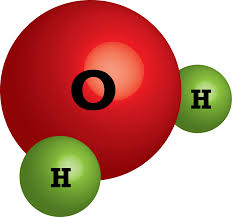
How many atoms are in this molecule?

a)

1

b)

2

c)

3

d)

4

19.
Which letter represents a proton?
a)
A
b)
B
c)
C
d)
D
20.
Which letter represents a neutron?
a)
A
b)
B
c)
C
d)
D
21.
Which letter represents an electron?
a)
A
b)
B
c)
C
d)
D
22.
True or False - Protons and Neutrons have about the same mass.
a)
True - They have about the same mass
b)
False - They do not have about the same mass
23.
During a physics lab, a plastic strip was rubbed with cotton and became positively charged. The correct explanation for why the plastic strip becomes positively charged is that ...
a)
the plastic strip acquired extra protons from the cotton.
b)
the plastic strip acquired extra protons from the charging process 
c)
protons were created as the result of the charging process
d)
the plastic strip lost electrons to the cotton during the charging process 
24.
Insulators are different than conductors in that insulators ____.
a)
do not contain electrons or protons 
b)
 do not contain any charge
c)
have a weaker affinity for electrons 
d)
do not allow charge to freely move 
25.
A glass rod becomes positively charged when it is rubbed with silk. This net positive charge accumulates because the glass rod
a)
gains electrons
b)
loses electrons
c)
gains protons
d)
loses protons
26.
 A balloon is rubbed against a student's hair and then touched to a wall. The balloon sticks to the wall due to
a)
magnetic forces between the particles of the balloon and the particles of the wall
b)
electrostatic forces between the particles of the balloon and the particles of the wall
c)
magnetic forces between the particles of the wall
d)
electrostatic forces between the particles of the balloon
27.

This image shows the before picture, when a balloon is rubbed with polyester. Identify the correct after picture.

a)
b)
c)
d)
28.

When an object gains electrons it becomes __________

a)

Neutral

b)

Positively charged

c)

Negatively charged

29.

An atom of oxygen has 8 protons and 10 electrons, this means the atom is ____________

a)

positively charged because it has excess electrons

b)

negatively charged because it has excess electrons

c)

positively charged because it has a deficiency of electrons

d)

negatively charged because it has a deficiency of electrons

30.

After a balloon is rubbed against wool, the two objects will ________ each other because they have ___________ charges

a)

attract; like

b)

attract, opposite

c)

repel; like

d)

repel; opposite

31.

What method of static charging is shown in this picture

a)

Contact

b)

Friction

c)

Grounding

d)

Electron Shifting

32.
Electric charges that are alike _______ each other.
a)
Attract
b)
Repel
33.
An atom loses an electron.  What type of charge does it have now?
a)
positive
b)
negative
34.

When an object gains electrons it becomes __________

a)

Neutral

b)

Positively charged

c)

Negatively charged

35.

An atom of oxygen has 8 protons and 10 electrons, this means the atom is ____________

a)

positively charged because it has excess electrons

b)

negatively charged because it has excess electrons

c)

positively charged because it has a deficiency of electrons

d)

negatively charged because it has a deficiency of electrons

36.
If two balloons have the same charge, what will happen if you place them close to each other?
a)
Nothing
b)
They will be attracted
c)
They will pop
d)
They will push each other away.
37.
Insulators are different than conductors in that insulators ____.
a)
do not contain electrons or protons 
b)
 do not contain any charge
c)
have a weaker affinity for electrons 
d)
do not allow charge to freely move 
38.
Which of the following is not a good conductor of electricity?
a)
copper
b)
silver
c)
Glass
d)
aluminum
39.
Which of the following is not a good insulator?
a)
Copper
b)
Glass
c)
rubber
d)
wool
40.

Recap:

Coulomb’s law states that the force between two charged objects will __________ when the magnitude of the object’s charge increases.

Coulomb’s law also states that the force between two charged objects will __________ when the distance between objects increases.

a)

increase; increase

b)

increase; decrease

c)

decrease; increase

d)

decrease; decrease

41.

What types of charges attract?

a)

Positive and Positive

b)

Positive and Neutral

c)

Negative and Neutral

d)

Positive and Negative

42.

The accumulation of excess electric charge on an object is called

a)

Static electricity

b)

Electric discharge

c)

Resistance

d)

Circuit

43.

Plastic is an example of _______.

a)

an insulator

b)

a conductor

44.

A metal spoon is an example of _____.

a)

a conductor

b)

an insulator

45.

Materials that tightly hold on to their electrons are considered

a)

Good conductors

b)

Good insulators

c)

Good anti-static agents

d)

Useful for storing charge

46.

Materials that easily loose or accept electrons are considered

a)

Good conductors

b)

Good insulators

c)

Good anti-static agents

d)

Good for storing charge

47.

Jo Jo the clown, rubbed two balloons with a piece of wool. What will happen when the balloons are brought near each other?

a)

The balloons will repel each other.

b)

The balloons will attract each other.

c)

The balloons will become positively (+) charged.

d)

The balloons will pop.

48.
The difference between attract and repel is that to attract is to pull something closer and repel is to push something away.
a)
True
b)
False
49.
What causes static electricity?
a)
only an object losing electrons
b)
only an object gaining electrons
c)
when positive and negative charges balance
d)
when positive and negative charges are not balanced
50.
Which type of charges do these balloons have?
a)
like charges
b)
opposite charges
51.
What type of charge do these balloons have?
a)
like charges
b)
opposite charges
52.

Which has more charge?

a)

Proton

b)

Electron

c)

Neither

53.
As a pair of charges is brought close together, the force between them
a)
Increases
b)
Decreases
c)
Increases only if they are the same sign
d)
Increases only if they are the opposite sign
54.
When you brush your hair you scrape off electrons, and your hair
a)
becomes positively charged
b)
becomes negatively charged
c)
becomes positively and negatively charged
d)
remains uncharged, or neutral
55.
What is adhesion?
a)
Water's ability to stick to itself
b)
Water's ability to stick to other substances
c)
The strength of the cohesion of all the water molecules combined
d)
Tape, glue and other adhesives
56.
What is cohesion?
a)
Water's ability to stick to itself
b)
Water's ability to stick to other substances
c)
The strength of the cohesion of all the water molecules combined
d)
Tape, glue and other adhesives
57.
Large bodies of water do not quickly fluctuate in temperature. Why?
a)
Water is a solvent.
b)
Water has a high heat capacity.
c)
Water acts as a buffer.
d)
Water is non-polar.
58.
What two elements make up water?
a)
Helium and oxygen
b)
Hydrogen and oxygen
c)
helium and carbon
d)
oxygen and carbon
59.
Why does water move from the roots to the leaves of plants?
a)
Water is pushed by solutes
b)
Capillary action pulls the water molecules like a chain
c)
Water is pulled by gravity
d)
Water’s cohesion causes it to “pull” towards the leaves
60.
What property of water helps to moderate earth's temperature?
a)
adhesion
b)
chohesion
c)
Specific heat capacity
d)
Latent heat of vaporization
61.
Water is a universal solvent because it...
a)
It can be found anywhere
b)
It freezes when it gets cold
c)
floats when frozen
d)
Dissolves most substances
62.

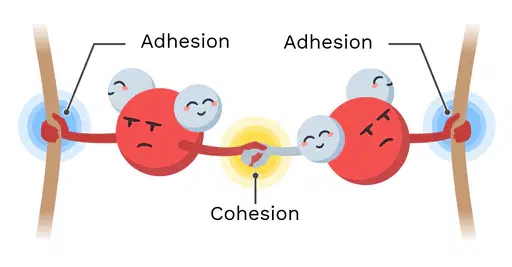
What characteristic is shown in the image?

a)

Polarity

b)

Hydrogen Bonds

c)

Cohesion

d)

Adhesion

63.

Water has ... specific heat. Meaning, it takes ... time to warm up a large amount of water.

a)

high/ long 

b)

high/ short

c)

low/long

d)

low/ short

64.
When water molecules stick easily to other water molecules, this is called what?
a)
cohesion
b)
adhesion
c)
solution
d)
polar molecule
65.
What is a solute?
a)
The substance that does the dissolving in a solution.
b)
The substance that is dissolved into the solution.
c)
The mixing of different substances.
d)
The process in which neutral molecules lose or gain electrons
66.
What is a solvent?
a)
The substance that does the dissolving in a solution.
b)
The substance that is being dissolved in a solution.
c)
The mixing of different substances.
d)
The process in which neutral molecules lose or gain electrons
67.

Why is water so good at dissolving so many substances?

a)

it is polar

b)

it is less dense as a solid

c)

cohesion

d)

adhesion

68.

Water has a slightly positive end AND a slightly negative end, this means water has

a)

polarity

b)

cohesion

c)

adhesion

d)

specific heat

69.

Water can hold a great deal of heat and help moderate the climate of a nearby landmass because of which property?

a)

specific heat (high heat capacity)

b)

cohesion

c)

adhesion

d)

polarity

70.
Paper clips are able to float on water because of ....
a)
adhesion
b)
capillary action
c)
surface tension
d)
universal solvent
71.
Surface tension is caused by ...
a)
strong cohesion between water molecules
b)
strong adhesion between the water molecules
c)
condensation
d)
water cycle
72.

What is the result of water's adhesion property?

a)

Water sticks to other water molecules.

b)

Water sticks to other materials.

c)

Water does not stick to anything.

d)

Water forms a gas.

73.

What is the result of water's cohesion property?

a)

Water sticks to other materials.

b)

Water sticks to itself.

c)

Water evaporates.

d)

Water becomes solid.

74.

How would you write 0.0005 in scientific notation?

a)

50 x 10-5

b)

5 x 10⁻⁴

c)

5 x 10³

d)

.5 x 103

75.
Scientific Notation is made up of two number parts. The first part should be a number between 1 and 100.
a)
True
b)
False
76.

Scientific Notation is made up of two number parts. The second part is a power 10.

a)

True

b)

False

77.

Which of the following numbers is written in scientific notation?

a)

20.35 x 10⁴

b)

.2035 x 104

c)

2035 4

d)

2.035 x10⁴

78.

Express the following in scientific notation:


.000457

a)

457 x 106

b)

457 x 10-6

c)

4.57 x10⁴

d)

4.57 x 10⁻⁴

79.

Convert to scientific notation:


520,000,000

a)

52 x 107

b)

5.2 x 10⁻⁷

c)

5.2 x 10⁸

d)

0.52 x 10⁹

80.

If the exponent is a positive number the original number was...

a)

a really big number.

b)

a really small number.

81.

If the exponent is a negative number the original number was...

a)

a really large number.

b)

a really small number.

82.

Convert this number into scientific notation:


0.068

a)

6.9 x 10⁶

b)

6.8 x 10⁻⁹

c)

6.8 x 10⁻²

d)

None of the above

83.

Convert this number into scientific notation:


950,000

a)

9.5 x 10⁵

b)

9.5 x 10⁻⁹

c)

9.5 x 10²

d)

None of the above

84.
Why do scientists use scientific notation?
¿Por que se usa la notaion cientifica los cientificos?
a)
They don't / No se usa
b)
To write large numbers quickly/ Para escribir numeros grandes facilmente
c)
It's fun / Es divertido
85.
The rule of scientific notation is to write all exponents with a base of ____.
Para escribir la notacion cientifica, se usan los exponentes con la base de ____.
a)
50
b)
5
c)
100
d)
10
86.
How many zeros would be in this number if written in standard form?
Cuantos ceros hay en la forma estandar de este numero?
6.47 x 10¹¹
a)
11
b)
9
c)
10
d)
12
87.
Write 52,300,000 in scientific notation.
a)
5.23 x 10⁷
b)
5.230 x 10⁷
c)
52.3 x 10⁶
d)
52.30 x 10⁶
88.
Which number tells us how many spaces to move the decimal?
Cual numero indica el numero de espacios para mover el decimal
8.317 x 10⁶
a)
exponent = 6
b)
coefficient = 6
c)
exponent = 10
d)
exponent = 8.317
89.

According to Coulomb's Law, when the distance increases, the electrostatic force ____________.

a)

increases

b)

decreases

c)

remains unchanged

d)

has no relationship to distance

90.

Coulomb’s law states that the force between two charged objects will __________ when the magnitude (value) of the object’s charge increases.

a)

increase

b)

decrease

c)

stay the same

d)

first increase, then decrease

91.

Select all answer that apply:


What kinds of particles do Coulomb's Law apply to?

a)

electrons

b)

protons

c)

neutrons

d)

neutral atoms

92.

A repulsive force exists between which two particles?

a)

Two neutrons

b)

An electron and a neutron

c)

An electron and a proton

d)

Two protons

93.

An attractive force exists between which two particles?

a)

Two neutrons

b)

An electron and a neutron

c)

An electron and a proton

d)

Two electrons

94.

As two oppositely charged particles approach each other, what happens to the electrical force between them?

a)

The attractive force increases

b)

The magnitude of the electric force decreases

c)

The repulsive force increases

d)

The magnitude of their charges increases

95.
The Electric Force is strongest when charges are...
a)
close together
b)
far apart
c)
the electric force is constant everywhere
96.

A positively charged balloon touching a wooden wall...

a)

pulls negative charge on the wall surface toward it.

b)

pushes positive charge in the wall away from it.

c)

polarizes molecules in the wall.

d)

All of the above

97.

Which one of the following statements is true?

a)

The salt solution conducts electricity.

b)

The sugar solution conducts electricity.

c)

The pure water conducts electricity.

98.

Which statement is true?

a)

Solids will conduct electricity.

b)

Solutions (water with dissolved particles) will conduct electricity.

99.

Which diagram best illustrates the ion-molecule attractions that occur when the ions of NaCl(s) are added to water?

a)

1

b)

2

c)

3

d)

4

100.

A substance that conducts an electrical current when dissolved in water is called

a)

catalyst

b)

metalloid

c)

electrolyte

d)

nonelectrolyte

101.

What is defined as an atom or molecule with a net electric charge due to the loss or gain of one or more electrons?

a)

Proton

b)

Conductivity

c)

Ion

d)

Electrolyte

102.

____________ conduct electricity by allowing ions to move through the solution.

a)

Ions

b)

Cations

c)

Electrolytes

d)

Nonelectrolytes

103.

Electrolytes ___________ electricity.

a)

ions

b)

conduct

c)

anions

d)

cations