
 Worksheets
Space
Total questions: 80
Worksheet time: 2hrs 2mins
Which of the following statement is best in accordance with Kepler's first law of planetary motion?
A. The orbits of planets form an ellipse, with the Sun at one focus.
B. Planets orbit in perfect circles, with the Sun slightly off-center.
C. All planets make one orbit of the Sun in exactly the same time period.
D. Planets farther from the Sun orbit proportionally faster.
How do Kepler’s laws of planetary motion compare to Newton’s laws of motion and Newton’s law of universal gravitation?
A. Kepler described Earth’s orbit around the Sun. Newton described the Moon’s orbit around Earth.
B. Kepler explained only the shape of Earth’s orbit. Newton explained only Earth’s speed in orbit.
C. Kepler explained the effect of gravity on Earth’s orbit around the Sun. Newton explained the
effect of the Moon’s gravity on the Sun.
D. Kepler described the shape and speed of Earth’s orbit around the Sun. Newton identified the
forces that cause Earth to orbit the Sun.

The diagram below shows four points along Earth's orbit as it revolves around the Sun. The shaded area in the sector bounded by Points 1 and 2 is the same as the shaded area in the sector bounded by Points 3 and 4.
Which statement accurately compares the conditions at these four points?
A. The magnitude of Earth's acceleration is the same at all four points.
B. The Sun's gravitational pull on Earth is the same at Point 1 as it is at Point 3.
C. Earth's speed is the same as it goes from Point 1 to Point 2 as when it goes from Point 3 to Point 4.
D. It takes Earth the same amount of time to go from Point 1 to Point 2 as it does to go from Point 3 to Point 4.
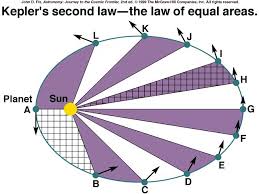
According to Kepler’s first law, orbiting planets follow an elliptical path with the Sun at one of the focal points of the ellipse. Kepler’s second law states that a line from the Sun to the planet must always pass over an equal amount of area in an equal amount of time. Based on this information,
which statement best describes the relationship between the speed of a planet and its distance from the Sun?
A. The speed of a planet is constant as it orbits the Sun.
B. The changes in the speed of an orbiting planet are independent of its distance from the Sun.
C. Planets move at higher speeds when they are close to the Sun and lower speeds when they are far from the Sun.
D. Planets move at lower speeds when they are close to the Sun and higher speeds when they are far from the Sun.

The table below lists the distances of Mercury, Earth, and Saturn from the Sun. Kepler’s third law of motion describes the relationship between the distances of the planets from the Sun and their orbital periods.
Based on the time it takes each planet to complete a ‘year’ around the Sun, rank these planets in order from shortest to longest.
A. Mercury, Earth, Saturn
B. Mercury, Saturn, Earth
C. Earth, Mercury, Saturn
D. Saturn, Earth, Mercury
A total eclipse of the Sun occurs when the disc-like shape of the Moon completely covers the Sun, as seen from locations on Earth. However, this depends on the Moon being at its closest point to Earth in its orbit. Some eclipses, known as annular eclipses, show a thin ring of bright sunlight visible around the dark disc of the Moon. What is the relative position of the Moon, the Sun, and Earth during an annular eclipse?
A. The Moon is at apogee.
B. The Moon is at perigee.
C. Earth is at aphelion.
D. Earth is at perihelion.
Which statement is a relationship described by one of Kepler's laws?
A. For every action, there is an equal and opposite reaction.
B. The acceleration of the Moon depends directly on the net force applied to it by Earth.
C. Every object in a state of uniform motion tends to remain in that state of motion unless an external force is applied to it.
D. A line drawn between the Moon and the center of Earth will sweep out equal areas of the plane of the Moon's orbit in equal time periods.

According to Kepler’s Second Law of Planetary Motion, a line drawn from a planet to the Sun sweeps out equal areas in equal time. In this drawing, a planet is orbiting around the Sun. The thinner triangle occurs over the same time period as the wider, shorter triangle. Both triangles have the same
area. How does Newton’s universal gravitation affect the movement of the planet as it approaches the Sun?
A. The planet’s own gravitational force causes the planet to speed up as it nears the Sun.
B. The Sun’s gravitational force slows the planet down, keeping it close by for a longer period of time.
C. The Sun’s gravitational force pulls more strongly on the planet as it approaches, speeding it up in its orbital path.
D. The planet's speed is unchanged by gravitation from the Sun, but the distance traversed by the planet in its orbit is shorter.
Because of its changing proximity to the Sun, which property does Kepler's Second Law of Planetary Motion predict will change during a planet's orbit?
A. orbital speed
B. orbital period
C. orbital minor axis
D. orbital eccentricity
Which statement is a direct implication of Kepler's Second Law of Planetary Motion?
A. A planet's acceleration is affected by its mass.
B. A planet's velocity depends on its position in its orbit.
C. A planet's total distance from the foci of its orbit is constant.
D. A planet's period can be predicted from the semimajor axis of its orbit.

Planets orbit the Sun in a shape called _?_.
a circle
an ellipse
a focus
an oblong

An ellipse is drawn around two points called _?_.
dots
points
foci
axis

According to Kepler's 1st Law, the _?_ is at one of the foci of each planetary orbit.
the axis
the magnitude
the center
the Sun
What has an eccentricity of zero?
a straight line
a large ellipse
circle
a small ellipse

Where is the planet moving faster?
around segment A
around segment B
around either segment - the speed doesn't change
impossible to know

While traveling around its orbit, during which segment does a line from the planet to the sun sweep through the most area of space?
The area between A, B and the Sun is the largest.
The area between G, H and the Sun is the largest
the areas are equal in size
There is not enough information to determine the areas

A planet moving counterclockwise in its orbit will be increasing speed at position _?_.
P1
P2
P3
P4

The diagram below shows a moon revolving around a planet in an elliptical orbit. At which position is the moon traveling fastest?
location 1
location 2
location 3
location 4

Which planet of those shown, because of its position, will take the least amount of time to revolve around the Sun?
Mercury
Venus
Earth
Mars

A comet moves much faster when it passes closer to the Sun than when it is further away. What is the primary cause in the change of the comet’s orbital speed?
Jupiter's gravitational field.
The sun's solar wind.
The sun's gravitational field.
Saturn's magnetic field.
According to Kepler's 3rd law, the square of the time it takes a planet to orbit (T) is directly related to the cube of half the distance across the orbital ellipse (a). This means the further away from the sun a planet orbits, _?_.
the larger the constant k is.
the smaller the constant k is.
the longer the orbital period is.
the shorter the orbital period is.
According to the Heliocentric Model of the Universe (the one we use in class), __?__ is at the center of our Solar System with the planets revolving around it.
Earth
The Sun
Jupiter
Helios

The period of Jupiter is 4,344 days. This tells you how long it takes _?_.
Jupiter to orbit the sun.
Jupiter to rotate one time on its axis.
the sun to orbit Jupiter.
Earth to orbit Jupiter.

Why is Earth’s year shorter than Jupiter’s year?
the gravitational pull of Jupiter’s moons
the shape of Earth’s orbit around the Sun
the smaller distance between Earth and the Sun
the mass and density of Jupiter

In this diagram, the length of the semi-major axis is labeled with _?_.
a
x
y
F


What is the smallest terrestrial planet?
The farther a planet is from the sun, the
less time it will take to revolve around the sun
more time it will take to revolve around the sun
distance does not play a role
One astronomical unit (1 AU) is the
average distance from the sun to Earth
average distance from the sun to Earth's moon
average distance from the sun to Mars
A random number made up by astronomers

If we are able to obtain orbital period from transit data, we can calculate _____ using Kepler's 3rd Law.
Orbital eccentricity
Average distance between the planet and its host star
Percentage of water vapor in the planet's atmosphere
The probability for advanced life
Even though Pluto's average distance from the Sun is much farther than Neptune's, Pluto is sometimes located closer to the Sun than Neptune because ____.
Neptune is more affected by the Gravitational pull of Jupiter
Pluto is traveling at a faster orbital velocity
Pluto's orbital eccentricity is greater than Neptune's
Pluto's orbital eccentricity is less than Neptune's
The (a) method uses the tug an exoplanet gives on its parent star and measures a star’s shift in speed wobbling toward and away from Earth.
Are you interested in exoplanets? Why?
What is an exoplanet?
Any planet which is not Earth
A dwarf planet located in the Kuiper belt
Any planet outside of our Solar System
A mystical planet from fairy tales
Which method is the most successful in detecting exoplanets?
Transiting
Microlensing
Radial Velocity
Imaging
How many extrasolar planet are estimated to be present in our galaxy?
10 000
1 million
8
100 billion
The first extrasolar planets were found around which unusual type of astronomical object?
A galaxy
A pulsar
A brown dwarf
A supernova
How do we call large short-period exoplanets?
Big Hotties
Hot Exoplanets
Hot Jupiters
Hot Saturns
How do we call an event when a planet crosses in front of the star?
Eclipse
Transit
Occultation
Moonlighting
What is one of the necessary conditions for life to exist on other planets?
Presence of vegetation on the planet surface
Presence of liquid water on the planet surface
Presence of oxygen in the atmosphere
Low CO2 level in the atmosphere
The place in a planetary system where liquid water can survive on a planet's surface is called what?
Aqueous zone
Liquid region
Habitable zone
Water belt
Planets that are found to be orbiting stars outside our solar system are called ___________
rogue planets
super planets
exoplanets
imaginary planets
How many confirmed exoplanets have been discovered so far?
2-3 thousand
3-4 thousand
4-5 thousand
5-6 thousand
What is the primary method used to detect exoplanets by observing the dimming of a star's light when a planet passes in front of it?
Radial Velocity
Transit Method
Direct Imaging
Astrometry
Which of the following characteristics is essential for an exoplanet to be considered potentially habitable?
Presence of a thick atmosphere
Being located in the habitable zone
Having a large number of moons
Being larger than Earth
What is the term for the effect that causes a star to wobble due to the gravitational pull of an orbiting exoplanet?
Transit Effect
Doppler Effect
Gravitational Microlensing
Astrometric Wobble



