wayground logo

Free Printable Worksheets

NEW

Font size

S
M
L
XL
Worksheets

Unit 2 Review

Total questions: 62

Worksheet time: 2hrs 11mins

Name
Class
Date
1.
Nancy got a graduated cylinder.She added 50 mL of water to the cylinder and recorded that amount.She added a rock to the cylinder. The water level rose to 70 mL. Nancy recorded the amount. She subtracted 50 mL from 70 mL and recorded 20 mL. What was Nancy trying to determine?
a)
density of the rock
b)
mass of the rock
c)
weight of the rock
d)
volume of the rock
2.
Physical or Chemical Property?  The solid form of water is ice.
a)
Physical
b)
Chemical
c)
Neither
3.
What is matter?
a)
Any subtance that doesn't take up space or have mass.
b)
Any substance that takes up space or have mass.
c)
Any substance that exists on Earth.
d)
Any substance that exists in space.
4.
Which of these is an example of a chemical property?
a)
density
b)
melting point
c)
ductility
d)
flammability
5.
Boiling point,melting point, and density are some of an element's
a)
pure properties
b)
physical properties
c)
chemical properties
6.
An example of a physical change would be a change in...
a)
Color
b)
Shape
c)
Size
d)
All of the above 
7.
Jack has a rock. The rock has a mass of 14g and a volume of 2cm3. What is the density of the rock?
a)
7 mL
b)
7 g/cm3
c)
28 g/cm3
d)
1/7 g/cm3
8.
Salt dissolves in water
a)
Physical change
b)
Chemical change
9.
A piece of copper is cut in half
a)
physical change
b)
chemical change
10.
iron rusts.
a)
physical change
b)
chemical change
11.
a sugar cube is ground up
a)
physical change
b)
chemical change
12.
pancakes cook on a griddle
a)
physical change
b)
chemical change
13.
food is digested in the stomach
a)
physical change
b)
chemical change
14.
water is absorbed by a paper towel
a)
physical change
b)
chemical change
15.
fireworks explode
a)
physical change
b)
chemical change
16.
Which shows evidence that a chemical change has occurred?
a)
slicing potato
b)
apple/potato turns brown
c)
biting apple
d)
peeling apple/potato
17.
Which evidence demonstrates that a chemical change has occurred.
a)
water level rises
b)
water becomes cloudy
c)
gas is produced (bubbles)
d)
tablet dissolves
18.
Can matter be created or destroyed?
a)
Yes, it can be created.
b)
Yes, it can be destroyed.
c)
No, matter is always conserved
d)
None of these
19.
How is a physical change different from a chemical change?
a)
There is absolutely no difference
b)
Chemical changes produce a new substance, physical changes stay the same substance
c)
Chemical changes create and destroy matter, physical changes don't
d)
Physical changes create and destroy matter, chemical changes dont
20.

An _____ is the smallest unit of an element that maintains the chemical identity of that element.

a)

Atom

b)

Element

c)

Matter

d)

Particle

21.

An _____ is a pure substance that cannot be broken down into simpler, stable substances and is made of one type of atom.

a)

Atom

b)

Element

c)

Matter

d)

Particle

22.

Water has a constant boiling point of 100oC. Boiling points are examples of _____ which do not depend on the amount of matter in a sample.

a)

Extensive properties

b)

Intensive properties

c)

Chemical properties

d)

physical properties

23.

A friend asks you to you help lift a box. He points you over to the large box with 100 kg printed on the side. You know that that is a HEAVY box. The mass of this box is an example of _____ which depends on the amount of matter.

a)

Extensive properties

b)

Intensive properties

c)

Chemical properties

d)

Physical properties

24.

A mixture is a blend of 2 or more kinds of matter which can be physically separated. If the 2 types of matter are not evenly distributed, the mixture is said to be _____.

a)

heterogeneous

b)

homogeneous

25.

Part of your lab instructions might be to add a salt to a sample of water. The salt dissolves in the water, but you would still taste it. What type of mixture did you make?

a)

a homogeneous solution

b)

a heterogeneous sol

c)

a heterogeneous suspension

d)

a homogeneous gel

26.
a)
element
b)
compound
c)
mixture of elements
d)
mixture of compounds and elements
27.
a)
element
b)
compound
c)
mixture of elements and compounds
d)
mixture of compounds
28.
NaCl
a)
Element
b)
Compound
c)
Homogeneous Mixture
d)
Heterogeneous Mixture
29.
Aluminum
a)
Element
b)
Compound
c)
Homogeneous Mixture
d)
Heterogeneous Mixture
30.
Kool-Aid
a)
Element
b)
Compound
c)
Homogeneous Mixture
d)
Heterogeneous Mixture
31.

Matter is defined as

a)

has mass

b)

has volume

c)

has mass and volume

d)

everything

32.
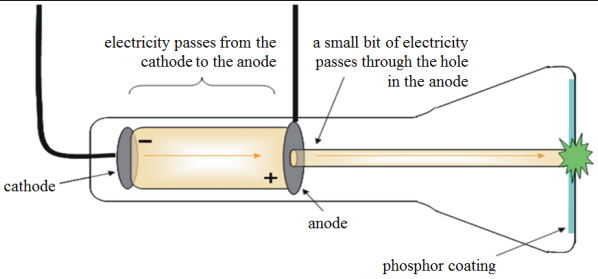
J.J. Thomson provided evidence that an atom...
a)
is the smallest particle of matter
b)
contains negatively charged particles
c)
has an overall negative charge
d)
has an overall positive charge
33.
Isotopes are elements with a different amount of
a)
protons
b)
neutrons
c)
electrons
d)
atoms
34.
Rutherford discovered the...
a)
electron
b)
proton
c)
neutron
d)
nucleus
35.
Which particle does not contribute mass to the atom?
a)
Proton
b)
Neutron
c)
Electron
d)
Nucleus
36.
An ______________ is the same element, with the same number of protons, but different numbers of neutrons
a)
Atom
b)
Isotope
c)
Atomic Number
d)
Mass Number
37.
What scientist first developed 4 rules for atomic theory, and helped kick start modern chemistry?
a)
J.J. Thomson
b)
Ernest Rutherford
c)
John Dalton
d)
Democritus
38.
In a correctly written symbol what would be located in the "A" position?
a)
number of neutrons
b)
atomic number
c)
number of electrons 
d)
mass number
39.
How many protons are in this element?
a)
79
b)
196
c)
117
d)
Cannot be determined
40.
Because atoms are neutral, the number of protons will be equal to the number of __________ in an atom.
a)
Positrons
b)
Neutrons
c)
Electrons
d)
Nuclei
41.
The three main subatomic particles are electrons, protons and ____________.
a)
photons
b)
neurons
c)
neutrons
d)
quarks
42.
What are the two main parts of the atom?
a)
nucleus and cytoplasm
b)
nucleus and electron cloud
c)
core and electron cloud
d)
protons and neutrons
43.

After Rutherford discovered the nucleus, which model is believed to be true?

a)

protons, neutrons, and electrons are evenly distributed

b)

the nucleus is made of protons, neutrons, and electrons

c)

the nucleus is made of protons and electrons

d)

the model is mostly empty space with a central nucleus

44.
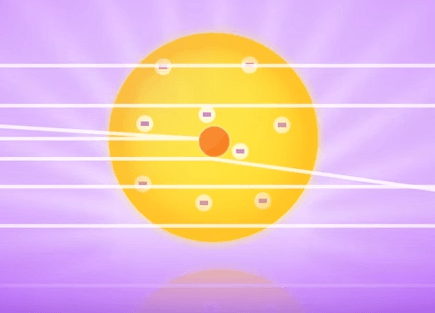
What scientist is best known for his "Plum Pudding" model of the atom?
a)
J.J. Thomson
b)
Ernest Rutherford
c)
John Dalton
d)
Democritus
45.
J.J. Thomson provided evidence that an atom...
a)
is the smallest particle of matter
b)
contains negatively and positively charged particles
c)
has an overall negative charge
d)
has an overall positive charge
46.
Rutherford's gold foil experiment provided evidence that...
a)
Negative and positive charges are spread evenly throughout the atom.
b)
Alpha particles have a positive charge.
c)
Gold is not a dense as previously thought.
d)
There is a dense positively charged nucleus at the center of an atom.
47.
Subatomic particles that are neutral in charge
a)
Neutrons
b)
Protons
c)
Nucleus 
d)
Electrons
48.
Subatomic particles with a positive charge
a)
neutrons
b)
atomic mass
c)
protons
d)
isotopes
49.

Subatomic particles with a negative charge

a)

Electrons

b)

Neutrons

c)

Protons

d)

Quarks

50.
What did Thomson discover?
a)
electron
b)
proton
c)
neutron
d)
electron cloud
51.

Potassium-39 has how many neutrons?

a)

19

b)

18

c)

20

d)

21

52.

Nickel-59 has how many neutrons?

a)

30

b)

31

c)

32

d)

33

53.

Bromine-80 has how many neutrons?

a)

41

b)

42

c)

44

d)

45

54.

76 protons and 114 neutrons

a)

Osmium-114

b)

Osmium-76

c)

Osmium-190

d)

Osmium-190.23

55.

12 protons and 13 neutrons

a)

Mg-12

b)

Mg-13

c)

Mg-25

d)

Mg-24.305

56.

Rubidium has two common isotopes, 85Rb and 87Rb. If the abundance of 85Rb is 72.2% and the abundance of 87Rb is 27.8%, what is the average atomic mass of rubidium?

a)

85.468 amu

b)

37 amu

c)

85.6 amu

d)

86.4 amu

57.

How do you calculate mass number?

a)

Mass x percent

b)

Protons + Electrons

c)

Protons + Neutrons

d)

Neutrons + Protons + Electrons

58.

How many protons are in the isotope pictured above?

a)

29

b)

34

c)

63

d)

92

59.

How many neutrons are in the isotope pictured above?

a)

29

b)

34

c)

63

d)

92

60.

What is the number of protons in phosphorus-31?

a)

15

b)

16

c)

31

d)

46

61.

An unknown element has two naturally occurring isotopes. One has a mass of 10.01 amu and % abundance of 19.8%. The other has a mass of 10.99 amu and % abundance of 80.2%. Calculate the atomic mass.

a)

1079.6

b)

107.95 amu

c)

21 amu

d)

10.8 amu

62.

Element X has 13 neutrons with a mass number of 28. Element Y has 13 protons. These elements are:

a)

Different elements

b)

Isotopes