
 Worksheets
Wayground U1 D4-D6 Practice Questions
Total questions: 60
Worksheet time: 3600secs

Looking at the picture, how would you classify the measurements?
Precise & accurate
Precise but not accurate
Accurate but not precise
Not accurate or precise

Looking at the picture, how would you classify the measurements?
Precise & accurate
Precise but not accurate
Accurate but not precise
Not accurate or precise
____________ is a measure of how close measurements come to each other when they are made in the same way.
Accuracy
Estimation
Displacement

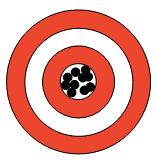
This bullseye demonstrates...
High Accuracy & High Precision
High Accuracy & Low Precision
Low Accuracy & High Precision
Low Accuracy & Low Precision

Describe the accuracy and precision of the image
Very accurate and somewhat precise
Very accurate but not precise at all
Not accurate at all but very precise
not accurate and not very precise
A set of data are all close to the actual value. This set of data can be described as _________________.
precise
accurate
estimated
displaced
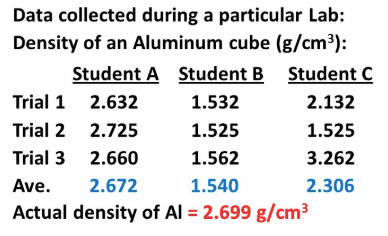
Which student is the most ACCURATE?
A
B
C

Which Student is the most Precise?
Student A
Student B
Student C
What is the definition of quantitative data?
Data that is collected through surveys and questionnaires.
Data that can be measured using qualitative methods.
Data that can only be expressed using words.
Numerical data that can be measured and expressed using numbers.
What is the definition of qualitative data?
Data that is collected through surveys and questionnaires.
Data that can be measured and expressed numerically.
Data that is collected through experiments and observations.
Non-numerical data that is descriptive in nature
Give an example of qualitative data.
Height of a building.
Weight of a person.
Color of a flower
Temperature of a room.
Is the number of students in a class an example of quantitative or qualitative data?
discrete
qualitative
quantitative
categorical

The temperature is 18 degrees Celsius today.
Is this a QUALITATIVE OR QUANTITATIVE observation?
qualitative observation
quantitative observation

It is hot and sunny today.
Is this a QUALITATIVE or QUANTITATIVE observation?
qualitative observation
quantitative observation

There are 16 birds in the tree.
Is this a QUALITATIVE or QUANTITATIVE observation?
qualitative observation
quantitative observation
The tree's leaves are yellow and orange.
Is this a QUALITATIVE or QUANTITATIVE observation?
qualitative observation
quantitative observation

Galapagos turtles weigh 500 pounds.
Is this a QUALITATIVE or QUANTITATIVE observation?
qualitative observation
quantitative observation
(3.4 x 10⁵)(1.2 x 10⁻³)
(6.9 x 10⁷) / (2.3 x 10⁻³)
(9.4 x 10⁶)(3.2 x 10⁵)
(2.1×102) × (3.0×104)
(6 x 10⁶) / (2 x 10³)
(9 x 10⁻⁶) / (3 x 10⁻³)
How many significant figures: 450 m
3
2
1
0
100000000
0.000008
Answer the question according to the sig figs in calculations rule:
200 x 3.58
(a)
Solve. Answer the question according to the sig figs in calculations rule.
0.00003 x 727
(a)
Solve. Answer the question according to the sig figs in calculations rule.
50.03 + 3.781
(a)
Solve. Answer the question according to the sig figs in calculations rule.
89 / 9.0
(a)
Solve. Answer the question according to the sig figs in calculations rule.
50.00 - 5.5
(a)
Solve. Answer the question according to the sig figs in calculations rule.
50. x 2.0
(a)
Solve. Answer the question according to the sig figs in calculations rule.
2.3 x 3.45 x 7.42
(a)
Solve. Answer the question according to the sig figs in calculations rule.
1.0007 + 0.009
(a)
Solve. Answer the question according to the sig figs in calculations rule.
51 - 7.6
(a)
Solve. Answer the question according to the sig figs in calculations rule.
208 / 9.0
(a)
Solve. Answer the question according to the sig figs in calculations rule.
54.0 - 29.54 - 8.70
(a)
Solve. Answer the question according to the sig figs in calculations rule.
150 + 5.99 + 129.90
(a)
Solve. Answer the question according to the sig figs in calculations rule.
315.00 x 0.066
(a)

