wayground logo

Free Printable Worksheets

Font size

S
M
L
XL
Worksheets

CIE - B6: Plant Nutrition (0654)

Total questions: 105

Worksheet time: 1hrs 12mins

Name
Class
Date
1.
What is the name of the process by which plants manufacture carbohydrates from raw materials using energy from light?
a)
photosynthesis
b)
respiration
c)
digestion
d)
synthesis
2.
Which raw materials do plants need to carry out photosynthesis?
a)
carbon dioxide and water
b)
oxygen and glucose
c)
nitrogen and sunlight
d)
methane and sunlight
3.
What is the energy source for photosynthesis?
a)
light energy
b)
heat energy
c)
chemical energy
d)
electrical energy
4.
Define photosynthesis
a)
the process by which plants manufacture carbohydrates from raw materials using energy from light.
b)
The breakdown of carbohydrates in plants
c)
The synthesis of proteins in plants
d)
The storage of carbohydrates in plants
5.
Which molecule required for photosynthesis is made of one carbon atom and two oxygen atoms joined together?
a)
carbon dioxide
b)
oxygen
c)
glucose
d)
water
6.
Which molecule required for photosynthesis is made of one oxygen atom and two hydrogen atoms joined together?
a)
water
b)
oxygen
c)
carbon dioxide
d)
glucose
7.
Which molecule produced in photosynthesis is made of six carbon atoms, 12 hydrogen atoms and 6 oxygen atoms?
a)
glucose
b)
carbon dioxide
c)
water
d)
oxygen
8.
Where in a plant cell does photosynthesis take place?
a)
chloroplast
b)
nucleus
c)
mitochondria
d)
vacuole
9.
What pigment is required for photosynthesis to take place?
a)
chlorophyll
b)
carotene
c)
melanin
d)
hemoglobin
10.
Describe the role of chlorophyll in photosynthesis.
a)
absorbs and transfers light energy into chemical energy
b)
chlorophyll inhibits photosynthesis
c)
chlorophyll reflects light energy
d)
chlorophyll stores chemical energy
11.
What is the word equation for photosynthesis?
a)
Carbon dioxide + water ---> glucose + oxygen (in the presence of chlorophyll and light energy)
b)
Glucose + oxygen ---> carbon dioxide + water
c)
Water + oxygen ---> glucose + carbon dioxide (in the presence of chlorophyll and light energy)
d)
Carbon dioxide + glucose ---> oxygen + water
12.
How many molecules of carbon dioxide do you need to make 1 molecule of glucose during photosynthesis?
a)
6.0
b)
1.0
c)
3.0
d)
12.0
13.
Describe photosynthesis in terms of the energy change that is occurring.
a)
Light energy is being converted to chemical (potential) energy
b)
Heat energy is being converted to light energy
c)
Chemical energy is being converted to kinetic energy
d)
Electrical energy is being converted to chemical energy
14.
What is meant by a limiting factor?
a)
the factor that is currently preventing a reaction from occurring at a faster rate
b)
the factor that has the least impact on a reaction
c)
the factor that is not important in a reaction
d)
the factor that is in excess in a reaction
15.
What are the two products of photosynthesis?
a)
glucose and oxygen
b)
carbon dioxide and water
c)
sucrose and starch
d)
nitrogen and methane
16.
How many molecules of oxygen are made for each molecule of glucose produced during photosynthesis?
a)
6.0
b)
12.0
c)
2.0
d)
1.0
17.
List 4 things that might happen to the glucose produced in photosynthesis.
a)
stored as starch, converted to cellulose for cell walls, used in respiration, converted to sucrose and transported to other parts of the plant.
b)
converted to oxygen, stored as fat, used in digestion, excreted from the plant
c)
used in photosynthesis, converted to glucose, transported to roots, stored as water
d)
converted to cellulose, used in respiration, stored as glucose, transported to leaves
18.
Which molecule transfers light energy into chemical energy during photosynthesis?
a)
chlorophyll
b)
carotene
c)
hemoglobin
d)
melanin
19.
Describe what might happen to the rate of photosynthesis as the light intensity is increased.
a)
it is likely to increase, then stay the same (as another factor will become limiting)
b)
it will continuously decrease
c)
it will remain constant
d)
it will become erratic
20.
Describe what is likely to happen to the rate of photosynthesis as the temperature is increased.
a)
it is likely to increase until the optimum temperature is reached then decrease as the enzymes involved denature.
b)
it will continuously increase
c)
it will remain constant
d)
it will decrease linearly
21.
Which mineral ion is required to make chlorophyll?
a)
magnesium
b)
calcium
c)
potassium
d)
sodium
22.
Describe the role of magnesium in plants.
a)
it is needed to make chlorophyll (which absorbs light for photosynthesis)
b)
it is required for the synthesis of proteins
c)
it is involved in cellular respiration
d)
it is important for water uptake in plants
23.
Why do plants deficient in magnesium have yellow leaves?
a)
without magnesium, they can't make enough chlorophyll (the green pigment in plants) so they look yellow.
b)
Without magnesium, they can't make enough cellulose, causing yellow leaves.
c)
Without magnesium, they can't produce enough oxygen during photosynthesis, resulting in yellow leaves.
d)
Without magnesium, plants develop a resistance to diseases, leading to yellow leaves.
24.
Which mineral ion do plants need in order to make amino acids and therefore proteins?
a)
nitrate ions
b)
Phosphate ions
c)
Potassium ions
d)
Sodium ions
25.
Describe the role of nitrate ions in plant nutrition.
a)
Nitrates are needed to convert carbohydrates from photosynthesis into amino acids that are used to make proteins.
b)
Nitrates provide energy for cellular respiration in plants.
c)
Nitrates act as structural support for plant cells.
d)
Nitrates aid in the synthesis of chlorophyll in plants.
26.
Explain why plants deficient in nitrates show stunted growth.
a)
Nitrates are needed to make proteins, proteins are needed for growth.
b)
Lack of nitrates inhibits water absorption, causing stunted growth.
c)
Nitrates prevent the synthesis of carbohydrates, leading to stunted growth.
d)
Nitrates enhance root development, causing stunted growth.
27.
What effect does magnesium ion deficiency have on plants?
a)
Yellow leaves
b)
Red leaves
c)
Wilting leaves
d)
Purple leaves
28.
What effect does nitrate ion deficiency have on plants?
a)
Stunted growth
b)
Rapid growth
c)
Increased resistance to pests
d)
Enhanced flowering
29.
Why does testing a leaf for starch tell us if it has been photosynthesising?
a)
excess glucose made in photosynthesis is stored as starch.
b)
Starch is a byproduct of cellular respiration.
c)
Starch is converted into glucose during photosynthesis.
d)
Starch inhibits the process of photosynthesis.
30.
What solution would you need to test for starch?
a)
iodine solution
b)
Benedict's solution
c)
Biuret solution
d)
Ethanol solution
31.
A leaf is tested for starch and an orange colour is formed. What does this tell us about the leaf?
a)
there is no starch in the leaf - it has not been able to photosynthesise recently.
b)
The leaf has a high concentration of starch.
c)
The orange color indicates a healthy photosynthesizing leaf.
d)
The leaf is undergoing rapid photosynthesis.
32.
A leaf is tested for starch and a black colour is formed. What does this tell us about the leaf?
a)
There is starch in the leaf, the leaf has been photosynthesising recently
b)
The leaf lacks starch and is not photosynthesizing.
c)
The black color indicates the presence of excess oxygen.
d)
The leaf is undergoing cellular respiration.
33.
A well-watered plant has been kept in a light place with lots of fresh air. You test the leaves for starch. What colour would you expect to see?
a)
A blue-black colour showing starch is present in the leaves.
b)
A green colour indicating the absence of starch.
c)
A red colour indicating excessive water intake.
d)
A yellow colour suggesting poor air circulation.
34.
A plant was kept in conditions with light, but no carbon dioxide. When its leaves are tested for starch, what would you expect to see?
a)
An orange/brown colour showing that no photosynthesis has taken place.
b)
A blue-black colour indicating efficient photosynthesis.
c)
A yellow colour indicating the presence of carbon dioxide.
d)
A green colour suggesting the lack of light.
35.
A plant was kept in dark conditions with access to carbon dioxide. When its leaves are tested for starch, what would you expect to see?
a)
An orange/brown colour showing that no photosynthesis has taken place.
b)
A blue-black colour indicating efficient photosynthesis.
c)
A yellow colour indicating the presence of light.
d)
A green colour suggesting the absence of carbon dioxide.
36.
It is a cold, sunny, winter's day. What factor is most likely to be limiting the rate of photosynthesis?
a)
Temperature
b)
Light intensity
c)
Carbon dioxide concentration
d)
Humidity
37.
It is a warm sunny day. What factor is most likely to be limiting the rate of photosynthesis?
a)
Carbon dioxide concentration
b)
Temperature
c)
Light intensity
d)
Wind speed
38.
It is a very cloudy day. What factor is most likely to be limiting the rate of photosynthesis?
a)
Light intensity
b)
Carbon dioxide concentration
c)
Temperature
d)
Rainfall
39.
What is meant by a variegated leaf?
a)
Some parts are green/have chlorophyll and some parts are white/do not have chlorophyll
b)
A leaf with a variety of shapes
c)
A leaf with alternating layers of different colors
d)
A leaf with a consistent green color throughout
40.
From top to bottom, name the 4 main tissue layers found in a leaf.
a)
Upper epidermis, palisade mesophyll, spongy mesophyll, lower epidermis
b)
Upper epidermis, vascular tissue, mesophyll, lower epidermis
c)
Upper layer, photosynthetic layer, respiratory layer, lower layer
d)
Upper layer, waxy layer, chlorophyll layer, lower layer
41.
In which layer of a leaf would you find the most stomata?
a)
Lower epidermis
b)
Upper epidermis
c)
Palisade mesophyll
d)
Spongy mesophyll
42.
Outline the role of stomata in a leaf.
a)
Allow gases to enter and leave the air spaces in the spongy mesophyll
b)
Stomata regulate water absorption in the root system.
c)
Stomata enhance chlorophyll synthesis.
d)
Stomata protect the leaf from pathogens.
43.
What is the name of the layer secreted by the upper epidermis that helps reduce water loss from the surface of the leaf?
a)
Waxy cuticle
b)
Vascular bundle
c)
Stomatal layer
d)
Mesophyll layer
44.
What is the role of the waxy cuticle?
a)
To prevent water loss from the surface of the leaf
b)
To enhance water absorption
c)
To provide structural support to the leaf
d)
To promote chlorophyll synthesis
45.
What two tissues would you find in the vascular bundles?
a)
Xylem and phloem
b)
Stomata and guard cells
c)
Mesophyll and epidermis
d)
Vascular and non-vascular
46.
Within which two layers would you find vascular bundles?
a)
palisade mesophyll and spongy mesophyll
b)
Upper epidermis and lower epidermis
c)
Waxy cuticle and stomata
d)
Vascular bundle and mesophyll
47.
What are the two roles of xylem in plants?
a)
1) Transport water and minerals, 2) Structural support
b)
1) Synthesize proteins, 2) Provide energy
c)
1) Transport nutrients, 2) Produce oxygen
d)
1) Support leaves, 2) Regulate water content
48.
What is the role of phloem in plants?
a)
Transport (translocation) of nutrients such as sucrose and amino acids.
b)
Synthesis of chlorophyll
c)
Storage of water and minerals
d)
Facilitation of gas exchange
49.
Describe two ways that the palisade mesophyll cells are adapted for photosynthesis.
a)
Tightly packed together and contain lots of chloroplasts.
b)
Loosely arranged with few chloroplasts
c)
Lack of chloroplasts for efficient gas exchange
d)
Stacked on top of each other to maximize sunlight absorption
50.
What is the name of the small pores that allow gases to enter and leave the air spaces?
a)
Stomata (plural) or stoma (singular)
b)
Pores
c)
Mesophyll openings
d)
Ventricles
51.
Describe 2 features of leaves that allow efficient gas exchange.
a)
1) Presence of stomata and 2) Air spaces and large surface areas of spongy mesophyll.
b)
1) Dense arrangement of cells and 2) Lack of stomata
c)
1) Thick cuticle and 2) Absence of air spaces
d)
1) Lack of chloroplasts and 2) Small surface area
52.
In which of the cell types found in the leaf would you not expect to find chloroplasts?
a)
It would be unusual to find chloroplasts in the xylem, phloem or the upper or lower epidermal cells
b)
Xylem
c)
Phloem
d)
Guard cells
53.
In the cells of which of the tissues found in the leaf would you usually expect to find chloroplasts?
a)
I would expect to find chloroplasts in the palisade cells, spongy mesophyll cells and the guard cells.
b)
Vascular bundles
c)
Epidermis
d)
Stomata
54.
In which tissue of the leaf does the most gas exchange take place?
a)
Spongy mesophyll
b)
Palisade mesophyll
c)
Upper epidermis
d)
Lower epidermis
55.
In which tissue of the leaf are the cells tightly packed to aid photosynthesis?
a)
Palisade mesophyll
b)
Spongy mesophyll
c)
Upper epidermis
d)
Lower epidermis
56.
Which tissue of the leaf contains guard cells and stomata?
a)
Lower epidermis
b)
Upper epidermis
c)
Palisade mesophyll
d)
Spongy mesophyll
57.
Which tissue of the leaf is covered by a waxy cuticle?
a)
Upper epidermis
b)
Lower epidermis
c)
Palisade mesophyll
d)
Spongy mesophyll
58.
Which cells can close the stomata to prevent water loss?
a)
Guard cells
b)
Palisade cells
c)
Xylem cells
d)
Phloem cells
59.
a)

A

b)

B

c)

C

d)

D

60.
a)

A

b)

B

c)

C

d)

D

61.
a)

A

b)

B

c)

C

d)

D

62.
a)

A

b)

B

c)

C

d)

D

63.
a)

A

b)

B

c)

C

d)

D

64.
a)

A

b)

B

c)

C

d)

D

65.
a)

A

b)

B

c)

C

d)

D

66.
a)

A

b)

B

c)

C

d)

D

67.
a)

A

b)

B

c)

C

d)

D

68.
a)

A

b)

B

c)

C

d)

D

69.
a)

A

b)

B

c)

C

d)

D

70.
a)

A

b)

B

c)

C

d)

D

71.
a)

A

b)

B

c)

C

d)

D

72.
a)

A

b)

B

c)

C

d)

D

73.
a)

A

b)

B

c)

C

d)

D

74.
a)

A

b)

B

c)

C

d)

D

75.
a)

A

b)

B

c)

C

d)

D

76.
a)

A

b)

B

c)

C

d)

D

77.
a)

A

b)

B

c)

C

d)

D

78.
a)

A

b)

B

c)

C

d)

D

79.
a)

A

b)

B

c)

C

d)

D

80.
a)

A

b)

B

c)

C

d)

D

81.
a)

A

b)

B

c)

C

d)

D

82.
a)

A

b)

B

c)

C

d)

D

83.
a)

A

b)

B

c)

C

d)

D

84.
a)

A

b)

B

c)

C

d)

D

85.
a)

A

b)

B

c)

C

d)

D

86.
a)

A

b)

B

c)

C

d)

D

87.

*N.B. Mistake in Q: Option 4 & 5 should end O2( the 2 in small subscript!)

a)

A

b)

B

c)

C

d)

D

88.
a)

A

b)

B

c)

C

d)

D

89.

So from top to bottom, a leaf's structure is

a)
  1. Palisade cells
  2. Waxy cuticle and epidermis cells
  3. Spongy mesophyll
  4. Epidermis and cuticle, with stomata
b)
  1. Waxy cuticle and epidermis cells
  2. Palisade cells
  3. Spongy mesophyll
  4. Epidermis and cuticle, with stomata
c)
  1. Epidermis and cuticle, with stomata
  2. Waxy cuticle and epidermis cells
  3. Palisade cells
  4. Spongy mesophyll
d)
  1. Waxy cuticle and epidermis cells
  2. Spongy mesophyll
  3. Palisade cells
  4. Epidermis and cuticle, with stomata
90.
The leaf has a shiny, waxy cuticle around it to
a)
increase the rate of photosynthesis
b)
attract more light
c)
control water loss
d)
stop carbon dioxide and oxygen gases escaping
91.
Most of the chloroplast cells are found in the
a)
upper epidermis
b)
pallisade mesophyll layer
c)
lower epidermis
d)
stomata
92.
The water needed for photosynthesis comes into the leaves through the
a)
upper epidermis
b)
stomata
c)
guard cells
d)
xylem cells
93.
The important gases, carbon dioxide and oxygen, enter and leave the leaf through the
a)
upper epidermis
b)
phloem
c)
stomata
d)
guard cells
94.
The role of the guard cell is to
a)
help control the temperature of the plant
b)
control how much water enters the leaf
c)
control how much glucose is stored
d)
control the movement of water vapour & gases 
95.
Which structure helps prevent water loss and protects the leaf?
a)
Palisades mesophyll
b)
Spongy mesophyll
c)
Vascular tissue
d)
Cuticle
96.

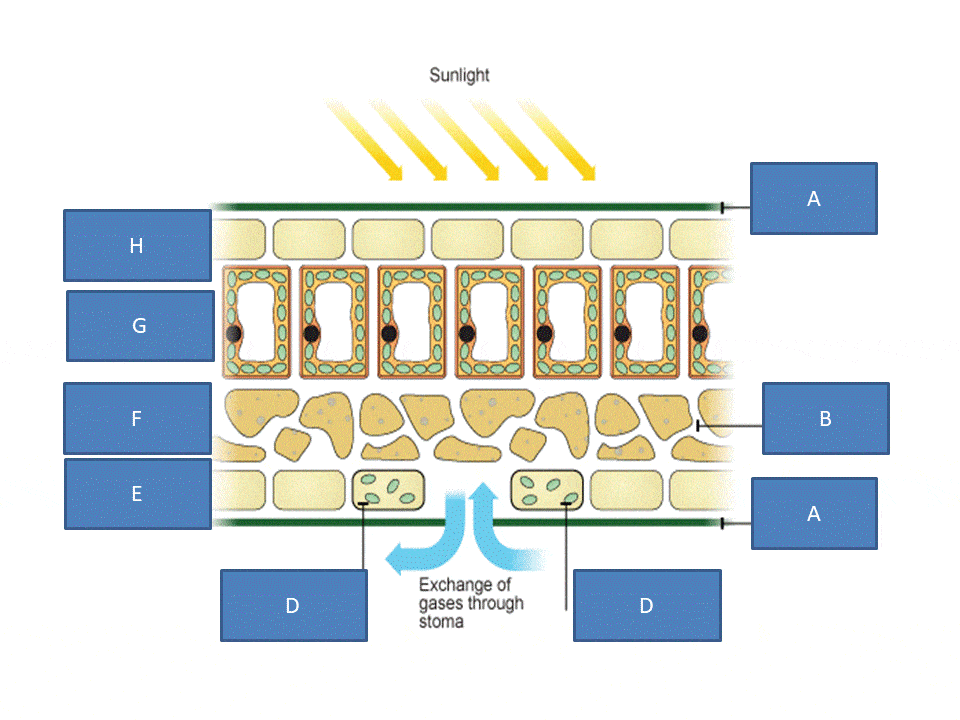
What is the name of the elongated, packed cells (part G) directly under the upper epidermis?

a)

Palisade cells

b)

Guard cell

c)

Spongy layer

d)

Lower epidermis

97.

What is letter "A" pointing to?

a)

cuticle

b)

upper epidermis

c)

lower epidermis

d)

palisade mesophyll

98.

Which number is pointing to the stomata?

a)

6

b)

7

c)

8

d)

9

99.

Identify structure 1 in the diagram.

a)

Spongy mesophyll

b)

Vascular bundle

c)

Waxy cuticle

d)

Palisade mesophyll

100.

Identify structure 2 in the diagram.

a)

Stomata

b)

Upper epidermis

c)

Vascular bundle

d)

Xylem

101.

Identify structure 3 in the diagram

a)

Waxy cuticle

b)

Palisade mesophyll

c)

Upper epidermis

d)

Guard cell

102.

Identify structure 4 in the diagram.

a)

Spongy mesophyll

b)

Guard cell

c)

Phloem

d)

Palisade mesophyll

103.

Identify structure 5 in the diagram.

a)

Vascular bundle

b)

Phloem

c)

Palisade mesophyll

d)

Lower epidermis

104.

Identify structure 7 in the diagram.

a)

Guard cell

b)

Phloem

c)

Stomata

d)

Upper epidermis

105.

Identify structure 10 in the diagram.

a)

Lower epidermis

b)

Vascular bundle

c)

Stomata

d)

Palisade mesophyll