
 Worksheets
Chapter 3. Biological Macromolecules 31 - 53
Total questions: 98
Worksheet time: 49mins
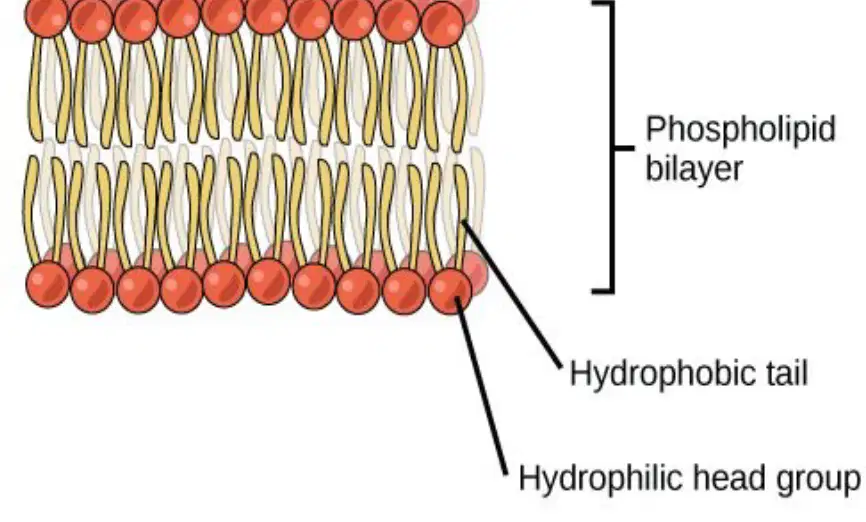
What do the hydrophilic head groups of the phospholipids face in the plasma membrane?
The middle of the bilayer
The aqueous solution
The cytoskeleton
The nucleus
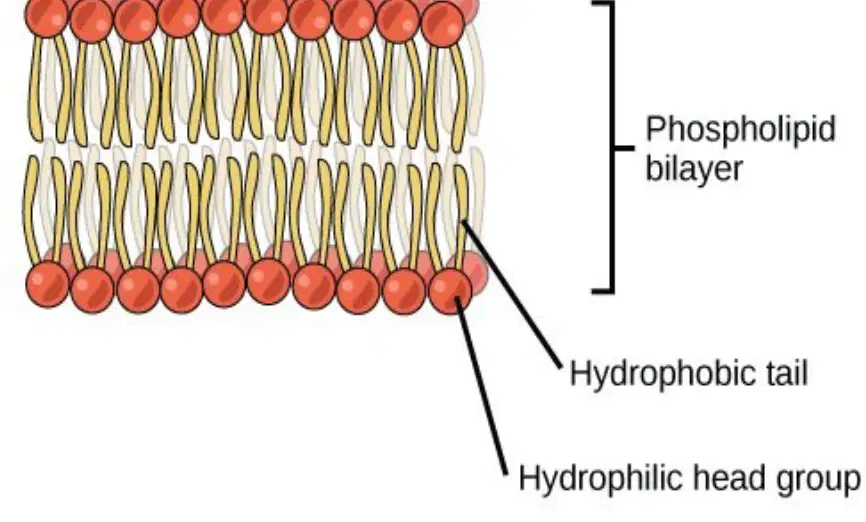
Fill in the blank: The hydrophobic tails of phospholipids are sequestered in the _______ of the bilayer.
middle
outer surface
cytoplasm
extracellular matrix
Phospholipids contribute to the dynamic nature of the plasma membrane.
True
False
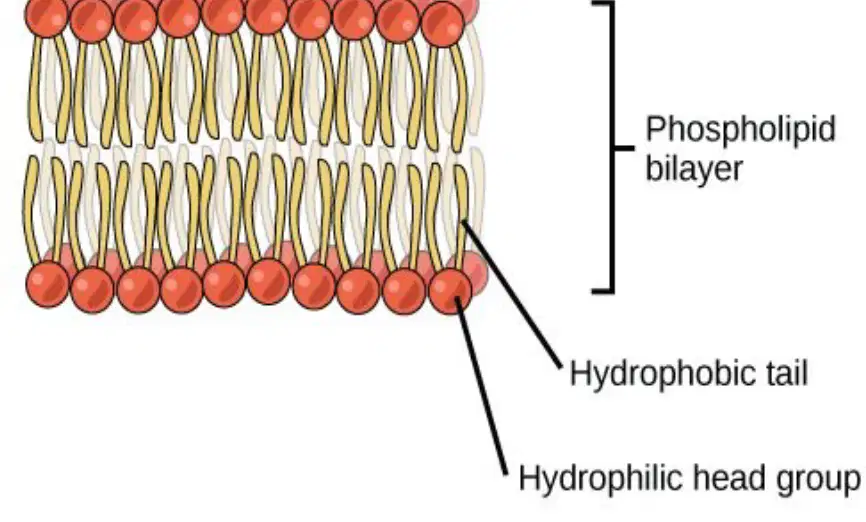
Which of the following correctly labels the parts of the phospholipid bilayer: hydrophilic head group, hydrophobic tail, phospholipid bilayer?
Hydrophilic head group is the outer part, hydrophobic tail is the inner part, and the structure is called the phospholipid bilayer.
Hydrophobic tail is the outer part, hydrophilic head group is the inner part, and the structure is called the phospholipid bilayer.
Hydrophilic head group and hydrophobic tail are both on the outer part of the bilayer.
Phospholipid bilayer is made only of hydrophilic head groups.
What type of molecule is a phospholipid?
Amphipathic molecule
Hydrophobic molecule
Hydrophilic molecule
Nonpolar molecule
Which of the following is the most abundant organic molecule?
Carbohydrates
Proteins
Lipids
Nucleic acids
Proteins have a diverse range of functions. Which of the following is NOT a function of proteins?
Transporting
Signaling
Photosynthesis
Defending
Fill in the blank: Proteins help in ________ functions, signaling functions, receiving, catalyzing, defending, and movement.
transporting
digesting
storing
absorbing
Match the type of protein with its example:
Digestive enzymes
Hemoglobin
Transport
Actin, tubulin, keratin
Structural
Amylase, lipase, pepsin, trypsin
Hormones
Insulin, thyroxine
Which type of protein helps in digestion of food by catabolizing nutrients into monomeric units?
Structural
Digestive enzymes
Hormones
Storage
What is the function of transport proteins such as hemoglobin?
Carry substances in the blood or lymph throughout the body
Produce hormones for the endocrine system
Break down nutrients during digestion
Transmit nerve impulses between neurons
Which of the following is an example of a structural protein?
Insulin
Actin
Immunoglobulins
Albumin
Fill in the blank: Immunoglobulins are proteins that ________ the body from foreign pathogens.
protect
harm
ignore
weaken
Which type of protein coordinates the activity of different body systems?
Hormones
Enzymes
Antibodies
Structural proteins
What is the function of contractile proteins such as actin and myosin?
Effect muscle contraction
Aid in digestion of food
Transmit nerve impulses
Store genetic information
Storage proteins provide nourishment in early development of the ________ and the seedling.
embryo
root
leaf
flower
What are the monomers that make up proteins?
Nucleotides
Amino acids
Fatty acids
Monosaccharides
How many common amino acids are commonly found in proteins?
10
15
20
25
Each amino acid has a different ______ group (variant group).
R
Amino
Carboxyl
Hydroxyl
What determines the chemical nature of each amino acid?
The amino group
The carboxyl group
The R-group
The hydrogen atom
What is the central atom in the fundamental structure of an amino acid called?
Alpha carbon
Beta carbon
Gamma carbon
Delta carbon
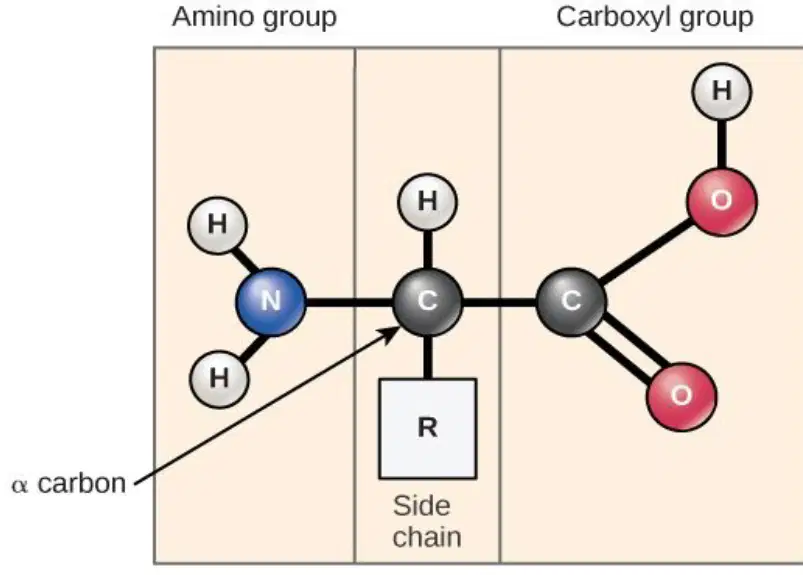
Label the groups attached to the central carbon in the amino acid structure shown in the diagram.
Amino group, Carboxyl group, Hydrogen atom, R group (side chain)
Amino group, Phosphate group, Hydrogen atom, R group (side chain)
Carboxyl group, Methyl group, Hydrogen atom, R group (side chain)
Amino group, Carboxyl group, Oxygen atom, R group (side chain)
What is the single letter or three-letter abbreviation for Valine?
V or Val
D or Asp
L or Leu
I or Ile
What is the single letter or three-letter abbreviation for Aspartic Acid?
V or Val
D or Asp
L or Leu
I or Ile
Which of the following is an essential amino acid that must be supplied in the diet for humans?
Glycine
Isoleucine
Glutamate
Proline
Which of the following is NOT listed as an essential amino acid in the image?
A) Isoleucine
B) Leucine
C) Cysteine
D) Glycine
Fill in the blank: The sequence and number of amino acids determine protein ______, size, and function.
shape
color
temperature
density
Match the following amino acids to their correct abbreviations:
V or Val
A
D or Asp
B
L or Leu
C
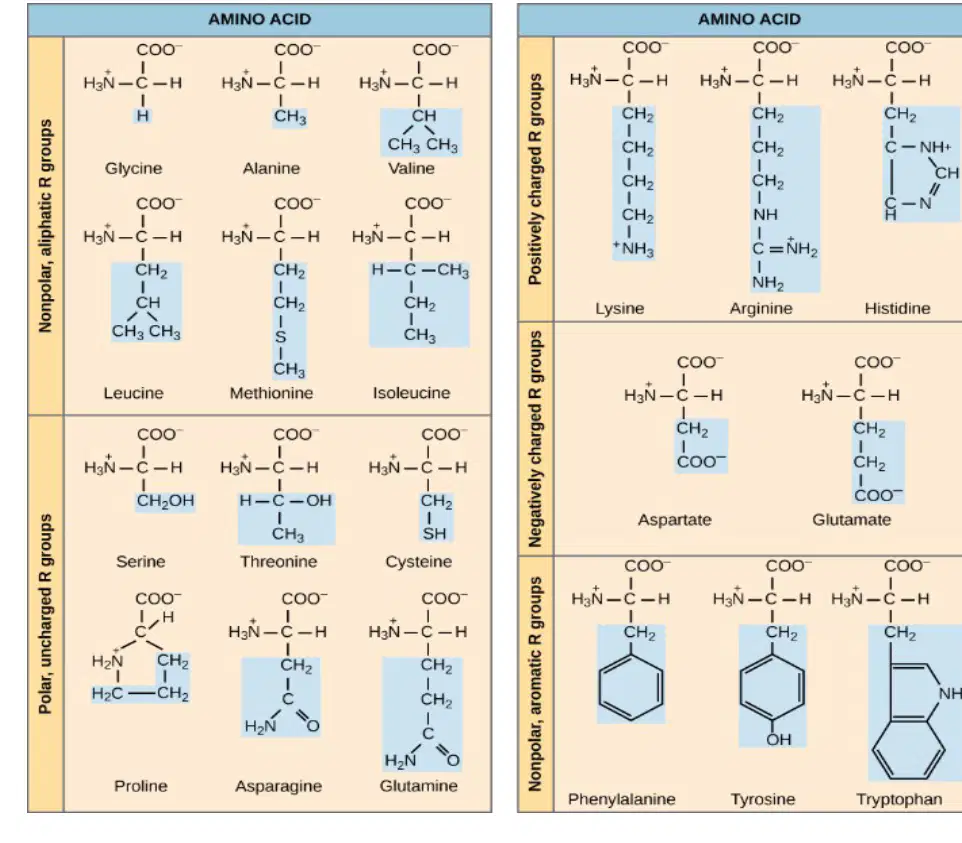
According to the diagram, which amino acid has a sulfur atom in its side chain?
Methionine
Serine
Glutamine
Alanine
There are 20 common amino acids commonly found in proteins, each with a different R group that determines its chemical nature.
True
False
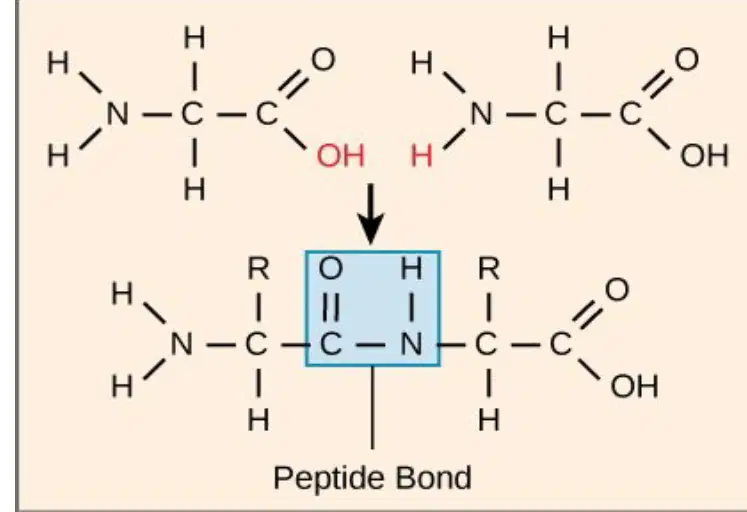
Amino acid monomers are linked via which type of bond formation?
Hydrogen bond
Peptide bond
Ionic bond
Disulfide bond

Fill in the blank: The carboxyl group of one amino acid is linked to the ______ group of the incoming amino acid during peptide bond formation.
amino
hydroxyl
methyl
phosphate
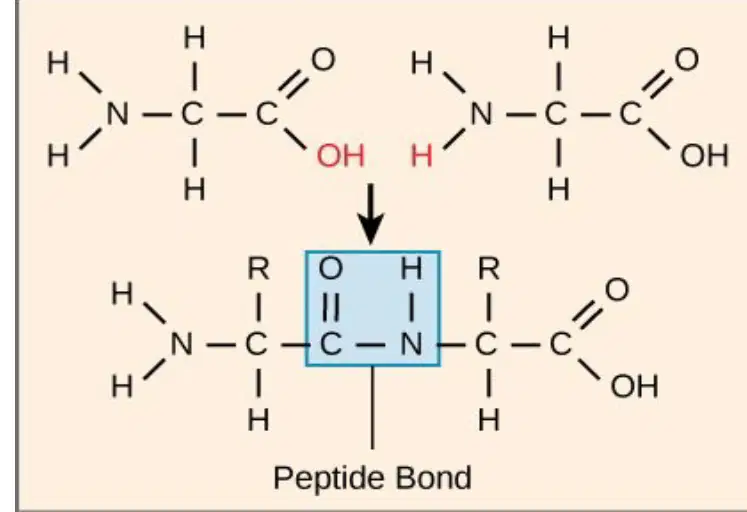
A molecule of water is released as part of the peptide bond formation reaction.
True
False
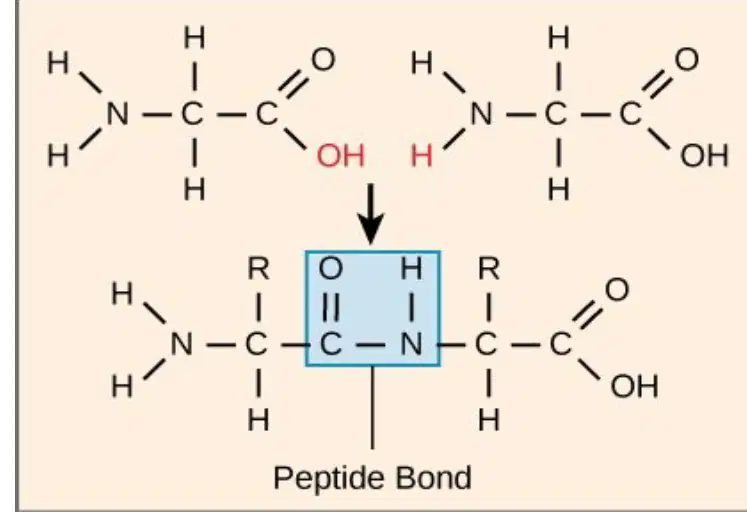
Peptide bond formation is also known as a (a) synthesis reaction.
Hydrolysis
Dehydration
Oxidation
Reduction
Fill in the blank: A polypeptide is a chain of ________ joined together in peptide linkages.
amino acids
fatty acids
nucleotides
monosaccharides
Fill in the blank: A protein is a ________ or multiple ________.
polypeptide, polypeptides
monosaccharide, monosaccharides
lipid, lipids
nucleotide, nucleotides
Which of the following is often combined with non-peptide prosthetic groups?
Polypeptide
Protein
Carbohydrate
Lipid
Proteins have a unique structure and function.
True
False
Fill in the blank: Many proteins are modified following ________ (process of creating a new protein).
translation
replication
transcription
degradation

What is the primary structure of a protein?
The sequence of a chain of amino acids
The folding of the protein into alpha helices and pleated sheets
The overall three-dimensional shape of the protein
A protein consisting of more than one amino acid chain
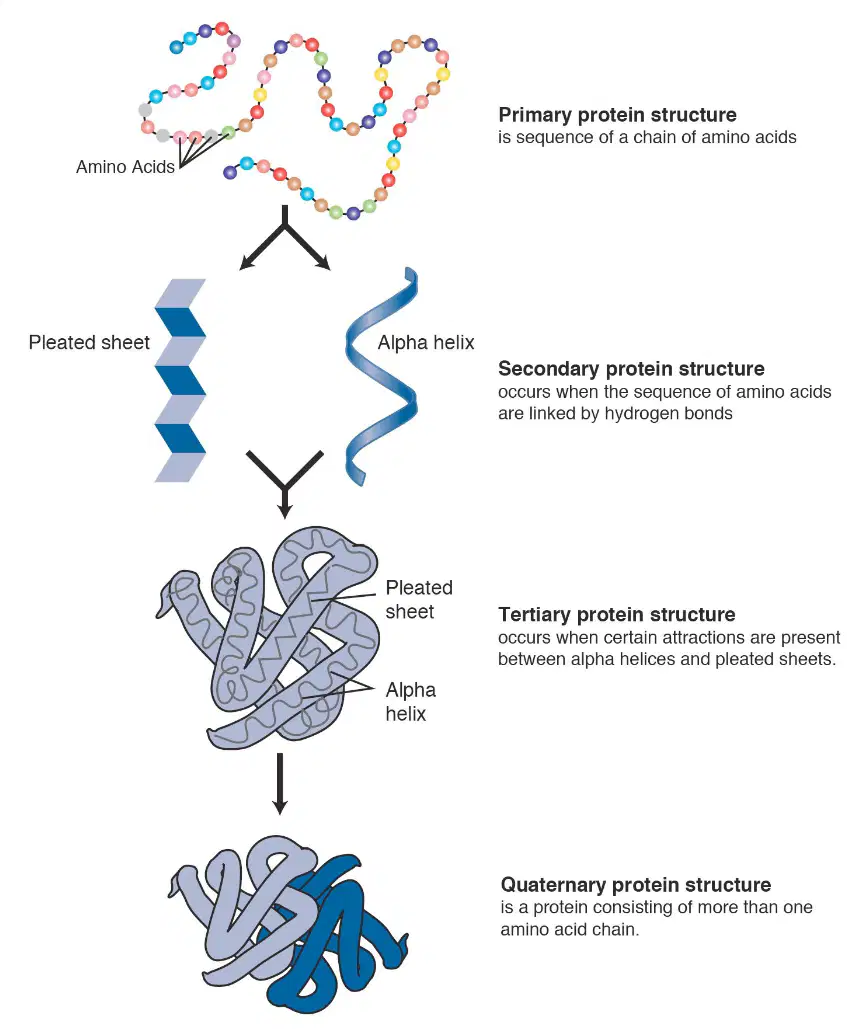
What occurs during the secondary structure of a protein?
The sequence of a chain of amino acids
The sequence of amino acids are linked by hydrogen bonds
The protein consists of more than one amino acid chain
The protein is broken down into amino acids

Tertiary protein structure occurs when certain attractions are present between which of the following?
A) Amino acids and water
B) Alpha helices and pleated sheets
C) DNA and RNA
D) Sugars and phosphates
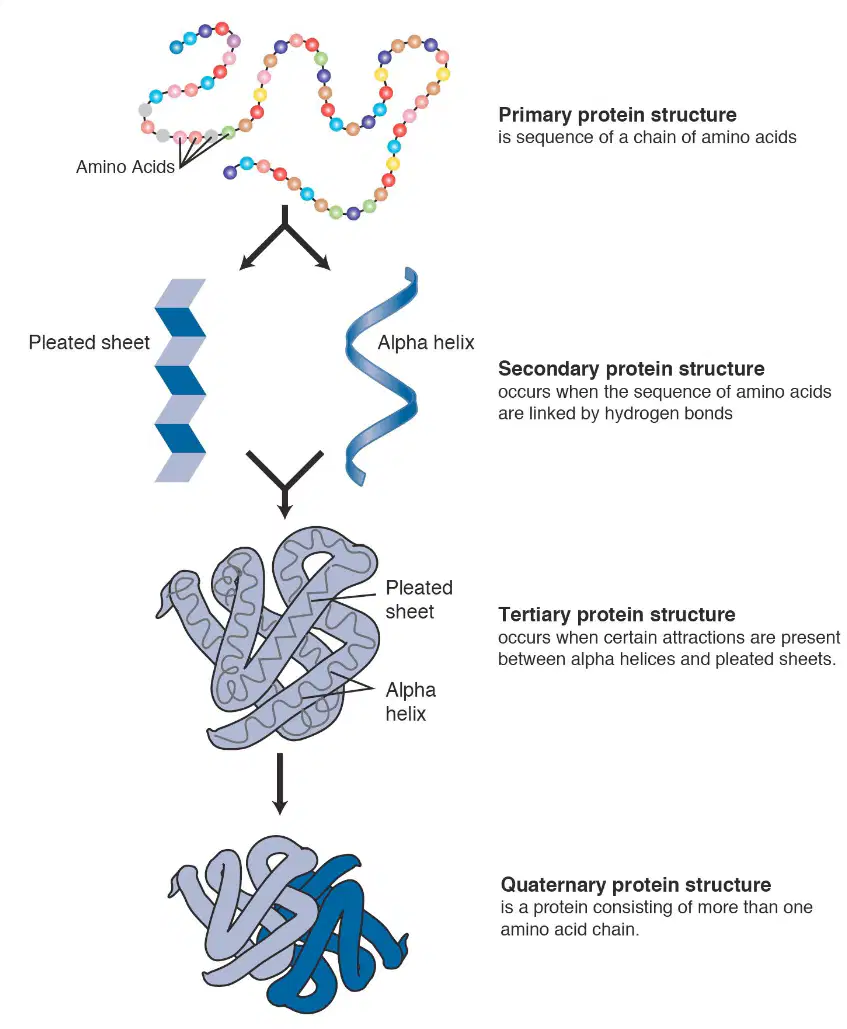
Quaternary protein structure is a protein consisting of more than one _________?
amino acid chain
peptide bond
nucleotide
sugar molecule
What is the primary structure of a protein?
The folding of the polypeptide chain
The unique sequence of amino acids in a polypeptide
The interaction between multiple polypeptide chains
The 3D shape of the protein
The sequence of amino acids in the A and B chain polypeptides of bovine serum insulin is ______ to this protein.
unique
similar
identical
variable
Protein function could be compromised if alterations in the order of amino acids were to be made.
True
False
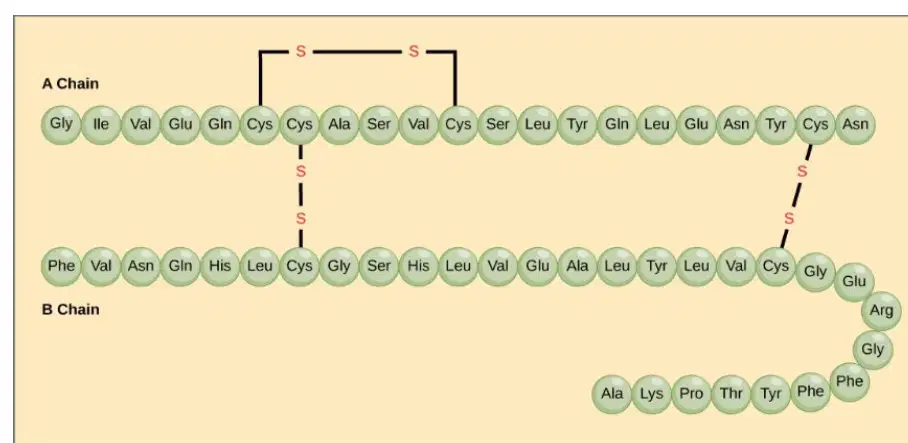
How many amino acids are present in the A chain and B chain, respectively?
A chain: 21 amino acids, B chain: 30 amino acids
A chain: 30 amino acids, B chain: 21 amino acids
A chain: 20 amino acids, B chain: 31 amino acids
A chain: 22 amino acids, B chain: 29 amino acids
According to the information provided, what is the amino acid at position seven in normal hemoglobin?
Valine
Glutamic acid
Leucine
Threonine
In sickle cell hemoglobin, which amino acid replaces glutamic acid?
Valine
Histidine
Proline
Glutamine
Sickle cells are ______ shaped, while normal cells are disc-shaped.
crescent
square
oval
triangle
Proteins in normal hemoglobin do not associate with one another; each carries oxygen.
True
False
What is the effect of the amino acid substitution in sickle cell hemoglobin on the function of the protein?
Proteins aggregate into a fiber; capacity to carry oxygen is reduced.
The protein becomes more soluble in water.
The protein gains the ability to break down glucose.
The protein is able to bind to carbon dioxide more efficiently.
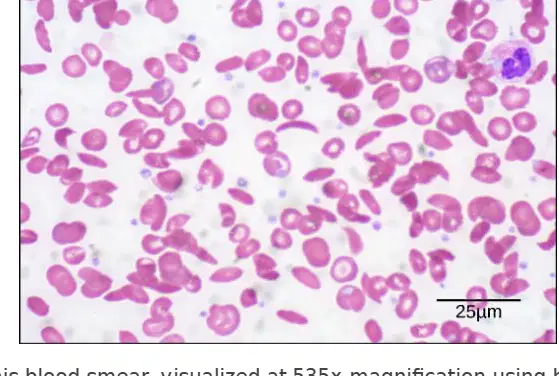
What is the main difference in shape between sickle cells and normal cells as seen under the microscope?
Sickle cells are crescent shaped, while normal cells are disc-shaped.
Sickle cells are star shaped, while normal cells are oval-shaped.
Sickle cells are square shaped, while normal cells are round-shaped.
Sickle cells are triangular shaped, while normal cells are rectangular-shaped.
What is secondary structure in proteins? Secondary structure is the local folding of the ________.
polypeptide
nucleotide
lipid chain
sugar backbone
How is an α-helix formed in a protein's secondary structure?
By hydrogen bond between oxygen in carbonyl group and an amino acid 4 positions down the chain
By disulfide bonds between cysteine residues
By ionic bonds between side chains
By peptide bonds between amino acids
What type of bonding is responsible for the formation of a β-pleated sheet in the secondary structure of proteins?
Hydrogen bonding between atoms on the backbone of the polypeptide chain
Ionic bonding between side chains
Disulfide bridges between cysteine residues
Peptide bonds between amino acids
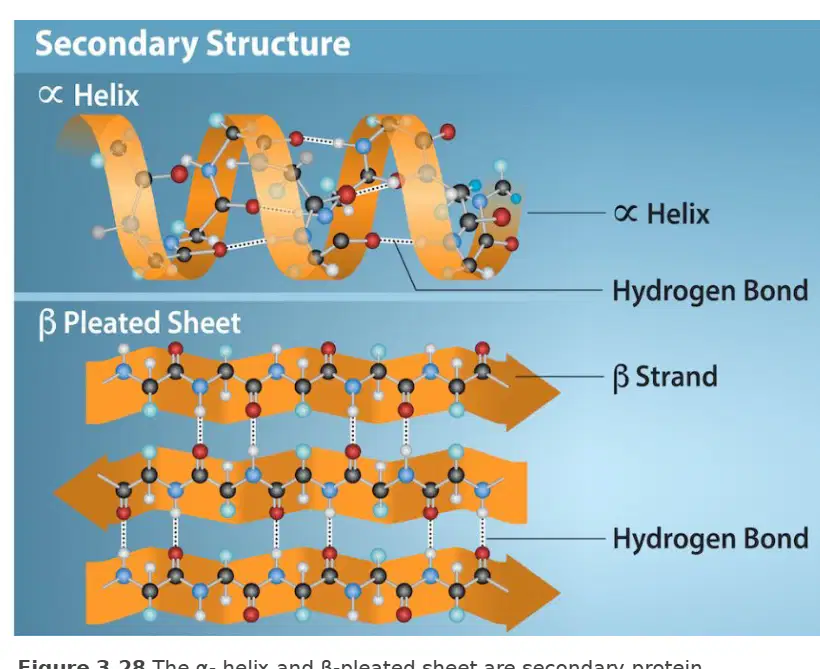
Which structure is stabilized by hydrogen bonds between the carbonyl oxygen and the amino hydrogen in the peptide backbone?
α Helix
β Pleated Sheet
Both A and B
Neither A nor B
What is the tertiary structure of a protein?
The sequence of amino acids in a polypeptide
The unique three-dimensional structure of a polypeptide
The arrangement of multiple polypeptide chains
The linear structure of a protein
Tertiary structure is due to chemical interactions between ______ on amino acids.
R-groups
peptide bonds
phosphate groups
hydrogen atoms
Which of the following is an example of a chemical interaction in tertiary protein structure?
R-groups with like charges are attracted to one another
R-groups with like charges are repelled from one another
R-groups that are hydrophilic will cluster in the interior of protein
Cysteine side chains form hydrogen bonds
In the tertiary structure of proteins, cysteine side chains form ______ bridges.
disulfide
hydrogen
peptide
ionic
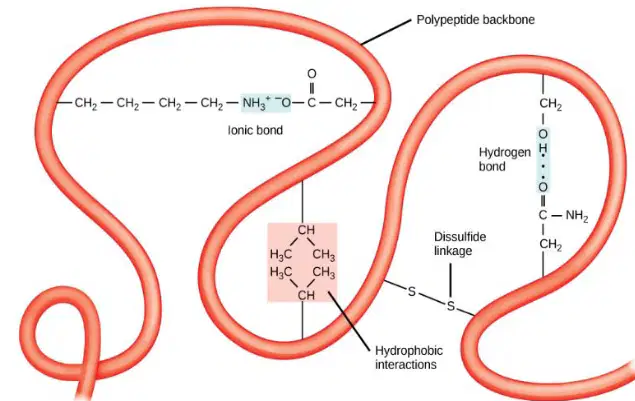
Which type of bond is shown forming between two cysteine side chains in the tertiary structure of a protein?
Ionic bond
Hydrogen bond
Disulfide linkage
Hydrophobic interaction
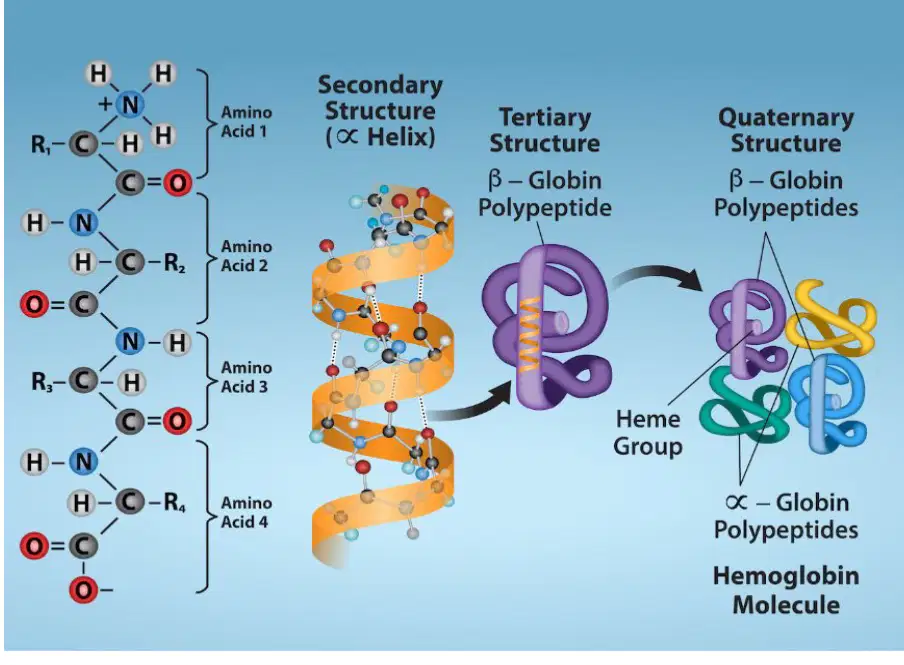
What is quaternary structure in proteins?
The sequence of amino acids in a polypeptide chain
The folding of a single polypeptide chain into a helix or sheet
The interactions between several polypeptides that make up a protein
The formation of peptide bonds between amino acids
Fill in the blank: Weak interactions between ______ help stabilize the quaternary structure of proteins.
subunits
amino acids
nucleotides
peptide bonds
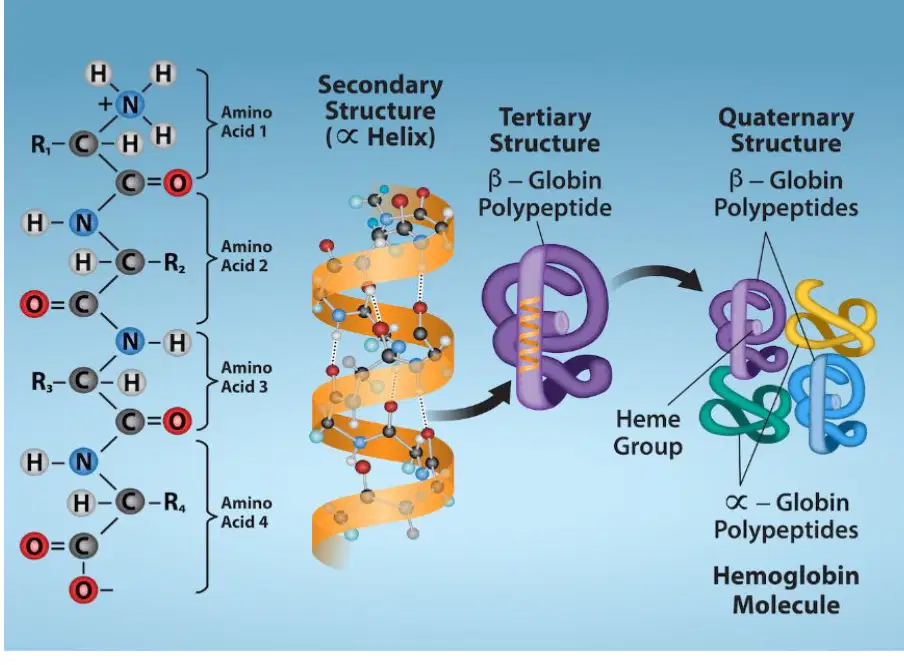
Match the following levels of protein structure with their descriptions:
Interactions between several polypeptides
B
Sequence of amino acids
C
Folding of a single polypeptide chain
D
3D shape of a single polypeptide
A
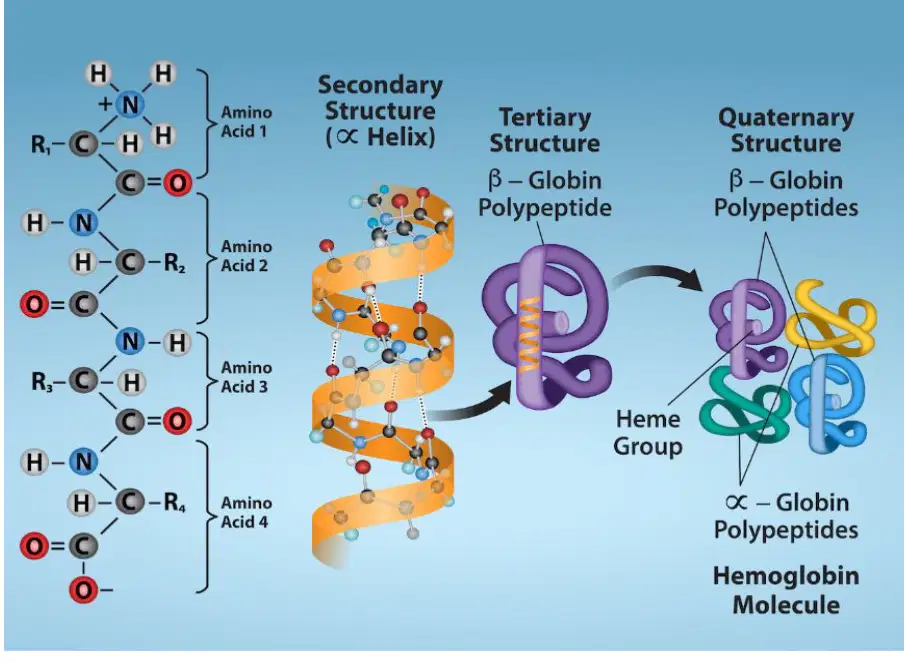
Which molecule is formed by the quaternary structure of β-globin and α-globin polypeptides?
Myoglobin
Hemoglobin
Insulin
Collagen
What can cause protein structure and shape to change?
Chemical interactions are formed
Chemical interactions are broken
No change in interactions
None of the above
Protein structure/shape can change with altering primary structure due to:
Changes in pH
Changes in temperature
Both A and B
None of the above
Fill in the blank: Denaturation is the change in protein structure that leads to changes in ________.
function
color
mass
temperature
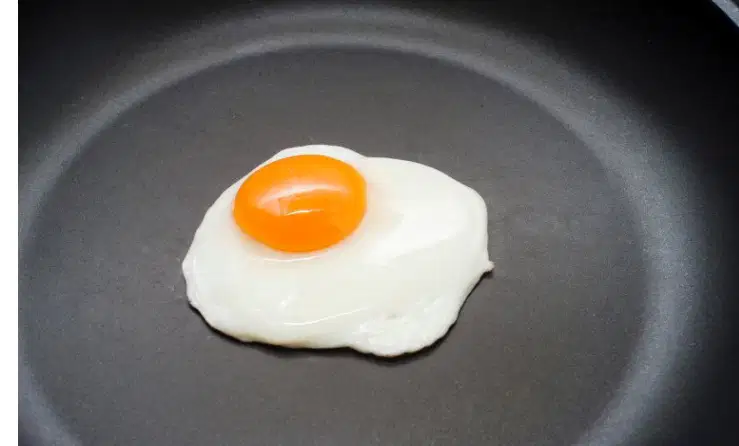
What happens to the albumin in the egg during this process?
The albumin in the egg goes from liquid to solid.
The albumin in the egg evaporates completely.
The albumin in the egg turns into gas.
The albumin in the egg changes color to blue.
What do nucleic acids constitute in living organisms?
The cell wall
The genetic material
The cytoplasm
The cell membrane
Name the two main types of nucleic acids.
Deoxyribonucleic acid (DNA) and ribonucleic acid (RNA)
Adenosine triphosphate (ATP) and guanosine triphosphate (GTP)
Polysaccharides and monosaccharides
Fatty acids and glycerol
Which of the following is NOT a type of nucleic acid?
Deoxyribonucleic acid (DNA)
Ribonucleic acid (RNA)
Amino acid
Both A and B
Where can nucleic acids be found in eukaryotic cells?
Nucleus, mitochondria, and chloroplasts
Cell membrane only
Golgi apparatus and lysosomes
Cytoplasm only
Nucleic acids in prokaryotic cells are membrane enclosed.
True
False
Fill in the blank: Nucleic acids are found in the _______ of eukaryotic cells, mitochondria, chloroplasts, and in prokaryotic cells (not membrane enclosed).
nucleus
cytoplasm
cell wall
ribosome
What does DNA code for in the cell?
The cell membrane
The genome of the cell - entire genetic content
The cytoplasm
The mitochondria
Fill in the blank: Chromatin is a complex of DNA and ______ proteins.
histone
keratin
collagen
elastin
Fill in the blank: Chromosomes are threadlike structures containing tightly wound and packed ______.
chromatin
ribosomes
mitochondria
cytoplasm
DNA codes for thousands of genes.
True
False
What do genes contain instructions for?
Producing proteins or various forms of RNA
Making lipids
Digesting food
Producing energy
Fill in the blank: DNA controls all cellular activities by turning ______ on or off.
genes
enzymes
hormones
organelles
Fill in the blank: RNA is primarily involved in ________ synthesis.
protein
lipid
carbohydrate
DNA
Which type of RNA acts as an intermediary nucleic acid that leaves the nucleus and contains the blueprint for protein synthesis (transcription)?
Messenger RNA (mRNA)
Transfer RNA (tRNA)
Ribosomal RNA (rRNA)
Which type of RNA serves as a bridge between nucleotides and amino acids (translation)?
Messenger RNA (mRNA)
Transfer RNA (tRNA)
Ribosomal RNA (rRNA)
Which type of RNA assists in protein synthesis?
Messenger RNA (mRNA)
Transfer RNA (tRNA)
Ribosomal RNA (rRNA)
Which of the following are the three parts of a nucleotide?
Nitrogenous base, pentose sugar, one or more phosphate groups
Amino acid, pentose sugar, phosphate group
Nitrogenous base, ribose, lipid
Deoxyribose, uracil, phosphate group
Which of the following is a pyrimidine nitrogenous base?
A) Adenine
B) Guanine
C) Cytosine
D) Deoxyribose
Which of the following is a purine nitrogenous base?
Thymine
Uracil
Adenine
Cytosine
Fill in the blank: Deoxyribose is found in _____
DNA
RNA
Protein
Lipid
Fill in the blank: Ribose is found in _____
RNA
DNA
Protein
Lipid
Which sugar is found in RNA?
Deoxyribose
Ribose
Glucose
Fructose
Which sugar is found in DNA?
Ribose
Deoxyribose
Glucose
Fructose
Thymine is a purine nitrogenous base.
True
False
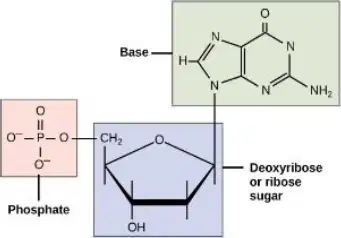
Which component is attached to the 5' position of the pentose sugar?
Nitrogenous base
Phosphate group
Ribose
Uracil
According to the information on Base Pairing In DNA, where do the sugar and phosphate lie in the DNA helix?
On the outside of the helix
In the interior
At the ends of the helix
In the nucleus
According to the information on Base Pairing In DNA, nitrogenous bases are stacked in the ______ of the DNA helix.
interior
exterior
phosphate backbone
major groove
According to the information on Base Pairing In DNA, the strands of the helix run in opposite directions. What is this orientation called?
Parallel
Antiparallel
Perpendicular
Rotational

