
 Worksheets
Renal Quiz
Total questions: 48
Worksheet time: 31mins
What is the function of aldosterone in the human body?
Regulates blood sugar levels
Controls water balance and blood pressure
Stimulates red blood cell production
Aids in digestion
Which hormone is responsible for reducing urine production by increasing water reabsorption in the kidneys?
Insulin
Adrenaline
Antidiuretic hormone (ADH)
Thyroxine
What does the term "anuria" refer to?
Excessive urination
Absence of urine production
Painful urination
Blood in urine
What is the primary role of erythropoietin in the body?
Regulates blood pressure
Stimulates red blood cell production
Controls glucose levels
Aids in protein digestion
Which diagnostic test is specifically used to examine the blood vessels of the kidneys?
Cystography
Renal angiography
Retrograde pyelography
CT with dye
Which of the following is a structure of the renal system?
Heart
Lungs
Kidneys
Liver
What is the primary function of the bladder in the renal system?
To filter blood
To store urine
To produce hormones
To absorb nutrients
Which part of the renal system is responsible for transporting urine from the kidneys to the bladder?
Urethra
Ureter
Bladder
Nephron

What is the function of the renal artery in the renal system?
To carry blood away from the kidneys
To carry urine to the bladder
To carry blood to the kidneys
To filter waste from the blood

What is the primary role of the ureter in the renal system?
To filter blood
To transport urine from the kidneys to the bladder
To store urine
To produce hormones
What is the primary purpose of the nephron?
To produce hormones
To filter waste from blood and produce urine
To regulate body temperature
To transport oxygen
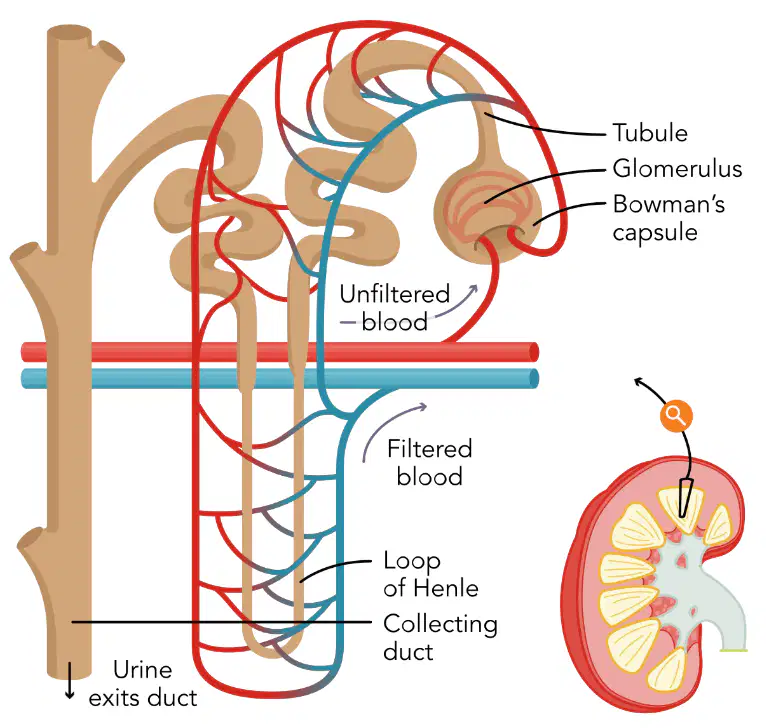
Where is the glomerulus located within the nephron?
Within the Loop of Henle
Within the Collecting Duct
Within Bowman's Capsule
Within the Tubule
Which artery enters the concave part of the kidney?
Interlobar artery
Segmental artery
Renal artery
Renal vein
Where is the female urethra located?
Between the Labia Majora
Between the Labia Minora
Above the bladder
Below the bladder
What is the normal range for Glomerular Filtration Rate (GFR)?
50 to 70 mL/min
90 to 120 mL/min
130 to 150 mL/min
60 to 80 mL/min
What is one of the primary functions of the kidneys?
Produce insulin
Remove waste products
Regulate body temperature
Produce bile
Which hormone is also known as vasopressin and is secreted by the posterior pituitary?
Insulin
Adrenaline
Antidiuretic hormone (ADH)
Thyroxine
What is GFR? Explain why this lab is significant and what information does it provide?
GFR is a measure of liver function; it provides information about liver enzyme levels.
GFR is a measure of kidney function; it provides information about how well the kidneys are filtering blood.
GFR is a measure of heart function; it provides information about cardiac output.
GFR is a measure of lung function; it provides information about oxygen exchange efficiency.
At what age does the decrease in GFR typically start?
20-25 years
34-40 years
50-55 years
60-65 years
What condition are older adults more susceptible to?
Diabetes
Hypertension
AKI
Asthma
What condition are multiparous women at high risk for if they have had a vaginal delivery?
Overflow incontinence
Stress incontinence
Neurogenic bladder
Kidney stone formation
What is a common complication of diabetes related to bladder function?
Nephritis
Uric acid stones
Neurogenic bladder
Overflow incontinence
What is the significance of deep tendon reflexes of the knee in a physical assessment?
They assess kidney function.
They evaluate bladder health.
They test the nerves that innervate the lower extremities.
They measure weight changes.
What does a colorless to pale yellow urine color indicate?
Presence of blood
Dilute urine
Presence of vitamins
Old RBCs

Which is not a function of the urinary system?
filtration
waste storage and removal
homeostasis maintenance
hormone production


What is the name of the part of the nephron indicated by the red arrow in the diagram provided?
descending loop of henle
ascending loop of henle
proximal convoluted tubule
distal convoluted tubule

Blood carrying dissolved cellular wastes enters each kidney to be filtered through the (a)

What is the name of the part of the kidney indicated by the red arrow in the diagram provided?
renal medulla
renal cortex
renal pelvis
ureter
What are the filtering units of the kidneys?
nephrons
ureters
nuerons
alveloi
Which of the following is NOT a function of the kidneys?
Regulate ion concentrations
Red blood cell production
Regulate pH
Absorption of fatty acids
The main function of nephrons is
blood filtration
blood purification and urine formation
all the above
When we are dehydrated, ADH is released which causes more water to be absorbed into our bloodstream. What type of feedback does this represent?
Positive feedback
Negative feedback
While planning care for elderly individuals, the nurse remembers the elderly are at a higher risk for developing dehydration because they have a(n):
Higher total body water volume
Decreased muscle mass
Increase in thirst
Increased tendency towards developing edema
Which electrolyte imbalance is characterized by high levels of potassium in the blood?
Hyponatremia
Hypokalemia
Hypernatremia
Hyperkalemia
Excess accumulation of fluid, which impairs the exchange of materials within the tissues, is called ________.
stroke
edema
MALT (mucosa-associated lymphatic tissue)
shock
B.11.A
An individual who participates in a long-distance run on a hot day will produce large quantities of sweat. As a result of the excessive sweating, the amount of urine produced by the kidneys will change.
How will the kidneys respond to help the individual's body maintain homeostasis?
The kidneys will decrease urine production so the body can maintain blood pH
The kidneys will increase urine production to eliminate excess salt in the body
The kidneys will decrease urine production to allow the body to conserve water
The kidneys will increase urine production so the body can absorb more nutrients
Which of these hormones would NOT be stimulated by dehydration or low blood volume?
Vasopressin
Renin
Aldosterone
ANP
Increased blood volume will ___ glomerular filtration, all other things being equal.
Increase
Decrease
When your kidneys fail or need to rest, you can go on a treatment that will filter your blood called
intubation
dialysis
physical therapy
nebulizer

The diagram demonstrates a feedback process involving antidiuretic hormone (ADH). ADH increases the permeability of parts of the nephrons of the kidney, resulting in less water in the urine.This feedback loop is likely to be activated when—
A) the body experiences dehydration B) blood glucose levels are stable C) body temperature drops D) the urinary tract is infected
A
B
C
D
Why would an enlarged prostate interfere with urination?
It develops calcified deposits that block the urethra.
It produces thicker prostatic secretions that block the urethra.
It inhibits the micturition reflex.
It compresses the urethra.
Renin is released from the ___ whereas angiotensinogen is released from the ___.

