
Font size
 Worksheets
Chemistry: Midterm
Total questions: 100
Worksheet time: 3hrs 45mins
What is the difference between a physical change and a chemical change?
A physical change can only be reversed, while a chemical change cannot.
A physical change creates energy, while a chemical change does not.
A physical change involves a change in temperature, while a chemical change does not.
A physical change does not alter the chemical composition, while a chemical change results in new substances.
Describe what happens to the molecules in a substance during a physical change.
The molecules rearrange or change state without altering their chemical structure.
The molecules break apart and form new substances.
The molecules remain unchanged in both structure and state.
The molecules lose their mass and become lighter.
Explain how temperature affects the state of matter.
Temperature influences the state of matter by changing the energy and movement of particles, leading to phase transitions.
Temperature changes the color of matter, not its state.
Temperature only affects gases, not solids or liquids.
Temperature has no effect on matter states.
What evidence can indicate that a chemical reaction has occurred?
Change in the size of the container
Absence of any visible changes
Formation of a solid without a reaction
Evidence of a chemical reaction includes color change, temperature change, gas production, precipitate formation, and odor change.
How can you separate a mixture of sand and salt?
Heat the mixture to burn off the salt
Use a magnet to attract the sand
Use water to dissolve the salt, filter to separate sand, and evaporate to recover salt.
Mix sand and salt together thoroughly
What is the difference between an endothermic and exothermic reaction?
Endothermic reactions absorb heat; exothermic reactions release heat.
Both endothermic and exothermic reactions absorb heat.
Endothermic reactions release heat; exothermic reactions absorb heat.
Endothermic reactions occur only in gases; exothermic reactions occur only in liquids.

The ability to rust is a
Physical property
Chemical property

The element sulfur smells like rotten eggs. This is an example of a
Physical property
Chemical property

The element iron is very magnetic. This is an example of a
Physical property
chemical property

Aluminum is a metal that can be flattened and molded into different shapes. It shows high ...
Magnetism
Hardness
Reactivity
Malleability
A property of matter that can be measured or observed without changing the substance of which it is made, is an example of a
Physical property
Chemical property
Mass
Intrinsic
Extrinsic
Volume
Intrinsic
Extrinsic
Color
Intrinsic
Extrinsic
Odor
Intrinsic
Extrinsic
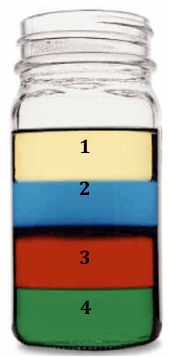

Which has the greatest density?
A
B
C
All the same density
What is mass?
The amount of space an object takes up
The amount of matter in a given space
The amount of matter in an object
What is volume?
The amount of space an object takes up
The amount of matter in a given space
The amount of matter in an object
What is density?
The amount of space an object takes up
The amount of matter in a given space
The amount of matter in an object

salt dissolving in water
physical change
chemical change
wood burning
physical change
chemical change
Molecules are always moving no matter what phase they are in: solid, liquid, gas.
True
False

What type of mixture is this?
Homogeneous
Heterogeneous
In Alpha decay what particle is emitted?
Helium (He)
Electron (e-)
Energy (Photon)
In Gamma decay what particle is emitted?
Helium (He)
Electron (e-)
Energy (Photon)
What is the most dangerous form of radioactive decay?
Alpha
Beta
Gamma
Which form of radiation can be stopped by something as thin as a sheet of paper?
Alpha
Beta
Gamma

Identify the missing variable in the following reaction.


Identify the missing variable in the following reaction.

Identify the missing variable in the following reaction.

Identify the missing variable in the following reaction.


Which identifies the correct type of decay and shows the correct formula for the reaction shown?


This type of radiation can travel across galaxies.
alpha
beta
gamma
all of the above
none of the above
This radiation can only be stopped by a thick sheet of lead or several meters of water.
alpha
beta
gamma
alpha and beta
none of the above
This type of decay creates a new element
alpha
beta
gamma
alpha and beta
none of the above
A high energy electron is a(n):
Alpha Particle
Beta Particle
Gamma Ray
In Alpha decay, the atomic number decrease by _________
1
2
3
5
In the symbol 167N what the 7 stand for?
Mass number
Atomic number
Atomic mass
Number of neutrons
The term given to unstable radioactive atoms.
Parent
Daughter
Half Life
Igneous
The % of the parent isotope remaining after 3 Half Lives.
50%
25%
12.5%
6.25%
The % of the parent isotope remaining after 1 Half Life.
50%
25%
12.5%
6.25%
The % of the parent isotope remaining after 2 Half Lives.
50%
25%
12.5%
6.25%
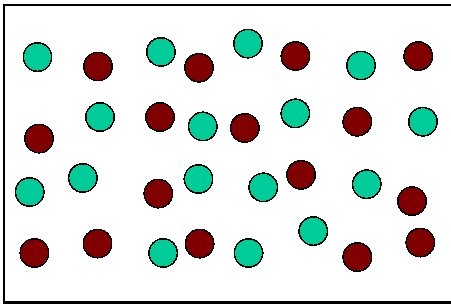
The diagram shows 32 atoms.
16 of the Red are parent isotopes
16 of the Green are daughter isotopes
How many half-lives have occurred?
0
1
2
3

The diagram shows 32 atoms
8 of the Red are parent isotopes
24 of the Green are daughter isotopes
How many half-lives have occurred?
0
1
2
3
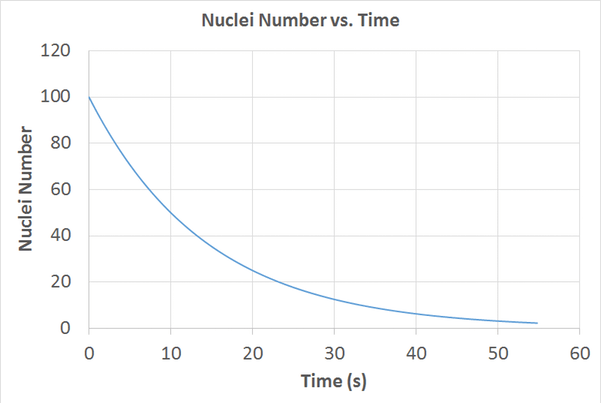
What is the Half life of this isotope?
5 seconds
10 seconds
15 seconds
20 seconds

The Half Life of Californium 252 is 5 years.
TRUE
FALSE
What is the maximum number of electrons that can occupy a single s orbital?
2
8
10
4
Which of the following orbitals can hold a maximum of 6 electrons?
s
p
d
f
In the electron configuration notation, what does the notation "3p4" indicate?
4 electrons in the 3rd energy level
4 electrons in the p orbital of the 3rd energy level
3 electrons in the p orbital of the 4th energy level
3 electrons in the 4th energy level
How many valence electrons does an atom of oxygen have?
2
4
6
8
Which of the following is the correct electron configuration for a sodium (Na) atom?
1s2 2s2 2p6 3s1
1s2 2s2 2p6 3s2
1s22s2 2p5 3s1
1s2 2s2 2p6 3p1
If an element has the electron configuration of 1s22s22p63s23p5 , how many valence electrons does it have?
5
7
2
8
Which of the following elements has the electron configuration 1s22s22p63s23p1 ?
Aluminum (Al)
Silicon (Si)
Phosphorus (P)
Chlorine (Cl)
What is the total number of electrons in the outermost shell of a chlorine atom?
5
7
8
6
Which of the following orbital diagrams correctly represents the electron configuration of nitrogen?
1s↑↓ 2s↑↓ 2p↑↑↑
1s↑ 1s↓ 2s↑ 2p↑↓
1s↑↓ 2s↑ 2p↑↑
1s↑↓ 2s↑↓ 2p↑↑↑↑
Given the electron configuration 1s22s22p63s23p64s23d104p5 , identify the element and its group in the periodic table.
Bromine, Group 17
Iodine, Group 17
Chlorine, Group 17
Selenium, Group 16
Explain how the concept of valence electrons is important in determining the chemical reactivity of an element.
Valence electrons determine the mass of an element.
Valence electrons are involved in bonding and chemical reactions.
Valence electrons are always equal to the number of protons.
Valence electrons do not affect the element's properties.
What is the significance of the electron configuration in predicting the chemical properties of an element?
It helps determine the element's mass.
It indicates the number of neutrons in the nucleus.
It reveals the element's reactivity and bonding behavior.
It has no significance in chemistry.
Which of the following statements about valence electrons is true?
They are always found in the innermost shell.
They determine the element's position in the periodic table.
They are involved in chemical bonding.
They are the same as the total number of electrons.
What is the electron configuration for the element with atomic number 26?
1s22s22p63s23p64s23d6
1s22s22p63s23p64s23d5
1s22s22p63s23p64s23d7
1s22s22p63s23p64s23d10


Electrons fill energy levels and sublevels _____ in energy first.
lower
higher

Region of high probability of finding an electron
atomic orbital
ground state
Heisenberg uncertainty principle
electron configuration
What is the noble gas configuration for Cobalt?
[Kr] 4s2 3d7
[Kr] 4s2 4d7
[Ar] 4s2 3d7
[Ar] 4s2 4d7
What is the noble gas configuration for 1s2 2s2 2p6 3s2?
[He] 3s2
[Ne] 3s2
[Ar] 3s2
[Ar] 4s2
What does the 1 in "1s" stand for?
energy level
s orbitals
p orbitals
the number of electrons
Bohr discovered that electrons are located in
the nucleus
inside protons
electron cloud
circular orbits around the nucleus
What is a particle with one negative charge called?
electron
proton
quark
neutron
What is a particle with one positive charge called?
proton
electron
neutron
quark
What is the center of an atom called?
nucleus
electron cloud
proton center
photon center
What is the neutral particle found in the nucleus called?
proton
neutron
electron
quark
The majority of an atom's mass exists where?
In the nucleus
In the electron cloud
In the space between the nucleus and the electrons
In the neutrons

What is Neils Bohr's contribution to the atomic theory?
Created the atomic theory
Created a model of the atom with electrons moving around the nucleus in a fixed orbits
Discovered that the proton had a positive charge
Believed that atoms of a given element are identical
Discovered the electron

A spectrum represents the specific parts of an object's
sound
light
shape
What causes the lines to appear in a spectrum? When an atom..... (select all that apply)
remains stable (unchanged)
loses energy (emits it)
gains energy (absorbs it)

True or False: The ground state is the highest energy state of an atom.
True
False

What is the light that you can see called?
observatory light
ultraviolet light
visible light
infrared light


The unknown emissions spectra belongs to the element
Hydrogen
Mercury
Neon
Sodium

The unknown emissions spectra belongs to the element
Hydrogen
Mercury
Neon
Sodium


Each element produces its own pattern of emission spectra lines because each element has its own distinct
Speed of light
Electron configuration
Number of neutrons
None of these

The unknown emissions spectra belongs to the element
Hydrogen
Mercury
Neon
Helium
On a wave, the distance between crest to crest is called?
amplitude
wavelength
frequency
trough
The number of cycles in a given amount of time is ...
longitudinal wave
frequency
diffraction
reflection
What does energy have to do with wavelength and frequency?
The higher the frequency the less energy the wave has.
The lower the frequency the more energy the wave has.
The shorter the wavelength the more energy the wave has.
The longer the wavelength the more energy the wave has.

