
 Worksheets
Exam 2 Review BIOL1308
Total questions: 121
Worksheet time: 2hrs 5mins
What is the primary role of the plasma membrane in a cell?
To provide structural support
To control the movement of substances in and out of the cell
To store genetic information
To produce energy for the cell
Which model describes the structure of cell membranes as a mosaic of components?
Lock and Key Model
Fluid Mosaic Model
Double Helix Model
Induced Fit Model
Which process involves the movement of water across a semipermeable membrane?
Diffusion
Osmosis
Active Transport
Endocytosis
Which type of cell is generally larger and more complex?
Prokaryotic cells
Eukaryotic cells
Bacterial cells
Viral cells
Explain what happens to an animal cell when it is placed in a hypertonic solution versus a hypotonic solution.
It swells in both solutions
It shrinks in a hypertonic solution and swells in a hypotonic solution
It remains unchanged in both solutions
It shrinks in both solutions
What is the primary difference between kinetic and potential energy?
Kinetic energy is stored energy, while potential energy is energy in motion.
Kinetic energy is energy in motion, while potential energy is stored energy.
Both kinetic and potential energy are forms of stored energy.
Both kinetic and potential energy are forms of energy in motion.
State the First Law of Thermodynamics. How does this law apply to a living organism?
Energy can be created; living organisms create energy
Energy can be destroyed; living organisms destroy energy
Energy cannot be created or destroyed; living organisms transform energy
Energy is unlimited; living organisms have unlimited energy
State the Second Law of Thermodynamics. What term is used to measure the disorder or randomness that is always increasing in the universe?
Entropy
Enthalpy
Energy
Equilibrium
Kinetic energy is best defined as which of the following, and what is a biological example?
Energy of motion; a moving muscle
Energy of position; a rock on a hill
Energy of chemical bonds; glucose molecule
Energy of heat; a warm object
What is the key six-carbon input molecule for glycolysis, and what three-carbon molecule is it broken down into?
Glucose; Pyruvate
Fructose; Lactate
Sucrose; Acetyl-CoA
Galactose; Ethanol
Which component of the plasma membrane is primarily responsible for its selective permeability?
Phospholipid bilayer
Cell wall
Nucleus
Ribosomes
What term describes the movement of molecules from an area of higher concentration to an area of lower concentration without energy input?
Active transport
Facilitated diffusion
Simple diffusion
Osmosis
Which organelle is responsible for producing most of the cell's ATP through cellular respiration?
Golgi apparatus
Mitochondrion
Endoplasmic reticulum
Chloroplast
Which process requires energy to move substances against their concentration gradient across the plasma membrane?
Osmosis
Simple diffusion
Facilitated diffusion
Active transport
What is the main function of ribosomes in a cell?
Producing ATP
Storing genetic material
Synthesizing proteins
Regulating cell division


Identify the cellular organelle that the process of cellular respiration occurs in:
mitochondria
chloroplast
nucleus
golgi

The reactants of cellular respiration are:

The diagram below represents a structure involved in cellular respiration. The release of which substance is represented by the arrows?
glucose
carbon dioxide
oxygen
DNA


A
B
C
D

Billy went on a 2 mile run. Was he using aerobic or anaerobic respiration?
Aerobic
Anaerobic
Plants do not go through cellular respiration
True
False
Which of the reactants of cellular respiration is chemical energy?
C6H12O6+6O2⟶6H2O+6CO2+ATP
Glucose
ATP
Aerobic respiration
H2O
What output of cellular respiration is energy?
Sunlight
ATP
Glucose
Water
What do organisms use ATP for?
To make glucose
To live and function
For photosynthesis
The chloroplast is where cellular respiration happens
False
True
What organisms go through cellular respiration?
Plants
Animals
Humans
Plants, animals and humans
A process that does NOT require oxygen
anaerobic
aerobic
sleep
relaxing
A process that requires oxygen
anaerobic
cardio
aerobic
O2
Cellular respiration happens in the ________________.
Chloroplast
Nucleus
Mitochondria
Stomata
What are the products of cellular respiration? C6H12O6+6O2⟶6H2O+6CO2+ATP
carbon dioxide, water and ATP
ATP and Glucose
Oxygen and Glucose
Sunlight, Glucose and Water
What is ATP
Usable energy
Food
carbon dioxide
only plants use it
What is cellular respiration
How plants make food using the sun
How organisms use CO2 and O2 to make energy
Carbon dioxide and water


In the Electron Transport Chain, H+ ions must pass through this enzyme so it can make ATP.
Rubisco
Lactase
NADase
ATP synthase
Match the following
CO2
Carbon Dioxide
02
Oxygen
C6H12O6
Glucose
Products
After
Reactant
Before
C6H12O6 + 6O2 ---> 6CO2 + 6H2O + 36 ATP
Cellular Respiration
Photosynthesis
The process that links glycolysis to the citric acid cycle is
pyruvate oxidation
pyruvate reduction
oxidative phosphorylation
the electron transport chain
Pyruvate oxidation occurs in the
cytosol outside the mitochondrion
the intermembrane space of the mitochondrion
in the mitochondrial matrix
the outer membrane of the mitochondrion
What product of pyruvate oxidation continues into the citric acid cycle?
the pyruvate molecule
CO2
Coenzyme A
Acetyl CoA


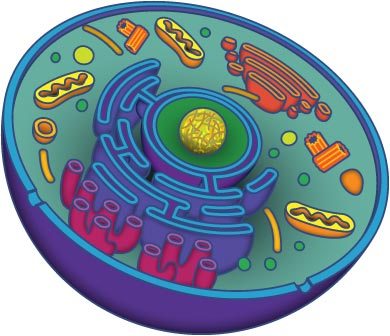


Which structures are found in plant cells but not in animal cells?
mitochondria and ribosomes
nucleus and vacuole
cell membrane and vacuole
chloroplast and cell wall
Match the following
There is more solute outside of the cell than inside of the cell. So, the solute moves into the cell and water moves out of the cell.
Hypertonic
There is an equal amount of solute inside and outside of the cell. Water moves in and out at the same rate, so there is no net change.
Isotonic
There is less solute outside of the cell than inside of the cell. So, solute moves out of the cell and water moves into the cell.
Hypotonic
Label the following cells by telling whether they are in a hypertonic, isotonic, or hypotonic environment.
Hypertonic
Isotonic
Hypotonic
Label the structures
Lipids
Protein

Endoplasmic Reticulum
Network of membranes that (a) lipids and (b) through the cell. (c) ER has (d) attached, (e) ER does not have ribosomes attached to it.
Rough ER synthesizes and stores (a) .
Smooth ER, on the other hand, helps in the storage of proteins and (b) .
The main difference between smooth and roughER is that smoothER (c) bound ribosomes whereas (d) is bound with ribosomes.
Match the following
Rough ER
Synthesizes and stores proteins
Smooth ER
Storage of Proteins and lipids
Endoplasmic reticulum
transportation system of cells
Match the following
Rough ER
Synthesizes and stores proteins
Smooth ER
Storage of Proteins and lipids
Endoplasmic reticulum
transportation system of cells
Match the following
Golgi bodies
Modify and package proteins
Ribosomes
Produce proteins
Chloroplasts
produce sugars
mitochondria
produce ATP/energy
Match the following
Digestive enzymes
Lysosomes
Protects and supports the cell
Cell Wall
Stores food and water, waste
Vacuole
Tiny hairs on paramecium for movement
Cilia
Whiplike structure on an Amoeba for movement
Flagella

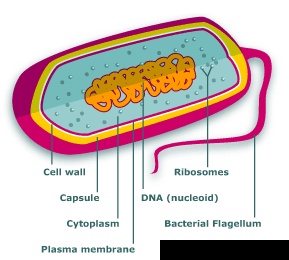
Which of the following is NOT a characteristic of a Prokaryotic cell?
unicellular
floating DNA
very small
nucleus

The organelle that regulates materials entering and leaving the cell, as well as supporting and protecting it:
Cell Wall
Cell Membrane
Centrioles
Cytoskeleton

The organelle that captures the energy from sunlight and converts it into chemical energy stored in food during photosynthesis:
Chloroplast
Mitochondrion
Cell Wall
Nucleus

The organelle that modifies, sorts, and packages proteins and other materials from the ER for storage in the cell or release from the cell:
Endoplasmic Reticulum
Golgi Apparatus
Vacuoles and Vesicles
Ribosome

The organelle where lipids are synthesized along with proteins and other materials that are exported from the cell:
Endoplasmic Reticulum
Golgi Apparatus
Vacuoles & vesicles
Nucleus

Gel-like material found in all cells, keeps things in their place
cell membrane
cytoplasm
Golgi bodies
nucleous
nuclear membrane
What happens to an enzyme when it denatures?
The activation energy of the reaction is doubled.
The activation energy of the reaction is lowered.
It's optimal conditions for temperature of the enzyme are doubled.
The shape of the enzyme molecule is changed.
Most enzymes are composed of .....
Lipids
Carbohydrates
Proteins
Nucleic Acids
Enzymes in your body probably work best at which of the following temperatures>
25oC
98oC
37oC
210oC
Organisms living in a bog environment must be able to tolerate nitrogen-poor acidic conditions. Bog plants such as the Venus flytrap and sundew are able to obtain their nitrogen by attacking and consuming insects. These plants produce chemicals that break down the insects into usable compounds.
These chemicals present in the bog plants that break down the insects mentioned in the reading passage are most likely...
hormones
lipids
enzymes
carbohydrates
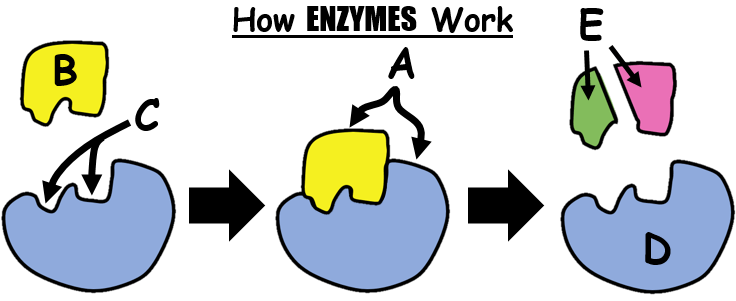
What is the sequence of events in the enzyme-substrate interaction process?
Substrates enter, products released, substrates converted, substrates held
Substrates held, substrates enter, substrates converted, products released
Substrates enter, substrates held, substrates converted, products released
Products released, substrates converted, substrates held, substrates enter
What occurs after the products are released in the enzyme-substrate interaction?
The enzyme is deactivated.
The active site is available for new substrates.
The enzyme is destroyed.
The enzyme changes shape permanently.
What two environmental conditions can affect the activity of an enzyme?
Temperature and pH
Light and humidity
Pressure and salinity
Altitude and wind speed
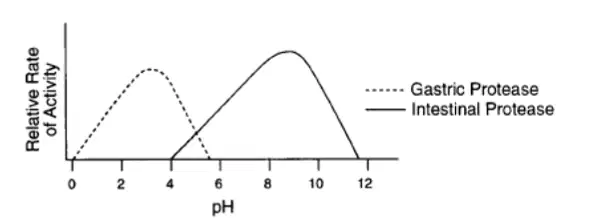
What is the optimal pH for Intestinal Protease?
2
6
8
10
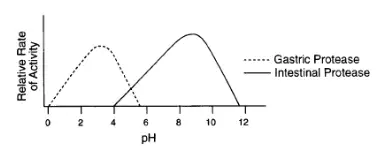
What is the optimal pH for Gastric Protease?
3
4
6
8

