
 Worksheets
BIO181 Unit 2 Review: Membrane and Enzyme
Total questions: 70
Worksheet time: 1hrs 10mins
What are the two primary molecular components of a cell's plasma membrane?
Carbohydrates and nucleic acids
Lipids and proteins
Proteins and carbohydrates
Nucleic acids and lipids
Which type of protein is primarily involved in cell-to-cell identification, allowing the immune system to distinguish between self and non-self cells?
Carrier protein
Channel protein
Cell recognition protein
Porin protein
An animal cell is placed into a salt solution that has a much higher concentration of solutes than the inside of the cell. What is the condition of the solution, and what will happen to the cell?
The solution is hypotonic, and the cell will burst.
The solution is hypertonic, and the cell will shrivel.
The solution is isotonic, and the cell will shrivel.
The solution is hypotonic, and the cell will shrivel.
Which cell connections act as seals to prevent the passage of substances between cells, creating a leak-proof barrier in tissues like the skin or lining of the digestive tract?
Gap Junctions
Plasmodesmata
Desmosomes
Tight Junctions
Which statement about the phospholipid bilayer of a cell membrane is incorrect?
It is semi-fluid and constantly in motion.
It spontaneously forms a closed structure in a watery environment.
It is typically non-sealing and must be continuously repaired.
It can fuse with other lipid bilayers.
Which of the following statements is incorrect about osmosis?
It involves the diffusion of water across a selectively permeable membrane.
It is a form of passive transport that does not require direct energy input.
It occurs independently of the concentration gradient of water.
It depends on the relative concentrations of water and solutes on both sides of the membrane.
The process by which large molecules or foreign particles are engulfed by a cell, such as when an amoeba consumes food or a white blood cell consumes a bacterium, is known as:
Pinocytosis
Exocytosis
Phagocytosis
Receptor-mediated endocytosis
Which cellular activity is an example of passive transport?
Endocytosis
Sodium-Potassium pump moving ions against their gradient
Movement of ions through a channel protein down their concentration gradient
Exocytosis
What is the primary role of cholesterol in the plasma membrane of an animal cell?
It helps the cell to perform facilitated diffusion.
It increases the permeability of the membrane to charged ions.
It acts as a temperature buffer, maintaining membrane fluidity.
It binds to substrates to initiate cell signaling pathways.
In a diffusion experiment with a membrane permeable only to water, which setup would be considered isotonic?
A. A bag containing starch in a beaker of starch/ water.
B. A bag containing water in a beaker of water.
C. A bag containing starch/ water in a beaker of starch/ water.
D. A bag containing water in a beaker of starch/ water.
What best describes the effect of increasing temperature on the rate of simple diffusion?
As the temperature decreases, the rate of diffusion increases.
As the temperature rises, the rate of diffusion increases.
Temperature changes have no significant effect on the rate of diffusion.
As the temperature rises, the rate of diffusion stays constant until a maximum is reached.
The movement of a small, uncharged molecule across the plasma membrane occurs via what mechanism?
Active transport through a protein pump.
Simple diffusion through the lipid bilayer.
Facilitated diffusion through a channel protein.
Exocytosis.
The movement of a charged ion, like a sodium ion, across a cell membrane typically requires:
Simple diffusion directly through the lipid bilayer.
Only an environment with low solute concentration.
Assistance from a specific transport protein.
Fusion with other bilayers.
What are aquaporins?
Specialized lipids that increase the fluidity of the membrane.
Proteins that transport sodium and potassium ions across the membrane.
Membrane channels that selectively and rapidly transport water molecules.
Cell recognition proteins in the kidney.
Plant cells maintain their turgid, firm state primarily because of which two structures working together in a hypotonic environment?
Chloroplasts and the Golgi apparatus.
Cell wall and the large central vacuole.
Plasma membrane and mitochondria.
Ribosomes and endoplasmic reticulum.
What is the fundamental source of energy for all work done by living organisms, either directly or indirectly?
The flow of protons between molecules.
The movement of electrons between molecules.
The breakdown of neutrons within atoms.
The stable structure of noble gases.
Chemical energy is stored within which part of a molecule?
Noble gas core
Atomic nucleus
Chemical bonds
Isolated carbon atoms
According to the Second Law of Thermodynamics, what is the fate of the heat produced when an organism does work?
It is completely recycled to regenerate ATP.
It is used in an endergonic reaction to fuel a coupled process.
It is converted into light energy.
It is lost to the surroundings and cannot be used for work.
Redox reactions, which involve the transfer of electrons, are classic examples of coupling of which two types of reactions?
Denaturation and inhibition
Endergonic and exergonic reactions
Hydrolysis and synthesis
Anabolism and catabolism
This illustrates the concept of entropy—the tendency for systems to move toward higher disorder and energy release.
Lipid synthesis
Entropy
Protein synthesis
Enzyme specificity
What class of organic molecule do all enzymes primarily belong to?
Lipids
Proteins
Carbohydrates
Nucleic Acids
Enzymes act as biological catalysts by performing which action?
Increasing the activation energy required for the reaction.
Lowering the of the surrounding fluid.
Providing an active site for the reaction.
Decreasing the activation energy needed for the reaction to occur.
Why do humans require trace amounts of metals like magnesium and calcium?
The metals lower the of the surrounding fluid.
The metals are essential for replication.
The metals act as cofactors to assist enzyme function.
The metals increase the activation energy of necessary reactions.
The active site of an enzyme is the specific region where:
The end product of the reaction binds.
Cellular respiration takes place.
The coenzyme or cofactor inhibits the enzyme.
The substrate molecule binds to the enzyme.
What is the best description of noncompetitive inhibition of an enzyme?
A substrate binds to the allosteric site and changes the enzyme's shape.
An inhibitor binds to the active site, preventing the substrate from binding.
The enzyme denatures.
A product binds to the active site and changes the enzyme's shape.
Which environmental change would most likely disrupt the tertiary structure of an enzyme, causing it to lose its function?
Maintaining the enzyme at a stable temperature of 32 degrees celsius.
Placing the enzyme in an environment with a temperature of 125 degrees celsius.
Placing the enzyme in a solution that is isotonic.
Which statement(s) are true about ATP? (Select all that apply)
It is an energy molecule that is used only once and then expelled from the cell.
It carries energy between different cellular processes and organelles.
The molecule becomes when it provides energy.
It is recycled over and over within the body.
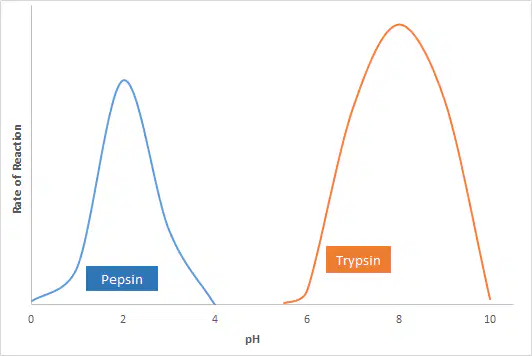
According to the graph, at what does the enzyme pepsin have its highest rate of reaction, and is this considered acidic or basic?
2; Acidic
8; Basic
7; Neutral
4; Acidic
An enzyme, like a protein, has an optimal working temperature of 50 degrees celsius. What would happen to the reaction rate if the enzyme was placed in an environment of 30 degrees ceslius?
The rate would increase significantly due to increased stability.
The rate would decrease significantly because the low temperature reduces molecular collisions.
The enzyme would denature, and the reaction would stop.
The rate would stay constant, as is the only factor affecting enzymes.
Cellular respiration is an exergonic reaction because:
The products ( and ) have more potential energy than the reactants
The products (CO2 and H2O) have less potential energy than the reactants (glucose and O2).
Which of the following is not a primary function of the plasma membrane?
Defining the outer border of the cell
Managing what enters and exits the cell
Synthesizing proteins for secretion
Receiving external signals
A phospholipid molecule is considered amphipathic (or amphiphilic) because it possesses:
A. A glycerol molecule and three fatty acid chains
B. Two hydrophobic tails and one hydrophilic head
C. Both saturated and unsaturated fatty acid chains
D. A charged phosphate group and a neutral carbohydrate
In the Fluid Mosaic Model, which component acts as a fluidity buffer, keeping the membrane fluid when cold and from getting too fluid when hot?
Glycolipids
Peripheral proteins
Cholesterol
Glycoproteins
The hydrophobic regions of integral membrane proteins are composed of what type of amino acids, allowing them to remain embedded within the lipid bilayer?
Polar amino acids
Charged amino acids
Hydrophobic amino acids
Hydrophilic amino acids
Which type of membrane protein is found only on the surfaces of the plasma membrane, acting as enzymes or attachment points for the cytoskeleton?
Integral proteins
Glycoproteins
Protein channels
Peripheral proteins
Carbohydrates on the exterior of the plasma membrane, which are bound to proteins, are called glycoproteins and primarily function in:
Providing structural support for the cell
Cell-cell recognition and attachment
Acting as channels for ion transport
Forming the non-polar barrier of the membrane
Which of the following would increase the rate of simple diffusion across a membrane?
Decreasing the temperature
Increasing the mass of the molecules
Increasing the concentration gradient
Increasing the solvent density
Facilitated diffusion differs from simple diffusion in that facilitated diffusion:
Requires an input of ATP
Moves substances against the concentration gradient
Requires the use of an integral membrane protein
Is the only method used by small, nonpolar molecules
Which statement correctly describes how the sodium-potassium (Na⁺/K⁺) pump contributes to the cell’s negative interior charge
It expels ions down their concentration gradient.
It brings in ions against their electrochemical gradient.
It expels more positive ions than it takes in.
It pulls in anions to balance the positive ions.
The combined effect of the concentration gradient and the electrical gradient across a membrane is known as the:
Membrane potential
Osmolarity
Electrochemical gradient
Turgor pressure
An increase in the concentration of Na⁺ ions outside a cell (a decrease in intracellular Na⁺) would increase the transport of amino acids into the cell via the Na⁺ cotransporter. What type of transport is this an example of?
Simple diffusion
Primary active transport
Facilitated passive transport
Secondary active transport
The movement of water from an area of higher water concentration to an area of lower water concentration across a selectively permeable membrane is called:
Diffusion
Osmosis
Active transport
Facilitated diffusion
What is the state of an extracellular solution that has a lower osmolarity than the cytosol, causing water to move into the cell?
Hypertonic
Isotonic
Hypotonic
Hyperosmotic
In plant cells, the process where the plasma membrane detaches from the cell wall due to the loss of water in a hypertonic solution is called:
Turgor pressure
Lysis
Plasmolysis
Osmoregulation
Organisms like freshwater protists (e.g., Paramecia) use which organelle to actively pump water out of the cell to prevent bursting in their hypotonic environment?
Large central vacuole
Cell wall
Lysosome
Contractile vacuole
What is the process of a cell taking in specific substances that bind to receptors on the membrane surface before being engulfed into a coated vesicle?
Phagocytosis
Pinocytosis
Receptor-mediated endocytosis
Exocytosis
In the context of bulk transport, the process of a white blood cell engulfing a bacterium is an example of:
Exocytosis
Pinocytosis (cellular drinking)
Phagocytosis (cellular eating)
Secondary active transport
What eventually happens to the membrane of a vesicle after it releases its contents to the cell exterior via exocytosis?
It is disassembled and recycled by lysosomes.
It becomes a permanent part of the extracellular matrix.
It fuses with and becomes part of the plasma membrane.
It leaves the cell entirely as a waste product.
Active transport is necessary for a cell to function continuously because:
The plasma membrane constantly wears out.
Facilitated transport and diffusion are constantly moving solutes in the opposite direction, trying to reach equilibrium.
All membranes are amphiphilic.
It uses ATP which is constantly being hydrolyzed.
A protein pump that carries two different molecules or ions in the same direction across a membrane is classified as a(n):
Uniporter
Symporter
Antiporter
Receptor
Which term refers to all the chemical reactions of a cell or organism?
Bioenergetics
Anabolism
Catabolism
Metabolism
A metabolic pathway that requires energy to assemble small molecules into larger ones is classified as:
Catabolic
Anabolic
Exergonic
Endothermic
According to the First Law of Thermodynamics, what is constant in the universe?
The total amount of energy
The measure of randomness (entropy)
The amount of usable energy (Gibb's Free Energy)
The amount of heat lost
The Second Law of Thermodynamics states that energy transfer is not completely efficient, resulting in energy being lost as unusable heat. This loss leads to an increase in:
Enthalpy
Gibbs Free Energy
Entropy
Potential energy
A reaction that is spontaneous, releases energy, and has a negative ΔG is called a(n):
Exergonic reaction
Endergonic reaction
Coupled reaction
Catabolic reaction
An endergonic reaction, which is not spontaneous and requires an input of energy, will have a value that is:
ΔG Equal to zero
ΔG Less than zero
ΔG Greater than zero
ΔG is Zero
Activation energy is defined as the energy required for a reaction to proceed to an unstable, high-energy state called the:
Active site
Allosteric site
Transition state
Products complex
In biological systems, the main source of energy used to overcome the activation energy barrier for a reaction is:
Light energy
Chemical bonds in glucose
ATP hydrolysis
Heat energy
When comparing a reaction without a catalyst to the same reaction with an enzyme, the enzyme fundamentally changes the:
(change in free energy)
Activation energy
Amount of energy in the reactants
Spontaneity of the reaction
ATP hydrolysis provides free energy to drive endergonic reactions. This process, where an exergonic reaction powers an endergonic one, is called:
coupled reaction
oxidation
diffusion
denaturation
The sodium-potassium pump uses the energy from to move:
3 out and 2 in
3 out and 2 in
2 out and 3 in
2 out and 3 in
Enzymes are generally classified as which type of macromolecule?
Carbohydrate
Lipid
Nucleic acid
Protein
The concept that the active site undergoes a mild shift in shape when the substrate binds to optimize the reaction is known as the:
Lock-and-Key model
Allosteric regulation
Induced-fit model
Competitive inhibition
What are cofactors and what are coenzymes?
Cofactors are organic molecules; coenzymes are inorganic ions.
Both are small protein chains that assist enzymes.
Both are inorganic metal ions like like Mg²⁺ or Zn².
Cofactors are inorganic ions; coenzymes are organic molecules (like vitamins).
A substance that binds to an enzyme at the allosteric site and causes a decrease in the enzyme's activity is specifically called a(n):
Competitive inhibitor
Cofactor
Noncompetitive inhibitor
Allosteric activator
In the graph of enzyme activity vs. substrate concentration, a noncompetitive inhibitor will cause the maximal rate of reaction to:
Increase
Remain unchanged
Decrease
Increase significantly only at low substrate concentrations
Suboptimal temperatures can impair enzyme function by causing denaturation. Denaturation is the loss of the enzyme's:
Specificity to its substrate
Three-dimensional shape
Ability to release energy
Allosteric site
Organisms evolved from common ancestors, as evidenced by the fact that different types of life share some of the same:
Substrates
Metabolic pathways
Denatured proteins
Activation energies
Which Graph shows that an enzyme works best at a pH of 4?


Which line shows that an enzyme works best at an ACIDIC pH?
A
B
C

