
 Worksheets
Neurologic Changes with Aging
Total questions: 98
Worksheet time: 49mins

What is one neurologic change that occurs with aging?
Increased number of brain cells
Decreased number of brain cells
Increased number of nerve fibers
Increased number of neuroreceptors

Decreased number of brain cells with aging leads to _________
Decreased reflexes
Increased memory
Faster learning
Improved vision

What is a result of decreased number of nerve fibers as people age?
Increased coordination
Decreased coordination
Increased perception of stimuli
Decreased motor responses

Decreased number of neuroreceptors with aging leads to which of the following?
Increased perception of stimuli
Decreased perception of stimuli
Increased motor responses
No change in motor responses
Decreased number of neuroreceptors with aging leads to ________ motor responses.
Decreased
Increased
Unchanged
Accelerated
Which of the following is a common memory-related change with age?
Forgetting names
Increased energy
Improved vision
Enhanced hearing
Name one strategy for adapting to age-related memory changes.
Making lists or posting reminders
Ignoring memory lapses
Avoiding social interaction
Reducing physical activity
Skipping meals
Which of the following is NOT a factor affecting sleep in older adults?
Diuretics
Alcohol
Caffeine
Increased appetite
List two aspects of cognition that may change with age.
State of consciousness, memory, language, intelligence, perception, insight and problem-solving ability, judgment, attention span.
Height, weight, hair color, eye color.
Blood pressure, heart rate, cholesterol level, glucose level.
Skin texture, nail growth, hair length, teeth color.
Making lists or posting reminders can help adapt to memory changes in older adults.
True
False
Which of the following is a sleep-related change in older adults?
Improved sleep quality
Inability to go to sleep or interrupted sleep
Decreased need for sleep
None of the above
Fill in the blank: Poor recall of recent events or conversations is an example of an age-related change in _______.
memory
hearing
vision
mobility
Which stimulant can affect sleep in older adults?
Nicotine or caffeine
Vitamin C
Calcium
Iron
Name one medication type that can affect sleep in older adults.
Diuretics or corticosteroids
Antacids
Vitamins
Topical antibiotics
Judgment and problem-solving ability are aspects of cognition that may change with age.
True
False
Fill in the blank: One age-related change in proprioception is ______ reflexes.
slower
faster
absent
enhanced
Fill in the blank: Age-related changes in proprioception include diminished strength of muscles for ______.
posture
digestion
hearing
vision
Fill in the blank: Increased ______ sway is an age-related change in proprioception.
postural
visual
auditory
tactile
Fill in the blank: Damage to the structures of the ______ ear is an age-related change in proprioception.
inner
outer
middle
external
Fill in the blank: Personality generally ______ stable with age.
remains
becomes less
never is
rarely is
Fill in the blank: Signs of impaired emotional control, diminished initiative, or withdrawal may indicate other problems or an initial sign of ______ dysfunction.
brain
liver
kidney
lung
Fill in the blank: One of the assessment steps is to assess the level of ____________.
consciousness
temperature
hydration
mobility
Fill in the blank: During assessment, it is important to assess appropriateness of ____________ and responses.
behavior
location
equipment
timing
Fill in the blank: Assess ____________ status as part of the assessment process.
mental
financial
nutritional
legal
Fill in the blank: Assess for the presence of ____________.
pain
hunger
color
temperature
Fill in the blank: Assess ____________ patterns during the assessment.
sleep
eating
walking
talking
Fill in the blank: Assess laboratory results for electrolyte imbalance, anemia, liver function, thyroid function, drug levels, and vitamin ____________.
B12
C
D
K
Fill in the blank: Assess CT scan or magnetic resonance imaging (MRI) results if there is reason to suspect tumor, subdural hematoma, or ____________.
stroke
fracture
infection
migraine
What is one nursing intervention for insomnia that involves bedtime habits? Fill in the blank: Encouraging a _______ ritual and promoting an environment conducive to sleep.
bedtime
morning
exercise
study
Which of the following is recommended as a nursing intervention for insomnia?
Exercise and activity during the day
Avoiding all physical activity
Sleeping during the day
Drinking caffeine before bed
Fill in the blank: Activities or dietary intake that promotes _______ should be avoided before retiring as a nursing intervention for insomnia.
stimulation
relaxation
hydration
nutrition
Which of the following statements is true regarding over-the-counter preparations or medications for insomnia?
They should be taken without consulting a health care provider
They should be monitored closely as they can cause falls
They are always safe for elderly patients
They do not require any monitoring
What is delirium?
A reversible condition of rapid onset
A chronic condition
A type of infection
A nutritional disorder
Which of the following is a symptom of delirium?
A) Behavioral changes such as restlessness
B) Increased appetite
C) Improved sleep
D) Enhanced memory
Fill in the blank: The symptoms of delirium may manifest as behavioral changes including ________, agitation, or appearing withdrawn.
restlessness
euphoria
insomnia
hallucinations
Which of the following is NOT a cause of delirium?
Fever or infection
Dehydration or malnutrition
Regular exercise
Electrolyte imbalances
Alcohol or drug use, abuse or withdrawal can cause delirium.
True
False
Which medication types can contribute to delirium?
Analgesics
Hypnotics
Psychotropics
All of the above
Fill in the blank: Physiological conditions resulting in inadequate ________ to the brain can cause delirium.
oxygenation
hydration
digestion
innervation
Once the cause of the delirium is identified, ________ is possible.
treatment
confusion
worsening
diagnosis
Which of the following is a nursing intervention for delirium?
Identifying the cause
Ignoring symptoms
Increasing stress
Reducing hydration

Which of the following is a nursing intervention for delirium?
Education of nursing staff about the signs and symptoms of delirium
Ignoring patient symptoms
Restricting communication
Withholding medication

Fill in the blank: One nursing intervention for delirium is ________ and communication, mobilization.
orientation
sedation
isolation
restraint
Which of the following is an environmental intervention for delirium?
Environmental modifications
Increasing medication
Ignoring caregivers
Restricting mobility
Fill in the blank: Education of ________ is an important nursing intervention for delirium.
caregivers
patients
doctors
pharmacists
Which of the following is a nursing intervention for delirium?
Pain control
Ignoring pain
Increasing pain
Restricting pain management
Fill in the blank: Management of ________ is a nursing intervention for delirium.
elimination
mobility
hydration
nutrition
Which of the following is a nursing intervention for delirium?
Medication management
Withholding medication
Ignoring medication
Increasing medication without monitoring
Fill in the blank: ________ planning is an important nursing intervention for delirium.
Discharge
Meal
Exercise
Financial
According to the nursing interventions for reality orientation, what should you do to address patients by their preferred name? Fill in the blank: Call patients by their correct names or by the name they ______ to be called.
wish
forget
refuse
ignore
According to the nursing interventions for reality orientation, what type of contact should you make with patients? Make ______ contact.
eye
hand
verbal
physical
According to the nursing interventions for reality orientation, what type of subjects should you converse about with patients? Fill in the blank: Converse about ______ subjects.
familiar
controversial
complex
unrelated
According to the nursing interventions for reality orientation, what should you provide in the older adult's environment? Fill in the blank: Provide ______ objects in the older adult's environment.
familiar
expensive
fragile
unusual
According to the nursing interventions for reality orientation, how should you explain events and procedures? Fill in the blank: Explain events and procedures in ______, simple language.
concise
elaborate
ambiguous
complex
According to the nursing interventions for reality orientation, what personal quality should you maintain when interacting with patients? Be ______.
honest
distant
sarcastic
impatient
According to the nursing interventions for reality orientation, what should you set and be consistent with? Fill in the blank: Set a ______ and be consistent.
routine
goal
schedule
plan
According to the nursing interventions for reality orientation, what type of activities should you engage the older adult in? Fill in the blank: Engage the older adult in familiar and simple activities that have a ______, such as washing the face or brushing the teeth.
purpose
color
sound
location
What is the progressive impairment of intellectual (cognitive) function called?
Dementia
Epilepsy
Migraine
Neuralgia
Which of the following is NOT a symptom of dementia?
A) Aphasia
B) Agnosia
C) Apraxia
D) Hypertension
Aphasia is the inability to:
Recognize familiar objects
Manipulate things
Understand words
Write and draw
Agnosia is the inability to recognize familiar objects.
True
False
Apraxia refers to problems with manipulating things.
True
False
Agraphia is the difficulty in ________ and ________, which are symptoms of dementia.
writing; drawing
reading; speaking
hearing; seeing
walking; eating
Dementia is characterized by loss of memory and at least one other disturbance of intellectual function. Which of the following are examples of such disturbances?
Impaired judgment and language disturbance
Increased appetite and improved vision
Enhanced physical strength and faster reflexes
Improved memory and concentration
What is the most common cause of dementia?
Parkinson's disease
Alzheimer's disease
Huntington's disease
Multiple sclerosis
Dementia of the Alzheimer's type is a ______ disorder in which the brain atrophies.
progressive
static
reversible
infectious
At what age does Alzheimer's disease usually arise?
Older than 40 years
Older than 50 years
Older than 60 years
Older than 70 years
Which of the following is NOT a characteristic of Alzheimer's disease?
Loss of cortical neurons
Enlarged ventricles
Increased muscle mass
Senile plaques and neurofibrillary tangles
Experts divide the progression of Alzheimer's disease into how many stages?
Two
Three
Four
Five
The early stage of Alzheimer's disease consists of a gradual onset of memory loss and difficulty focusing attention.
True
False
The middle stage of Alzheimer's disease involves difficulty with language, object recognition, and _______.
judgment
hearing
appetite
vision
The terminal (final) stage of Alzheimer's disease is characterized by which of the following?
Improved memory
Inability to communicate
Increased mobility
Enhanced self-care
What is the second most common cause of dementia in older adults?
Alzheimer's disease
Multiinfarct dementia (MID), vascular dementia
Parkinson's disease
Huntington's disease
Multiinfarct dementia (MID) results from the interruption of _______ to the brain.
blood flow
nerve signals
oxygen absorption
hormone secretion
Which of the following is NOT a risk factor for the development of multiinfarct dementia (MID)?
Arteriosclerosis
Hypertension
Peripheral vascular disease
Asthma
The usual progression of multiinfarct dementia (MID) follows a slow, steady decline similar to Alzheimer's disease.
True
False
Periods of remission in multiinfarct dementia (MID) are characterized by:
Absence of symptoms
Rapid personality changes
Constant mood swings
Severe memory loss
Fill in the blank: Vasospasms in the brain called _______ are a risk factor for MID.
transient ischemic attacks (TIAs)
cerebral aneurysms
subdural hematomas
meningiomas
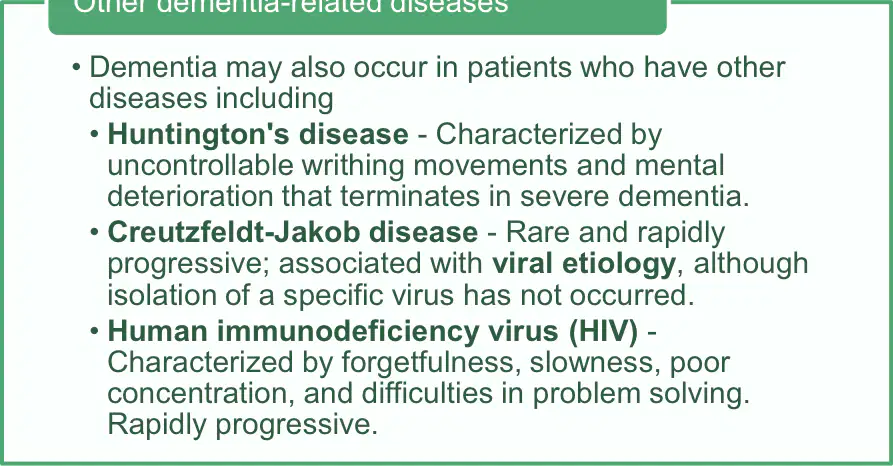
Which disease is characterized by uncontrollable writhing movements and mental deterioration that terminates in severe dementia?
Huntington's disease
Creutzfeldt-Jakob disease
Human immunodeficiency virus (HIV)
Parkinson's disease
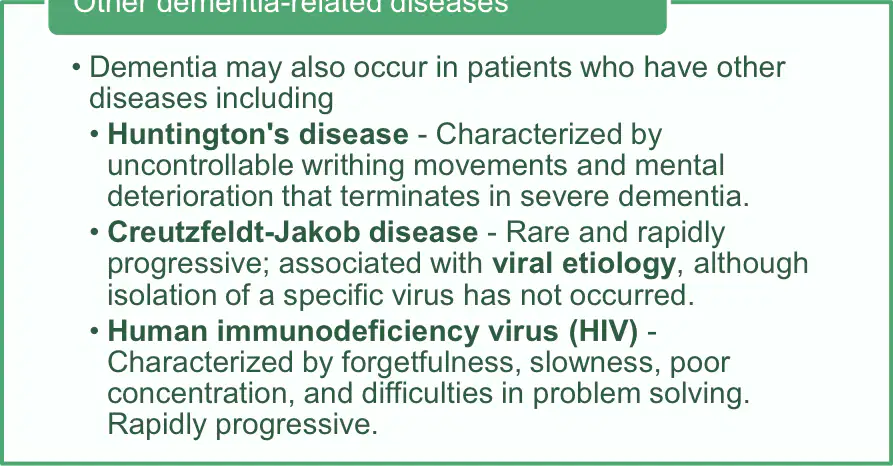
Which dementia-related disease is rare, rapidly progressive, and associated with viral etiology, although isolation of a specific virus has not occurred?
Huntington's disease
Creutzfeldt-Jakob disease
Human immunodeficiency virus (HIV)
Alzheimer's disease
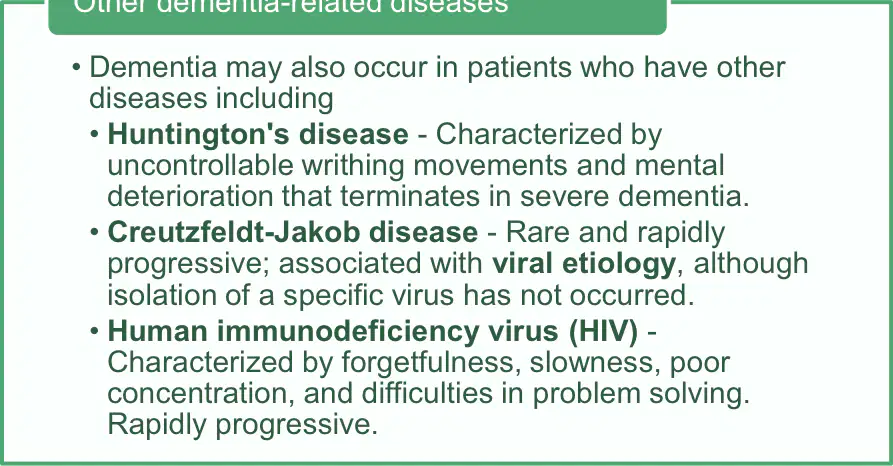
Which disease is characterized by forgetfulness, slowness, poor concentration, and difficulties in problem solving, and is rapidly progressive?
Huntington's disease
Creutzfeldt-Jakob disease
Human immunodeficiency virus (HIV)
Multiple sclerosis
What is the typical onset of Delirium?
Sudden
Insidious, relentless
Sudden or insidious
What is the duration of Dementia?
Hours to days
Persistent
For longer than 2 weeks
During what time of day does Depression typically affect individuals?
Increases and decreases during the day
Stable or no change
Throughout the greater part of the day
Fill in the blank: Delirium is characterized by impairment of memory, attentiveness, consciousness, and numerous errors in ______ tasks.
assessment
motor
visual
verbal
Which condition is associated with insomnia or excessive sleeping, fatigue, restlessness, anxiety, and increased or decreased appetite?
Delirium
Dementia
Depression
Which condition is characterized by rambling and irrelevant conversation, illogical flow of ideas, and incoherent speech?
Delirium
Dementia
Depression
Which condition is described as having slower speech?
Delirium
Dementia
Depression
Fill in the blank: The mood and affect in dementia is described as ________, apathetic, uninterested.
depressed
elated
anxious
euphoric
Which condition is associated with rapid mood swings, fearfulness, and suspiciousness?
Delirium
Dementia
Depression
Fill in the blank: The reversibility of dementia is described as ______; progressive.
No
Yes
Sometimes
Rarely
Which condition can be treated according to the table?
Delirium
Dementia
Depression
Delirium has the potential for reversibility.
True
False
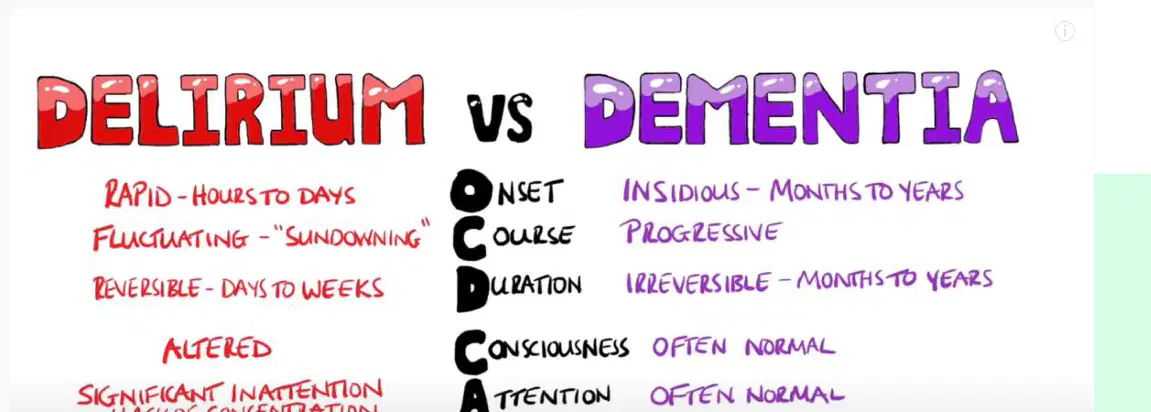
What is the onset of Delirium?
Insidious - months to years
Rapid - hours to days
Progressive
Irreversible - months to years
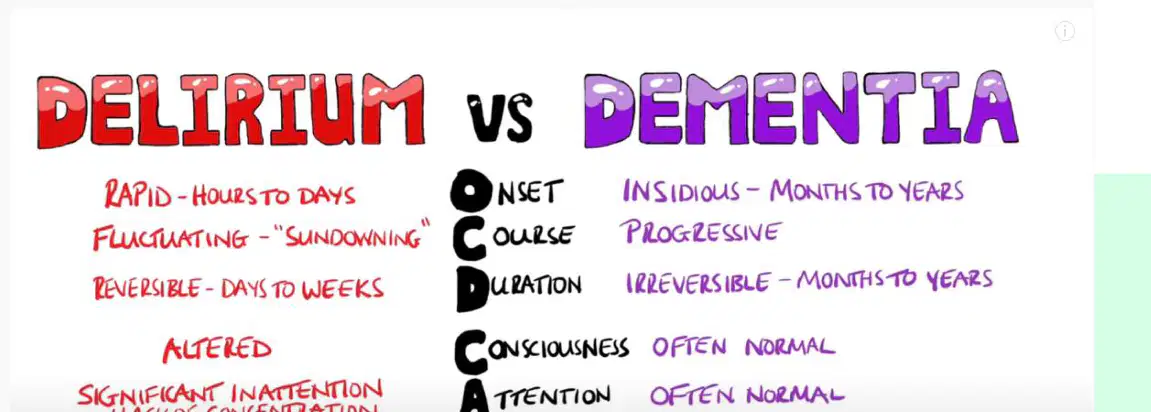
What is the onset of Dementia?
Insidious - months to years
Rapid - hours to days
Fluctuating
Reversible - days to weeks
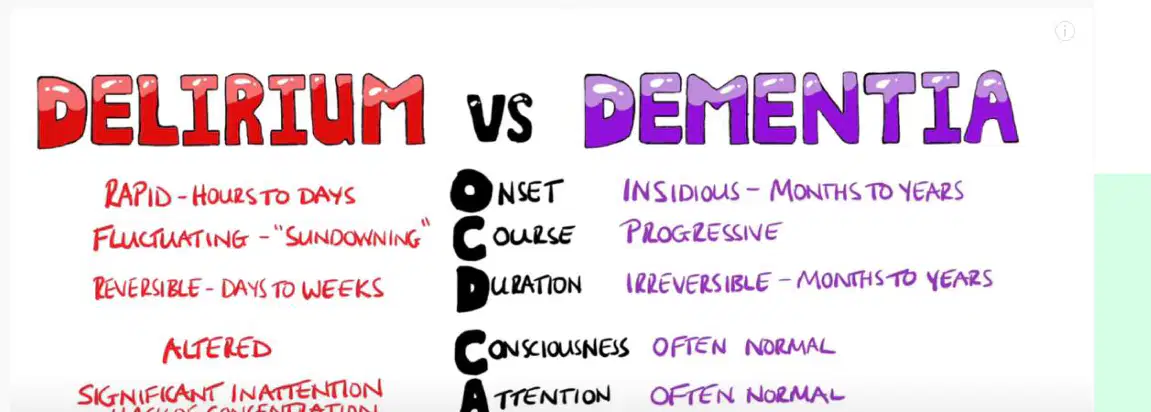
Which of the following best describes the course of Delirium?
A) Progressive
B) Fluctuating ("sundowning")
C) Irreversible
D) Often normal
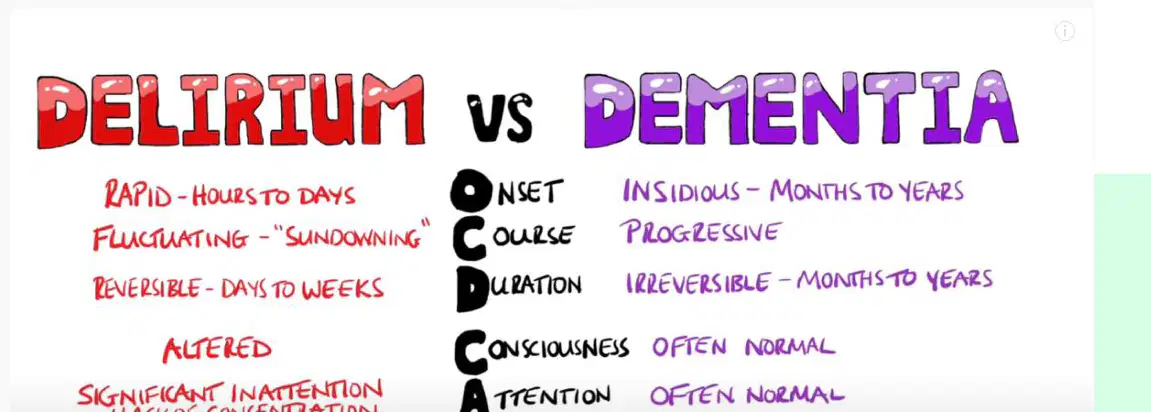
Which of the following best describes the course of Dementia?
Fluctuating
Progressive
Reversible
Hyperactive

Is Delirium reversible or irreversible?
Reversible - days to weeks
Irreversible - months to years
Irreversible - permanent
Reversible - hours only

