
 Worksheets
Metabolism & Enzymes
Total questions: 76
Worksheet time: 1hrs 11mins
What is the name of the thermodynamic barrier (initial energy input) that must be overcome before products are formed in a spontaneous reaction?
activation energy
free energy
entropy
enzyme energy
The second law of thermodynamics states that all energy conversions are inefficient, and some energy is always lost as which biologically unusable form?
ATP
potential energy
thermal energy (heat)
chemical energy
The hydrolysis of ATP to ADP + Pi can best be described as an ________________ reaction that ______________ energy.
exergonic/release
endergonic/release
endergonic/require
exergonic/require
Which of the following statements regarding enzymes is TRUE?
Enzymes are NOT reusable.
Enzymes increase the rate of a reaction by lowering the activation energy.
Enzymes alter the free energy change (△G) of a reaction.
Enzymes are permanently changed by the reactions they catalyze.
A friend tells you that his hamster has reached equilibrium. You
congratulate your friend on teaching the hamster a trick.
send a sympathy card since the hamster is dead.
ask if the hamster is tired of running on the wheel.
say that the hamster must produce lots of ATP.
Most cells cannot harness heat to perform work because
heat does not involve a transfer of energy.
heat can never be used to do work.
temperature is usually uniform throughout a cell.
cells do not have much heat; they are relatively cool.
Some bacteria are metabolically active in hot springs because
they are able to maintain a lower internal temperature.
their enzymes are completely insensitive to temperature.
their enzymes have high optimal temperatures.
high temperatures make catalysis unnecessary.
Which of the following statements is true of metabolism in its entirety in all organisms?
Metabolism depends on a constant supply of energy from food.
Metabolism uses all of an organism's resources.
Metabolism consists of all the energy transformation reactions in an organism.
Metabolism manages the increase of entropy in an organism.
Which of the following statements is consistent with the second law of thermodynamics?
A gain of free energy in a system is always associated with conversion of energy from one form to another.
Without an input of energy, the entropy of an organism would tend to decrease over time.
Every energy transformation performed by an organism decreases the entropy of the universe.
A constant input of energy is required to maintain the high level of cellular organization.
Which of the following statements is true for a system at chemical equilibrium?
The system can do no work.
The system releases energy at a steady rate.
The kinetic energy of the system is zero.
The system consumes energy at a steady rate.
A chemical reaction that has a + ΔG is best described as ________.
endergonic
spontaneous
exergonic
at equilibrium
The relationship between catabolism and anabolism is most similar to the relationship between which of the following pairs of terms?
free energy; entropy
exergonic; endergonic
exergonic; spontaneous
work; free energy
Which of the following statements describes a common characteristic of catabolic pathways?
They are endergonic and consume energy such as ATP to build larger molecules.
They combine small molecules into larger, more energy-rich molecules.
They require energy from ATP hydrolysis to break down polymers into monomers.
They are exergonic and provide energy that can be used to produce ATP from ADP and P.
When chemical, transport, or mechanical work is done by an organism, what happens to the heat generated?
It is lost to the environment.
It is used to generate ADP from nucleotide precursors.
It is used to power yet more cellular work.
It is captured to store energy as more ATP.
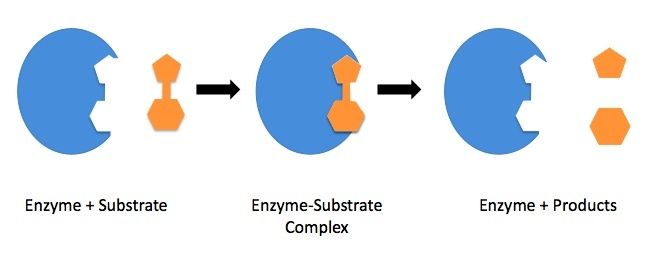
Which of the following aspects of enzyme structure is best described by a clasping handshake analogy?
the specific manner in which an enzyme interacts with water
the specific manner in which an enzyme folds to form secondary and tertiary structures
the specific manner in which an enzyme is denatured by low pH
the specific manner in which an enzyme binds to a substrate
Which of the following is a primary function of the active site of an enzyme?
It is activated by the presence of the end product of the metabolic pathway in which the enzyme is involved.
It binds allosteric regulators of the enzyme.
It binds noncompetitive inhibitors of the enzyme.
It catalyzes the reaction associated with the enzyme.
Zinc, an essential trace element for most organisms, is present in the active site of the enzyme carboxypeptidase. The zinc most likely functions as ________.
a coenzyme derived from a vitamin
a noncompetitive inhibitor of the enzyme
a cofactor necessary for enzyme activity
an allosteric activator of the enzyme
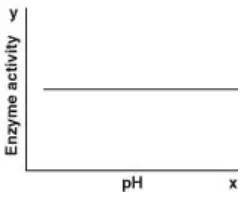
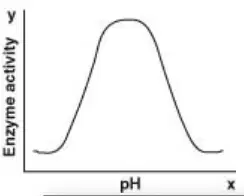
Which of the following graphs most likely describes the effect of pH on the function of the enzyme catalase in human cells?


Which of the following terms most precisely describes the cellular process of breaking down large molecules into smaller ones?
dehydration
catabolism (catabolic pathways)
metabolism
anabolism (anabolic pathways)
HIV is the virus that causes AIDS. In the mid-1990s, researchers discovered an enzyme in HIV called protease. Once the enzyme's structure was known, researchers began looking for drugs that would fit into the active site and block it. If this strategy for stopping HIV infections were successful, it would be an example of what phenomenon?
competitive inhibition
denaturation
allosteric regulation
noncompetitive inhibition
A series of enzymes catalyze the reactions in the metabolic pathway X → Y → Z → A. Product A binds to the enzyme that converts X to Y at a position remote from its active site. This binding decreases the activity of the enzyme. What is substance X?
an allosteric inhibitor
an intermediate
the product
a substrate
A series of enzymes catalyze the reactions in the metabolic pathway X → Y → Z → A. Product A binds to the enzyme that converts X to Y at a position remote from its active site. This binding decreases the activity of the enzyme. With respect to the enzyme that converts X to Y, substance A functions as ________.
an allosteric inhibitor
an intermediate
a competitive inhibitor
a substrate
Which of the following statements about anabolic pathways is true?
They release energy by degrading polymers to monomers.
They are usually spontaneous chemical reactions.
They decrease the entropy of the organism and its environment.
They consume energy to build up polymers from monomers.
Which of the following statements describes the first law of thermodynamics?
The entropy of the universe is constant.
Energy cannot be created or destroyed.
Energy cannot be transferred or transformed.
The entropy of the universe is decreasing.
If an enzyme in solution is saturated with substrate, the most effective way to obtain a faster yield of products is to
add more substrate.
add a noncompetitive inhibitor.
heat the solution to 90°C.
add more of the enzyme.
If an enzyme is added to a solution where its substrate and product are in equilibrium, what will occur?
Additional substrate will be formed.
The free energy of the system will change.
Nothing; the reaction will stay at equilibrium.
The reaction will change from endergonic to exergonic.
How can we know that fungus are consistent with the second law of thermodynamics?
The total amount of entropy in the universe increases when heat is released from the fungus into the environment.
The total amount of entropy in the universe decreases when the fungus builds large biological molecules from smaller molecules.
The total amount of energy in the universe decreases when the fungus breaks large molecules down into smaller ones.
What is true about an exothermic reaction
it is spontaneous
the difference between the energy levels of the product and reactant is a positive value
there is an increase in the enthalpy H of the system
it is a planned reaction
What do competitive inhibitors do?
Denature the enzyme and shut it off from all processes
Alter the shape of the enzyme to stop its substrate from binding
Prevent the substrate from binding to the enzyme, reducing productivity
The organization seen in living organisms represents a..............
increase in entropy
decreasing in entropy
output of energy
input of energy

If a process is spontaneous, what can be said about the Gibbs Free Energy of the process?
ΔG is negative
ΔG is positive
ΔG is zero

Where is the most easily accessible energy stored in an ATP molecule?
between the 1st and 2nd phosphate groups
between the adenine and ribose groups
between the 2nd and 3rd phosphate groups
between the ribose and the 1st phosphate groups
The place, other than the active site, where activators and inhibitors bind to an enzyme is called the ________ site.
competitive
allosteric
alterior
rate
Succinate dehydrogenase catalyzes the conversion of succinate to fumarate. The reaction is inhibited by malonic acid, which resembles succinate but cannot be acted upon by succinate dehydrogenase. Increasing the ratio of succinate to malonic acid reduces the inhibitory effect of malonic acid. What is malonic acid's role with respect to succinate dehydrogenase?
It is a competitive inhibitor.
It is an allosteric regulator.
It is able to bind to succinate.
It blocks the binding of fumarate.
Which of the following is an example of potential rather than kinetic energy?
the flight of an insect foraging for food
the muscle contractions of a person mowing grass
water rushing over Niagara Falls
a molecule of glucose
Energy is released from ATP when
a phosphate group is added
adenine bonds to ribose
ATP is exposed to sunlight
a phosphate group is removed

Use the diagram to answer the question. Between which parts of the molecule must the bonds be broken to form an ADP molecule?
A and B
A and C
B and C
C and D

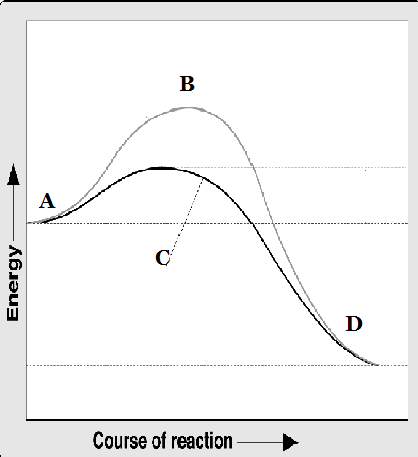
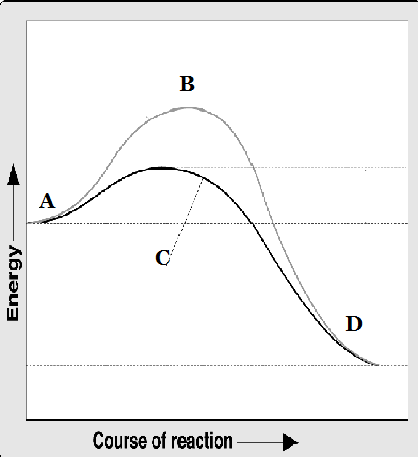
What type of reaction is occurring in this graph?
endergonic
exergonic
unable to determine
Enzymes are usually....
Proteins
Lipids
Carbohydrates
None of the Above

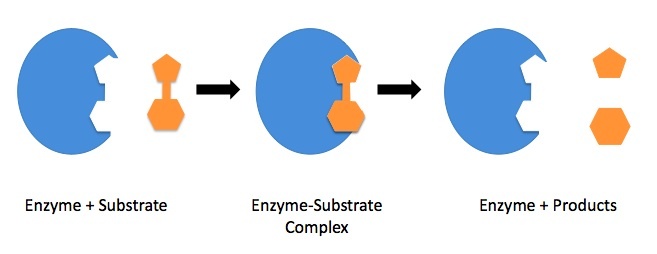
What is being represented by the letter B in the image?
Substrate
Enzyme
reactants
Product
The break down of larger molecules into small one.
metabolism
catabolism
anabolism
oxidation
The equation that relates enthalpy, temperature and entropy is
Hess's Law
Second Law of Thermodynamics
Gibbs Free Energy
Calorimetry
Which type of reaction increases entropy?
Endergonic
Nonspontaneous
Synthesis
Exergonic
Which of the following is true for anabolic reactions?
They are spontaneous and breakdown molecules.
They are nonspontaneous and breakdown molecules.
They are spontaneous and build molecules.
They are nonspontaneous and build molecules.
Endergonic reactions require:
an input of energy
a release of energy
do not change energy
A catalyst works by
changing the order of the reaction
increasing the temperature
lowering the activation energy
making the activated complex
Reaction that results in an INCREASE of free energy (energy is put in).
endergonic
exergonic
spontaneous
Reaction that results in a DECREASE of free energy (energy is released)
endergonic
exergonic
nonspontaneous
Spontaneous reactions are always fast reactions.
true
false
Which is TRUE of enzymes?
enzymes lower activation energy but do not affect spatial orientation
enzymes increase the activation energy and spatially affect reactants
enzymes decrease activation energy and help reactants bind by affecting spatial orientation
enzymes are reactants that decrease activation energy and decrease the concentration of reactants
What is an active site?
the place where non-spontaneous reactions gain energy and become spontaneous
the catalyst for the reaction
the place where chemical activity or reactions occur
the place where non-spontaneous reactions occur
When an enyzme catalyses a reaction, the ___________ decreases.
free energy of reactants
free energy of products
progress of reaction
activation energy
True or False: Since Enzymes catalyze a reaction, they affect the amount of free energy in either reactants or products.
true
false
Which of the following is a correct association?
non-spontaneous reaction --- exergonic
spontaneous reaction --- endergonic
non-spontaneous --- endergonic
spontaneous reaction --- isogonic
Which is correct?
when a chemical reaction increases entropy when products are compared to reactants, it is non-spontaneous
when a chemical reaction leads to lower potential energy when products are compared to reactants, it is non-spontaneous
reactions are spontaneous when free energy is lower in the products than the reactants
reactions are spontaneous when free energy is higher in the products than the reactants
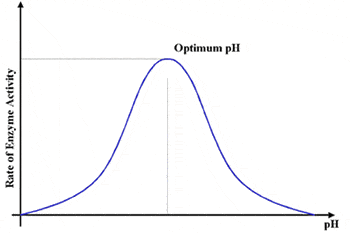
Fireflies emit light. The production of light by an organism is called bioluminescence. To generate visible light, cells in a firefly’s tail produce thousands of luciferase enzymes. Luciferase binds to a chemical called luciferin. Once bound, the luciferase enzyme speeds up a chemical reaction that combines an oxygen molecule and luciferin to produce oxyluciferin. This reaction requires energy and releases light. Which of the following best describes how the luciferase enzyme speeds up the chemical reaction?
Luciferase increases the amount of time the light is visible.
Luciferase decreases the amount of energy required for the reaction to start.
Luciferase increases the number of sites on luciferin that must bind to oxygen.
Luciferase decreases the temperature of the environment inside the body of the firefly.
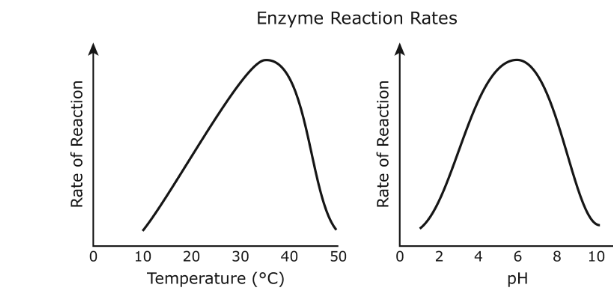
The graphs show the reaction rate for an enzyme across a range of temperatures and pH.
Based on these data, this enzyme functions best as what temperature and pH?
Temperature of 27oC and a pH of 4
Temperature of 37oC and a pH of 6
Temperature of 40oC and a pH of 8
Temperature of 50oC and a pH of 10

The diagram represents one way an enzyme can be inhibited.
Which statement explains the effect of an inhibitor on an enzyme?
A substrate will be able to bond with the enzyme.
The enzyme will likely be attacked by immune cells.
The enzyme will be unable to produce more enzymes.
A substrate will be unable to attach to the enzyme.
If nerve gasses are inhaled, they will temporarily bind to an area on many enzymes that will change the shape of the enzyme. This prevents the enzymes from interacting with other substances and interferes in proper nervous system functioning resulting in death. The nerve gas is an example of a(n):
Substrate
Activation Inhibitor
Production Inhibitor
Competitive Inhibitor
Non-competitive Inhibitor
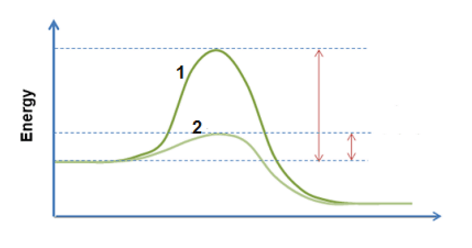

If enzyme 4 is denatured (stops working), the levels of which substance will increase?


A receptor site that a molecule can bind to that changes the shape of the active site is called a(n):
Allosteric Site
Active Site
Activation site
Reactant site
Describes the process by which an enzyme's function at the active site may be either activated or inhibited by the binding of a regulatory molecule at a separate site.
Allosteric Interactions
Feedback Inhibition
Competitive Inhibition
Noncompetitive Inhibition
A molecule that is so similar to the normal substrate that it competes for the active site of the enzyme
Allosteric Inhibition
Competitive Inhibition
Noncompetitive Inhibition
Feedback Inhibition

In Figure 6.2, why does the reaction rate plateau at higher reactant concentrations?
Feedback inhibition by product occurs at high reactant concentrations.
Most enzyme molecules are occupied by substrate at high reactant concentrations.
The reaction nears equilibrium at high reactant concentrations.
The activation energy for the reaction increases with reactant concentration.

Which TWO of the following best describes this reaction?
endergonic
exergonic
spontaneous
non-spontaneous

