
 Worksheets
year 8 Fluids
Total questions: 194
Worksheet time: 2hrs 21mins
_______ does not change shape or volume.
Solids
Liquids
Gasses
_______ have lots of space between particles and no regular arrangement.
Solids
Liquids
Gasses
_______ cannot be compressed.
Solids
Liquids
Gasses
_______ have molecules that flow/slide past each other, but are still close together.
Solids
Liquids
Gasses
_______ have Particles that Vibrate in place.
Solids
Liquids
Gasses
_______ have Particles move freely and are fast moving.
Solids
Liquids
Gasses
_______ have molecules that are usually arranged in a pattern.
Solids
Liquids
Gasses
_______ have little to no space between molecules
Solids
Liquids
Gasses
_______ can change shape and volume.
Solids
Liquids
Gasses
________ Easily compress.
Solids
Liquids
Gasses
________ have no regular pattern or arrangement as molecules just flow
Solids
Liquids
Gasses
________ molecules are locked in place
Solids
Liquids
Gasses
________ can not change volume, but can change shape.
Solids
Liquids
Gasses
If water is at 0 degrees celsius or below it will_________.
Be a solid
Be a liquid
Be a gass
If water is between 0 and 100 degrees celsius it will_________.
Be a solid
Be a liquid
Be a gass
If water is 100 degrees celsius or over it will_________.
Be a solid
Be a liquid
Be a gass

This shows the particles of a _______
Solid
Liquid
Gass

This shows the particles of a _______
Solid
Liquid
Gass

This shows the particles of a _______
Solid
Liquid
Gass
The energy an object has due to its motion
thermal energy
temperature
kinetic energy
Measure of the average kinetic energy of the particles in an object
thermal energy
temperature
kinetic energy
The total potential and kinetic energy of an object
thermal energy
temperature
kinetic energy
Changing from a liquid to a gas
condensation
vaporization
sublimation
melting
Changing from a gas to a liquid
condensation
vaporization
sublimation
melting
Changing directly from a solid to a gas
condensation
vaporization
sublimation
melting
Evaporation and boiling are two kinds of _______
condensation
vaporization
sublimation
melting
Deposition is a change from a __________
gas to a solid.
solid to a gas.
liquid to a gas.
gas to a liquid.
Vaporization that occurs within a liquid is _________
boiling.
evaporation.
sublimation.
condensation.
Anything that takes up space and has mass is
Matter
Volume
Liquid
Atom
A solid
has particles that are far apart
has a size and shape of its own
takes the shape of its container
The smallest part of matter and makes up molecules
is an atom
is a molecule
is a gas
is matter
Oxygen is
a gas you can breathe
a solid you can eat
a liquid which changes shape
a brother to carbon dioxide
In a _______ the molecules are close together.
solid
liquid
gas
All _______ can move and flow.
liquids
solids
gases
An example of a solid is
a desk
oxygen
water
juice
An example of a liquid is
honey
a stapler
a water bottle
One similarity between solids, liquids and gases is
all three have atoms and molecules
all three have molecules that are close together
all three take the shape of their containers
A ________ has no shape and no size.
gas
liquid
solid
The attraction between particles gives solids a definite
shape and volume
shape and color
shape and position
flow and radius
The temperature at which a solid begins to liquefy is its ______ point.
freezing
boiling
melting
mass
The amount of energy required for a liquid at its boiling point to become a gas is _____________.
heat of fusion
heat of vaporization
transpiration
freezing point
_______________ is an increase in the size of a substance when the temperature is increased.
kinetic energy
potential energy
thermal point
thermal expansion
According to the kinetic theory of matter, all matter is composed of
waves
particles
solid material
plasma
Which of the following is a state of matter?
particle
thermal
plasma
diffuse
When the temperature of a substance is lowered, its particles
vibrate more quickly
stop vibrating completely
escape the attractive forces of the other particles
vibrate more slowly
The amount of energy needed to change a substance from the solid phase to the liquid phase is the substance's
heat of vaporization
heat of transformation
melting point
heat of fusion
Why can people on one side of a room smell the scent of an air freshener sprayed on the opposite side of the room?
The molecules of air freshener have thermally expanded
The air pressure where the freshener was sprayed is greater than in the rest of the room
The molecules of air freshener spread out until they are evenly distributed throughout the room
The molecules of air freshener are amorphous
What is the most common state of matter in the universe?
solid
liquid
gas
plasma
An example of an amorphous solid is
glass
dry ice
liquid crystals
water
An example of a substance that can undergo sublimation is
glass
liquid crystals
water
dry ice (frozen carbon dioxide)
When a gas becomes a liquid it is called
condensation
evaporation
sublimation
freezing

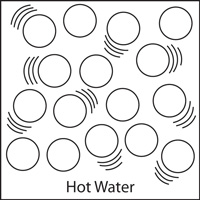

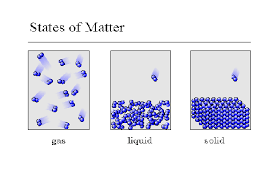
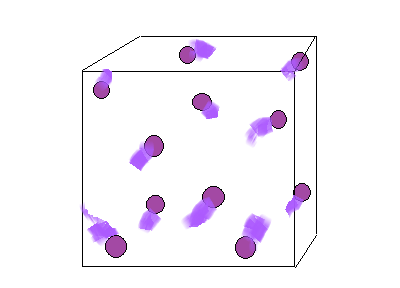
Which phase is represented in the model.
Solids
Liquids
Gas
Carousso
A substance's ______________ is when it changes from a liquid to a solid
melting point
boiling point
freezing point
triangle point
What is the phase change called when a gas becomes a liquid?
condensation
evaporation
sublimation
freezing
A solid takes up a certain amount of _____.
space
light
food
Gases keep their shapes and spread out.
true
false

Which choice correctly identifies each kinetic theory diagram?
Solid, liquid, gas
Gas, solid, liquid
Liquid, gas, solid
gas, liquid, solid
Solution B has a density of 21g/50mL
Solutions C has a density of 41/50mL
Put them in order from most dense to less dense.
Which one describes purity or pure element?
it has two or more different types of atom
it has one and the same type of atoms all throughout
it is made up of sub-atomic particles
it is a matter and has the different subatomic particles
Gold is divided into 24 parts, with each single unit called a karat. The higher the karat, the purer the gold. How much is the concentration of gold in a 14 K neclace?
99.5 %
75 %
58.3 %
41.7 %
A sample of impure gold weighed 20 g and only contained 5 g of pure gold. The percentage of purity is... (% purity = mass of the substance in the sample/mass of the sample X 100)
0.25 %
25 %
4 %
400
A sample of impure mercury weighed 10 g and only contained 2 g of pure mercury. The percentage of purity is... (% purity = mass of the substance in the sample/mass of the sample X 100)
0.2 %
20 %
5 %
500
If I dissolve sugar in water, what is the solution?
water
sugar
sugary water
none of the above

Which of the following refers to the substance that is being dissolved in a solution?
solvent
solute
mixture

This is an example of a
Solution
Mixture
10 grams of sugar have been dissolved in 100 mL of water. The concentration of sugar in water is as follows:
(Equation Concentration of substance = mass of solute in grams/volume of solvent in liters or milliliters)
(a)
Calculate the concentration for a 20 g of food coloring dissolved in 10 mL of water in a beaker. (Equation Concentration of substance = mass of solute in grams / volume of solven in liters or mililiters)
0.5 g / mL
2 g / mL
200 g / mL
10 g / mL
30 g / mL
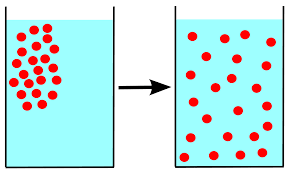
The picture below is an example of _________________.
osmosis
isotonic
diffusion
active transport


What is DIFFUSION?


Diffusion occurs only in solids
True
False
Diffusion is the free movement of particles from an area of __________ concentration to an area of ________ concentration.
High to high
High to low
Low to low
Low to high
An increase in temperature does what to diffusion?
Speeds it up
Slows it down
Stops it
No effect
When does diffusion stop?
After a day and a night
When the particles are evenly spread out
When there are no particles left
When all the particles leave the system
Diffusion occurs only in solids
True
False
What is a solute?
A substance dissolved in another substance
the substance doing the dissolving
What is a solvent
The one doing the dissolving
The substance dissoved in another substance
How do the particles move in diffusion?
From a region of low concentration to a region of high concentration
From a region of high concentration to a region of low concentration
From a region of low concentration to a region of low concentration
From a region of high concentration to a region of high concentration
How long does diffusion last?
Until the concentration of particles in the system is equal
(Select this answer and I swear i'll make it harder for you in the assessment task)
Until a region in the system has a greater concentration of particles than the other
Until the particles disappear from the system
What happens to the coffee particles when coffee is added to hot water?
They sink to the bottom of the cup
They spread out
They clump together
Select the 4 correct answers. A particle _____.
can be a solid.
can be a liquid.
can be a gas.
has random motion.
remains stationary.

Diffusion is the movement of molecules from an area of _____ concentration to an ______ concentration
High, low
Low, high
Low, low
High, high
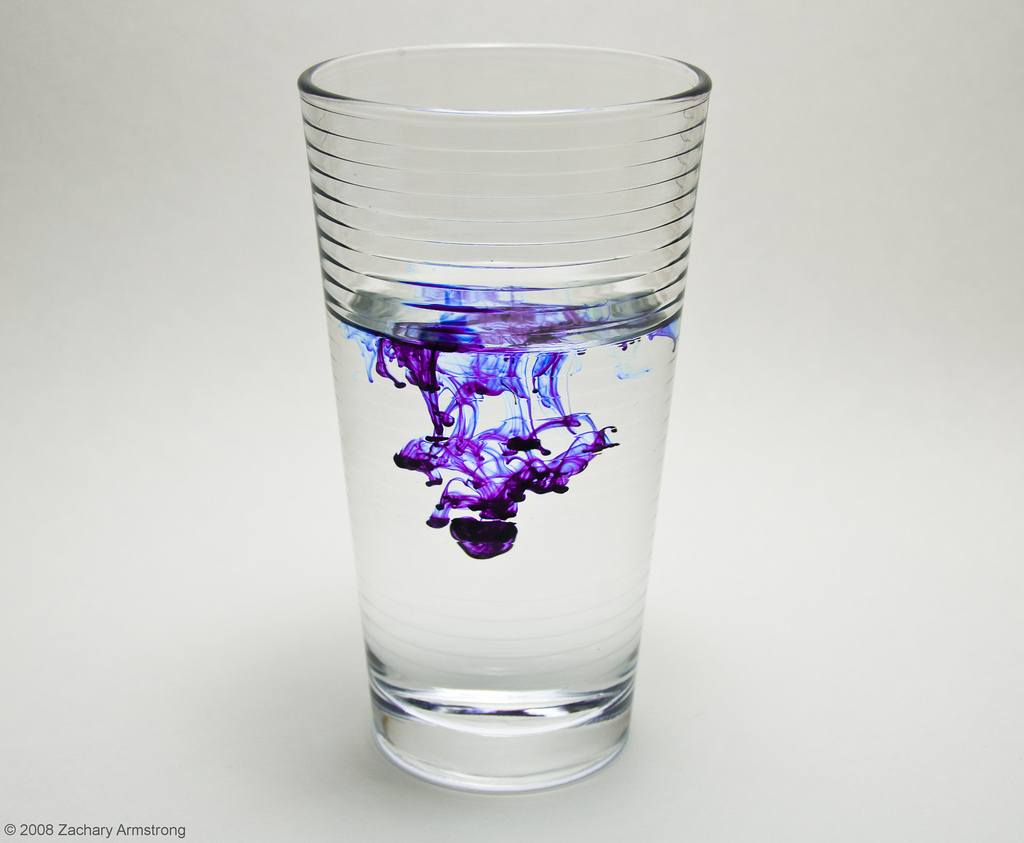
Where is there a low concentration of dye?
at the bottom of cup
in the color
at the top of cup
no concenteraion gradient
From fastest to slowest rate of diffusion, which of the following is in the correct sequence?
Solids, liquids, gases
Liquids, gases, solids
Gases, liquids, solids
Gases, solids, liquids
Which of the following will diffuse the fastest?
A tablespoon of sugar in a glass of water
Heat through a solid piece of steel
A pinch of salt in a glass of water
The smell of bacon cooking throughout a room
What does a 'region with high concentration' mean?
An area with a SMALL number of particles
An area with a LARGE number of particles
An area with an UNEVEN number of particles
An area with no particles
An increase in temperature does what to diffusion?
Speeds it up
Slows it down
Nothing
Stops it all together
If a hairspray can is heated, what can be expected of the pressure of the gas inside the can?
The pressure will increase
The pressure will decrease
The pressure will remain constant
The pressure will equalize

The pressure inside the balloon will:
Decrease
Increase
Remain the same
Not enough information to formulate an answer

The pressure of the gas in the balloon in the ice water will be:
Greater than that of the balloon in the boiling water.
Less than that of the balloon in the boiling water.
The same as that of the balloon in the boiling water.
Not enough information to answer the statement.

This is an example of the everyday application of pressure in:
Solids
Liquids
Gases
Plasma

We can increase the pressure of a gas by:
Adding more gas.
Reduce the volume of the container.
Increase the temperature of the gas.
None of the above answers.

The reason gases can be compressed is because:
The particles are very close together.
The particles are merely vibrating.
The particles are unable to move.
The particles are very far apart.
Gas pressure is caused by
Gas molecules heating up
Gas molecules reacting with other gas molecules
Gas molecules hitting the walls of a container
Gas molecules hitting other gas molecules
why does increased temperature cause an increase in pressure
kinetic energy increases which causes more collisions
kinetic energy decreases which causes less collisions
there are no collisions
that's not what happens
State of matter with a definite shape and definite volume.
solid
liquid
gas
State of matter with a definite volume, but no definite shape.
solid
liquid
gas
State of matter with no definite shape and no definite volume.
solid
liquid
gas
Particles are closely spaced.
solid
liquid
gas
Particles are not so closely spaced and slide past each other.
solid
liquid
gas
Particles are widely spaced except when they collide.
solid
liquid
gas
What happens to particles when their temperature increases?
The particles move slower
The particles move faster
The particles lose mass
The particles gain mass


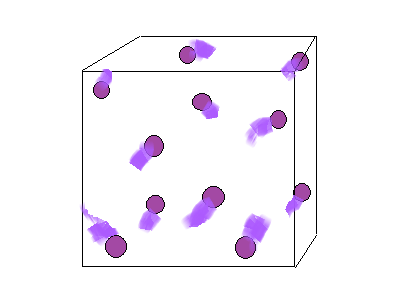

___________is the result of the weight of a column of air pushing on an area.
Air pressure
Density
Volume
none of the above
In what direction does air exert pressure?
Upward
Downwards
In all directions

A _____________ is the scientific instrument used to measure air pressure.
Thermometer
Anemometer
Barometer
None of the above
As you go up a mountain air pressure ....
Increases
Decreases
Stays the same

If we blow up a balloon, what happens to the pressure inside the balloon?
Increases
Decreases
Remains same

Will you be able fully to blow up a balloon inside a bottle?
Yes
No

This is a barometer with mercury in it. If the height of the column is 76cm at Sea level , what happens as we go up the mountains ?
Height of column increases
Height of column decreases
Height remains the same

Cold places have higher barometric pressure so, do cold places suffer from cyclones?
Yes
No

An astronaut's lungs without a spacesuit will in the vacuum of space will ...
Blow up and rupture
Implode

In an airplane, the ears pop at higher altitudes because pressure inside the ear ....
Higher than outside
Lower than outside
Which of the following would NOT increase the rate at which a sugar cube dissolves?
Reducing the amount of solvent
Crushing the sugar cube
Stirring the solution
Heating the solvent
You can make a solute dissolve more quickly in a solvent by
adding more solute.
adding ice.
heating the solvent.
removing some solvent.
Which of the following would result in being able to dissolve a greater amount of solid in a solution?
Lower the temperature.
Decrease the pressure of the solution.
Increase the pressure of the solution.
Heat the solution.
Stirring the solution...
decrease the rate of solubility
Doesn't change the rate of solubility
increase the rate of solubility
None of the above
When you measure how fast a solute dissolves, you are measuring the
amount of dissolving
rate of particle movement
amount of particle movement
rate of solubility
Sugar dissolves faster in hot tea compared to iced tea.
What is the factor affecting the rate of solubility in the statement above?
Rate of stirring
Temperature
Size of solute
Total surface area
The amount of solute that can be dissolved in a specific amount of solvent at a given temperature is its
concentration.
density.
dilution.
solubility.
Why do sugar particles dissolve faster in hot water?
water particles move slow
water particles move fast
water particles settle down
water particles stay on top
What combination would dissolve a solid solute the fastest?
high temperature, no stirring
no heat, no stirring
sugar cube, no heat
high temperature, stirring
A ___________ is the mixture formed when solutes dissolves in a solvent.
solution
solvent
liquid
solid
What is evaporation?
The process by which a gas turns into a liquid.
The process by which a liquid turns into a gas or vapor.
The process by which a solid turns into a gas.
The process by which a gas turns into a solid.
What is evaporation?
The process by which a gas turns into a liquid.
The process by which a liquid turns into a gas or vapor.
The process by which a solid turns into a gas.
The process by which a gas turns into a solid.
What is condensation?
The process by which a liquid changes into a solid state.
The process by which a liquid changes into a gas or vapor state.
The process by which a gas or vapor changes into a liquid state.
The process by which a solid changes into a gas or vapor state.
What is vaporization?
The process of converting a substance from its solid state to its liquid state
The process of converting a substance from its solid state to its gaseous state
The process of converting a substance from its gaseous state to its liquid state
The process of converting a substance from its liquid state to its gaseous state
What is the boiling point?
The temperature at which a substance changes from a solid to a liquid.
The temperature at which a substance changes from a liquid to a gas.
The temperature at which a substance changes from a gas to a liquid.
The temperature at which a substance changes from a gas to a solid.
What is evaporation?
The process by which a gas turns into a liquid.
The process by which a liquid turns into a solid.
The process by which a solid turns into a liquid.
The process by which a liquid turns into a gas or vapor.
What is phase change?
Change in the color of an object
Transition of matter from one state to another
Change in the time of day
Change in the weather pattern
What is boiling?
The process in which a liquid turns into a solid when it is heated to its boiling point.
The process in which a solid turns into a liquid when it is heated to its boiling point.
The process in which a gas turns into a liquid when it is heated to its boiling point.
The process in which a liquid turns into vapor when it is heated to its boiling point.
What is the opposite of evaporation?
Melting
Sublimation
Freezing
Condensation
What is the opposite of boiling?
Melting
Evaporating
Heating
Freezing

